A-mazing Grace by Carol P. Christ

carol p. christ photo michael bakasA few days ago I received a message out of the blue on Facebook:

Thank you for your accepting my friend request. I am fighting to find my way out of depression during a life transition as I move into retirement from my years of work as an educator. I look forward to your book this spring. I have long called myself a Goddess feminist having struggled with patriarchal Christianity since my youth, but have felt abandoned by the Goddess for many years now. I’m not sure how I found you today. I stumbled onto a blog from you on your book while googling something else. Your words gave me a spark of hope. Laurel

In my blog I said that when I began to write A Serpentine Path, I felt abandoned by the Goddess. I wrote back, hoping that sharing what I had learned on my journey would be helpful.

The short answer is that the Goddess has never abandoned any of us. However, She does not have the power to make everything turn out as it could be or should be or we wish it would be. Hers is the power to inspire but not to control. If you have been unhappy, She is with you, She understands your pain, and She will be with you as you seek to find your way. I hope this doesn’t sound too preachy. It is from the heart of my experience. Take care of yourself.

I immediately received an answer back.

Thank you. Those were just the words I needed to hear with my heart. I am “too much in my head,” having spent a life in academia.

This interchange got me thinking about how we import toxic ideas from traditional theologies into what we believe are new religious worldviews. In this case the toxic idea is omnipotence—the idea that the Divine Power is in control of everything. It follows from this that the Divine Power can answer our prayers. If the Divine Power does not answer our prayers, there must be a reason. The reasons we give are many, including: because we are sinful and unworthy or because the ways of God are not our ways. We sometimes conclude, as Laurel and I did: the Divine Power simply does not care about me.

The prominence of magic in Wicca, the most widely known form of contemporary Goddess religion, can contribute to this feeling of abandonment. The Western occult or magical tradition teaches that there are practices, including rituals and spells, through which we can manifest our wills and achieve our deepest desires. In Goddess practice rituals and spells are directed to or through the Goddess. In this situation, it can feel logical to blame the Goddess when, after working very hard and doing every ritual and spell we can think of, our will or desire is not manifested. “Why me,” the child within us asks. “Why has the Goddess abandoned me?”

In the story I tell in A Serpentine Path, I felt precisely that. What I learned was that the Goddess had never abandoned me. She had been with me all along. Where I went astray was in believing that the world could become as I wanted it to be.

The world is made up of a multiplicity of wills, including my will and the will of the Goddess, but also the wills of every other individual, human and other than human, who has lived or is living now. If individuals, human and other than human, have the power to affect the world, then even the Divinity cannot have all the power. This means that Her power (and our power) is the power to influence the world, but not to determine or control it. This is one of the key metaphysical insights of process philosophy, but it is also an existential truth.

The Divine Power is not omnipotent. And neither am I. It may seem odd to put these two statements together. Yet they are mirror images: both ideas deny the reality that a multiplicity of wills have shaped and continue to shape the world we experience. The world really is not at my beck and call. Not even the Goddess gets that.

I would never have said that I believed that the world revolved around me. Stating it so baldly makes it clear how silly idea that idea is. For me “enlightenment” came when I realized—really understood—that the world is not “about me.” Once I gave up having to have what I thought I needed to have, I found, felt, and experienced love and beauty all around me. This truly is a-mazing grace. To feel love and beauty is not to deny suffering. Yet much of our suffering is caused by ideas about how life should be, as Laurel recognized, by living too much in the thoughts of our heads.

Email from Laurel Tangen-Foster, Ph.D.

Carol P. Christ is author or editor of eight books in Women and Religion and is one of the Foremothers of the Women’s Spirituality Movement. She leads the Goddess Pilgrimage to Crete in Spring and Fall. Photo of Carol by Michael Bakas.

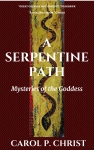
A Serpentine Path Cover with snakeskin backgroundA Serpentine Path: Mysteries of the Goddess will be published by Far Press in the spring of 2016. A journey from despair to the joy of life.
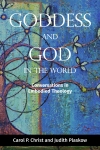
Goddess and God in the World: Conversations in Embodied Theology with Judith Plaskow will be published by Fortress Press in June 2016. Exploring the connections of theology and autobiography and alternatives to the transcendent, omnipotent male God.

‘Tis the Season…For Holiday Movies by Anjeanette LeBoeuf

AnjeanettePope Julian I in 350 C.E. set December 25th as the official day of observance for Christmas. It wasn’t until 1834 that it became a public holiday in the United Kingdom and it was declared a national holiday in the United States in 1865. The Night Before Christmas story was published in 1823, which solidifies the modern day Santa Claus in popular culture. 1898 saw the first depiction of Santa Claus on screen– a British short black and white silent filmContinue reading “‘Tis the Season…For Holiday Movies by Anjeanette LeBoeuf”

Becoming by Deanne Quarrie

Deanne Quarrie, D.Min.The Year 2015 is coming to a close. It is a time of endings and a time of beginnings. That is the wonderful thing about our cycles. We all have the opportunity to end and begin – over and over. Each day, each month and each year. We all scurry about making resolutions for the new year only to see them fail almost immediately.

This is where a good basic magical practice can lend a hand with our resolutions. In every magical act we must first know what it is we wish to manifest. I am not talking some empty wish here but a real look at what we want – really want – for the new year to bring.

If there were one thing I would say needs to be given the most attention in one’s magical practice is the Art of Becoming. Continue reading “Becoming by Deanne Quarrie”

There Is No Santa: The Antlered Flying Goddess– with Gifts by Marie Cartier

temple of isis elen 2
Marie bringing in Elen of the Ways
photo by Tony Mierzwicki

One of my colleagues at Feminism and Religion recently wrote of Xmas and Feminine Wisdom. My blog, for Christmas Day continues this exploration.

Elen of the Ways is a figure primarily studied by scholar, Carolyn Wise. She wrote two core articles available on the web here and here. Wise writes that in order to “track” and find Elen of the Ways she had to peel back the layers:

to the earliest track ways, the migratory tracks of the Reindeer and Elk. Elen moves across vast tracts of time, and land, cloaked and masked appropriately for each age.

As the Green Lady, she peers out between the trees in forests As a British Venus she is guardian of the underground streams that carry the sacred waters. She is the Guardian of the ancient track ways, the Leys, the Kundalini currents in nature. And as the Horned Goddess, she leads us to the first track ways, the migratory tracks of the reindeer and later, to the path of the red deer through the forests. From here she leads us to the lost Shamanism of the isles of Britain and we can follow her across Scandinavia, Russia, Mongolia, Siberia, India and beyond.

You can read more about Elen in the book edited by Carolyn Wise, Finding Elen: The Quest for Elen of the Ways. Elen is:

…part goddess, part dream, part saint, a green lady and a water nymph, primordial mother and patroness of deer, and guardian of the Old Straight Tracks and solar alignments. …Elen is as real as the roads named after her, as solid as the ancient paths that carry her presence.

What are these tracks? Part of the story can be explained by understanding that there are ley lines, or energy paths throughout the globe. These paths were “tracked” by shamans, pagans, and regular folk and still exert their influence today in very recognizable ways. People celebrated earlier this week on the Solstice (December 21) at Stonehenge“One of the most important and well-known features of Stonehenge is its alignment on the midwinter sunset-midsummer sunrise solstitial axis,” a spokesperson said. “The midwinter sun sets between the two upright stones of the great trilithon.” The solsitial axis is part of the ley line network that connects sacred sites such as Newgrange in Ireland, a sacred burial mound which lights up only the morning of Solstice.

Continue reading “There Is No Santa: The Antlered Flying Goddess– with Gifts by Marie Cartier”

Slant the Truth by Esther Nelson

esther-nelsonSeems to me that our society nowadays “believes in” slavishly following step-by-step instruction found in “how-to” manuals.  By following such rigid-like instruction, we hope to find meaning that enables us to live fulfilled lives.  This became evident to me (all over again) during a recent departmental meeting at the university where I teach.  We put aside discussion of items on the agenda because our director had invited a guest speaker, the Vice President of the Division for Inclusive Excellence, to talk to our group about “equity and inclusivity.”

In the wake of the University of Missouri students’ complaints (Fall 2015) regarding persistent racism (among other things) and their demand for more inclusion within the university, a group of students recently made their way into our university president’s office to demand change.  More Black professors.  More Black counselors.  Cultural training on campus.  After listening to the students, the president invited them to participate in an upcoming forum on diversity and inclusion, promising that his staff would work to get them excused from class.  Continue reading “Slant the Truth by Esther Nelson”

Mor, Celtic Goddess of Sun and Sea by Judith Shaw

judith Shaw photoMor is an ancient Celtic Goddess of the Sea and the Sun, bringing to mind the shining days of summer and the abundance of the harvest. Yet in a typical Celtic paradox in which opposites exist as one whole she is also a Dark Goddess of Death and Rebirth.

She is depicted sitting on a throne, revealing her association as a sovereignty goddess.  But no ancient stories of courtship and marriage are associated with Mor, no making of a king through marriage to Her.  So She must have been a sovereignty goddess in the most ancient sense – as a protector and guardian of the land, as the spirit of Earth itself. Continue reading “Mor, Celtic Goddess of Sun and Sea by Judith Shaw”

Remembering to Be Thankful by John Erickson

Remembering to be thankful may just be a privileged illusion that individuals in positions of power get to write about in the December of each year to self-congratulate themselves about being actually able to be able to be thankful. It may just seem like people who write about being thankful are complaining or pontificating that being thankful is in itself a chore.

WEHO CA (June 7, 2015)©2015 Rebecca Dru Photography All Rights Reserved    www.rebeccadru.com
WEHO CA (June 7, 2015)©2015 Rebecca Dru Photography All Rights Reserved
http://www.rebeccadru.com

With the holidays just around the corner and the frazzled, crisp ping of anxiety, rush, and panic take over the air around us, it is easy to forget to stop and “smell the roses.”  In times where teaching positions continue to shrink and more universities switch to adjunct labor, fees and class costs continue to rise, or just simply life becomes a little more complicated, due to the nature of balancing life, activism, work, friendships, or relationships, remembering to remind myself to be thankful is another task, I find adding to the never-ending list of stuff I always seem I have to do.

However, remembering to be thankful, scheduling it into one’s daily schedule are vital to our success as new and emerging faculty or activists or just in general because being thankful reminds us that we have aspects of our lives that are worth being thankful for.  Remembering to be thankful proves that we are in some way, connected to a larger sense of life that, at times, grants our wishes, wants, or desires, brings us despair, and then allows us to get through it, or even makes us feel alive.

As I sit back and look at the personal and professional landscape around me I understand that I have a lot to be thankful for both consciously and unconsciously.  Most recently at AAR, I participated on a panel in response to Bernadette Barton’s Pray the Gay Away.  During the course of our panel, the conversation of chosen vs. biological families came up.   Most recently, my mentor and panel moderator, Dr. Marie Cartier, talked about the same topic here on FAR and the difficulties many of us experience in regards to our chosen families vs. our biological families.   With the holiday season all around us, and regardless of what or if, you celebrate it or not, it is quite hard to get away from it all without realizing who your “family” is and whether or not you’re close or connected with them can be traumatizing during these times where we’re taught or expected to be with them.

After our discussion on the panel and then at the hotel bar, people discussed the pains and traumas in relation to not having a biological family to go home to during the holidays.  Sitting there and listening to the conversations, I realized that, for once in my life, I had nothing to say. Continue reading “Remembering to Be Thankful by John Erickson”

Announcing A Serpentine Path: Mysteries of the Goddess by Carol P. Christ

carol p. christ photo michael bakas“The serpentine path is the path of life, a snakelike, meandering path, winding in and out, up and down, with no beginning and no end, into the darkness and into the light.”

As the year draws to a close, I am putting the finishing touches on A Serpentine Path: Mysteries of the Goddess. In the spring of 2016 it will be published by the Far Press, founded by Gina Messina-Dysert.  A Serpentine Path is the original title of the memoir of my journey from despair to the joy of life on the first Goddess Pilgrimage to Crete. It was published in 1995 as Odyssey with the Goddess, a title chosen by the publisher.

A Serpentine Path marked a turning point in my life and in my career as a writer. During the time described in my memoir I had fallen into a deep despair, sparked by the end of a marriage, the end of a love affair, and disappointment in my career. Hoping to make a fresh start, I moved to Greece. Not surprisingly, my despair followed me there. Nonetheless, as I would learn, I made the right decision, for as my Greek therapist was to tell me, I needed to learn to live in my body, not my head, and Greece was the place to learn that.

I was at a crossroads in my spiritual quest. I left Christianity for Goddess feminism, yet I felt the Goddess had abandoned me. I had a contract to write the first Goddess thealogy, but as I said in a speech at I gave at Harvard Divinity School just before I made the decision to move to Greece, I was not sure of the meaning of the symbol of the Goddess. Is Goddess a personal being who cares about the world? Or the name we give to the cycles of birth, death, and regeneration in nature? My inability to answer this question led my editors to return draft of my Goddess thealogy with the comment that something was missing. Continue reading “Announcing A Serpentine Path: Mysteries of the Goddess by Carol P. Christ”

Entering The Cave: Jewish Women and the Art of Feminist Dreaming (Part 1) by Jill Hammer

Jill HammerDreams are my window on my wildest self. They are also a way to observe the conflicts within, and therefore they are a feminist practice, teaching me about my relationship to power, gentleness, love, and brokenness. Claiming my dreams is a way of claiming all the parts of myself. I am inspired in my dream practice by my own Jewish tradition, which has many dream practices, as well as by contemporary knowledge about dreams. Frequently in my dreams, I am able to observe my own longing for the company of women and for the presence of Goddess—deity in a female mode—in my life. Frequently, I learn about my experience as a woman by watching my dreams.

In one recent dream, I found myself in a town called Ursula, visiting a cave. Inside the cave were statues of holy women. After my visit, I expressed a desire to move to this town, Ursula. When I woke up, I remembered a painting I had seen in London when I was young: a depiction of St. Ursula, a fourth-century Catholic saint said to have led eleven thousand women on pilgrimage. Ursula is also the she-bear, an archetype of the sacred feminine. The desire to live in the town of Ursula could be read as a desire to live in the realm of the she-bear: in the company of women. The town of Ursula is also a town of the ancestors: the priestesses, prophetesses and wise women of old, represented by the statues in the cave. Though the imagery in my dream comes from a variety of cultures, the dream reminds me of my desire to connect to the women my tradition through dreams.

I teach Jewish dreamwork (based on biblical, Talmudic, kabbalistic and contemporary texts) to rabbinical and cantorial students at the Academy for Jewish Religion. I have seen how deeply it adds to my students’ spiritual lives. And, as one of the co-founders of the Kohenet Hebrew Priestess Institute, I have seen dreamwork transform the lives of women who are becoming ritual leaders and healers. Kohenet’s dream practice includes dream circles in which each participant offers a different reading of each dream, beginning with “In my dream of this dream.” We begin this way because each of us has a different understanding, influenced by who we are.

At Kohenet retreats, we often find that the dream of one person provides powerful healing for the whole community. For example, one woman dreamed of finding a bearded father-figure in a house. When she went into the basement, she found her mother working and writing next to a goddess shrine (Jill Hammer and Taya Shere, The Hebrew Priestess: Ancient and New Visions of Jewish Women’s Spiritual Leadership, p. 70). The dream expressed an experience many of us shared: the process of unearthing the power of women and the mythic feminine in our own lives.

Continue reading “Entering The Cave: Jewish Women and the Art of Feminist Dreaming (Part 1) by Jill Hammer”

Complete in Incompleteness by Oxana Poberejnaia

oxanaA former monk and hospice worker Rodney Smith, now the Founding teacher in Seattle Insight Meditation Society uses the phrase: “Be complete in incompleteness” quite a lot.

When applied to Feminism, to me it means a couple of things. First, I find it hard, but I have to accept the fact that I will not probably experience the fullness of triumph of Feminism in my lifetime. I am of the “I want it all and I want it now” variety, but in this case I will have to come to terms with the fact that even my closest loved ones might not be fully feminist.

Angela_Merkel_(G8_2007)Only recently a woman close to me criticised Angela Merkel for her masculine style of clothing. I honestly thought that we had stopped judging politicians based on their gender or the clothes we think appropriate to that gender.

Continue reading “Complete in Incompleteness by Oxana Poberejnaia”