“So, when we in the West talk about religion as the cause of this violence, how much are we letting ourselves off the hook, and using religion as a way to ignore our role in the roots of this violence?” Karen Armstrong, author of Fields of Blood This statement was made by scholar of religions Karen Armstrong in an interview in Salon magazine in response to characterizations of Islam as a violent religion by Bill Maher and others. Speaking in the context of the rise of anti-Islamist prejudice in Europe, Armstrong said that Maher’s demonization of “the other” was the kind of talk that could lead us back to the concentration camps.
How humans treat one another matters. Oppression is not only systematic; it is also personal because humans reproduce societal forms of oppression in interpersonal relationships. Take sexism for example. Sexism, at its worst, manifests itself in intimate relationships through physical abuse, emotional violence, mental manipulation and/or controlling behavior.
This isn’t the only of form of interpersonal oppression that exists between humans. Humans oppress one another in many subtle (and not so subtle) but equally harmful ways. For instance, there are also racist remarks and sexual harassment. Yet, that’s not what I want I want to focus on here. Instead, I want to look at interpersonal forms of oppression in which agents often believe themselves to be an agent of the good.
Let’s probe two examples. As the reader will see, each example has its own motivating factor, its own concept of “the good” and at least one oppressive outcome. I believe all of these agents think they are doing what is best for another person and do not necessarily understand the ways in which they are reproducing oppression. If they did, I’m pretty sure they’d modify their behavior, or at least I hope they would.
Example #1
Last month I wrote about a job that I quit because they were so critical of me that I felt like nothing I did was ever good enough. They treated everyone, regardless of experience, exactly the same. More than that, the way in which I was made to feel completely inept at teaching dragged down not only my opinion of myself but upped my level of stress as I tried in vain to do better in their eyes. After months of constant criticism and a poignant discussion with a colleague, I realized that nothing I did would change the system. Likewise, my evaluations would continue to focus on the negative and write off the positive. The corporate culture valued, encouraged and systematized multiple forms of critique with the assumption that this system produced better teachers and better experiences in general. They even had “satisfaction surveys” at their holiday party. Who does that?
Clearly, the company operated out of the assumption that their method of consistently negative feedback motivated people to fix their mistakes. Rather, it inculcated high levels of stress, constant second guessing and poor self-esteem. That’s why it is oppressive. While it motivated me temporarily (I gave my three-week notice after three months of trying to do better in their eyes), no one can operate within that system for long. It is no wonder their turnover rate is so high. I can think of a million other ways to create better teachers.
Example #2
Two weeks ago, I experienced the worst vertigo in my life. I’m not one to rush to a doctor at the drop of a hat so for me to spend the day in the emergency room, something is wrong. Yet, my treatment here in Prague was awful. In the end, I went to three different hospitals before I was seen. The first nurse we went to turned me away saying I wasn’t bleeding and the doctor would not help me. Another office within the hospital took my insurance card and my passport about ten minutes after I arrived. After an hour of waiting, and watching the staff struggle with a patient seizing and puking up blood in the hallway of the treatment area, I was told that it would be hours before I would be seen. I was the only patient in the waiting room. The doctor told me that she did not consider my symptoms to be an emergency and that she was there to help the emergencies. What made matters worse was that she made it clear that she wasn’t going to treat me until she was sure no other emergencies would arrive. How can one be sure no other emergencies would arrive? Clearly, that would never happen. She literally said, “While I can’t technically turn you away, I want you to know you will be waiting a long time.” She was turning me away the only way she could by making me the last patient to receive treatment.
Clearly, the doctor felt stressed and overwhelmed. She was trying the best she could. Her concept of the good was to help only those patients she considered to be emergency cases. Yet, she also was extremely quick to judge how she thought I was feeling and made me feel that my experience was insignificant. Rather than value my experience and take what I was saying seriously, she behaved oppressively. Yet, to me, the worst part of the treatment was her telling me that if she could, she would turn me away. I’m speechless.
***
Because of these experiences I’ve spent a lot of time thinking about how we treat each other and the ways in which our behavior replicates societal oppression. What bothers me the most is that these people thought that they were acting within the framework of the good. I’ve been wondering whether their definition of the good is wrong. If it is not, then why is their behavior, motivated by a definition of the good, not actually doing good? How could behavior be modified to better align with definitions of the good?
In both of the examples above, I would say that their intentions within their understanding of the good are generally correct (creating better teachers and helping emergency cases first when swamped), but it is the way they are put into practice that produces oppressive behavior. Here, analysis of individual interactions and experiences needs to be assessed as well as corporate models that require certain interactions. Is there a way to do so outside of individual human initiative? From where does the motivation come? Do I, the receiver of poor treatment, have the moral responsibility to call them out on their actions?
I’m not sure how to answer these questions. On the one hand, I believe that they may not be aware of the ways in which their behavior oppresses others, so I should speak up. Yet, on the other hand, people who behave oppressively need to take responsibility for their behavior.
What I am sure about is this: humans often oppress others even when they act out of a common definition of the good. Yet, operating out of the good requires that all of our interactions create experiences that are liberating and life affirming. Failing to do so only replicates oppression. Humanity has a long way to go.
I never imagined I’d paint her. Though I was not raised in church, I have vivid memories of worshiping in Southern Baptist Churches, churches where women’s voices were not permitted behind the pulpit, churches where women could never dream of ordination, churches that damned LGBTQ folks to hell with a pound of a fiery fist on a well-worn bible perched atop an angry pulpit. Canonize a Southern Baptist woman into the sainthood of Holy Women Icons? No, thank you.
Though I am an ordained Baptist minister myself, it’s important to remember that there is a vast spectrum of belief and practice when it comes to the Baptist church. Because our polity is non-hierarchical and we are anti-creedal, one cannot easily say, “All Baptists believe ______ or all Baptists practice _______.” Whether you are as conservative as the Southern Baptist Convention or as liberal as the Association of Welcoming and Affirming Baptists, we all share some core Baptist distinctives: the separation of church and state, believer’s baptism, the autonomy of the local church, freedom of conscious, and the priesthood of all believers. Learning of these distinctives as a young feminist searching for a faith to call my own, I was immediately drawn to the core Baptist tradition. They reject hierarchy. All are supposed to be equal. It is up to the individual conscious to determine what one believes. And it is up to the individual church to determine how that particular community of faith will practice those beliefs. It is feminist to its core. Southern Baptists feel otherwise, which is why they refrain for ordaining women and claim that they should be submissive to their husbands.
The twelve days between Christmas and the New Year are still held to be holy days in Greece, a mystical and dangerous time when mischievous spirits emerge from the underworld, seeking to wreak havoc in the human realm. On the 6th of January, Theophania or Twelfth Night, masked men in goatskins and sheepbells dance through the streets to dispel these spirits, awaken the fertility of the earth, and ensure a good year. The name Theophania, literally ‘the appearance of god’, here refers to the return of the sun after the winter solstice, and fire and light are very important to this holiday.
The rituals I describe here come from six tiny villages in the region of Drama, just south of the Rhodope Mountains, close to the border between northern Greece and Bulgaria. Similar rituals featuring masked, bell-wearing men appear all through the Balkans and Central Europe as far as the Swiss Alps. They will dance through the village streets, in the cemetery, and in front of every house, in a ritual of blessing and catharsis which has roots in age-old worship of Dionysus, god of fertility and wine.
For me, who came to Greece to study women’s traditional songs, dances and costumes, it makes a refreshing change to observe ritual customs almost exclusively performed by men. These activities take place in winter, either at Theophania or during Carnival, in contrast to spring and summer rituals which are chiefly in the hands of the women. However, as we shall see, in order for men to assume ritual abilities and responsibilities normally ascribed to women, some of the men must dress in women’s clothes.
Here I would like to mention Carol Christ’s recent analysis of essentialism in feminist theory in her excellent post of September 15. In Carol’s words, the essentialist view holds that the “‘essential qualities’ of a thing (a table, a horse, a woman, or a man) precede the ‘existence’ of any individual in the group to which it belongs; these qualities are universally—always and everywhere—expressed by members of the group.”
Carol and I both live in Greece, where, as in many other parts of the world, tradition assigns quite different tasks and attributes to men and to women. Without reawakening the essentialist discussion here, I would just like to say that modern-day feminists do not have to agree on whether women and men are essentially or inevitably different; however, in order to understand Balkan culture, we do need to realise that people here believe in these differences and have done since ancient times.
Angelos Keras, the Archigos of the Arapides in Monastiraki
Back in Drama, in the village of Monastiraki, preparations have been underway for days. The night before the big event, a designated house – half-ruined, but still with a roof intact – slowly fills with the joy of friends and acquaintances greeting one another. Red wine flows, and traditional goat soup is served free to all. A fire has been kept burning here continuously throughout the twelve nights of Christmas, producing sacred ash with healing and protective powers. Musicians play through the night, producing archaic sounds on the Macedonian bowed lyra or kemene, accompanied by large goatskin tambourines called daheres. These are the only instruments. The overall effect is all the more hypnotic as the musicians play in absolute unison; even the singing is monophonic, in a musical structure intended to emphasise old values of community and coherence.
Meanwhile, people dance the same few dances over and over. As on all ritual occasions, the repetition of familiar simple step patterns frees the dancers to focus on the inner work of igniting their own good mood and raising good energy (kefi) to bless the community.
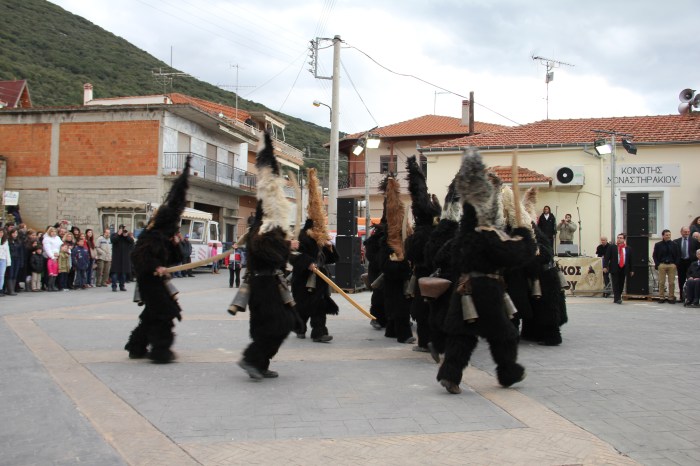
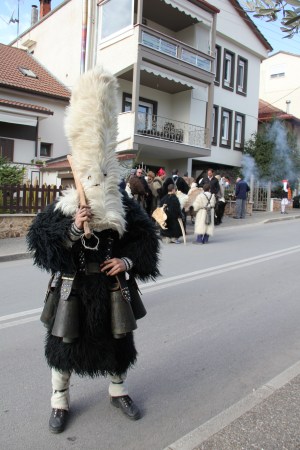
After dancing and drinking all night, the male celebrants help each other dress in the early hours of dawn. They are truly fearsome in shaggy dark skins, tall conical masks, and wide leather belts from which swing three pairs of heavy double bells. One of their names, koudonofori, means bell wearers; they are also called Arapides, the Black Ones or Moors.
Looking behind the apparent racism of the terminology, these ritual dancers blacken their skin with burnt cork both to invoke the power and protection of the sacred fire, and also in order to enter the realm of darkness. Here, the dark is seen as the repository of the earth’s fertile powers, which their bells and dances aim to awaken, as well as the realm of things ‘not seen’ , such as the spirits known as kallikantzari, which pose a threat to the new light and the new year. They themselves must go unseen, in masks and disguises, to enter this realm.
‘Arapides’, masked ritual dancers at Theophania in Monastiraki
Brandishing long wooden swords, this group – known as a tseta – appears fully capable of driving out any number of kallikantzari. The phallic swords and headdresses leave one in no doubt that the Theophania rituals are men’s rituals, yet the ability to give new life, to enter the realms of the dead, and to bestow the blessing of fertility are essentially women’s powers. To claim these powers, some of the men must dress as women, as Dionysian revellers have done since ancient times. These are theGilinges, or Brides.
Pappoudes (‘Grandfathers’) with lozenge-shaped beaded amulets, and Gilinges (‘Brides’) in Ksiropotamos
Wearing women’s clothing may be a means for men to temporarily gain access to the realms of life and death, where normally only women may go, or to symbolically give birth to the life-affirming fertility and joy which bring renewal at this dark and hungry time of the year. (Men wearing women’s clothing for ritual purposes are depicted in archaeological finds dating back to the 5th C. BCE; I think we see it today in the ecclesiastical robes worn by Christian priests.) In an additional affirmation of what is seen as women’s power, the Brides’ costume is rich in goddess embroideries, while all the members of the party wear beaded amulets in the lozenge-shaped symbol of female fertility going back to Neolithic times. Goddess symbols are also stamped on many of the bells.
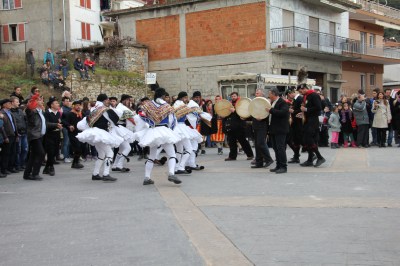
As well as the Arapides and the Brides, the tseta includes Pappoudes or Grandfathers in Thracian men’s traditional dress, and Evzones or Tsoliades wearing short white pleated foustanella kilts and thetsevres, a special garment made of twelve large white kerchiefs sewn into a triangle densely fringed with beads, sequins and coloured threads, which takes four months to prepare.
Musicians and ‘Tsoliades’ ritual dancers in Monastiraki
There is also an occasionally appearing Bear, who some say represents ancient worship of the Goddess Artemis.
As they journey together through the village, the bell-wearers leap and stamp, swinging their bells back and forth in an apotropaic din – this will indeed awaken the earth! – almost drowning out the eerie sound of the lyras and daïres. The Evzones dance with athletic half-turns which send their short kilts sailing up to their waist, emphasising (so I am assured) the fertile power of the male generative organs, without revealing the organs themselves. At every house the entire tseta is rewarded with abundant food and drink, in the living tradition of sacred hospitality which is the most powerful blessing of all.
Hospitality to strangers in Ksiropotamos
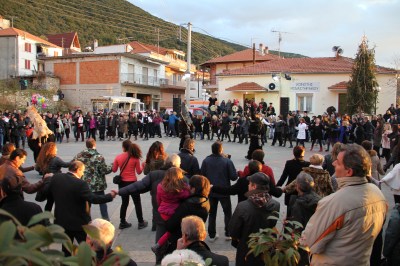
By three o’clock, the whole village gathers at the plateia to dance. Hundreds of people spiral into a single circle with one leader, keeping the large centre open as a sacred space for the tseta to enact ancient rituals of death and resurrection, plowing and planting, and the hieros gamos or sacred wedding. The dancing goes on until dusk and then continues at a taverna through a second consecutive night.
Everyone joins in the great circle dance in the plateia of Monastiraki
Each village has its own variation of the Theophania rituals. In some places, children and women also participate: in Ksiropotamos young girls dance in traditional costume, while in Petrousa, all the dahereplayers are teenage girls. Some traditionalists view this change with unease, but I must confess my pleasure at seeing thirteen young women lined up like priestesses of Cybele from the time when the drummers were women. Here too, people dance at crossroads, springs, sacred trees and finally around an enormous bonfire.
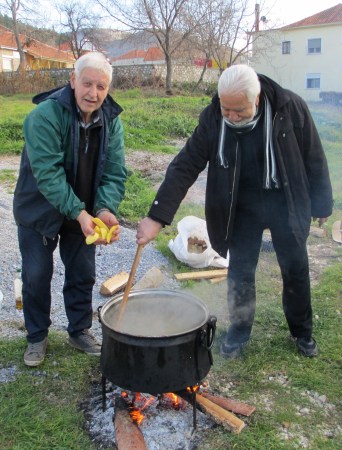
Cauldrons at the crossroads in Ksiropotamos
Fire is important in all the Theophania rituals, and cauldrons on open fires are a key part of the festivities. This is another symbol of women’s power adopted on this occasion by men – traditionally, women cooked in pots; men roasted meat over an open fire.In Petrousa, the Dance of the Cooks can still be seen. Although it is no longer danced around the cauldrons themselves, the symmetrical step pattern still focuses the energy or ‘fire’ of the dancers in a particular way.
It seems to me that these fire-focused rituals hint at the unnamed presence of the Goddess Hestia, whose domain is centred on the hearth, source of light, warmth, food and all that is beneficial to the home. The nikokira, the lady of the house, was seen since ancient times as Hestia’s priestess. Her role is to tend the sacred fire through practical and ritual work and to literally focus its brilliance (estiazo, fromHestia, means ‘to focus’) so that it may bless the household and all its inhabitants. In ritual activities such as the Theophania, through the mediation of men dressed as women, this focused fire can be brought once a year from the private space of the home – the realm of the women – into the public space of the village, the realm of the men. This union of men’s and women’s fertile powers is the hieros gamos, the holy spark of blessing which ensures health, wealth, happiness and abundance for all in the coming year.
Two New Years’ Eves ago, I came to the realization that I did not need to watch the television countdown to ring in midnight and begin the New Year. I had always watched the show with my family as a child, and even while it made me feel curiously bad, I still somehow felt like it was an obligatory component of the day, right up there with kisses, well wishes, blowers, horns, and sparkling wine. Since we seldom went to an actual New Year’s party, it was a way of connecting with the world. I gave it up, though, when I ultimately deemed the musical guests and hosts to be unviewable.
I was not looking to make a new tradition per se that year when I decided to light a hunk of myrrh in the fireplace. The myrrh had come to me as a gift in a Three Kings Christmas set. It made a pretty decent blaze because I had placed it atop a bed of shallow candle wax from an old votive candle. Let me say, while it smelled lovely and burned a long time, I do not recommend doing this – the fire became alarmingly vigorous for a little while. Anyway, I spread a cloth on the floor and set out some food, calling my family together to sit in a circle by the hearth. We dimmed the lights, and by fire I read the Epic of Gilgamesh (with some tasteful PG 13 edits) from 11:00 pm until 1:00 am. I had been reading great epics to the kids, and it seemed somehow appropriate to return to Babylon that year. We did not mark the New Year at a precise moment but rather sailed into it on the tides of an ancient tale. It was a revelation to us all, mostly because we were reclaiming that night from the media usurpers who had defined it for us for most of our lives.
This year, we intended to do something similar until we ended up throwing an impromptu party for some friends and their children. I knew they would all have limited interest in my second annual fire reading, so we just fed them and eventually counted down the final moments of 2014 on my watch. But, after they left, we returned to the myth, this time reading the Babylonian Epic of Creation. We hit the mark, as the story itself was ritually performed at each New Year. It carried us deep into the first day of 2015 and was also a great revelation. Continue reading “Stories for (Re)creation in the New Year by Natalie Weaver”
It has been nearly 2000 years since the Roman emperor Nero kicked his pregnant and sick wife, Poppaea Sabina (hereafter Poppaea), killing her and what was probably the near full term fetus she was carrying. That Poppaea was murdered deliberately should not be doubted, for not long after her death Nero had her son by an earlier marriage, who was then still a minor, killed by being drowned (a fishing ‘accident’).
Given that domestic violence has a history that repeats itself with sickening regularity it is necessary to explain why this particular case should matter now. It is because at the time of her murder Poppaea was, with the sole exception of her murderer, the wealthiest and most powerful person in the world, whose attention was curiously focused not on Italy or Rome but on Judaea and Jerusalem. There is evidence to suggest that had Poppaea not been murdered the history of Judaism and Christianity would have been substantially different than it has been, especially with respect to the role of women. Continue reading “Poppaea Sabina: A Victim of Domestic Violence– But Why Does That Matter Now? by Stuart Dean”
I wish the analysis that accompanies this quote had been mine, but maybe I should be glad that it comes from an insightful young man who goes by the name liamcdg. He argues that the real beef the New York police have with Bill de Blasio is his challenge to their definition of masculinity as dominance, or shall we say white male dominance.
As noted by liamcdg, in the NYPD version of reality, parents should teach children to comply “to comply with New York City police officers even if they think it’s unjust.” In terms of competing definitions of masculinity, the NYPD version is that men in power should be respected simply in virtue of their position, even if they are acting or appearing to act unjustly. In other words we should respect the powerful because they are powerful.
To be empathetic is to be able to put yourself in another person’s place, and in its literal meaning, to feel the feelings of another. In the recent public conversations about race and the police, both Obama and de Blasio have invited white Americans to put themselves in the place of a black man stopped by the police for little or no reason and to ask themselves how they would feel in that situation.
In so doing, liamcdg asserts, Obama and de Blasio were not only trying to explain the feelings of those on the other side of the racial divide, but they were also redefining masculinity. We all know that according to traditional stereotypes, the realm of feeling is the realm of women. And of course we also know that real men don’t cry. Yet what is happening to black men is enough to make anyone who feels their feelings want to cry.
The conflicts between de Blasio and the police and between Obama and a large segment of the older white male voting public may have as much to do with the challenge to white male privilege as it has to do with any particular event or issue. White male privilege involves a complex interconnection of race and sex. It is about the power that comes or is expected to come to one simply by virtue of being born into a white male body.
Forty years ago, inspired by the feminist movement, men began to speak about redefining masculinity. This was easier said than done. It is so easy to accuse men who criticize male power as domination of being “sissies,” “girls,” or “gay.” Even men who might want to discuss the subject may be afraid of being labeled.
I say the fact that the NYPD is turning its back on de Blasio is one measure of how far we have come. I suggest that the NYPD recognizes that a different definition of masculinity and male power is being born right before their eyes. And it is this that they cannot bear to see.
We have been taught that feeling and feeling the feelings of others belongs in the feminine realm. What if it doesn’t? What if in the end male power and female power are much the same? And what if they both begin with empathy?
What if Freud got it wrong? What if males do not have to differentiate themselves from their mothers by becoming “not like” women and girls? What if masculinity and femininity are not polar opposites? What if all any of us has to do is to learn to embody the qualities of those who nurture us?
We are beginning to glimpse a different world. Any thoughts on how to bring the NYPD and other older white males into a new world along with us?
Once upon a time there lived a smart but lonely woman named Wrenhilde who had had five husbands (but only one of them was her own) and was a single mother. Because she was seldom unwilling to speak her mind in public, she was either unliked or envied by the respectable women of the town, who were ordered by her husbands to avoid her company. So Wrenhilde did what she could to earn a pittance to pay the rent. She also grew as much of her food as she could. As she worked (or didn’t work), she sang to herself:
Bitter is my cup,
My life’s not worth a shtup,
I believe I need a new world—
I’ll have to make one up.
Well, with that kind of song and the attitude it betrayed, no one was surprised that her son Jack was a dropout by the time he was fifteen. Jack lazed around, acted stupid, stood up to the rich boys who tried to bully him, and secretly wished he had a pet for company. One of his chores at home was to milk the cow. This was the only thing he never neglected because the cow was big and white and warm and affectionate. She practically purred while she was being milked! Continue reading “A New Yarn for a New Year by Barbara Ardinger”
Social justice. Progressive politics. Improper media depictions. What exactly is the F-word (feminism) about?
I have always understood feminism as a project that casts a very wide net, the goals and values of which can keep quite a few people dry under the shade of its umbrella. But more and more, I see a narrowing of who can count as a feminist. There are a few reasons for this constriction. First, the more the F-word becomes a pejorative in contemporary society, the greater the need is to circle the bandwagons and set up camp. Second, when a particular group has elevated levels of in-fighting occurring, it makes sense to start psychologically splitting people into “feminist” and “not feminist.” Or, on a spectrum, “strong feminist” vs. “weak feminist.” Third, there is a pragmatic need for groups to find an optimal tension with society. When social groups are too counter-cultural or revolutionary, they get branded extremist and fanatical, but when they are wishy-washy and lukewarm, they become another extension of the status quo and lose their prophetic fire.
As an atheist, I see all of this occurring in non-believing circles as well. And I’m not really sure how to navigate it. There is also no shortage of men in this social group–from Dawkins to Boghossian–who think of feminism in the negative. All of this has to do with what they think the F-word amounts to. Continue reading “What is the F-word Anyway? by Kile Jones”
I have spoken about the Social Responsibility of the Artist on numerous occasions. This blog approaches similar subject matter, but in relation to using art as a potent tool for change and as a platform for raising awareness of important environmental and ecological issues that all of humanity is currently faced with.
All forms of art have the potential to be tools for healing. I believe that through the creative process the relationship with self and the environment can be transformed. Why? Because when creative work is approached from a place of passion and purpose and art is brought to life with intention, great shifts can occur. Not only for the artist, but also for the viewer. I believe wholeheartedly that I can approach the canvas and paint intentionally to heal the earth and deepen my connection to it, and in doing so inspire others to deepen and honour a connection to the earth creatively.
There are many contemporary artists who are agents of environmental change and who are using their creative gifts and talents to build awareness and provoke thought through their work and process. Many artists, such as myself are working with transformative approaches and processes towards a new vision that is ecological and participates with the living cycles of nature. Many topics are approached such as oceans, climate change, water quality, recycling, water purification, natural disasters, de-forestation, endangered species and more.
Artists today are finding all sorts of inventive ways to call attention to the problems facing our environment, as corporate greed and profit impose destruction on our planet. While each artist works very differently and explores diverse territories, they share awareness about the critical loss of natural resources and a desire to save the planet from human destruction.
“Today the talk of the world is about an endangered Earth. One often wonders how much of the talk is backed with genuine concern and the will to take positive steps. But it should not surprise the world that artists are in the forefront of the discussion on the environment.”
Eco-feminist artist Ann T. Rosenthal and activist artist Steffi Domike have been collaborating on environmental installations for years. Their wall installation, Watermark: Wood, Coal, Oil, Gas (2011) consists of four panels that illustrate an evolutionary timeline of energy resources—wood, coal, oil and natural gas.
Dominique Mazeau is a poet and artist from Santa Fe, New Mexico. She has made an exquisite journal of poems and drawings of cleaning up the Rio Grande River over many years. She has made sculptures from the trash and she teaches school children about the river with her poems and her art.
There are many more Eco-feminist and Environmentalist/Activist artists such as Charla Puryear and Helene Aylon using their art to raise awareness of ecological issues. These few examples alone demonstrate that art, in its myriad of forms, has the capacity to effect positive change on the earth and its environments.
Artists are catalysts for change, and this “change” takes place when we feel deeply for a precious cause. I feel deeply for the state of the earth and feel that it is largely humanity’s spiritual disconnection from the earth and from the earth as sentient that has contributed to the current state of not only the health of the earth body, but also the health of our bodies.
Coming up in October I will be presenting an exhibition ‘Voices for the Earth’ in Bundaberg, QLD Australia. This exhibition will feature the works of select regional artists who are using their art to speak for the earth. It is held in conjunction with RONA-16 an Earth Arts Festival as part of the The Rights of Nature Tribunal that is taking place the same month. Artists of all genres from around Australia are participating in creative activities to raise awareness of the urgency required to make the necessary changes so that ways can be found to make the health of our planet an absolute priority.
I know that more has to be done, and some might see ‘art’ as a hedonist, self absorbed way to attempt to bring about change – but the power of image should NEVER be underestimated.
I am Painting for the eARTh.
This Earth is my sister I love her daily grace Her silent daring And how loved I am. How we admire this strength in each other All that we have lost All that we have found We are stunned by this beauty, And I do not forget What She is to me And what I am to Her.
Jassy Watson, who lives on the sub-tropical coast of Queensland Australia, is a Mother of four, passionate organic gardener, Intuitive/Visionary & Community Artist, Teacher, Intentional Creativity Coach and a student of Ancient History and Religion at Macquarie University, Sydney. She is the Creatress of Earth Circle Studios; a school for the Sacred Creative Arts. Jassy teaches regular painting workshops in person, nationally and internationally, and online based around themes that explore myth, history and our connection to the earth.


 This statement was made by scholar of religions Karen Armstrong in an interview in Salon magazine in response to characterizations of Islam as a violent religion by Bill Maher and others. Speaking in the context of the rise of anti-Islamist prejudice in Europe, Armstrong said that Maher’s demonization of “the other” was the kind of talk that could lead us back to the concentration camps.


 I never imagined I’d paint her. Though I was not raised in church, I have vivid memories of worshiping in Southern Baptist Churches, churches where women’s voices were not permitted behind the pulpit, churches where women could never dream of ordination, churches that damned LGBTQ folks to hell with a pound of a fiery fist on a well-worn bible perched atop an angry pulpit. Canonize a Southern Baptist woman into the sainthood of Holy Women Icons? No, thank you.



 Two New Years’ Eves ago, I came to the realization that I did not need to watch the television countdown to ring in

 Social justice. Progressive politics. Improper media depictions. What exactly is the F-word (feminism) about?


