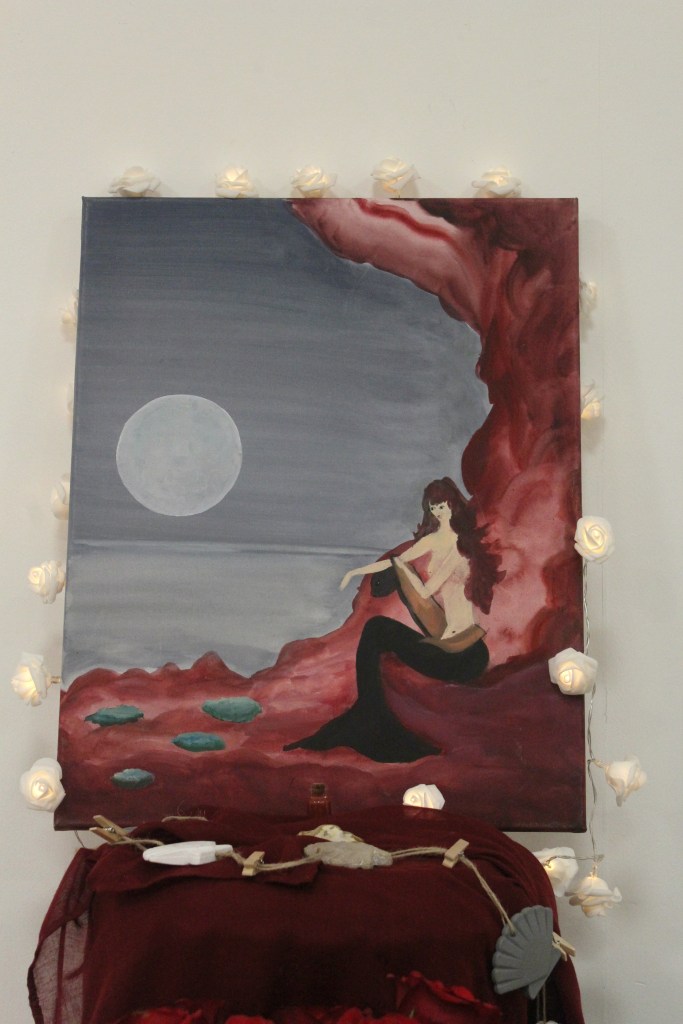
It was beautiful to read Carol P. Christ recent ‘from the archives’ post “Mermaid, Goddess Of The Sea,” especially because I’m in the middle of organising my first live Story-Dance workshop since several years, to move through one of my favourite stories of the Selkie-Seal Woman!
Stories of seal-women drift across the sea from the windswept coasts of Scotland to the icy shores of the Arctic. In the Scottish and Irish Highlands, Seal-women are known as selkies—shapeshifters who live as seals in the ocean, and who, when they shed their skins, walk as women on land. These selkie women dance beneath the moonlight, their laughter echoing across the waves as they rejoin their sisters in joyful reunion with the earth.
I recently attended an event in Salem, Virginia, put on by The Salem Choral Society titled “People Get Ready,” directed by S. Reed Carter IV. This popular group has sung on numerous occasions locally as well as performing at Carnegie Hall in New York City and the National Cathedral in Washington D.C. The choir (11 men and ~45 women) sang fourteen selections. The song arresting my attention was “People Get Ready.”
From Wikipedia: “‘People Get Ready’ is a 1965 single by the Impressions, the group’s best-known hit, reaching number three on the Billboard R&B chart. The gospel-influenced track was a Curtis Mayfield (1942–1999), American singer-songwriter, guitarist, and record producer. This particular composition displayed [his] growing sense of social and political awareness…. In 2021, Rolling Stone named this song the 122nd greatest song of all time. Martin Luther King Jr. named the song the unofficial anthem of the Civil Rights Movement and often used the song to get people marching or to calm and comfort them.”
I have been building houses. Reducing. Reusing. Recycling. Recreating. Birthing homes from giant cardboard boxes, old newspapers, twigs, twine, flour paste, and joy. Joy for it is vital for me to nourish my days with meaning that strengthens my commitment to being. To belonging. heART that is offered to and for community because community and housing are siblings. With the sale of each finished piece, both funds and awareness are raised for the New Canadians Center Peterborough. Here in my city. A city which offers the heart of welcome. Newcomers to this city, to any city, to any country, yearn for home. To find, to create, and to be: welcomed home.
Home and welcome are an intricately and finely woven fabric.
The heART of home, the heARTh itself, is welcome and warmth.
you whistled my name four notes chilled prickly skin needling truth we are forever bound you bird woman owl tree wounding wounding wounding we weep grief grief grief too deep half a million dead gunned down by Explosive Will I make no apology Return atrocity to those whose behaviors will one day destroy them too. What we do to nature we do to ourselves.
Context for Poem:
Yesterday I wrote an essay about the barred owl killings beginning with a personal story about my relationship with barred owls. I have known about this Federal Fish and Wildlife Organization’s proposal since 2023.
This post was originally published on Oct. 7th, 2011
Carol P. Christ, a founding mother in the study of Women and Religion and Feminist Theo/a/logy, has been active in anti-racist, anti-poverty, anti-war, feminist, pro-gay and lesbian, anti-nuclear, and environmental causes (in that order) for many years. All of these issues have informed her teaching, her scholarship, and her politics.
The recent posting of Mary Daly’sletter to Audre Lorde on the Feminism and Religion blog is a correction of a piece of feminist history that is important in its own right and because of the way Lorde’s letter has shaped feminist discourse and politics up to the present day. Knowledge of the existence of Daly’s letter and the facts surrounding Lorde’s distortion of history has been in the public domain since the 2004 publication of Alexis DeVeaux’sWarrior Poet, but when I searched the internet for a copy of “Mary Daly’s letter to Audre Lorde” a few days ago, what came up was Lorde’s letter to Daly — not Daly’s letter to Lorde.
I often hear younger feminists say that “all white feminists” of the older generations “were racist.” Sometimes Mary Daly is mentioned. Finding the more detailed record about Mary Daly is one step in retelling the history of feminism in a more complex way.
Hope is the thing with feathers . . . Emily Dickinson
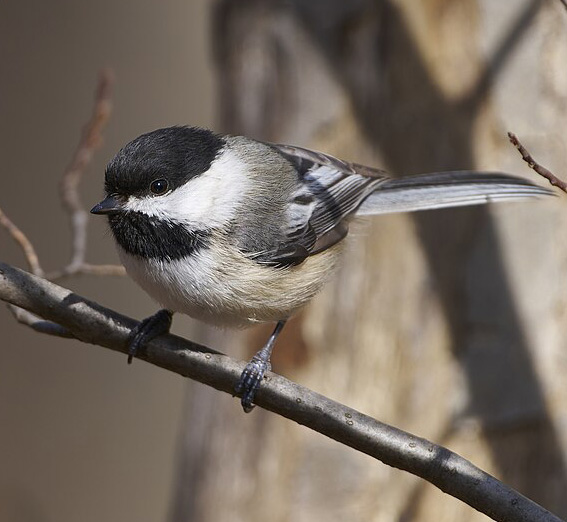
Chickadee
I awoke this morning to bird song, and for a moment I was lifted beyond the despair that has caught me in its grip — despair for the country, for the earth, for loved ones whose lives are increasingly tossed into the chaos, for the future The disappearance of persons into labyrinths of prisons in this country, Guantanamo, and the tortuous CECOT prison complex in El Salvador has broken what was left of my spirit. Then this morning I heard a report that the State Department has changed what it considers to be human rights abuses in order to align with recent Executive Orders, deleting critiques of such practices as retaining political prisoners without due process of law, restrictions on free and fair elections, violence against LGBTQ persons, threats against people with disabilities, restrictions on political participation, coercive medical or psychological practices, and extensive gender-based violence. Ostensibly these changes are to lift restrictions on sanctions toward other countries, but I fear they portend clearing the way for such abuses in the US as well.
My heart is heavy in ways I have not previously known, so I am grateful for that brief moment of delight in the early morning. Later in the day, I found myself wondering whether those who suffered and died in concentration camps, whose despair certainly was beyond comparison with my own, found any solace in the sight and sound of birds who flew freely over the walls of the camps in ways they could not. The daughter of survivors of Auschwitz, Toby Saltzman, recalled that her mother, who often suffered bouts of despair over the Holocaust, found her spirits lifted by the songs of birds. When Toby later visited Auschwitz, she was greeted by flocks of birds. Upon her return, she reflected, “I left Auschwitz feeling a surge of triumph that my parents survived, and gratitude to the birds that gave my mother spiritual sustenance and hope.” We are sorely in need of such sustenance in these times.
For over forty years I have been researching women’s dance and folk arts. This quest has been inspired by Merlin Stone, Max Dashu, Vicki Noble, Mary Kelly, Marija Gimbutas and others, including my close friend Carol P. Christ, who encouraged scholars to examine ‘nontextual artifacts’ and ‘expand our notion of history to include records that are not written’. 1
Through extensive travels in southeastern Europe, North Africa and the Near East, I’ve learned to recognise the symbols and significance encoded in dance patterns, textile motifs, jewellery designs, healing practices, and other forms of women’s ritual arts.2 This experience has trained me to discern patterns and meaning beyond superficial interpretations – to look ‘with eyes to see’.
In this article I would like to offer a closer look at the ‘nontextual artifacts’ in the Christian Nativity story: the gold, frankincense and myrrh brought by the Magi. My lifelong interest in North African bridal jewellery leads me to suggest that the gifts of the Magi were meant for the mother, not the child. Not only that, this closer look reveals that the Magi were probably not three, almost certainly not kings, and very likely included both men and women.
He never let me eat communion because I wasn’t a catholic, but it was okay for me to eat his dick. My tiny palms forced to stroke him, the same dextrous hands that coloured in the lines.
I knew his God wasn’t my God. I knew she saw everything there was to see and that he wouldn’t reach salvation; no matter how many Hail Marys he said at mass in Ireland.
The Virgin Mary knew what he stole from me, what they steal from all of us.
I couldn’t fall apart on Sundays at noon when he took me to church—before he took me home after he did what he did—to the little Jewish girl who didn’t know she was Jewish.
I couldn’t remember it because I buried it in Survive, until, it was resurrected by nightmares and demons who professed caring and brought me to altars of despair to vomit up all the darkness, and when there was no more left to cleanse or tear out; light ripped in.
No one talks about the embarrassment that goes along with the telling, sharing and surfacing of sexual violence. How it comes up, how it comes back. How we’re always haunted by the deadbeat dead and grabby grandfathers who try to reach from there into here, pretending they are made of heaven.
I fled a friend’s choir concert because perpetrators keep stealing time, moments, sleep, joy, and friendship, in churches and baths. On my flight, I hunted for nature, soil and anything else that felt most alive in the hilly town of Nelson. Pretending I was like everyone else, I hid the panic that strikes broken hearts.
I am the holy place somewhere in the stars of eternity, someone’s daughter who seeks reprieve somewhere.
Yetta changed her name to Mary. She tried to erase her past, not as a Jew, well maybe some of that, but more as a Jew molested by her father—a frum[1],“Monster”, his daughters called him.
On my altar sits my tallit alongside a Menorah with seven brass holders. No stars of David—before or after the decimation of Gaza. Can rose water sweeten our hearts? We pour it graciously in our hands, hoping the lost petals heal our guts and brighten our thoughts. She searches hungrily for hope in glass bottles adorned with Farsi, that cost $4.29 each.
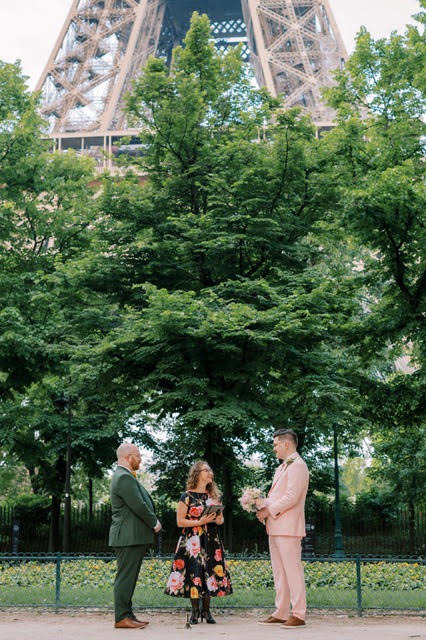
Springtime in Paris brings the magnificence of cherry blossoms, the scent of sweet crêpes, and an influx of tourists eager to capture their own moment of passion on the cobblestone streets of the world’s most romantic city. I may be biased because Paris is my home, but there’s no denying its magic. With its art, history, cuisine, fashion, and architecture, the city offers extraordinary experiences. It’s no wonder so many couples choose to marry in the City of Light.
Years ago, when I entered the wedding industry, I did so reluctantly, only after leaving the one profession I had ever known – ministry. What I didn’t expect was that I would become a bridge for couples navigating the ever-widening gap between love and institutional religion. The so-called “rules” of tradition are often mislabeled as matters of faith but are more accurately named as remnants of the heteropatriarchy. They place enormous pressure on engaged couples. It’s no surprise that many of the eloping couples I meet in Paris have chosen their path simply because it is less stressful than trying to appease tradition, religion, family, or friends (or all of the above).



 Feminism and Religion