A RITUAL OF FAITH: SENDING LOVE TO THE CHILDREN OF VETERANS by Stephanie Mines

May is the Month of Mary and the Month of Mothers. With this in my heart I want to ask everyone receiving this newsletter to SEND LOVE to the children in the families of our returning veterans. As vets stream back from Iraq and Afghanistan, many with PTSD (Post Traumatic Stress Disorder) and/or TBI (Traumatic Brain Injury), the children in their families are the most vulnerable to how war comes home.

Children are prime targets for the unnoticed and untreated war wounds of intergenerational shock. As politicians wrangle for power and use the current wars for that purpose, the children absorb the fallout and cannot hide. Their very shelter is a war zone. I am not talking about a few children. I am talking about thousands and thousands of children. The Pentagon itself notes, through Dr. Sonja Batten, Assistant Deputy Chief of Patient Services for the VA, “PTSD and TBI are occurring in unprecedented numbers. At least 320,000 soldiers have been diagnosed with TBI and one in eight returning soldiers has PTSD.” Continue reading “A RITUAL OF FAITH: SENDING LOVE TO THE CHILDREN OF VETERANS by Stephanie Mines”

Art – A Bridge Between the Physical and Spiritual Worlds by Judith Shaw

judith shaw photoBrushing yellow gold on top of deep crimson, I sense the paints coming alive, even as I feel myself moving outside of ego, outside of time, and inside to my deepest source.

At least forty thousand years ago the human family began to make art; drawing, painting, sculpting and playing music. For much of human history, art has served a dual purpose. Some art has been purely decorative, while much art has expressed a spiritual understanding of our physical existence.

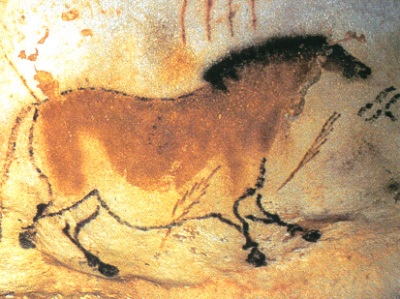
During the Paleolithic period, c.15–18,000 B.C. on the walls of a sacred cave, Lascaux, in southern France, our ancestors created beautiful paintings, often interpreted as a ritual that invoked sympathetic hunting magic. They are a reminder of the bond between the spirit world and the human world. This was a magical time in which humans lived immersed in the connection between the physical and spiritual worlds. Art was a means to both express and facilitate that connection.

Neolithic Goddess Figure

The seasons turned and the art and mythical imagery of the Paleolithic era was transmitted to the Neolithic era in Old Europe. Worship of the Goddess, as giver of all life, continued as did the art which honored Her and our connection to Her. The artists from these ancient days expressed their communal worship through the creation of cult idols and objects, shrines, painted pottery, and religious ceremonialism. The artists, though anonymous, were the hands and eyes of the creator, deepening and transforming the consciousness of their community.

As the human community in the western world developed and grew, art remained firmly grounded in the spiritual. From the megalithic stones of the Celtic era, to the illuminated manuscripts, mosaics and fresco paintings in the churches of the Middle Ages, right up to the work of painters like Van Gogh, Kandinsky, Malevich and Mondrian in the more modern era of late 19th and early 20th century – art expressed our human connection to the divine.

Continue reading “Art – A Bridge Between the Physical and Spiritual Worlds by Judith Shaw”

“AS WE BLESS THE SOURCE OF LIFE, SO WE ARE BLESSED” by Carol P. Christ

Blessing the Source of Life harks back to the time when shrines were built near springs, the very literal sources of life for plants, animals, and humans.

The prayer “As we bless the Source of Life, so we are blessed,” based on a Hebrew metaphor which refers to a water source and set to music in a Jewish feminist context by Faith Rogow, has become one of the bedrocks of my Goddess practice.

In Minoan Crete, seeds were blessed on the altars of the Goddess and the first fruits of every crop were returned to Her. The ancient Minoans piled their altars high with barley, fruits, nuts, and beans, and poured libations of milk and honey, water and wine, over the offerings they placed on altars. Evidence of these actions is found in the large number of pouring vessels stored near altars.

Recreating these rituals on the Goddess Pilgrimage to Crete, and singing together, “As we bless the Source of Life, so we are blessed,” again and again, we begin to understand that the gestures of our ancestors were based in gratitude for Life itself. They understood that the fruits of the earth, the grain, the wine, and the oil, the cherries, the peas, the olives, and everything else that we eat, are gifts of bounteous Mother Earth. Continue reading ““AS WE BLESS THE SOURCE OF LIFE, SO WE ARE BLESSED” by Carol P. Christ”

Abuse of Power in the Catholic Church: Undoing Almost Fifty Years of Progress – Part I, by Michele Stopera Freyhauf

“Now the Vatican says that nuns are too interested in “the social Gospel” (which is the Gospel), when they should be more interested in Gospel teachings about abortion and contraception (which do not exist).  Nuns were quick to respond to the AIDS crisis, and to the spiritual needs of gay people—which earned them an earlier rebuke from Rome. They were active in the civil rights movement.  They ran soup kitchens.” —  Roman Catholic Women Priests (via Facebook)

I once had a conversation with my New Testament Professor about the issue of women ordination.  He was optimistic and thought there might be a possibility that change was in the air – that was six years ago.  The basis for his statement had to do with language.  Of the journals and articles read, he felt the language used was more inclusive and that once people adjust to this discrete change in gender inclusive language, change for women in the Church can come.

He was right about change coming.  The result was not equality and ordination for women, but an attempt to silence and force these women back into their habits and cloisters. Continue reading “Abuse of Power in the Catholic Church: Undoing Almost Fifty Years of Progress – Part I, by Michele Stopera Freyhauf”

A Semester of “Gendering Mormonism” by Patrick Mason

Readers of FAR have been treated to a number of posts over the past few months from members of the “Gendering Mormonism” class I taught this semester at Claremont Graduate University.  I was fairly apprehensive in offering the course.  For one, I’m not a scholar of gender, gender studies, feminist theory, feminist theology, queer studies, queer theology, or anything related—I’m a historian of American religion, and most of my training to that effect was about the white guys in American religion (most of whom, you’ll be shocked to learn, weren’t exactly feminists).  I have also spent some time in international peace studies, where I got a crash course in issues of gender justice.  But I entered this course as a relative novice.  This is one of the fun things about being a member of a graduate faculty—as a professor I don’t have to pretend to be the fount of all wisdom all the time, and I learn a lot from students who are often more expert in a particular field than I am. Continue reading “A Semester of “Gendering Mormonism” by Patrick Mason”

The Inquisition of Today and U.S. Women Religious by Ivone Gebara

Statement from Ivone Gebara, writer, philosopher and theologian from Brazil on the Vatican action against U.S. religious women. 

Translated from Portuguese. Reprinted with permission. 

Once again, we watch dumbfounded as the Congregation for the Doctrine of the Faith directs a “doctrinal assessment of” or a “calling attention to” or the “punishment of” those who, according to the CDF, break away from the proper observance of Catholic doctrine. Only this time, the CDF is not pointing an accusatory finger at a person, but rather at an institution that brings together and represents more than 55,000 women religious in the United States- namely, the Leadership Conference of Women Religious, known by its acronym LCWR.

Throughout their long history, these women religious developed and continue to develop a broad educational mission which advances the dignity of many people and groups both within and beyond the United States. Most of these women belong to diverse national and international congregations.

In addition to their Christian and humanistic formation, they are intellectuals and professionals in various fields of knowledge. They are writers, philosophers, biologists, sociologists, lawyers and theologians. They have broad backgrounds and their expertise is recognized nationally and internationally. They also are educators, catechists and human rights activists. In many situations, they set their lives at the service of those affected by injustice or set themselves in opposition to the grave actions taken by the government of the United States. Continue reading “The Inquisition of Today and U.S. Women Religious by Ivone Gebara”

Maiden and Monster by Daniel Cohen

 A story that follows on from my version of Perseus and Medusa…

Perseus flew on, away from Medusa. He gave thanks to Athene that he had understood her words, “It is necessary that I have the head of Medusa. Therefore I bid you seek her out”, just in time to avoid a killing.

He flew across the sea until he reached a rocky coastline, the boundary of a fertile kingdom. Here he landed and was given hospitality by the king and queen. Though they made him a welcome guest he could see that they were greatly upset and he asked why. He learnt that they had offended the Changeless Changeable Ones, the Goddesses of the Sea. They had sent out a sea-serpent and demanded that the princess Andromeda be given to the monster. The king and queen begged Perseus, who they could see was a hero, to aid them and he agreed.

Next morning Andromeda was taken to the seashore and chained to a rock. She asked them not to chain her, saying that it was not necessary and that the monster was her fate. But they were afraid she would run away and bring a worse disaster on the land, and they would not listen to her.

Perseus leapt lightly into the air on his winged sandals, while the king and queen and all the people retired to the safety of a cliff-top. Perseus looked at Andromeda as he waited for the monster – as she stood there so calmly the tall grey-eyed young woman seemed to him like a mortal image of Athene. He looked out to sea where great waves were coming in as the monster approached. The monster in some way reminded him of the Gorgon. He waited for the monster to come closer. Continue reading “Maiden and Monster by Daniel Cohen”

Change My Mind, Move My Heart: Feminist Ethics in Practice by Marie Cartier

As some of you know, this spring I am teaching “Feminist Ethics” at California State University Northridge. I recently posted a blog on this site regarding the students’ project April 4, 2012 The Feminist Toolbox by Marie Cartier. If you read the original blog you know that the students have been asked to find a problem in the public or private world that they will deconstruct and then find a full or partial solution for. For their actual final they must actually *do* their proposed solution.

Students must use the tools described in the earlier blog, in what I call “the Feminist Ethical Toolbox,” or what my students call “Cartier’s Toolbox.” The toolbox contains questions such as “Is everyone affected by the decision (the solution to the problem) at the decision making table?” and “If they are not at the table, are they represented at the table by someone who will speak to their interests?” among others. Continue reading “Change My Mind, Move My Heart: Feminist Ethics in Practice by Marie Cartier”

Home At The Margins With My Sisters By Xochitl Alvizo

My faith is in living and being shaped into the divine way of life that happens at the margins, with others who also see that a new world is needed and are willing to participate with one another in creating it.

I wasn’t always a student of theology – obviously. So the summer before I started my masters program at Boston University, I spent my days reading primers in theology. As I read, I started to notice a trend; chapter by chapter, authors would discuss a specific theological topic or doctrine and toward the end of the chapter would usually add, almost as if an afterthought, the critiques or insights from feminist theology regarding the particular theological doctrine or theme being discussed. Even back then, before feminism had even had the chance to seep into my bones, I wondered why feminist theology, along with the other liberation theologies mentioned, was always presented as an afterthought, a footnote, clearly not as important as the theological perspective from which the authors happened to be speaking. I knew though, even from my first reading of these feminist theological perspectives at the margins of these primers, that feminist theology rang true and was important to me; what I didn’t know or understand was why it didn’t seem to shape “mainstream” theology in a central way but was instead relegated to afterthoughts by the authors of these primers. Continue reading “Home At The Margins With My Sisters By Xochitl Alvizo”

WHY I AM RUNNING IN THE GREEK NATIONAL PARLIAMENTARY ELECTIONS ON MAY 6 by Carol P. Christ

Greece is in the throes of a terrible economic crisis. National elections were called last week and will be held on Sunday May 6.

I am one of the 5 candidates for the Greek Parliament on the Green Party ticket in electoral region of Lesbos. We are a small country of only about 10 million people. The Lesbos district includes about 100,000 people. It is truly amazing that I as an immigrant have been asked to run. It is also amazing that though most of our politicians are corrupt, our electoral system has not yet been completely bought. No polls are allowed during the last 2 weeks of the election. The final poll indicated that the Green Party will have a voice in parliament for the first time on May 7. No Green candidate from Lesbos is likely to become a member of parliament, but all of the votes we gather will be counted towards the party’s total representation. Unfortunately two right wing fascist parties are also likely to get seats, and no party looks poised to gain a ruling majority. What will happen next is anyone’s guess.

Ecofeminist Petra Kelly was one of the founders of the European Green Party of which we are part. Due in part to her good work, the Green Party’s goals include: sustainability, social justice, nonviolence, and participatory democracy. Not a hard platform to run on! Continue reading “WHY I AM RUNNING IN THE GREEK NATIONAL PARLIAMENTARY ELECTIONS ON MAY 6 by Carol P. Christ”