I carry the exact replica of MDNA handed down from mother to daughter since the depths of the last Ice Age 17,000 years ago. My father carries the YDNA of the Indo-Europeans handed down from father to son since the time when his male ancestors invaded Europe about 5000 years ago.
My female ancestors moved with the seasons as they gathered fruits and nuts, roots and greens to feed their families. Some of them may have blown red ochre around their hands to leave their marks in ritual cave-wombs.
In patriarchal heterosexist societies women do most if not all of the cooking for their families. Women are also usually assigned the tasks of cleaning, raising children, tending the family garden, gathering water and anything else that is considered part and parcel of caring for the family. These feminine tasks are often devalued compared to the activities men spend their time doing. I wholeheartedly support the reevaluation of the significance of these tasks and the movement toward shared responsibility for family life among heterosexual couples, however that is not what I want to discuss today.
I want to explore the religious and spiritual significance of the food cooked by our mothers, grandmothers, aunts, sisters and female friends, especially those dishes we would consider to be comfort food. Every person, every family has their own idea of what meals are comfort foods. Bubbe’s matzah ball soup on Shabbat maybe? Aunt Betsy’s Easter ham? Mom’s turkey, gravy and oyster stuffing on Thanksgiving? Your sister’s famous mac and cheese? Continue reading “On Cooking and Eating by Ivy Helman”
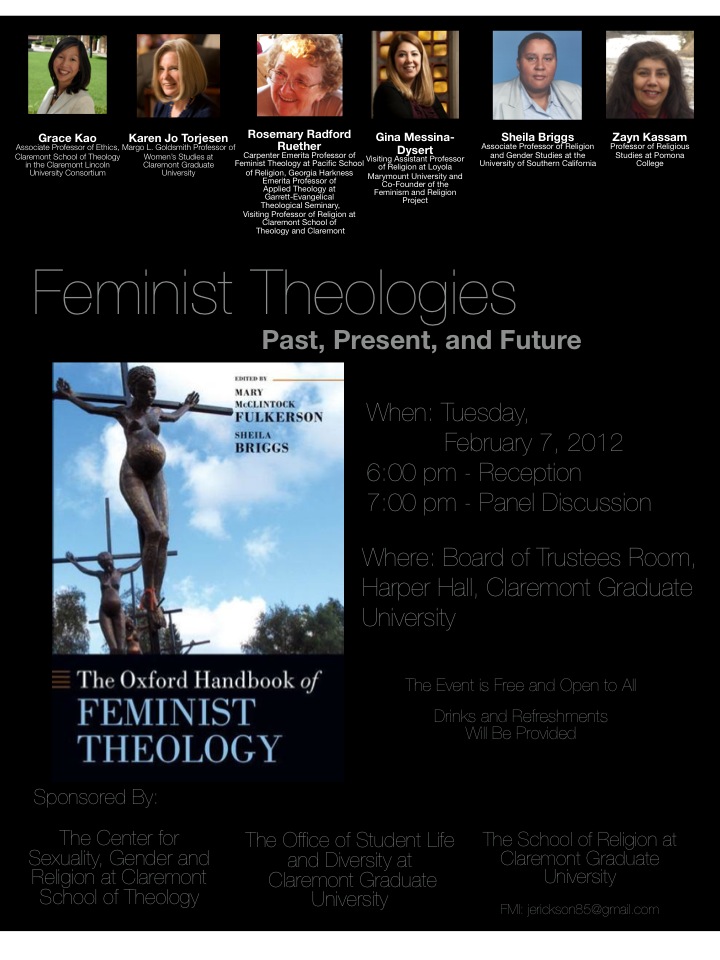
On February 7, 2012, a panel discussion focused on the past, present, and future of feminist theologies took place at Claremont Graduate University to celebrate the release of TheOxford Handbook on Feminist Theology. The panel was organized by John Erickson, moderated by Grace Kao, and featured Karen Torjesen, Rosemary Radford Ruether, Gina Messina-Dysert, Zayne Kassam, and Sheila Briggs as presenters. What resulted was a terrific discussion about women, religion, and feminist theologies. Many were in attendance and participated in the panel; for those who were unable to attend, here is a video of the presentations from that evening. We look forward to you sharing your thoughts and comments about the past, present, and future of feminist theologies.
I have often heard people speak of times when “life stood still,” where the activity of others continues while yours comes to a sudden halt.
I love the sound of lyrics to the Skylar Grey song “Coming Home.” It has a mantra type melody that allows me to find my center when I am off kilter.
I’m coming home
I’m coming home
Tell the World I’m coming home
Let the rain wash away all the pain of yesterday
I know my kingdom awaits and they’ve forgiven my mistakes
I’m coming home, I’m coming home
Tell the World that I’m coming
It speaks to me often when I am in the midst of interior conflict roused by change, growth, transition, disappointment etc. Each personal encounter causes a shift in my interior landscape which in turn requires me to find my center again. Sometimes the homecoming takes longer, depending on the cause of the axis shifting.
March 15th, 2012 will mark the 3 year anniversary of my mother’s death. A day that caused me much turmoil within and a life event from which I continue to search for my center. I would never have thought that this life event would shake me to the core as it did, causing me to question everything I ever thought to have known about my mother. Continue reading “Coming Home by Catherine Gorey”
I may be a bit late to the conversation, but it is impossible for me not to comment on the infuriating statements made by Liz Trotta on Fox News about the staggering 64% increase in sexual assaults against women in the military since 2006. Responding to reports from the Pentagon about women serving in combat, Trotta complained that money is being wasted on women in the military who are “raped too much.” The statements by the Fox News pundit well demonstrate the existence of rape culture within our society and the continued problem of victim blaming and double victimization experienced by women who have been raped.
In her rant, Trotta claimed that women want to be “warriors and victims at the same time.” She argued that women who want to serve in the military should expect to be raped and not raise such a fuss about it. She also alleged that “feminists” have demanded too much money to fund programs for sexual abuse victims.
“I think they have actually discovered that there is a difference between men and women. And the sexual abuse report says that there has been, since 2006, a 64% increase in violent sexual assaults. Now, what did they expect? These people are in close contact, the whole airing of this issue has never been done by Congress, it’s strictly been a question of pressure from the feminists… You have this whole bureaucracy upon bureaucracy being built up with all kinds of levels of people to support women in the military who are now being raped too much.”
First, I must ask, is there an acceptable amount of rape? Trotta’s tone is outrageous as she implies that we should expect rape to occur if women and men are going to be in such “close contact” with each other. Rape is not about sex; it is about violence. Thus, the disturbing notion that men in the military rape because they cannot control their sexual urges is one that is ill-informed (not to mention a major insult to all men!). Continue reading “Women being “Raped too much?”: Fox News, Liz Trotta, and Rape Culture by Gina Messina-Dysert”
Now, with only a minimum purchase, you can save your loved ones—your friends—your neighbors—your business associates—from eternities of suffering and torment. Our new Multi-Level Marketing company guarantees Eternal Salvation for you and your entire downline.
Some days, it’s just not safe to let me watch MSNBC. I think politics is both scary and fun, and the current field of Republican candidates is majorly scary. Well, I did vote Republican once. This was in 1976, when I’d just finished my Ph.D. at Southern Illinois University atCarbondale. I voted for Jim Thompson, one of the governors ofIllinoiswho did not go to jail. But I digress. I’ve decided to help the current Republicans with their advertising. I reached into my three-ring binder again for another souvenir of my days writing for multi-level marketing and found an early version of this ad. Religious issues and identities seem to playing a big part in the campaigns. In November, be sure to vote for the candidate of your choice. Continue reading “No One Is Safe from the Parodist (Part 1) by Barbara Ardinger”
A recent occurrence in the recent Islamic legal history of England involves women’s use of Shar’ia law to protect their autonomy, marital security, and property rights. Beginning in September 2008, decisions made by Shari’a councils in Britain became legally binding due to a new application of the 1996 Arbitration Act. Much as Jewish Beth Din courts and Quaker courts, had been doing for over a century, over 84 Shar’ia councils could begin to act as “arbitration tribunals,” making legally binding decisions about issues pertaining to marriage, divorce, inheritance, and custody. Scholars and political observers alike immediately voiced concern that Muslim women would be treated unfairly in these councils, or, alternative, claimed that the continued use of these councils was further evidence of cultural separatism, or an unwillingness to assimilate (See McKinstry). However, Muslim women have actually managed to secure better outcomes from the Shar’ia councils than from English courts; it is thus possible to frame their continued use the Shar’ia councils a rational decision motivated by financial security, as opposed to a disinclination towards assimilation. In order to understand why this is the case, it is necessary to compare salient aspects of English Family Law and Shar’ia law. Continue reading “England’s “Problem” with Shar’ia by Kristina Benson”
“In the beginning…God was a woman. Do you remember?” Feminst foremother and author of these words Merlin Stone died in Feburary last year.
I can still remember reading the hardback copy of When God Was a Womanwhile lying on the bed in my bedroom overlooking the river in New York City early in 1977. The fact that I remember this viscerally underscores the impact that When God Was a Woman had on my mind and my body. Stone’s words had the quality of revelation: “In the beginning…God was a woman. Do you remember?” As I type this phrase more than thirty-five years after first reading it, my body again reacts with chills of recognition of a knowledge that was stolen from me, a knowledge that I remembered in my body, a knowledge that re-membered my body. My copy of When God was a Woman is copiously underlined in red and blue ink, testimony to many readings.
Though I could then and can now criticize details in the book, the amassing of information and the comprehensive perspective When God Was a Woman provided was news to me when I first read it. Despite having earned a Ph.D. in Religious Studies from Yale, I did not “know” that Goddesses were worshipped at the very dawn of religion. I had not heard of the theories of Indo-European invasions of warlike patriarchal peoples into areas already settled by peaceful matrilineal, matrifocal cultures in Europe and India. I had written my undergraduate thesis on the prophets, studying their words in the original Hebrew, but I did not understand that their constant references to the Hebrew people “whoring” after “idols” and worshipping “on every high hill and under every green tree” referred to the fact that many of the Hebrew people were choosing to worship Goddesses in sacred places in nature. Nor did I understand that the Genesis story which I had studied and taught took the sacred symbols of Goddess religion– the snake, the tree and the fruit of the tree, the female body—and turned them upside down. Continue reading “REMEMBERING MERLIN STONE, 1931-2011 by Carol P. Christ”
This is the first blog post I have written, so the concept of being a blogger is a little foreign to me. But I will just jump in!
I grew up in a religious house that became far more religious after my mother passed away from brain cancer when I was thirteen. My single father became heavily involved in the Lutheran Church, thinking this was the best way to raise his two daughters. I was happy to go to church and get the structure that the church provided. I was also grateful that I went to a church that had a female pastor. Lacking a mother, it was nice to have a strong female role model who was breaking into the “boys’ club” that was the church. Having found a postitive, female role model, I was really upset when I heard very conservative members of other churches and my own family say that women have no business speaking or leading people in church. I was around sixteen when this was happening, and it broke my heart to see women telling other women that they have no right to be heard in the church. Continue reading “A Feminist “Nutt” Point of View by Shannon Nutt”
“Where are you from?” I wish I had a dollar for every time someone has asked me that question since moving to California. I would be able to make a substantial payment towards my student loan debt by now. No one knows I’m “different” here in SoCal until I open my mouth. My thick Southern accent happens to be my signifier.
Before I moved to Claremont to begin graduate school, I never considered my accent a problem. Despite the fact that when I moved outside of my hometown to college only two hours away, some of my friends teased me about my accent. Since I grew up in the very southwestern corner of Georgia, I lived right along the Alabama border. Some of my college friends from other regions of Georgia thought I sounded more Alabamian. Still, mostly everyone I went to college with had some form of a Southern accent and that was okay. It was safe. It was normative. Continue reading “Navigating the Academy with an Accent by Amanda Pumphrey”


 I carry the exact replica of MDNA handed down from mother to daughter since the depths of the last Ice Age 17,000 years ago. My father carries the YDNA of the Indo-Europeans handed down from father to son since the time when his male ancestors invaded Europe about 5000 years ago.






 Feminism and Religion