From the Archives: Writing Through the Body: Betty Smith’s A TREE GROWS IN BROOKLYN by Joyce Zonana

This was originally posted on April 29, 2017

In her 1975 manifesto, “The Laugh of the Medusa,” French feminist Hélène Cixous urges women to write: “Writing is for you, you are for you; your body is yours, take it. . . . Women must write through their bodies, they must invent the impregnable language that will wreck partitions, classes, and rhetorics, regulations and codes . . .”

“The Laugh of the Medusa” remains a thrilling essay, challenging and inspiring women to “return to the body” and to language.  “Woman must write woman,” Cixous insists, “for, with a few rare exceptions there has not yet been any writing that inscribes femininity.”

Continue reading “From the Archives: Writing Through the Body: Betty Smith’s A TREE GROWS IN BROOKLYN by Joyce Zonana”
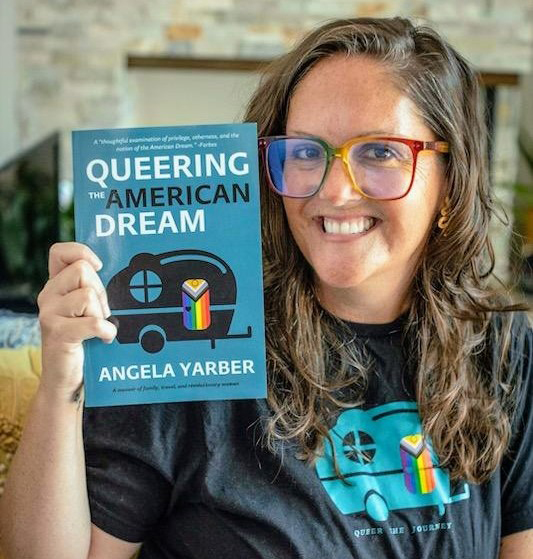
Why I Wrote Queering the American Dream by Rev. Dr. Angela Yarber

Like most authors, I had grand plans for Queering the American Dream. Heeding the wisdom of the venerable black, queer writer, Pauli Murray—“One person plus one typewriter constitutes a movement”—I committed, not simply to writing and publishing a book, but creating a movement. With my modern-day typewriter (laptop) in hand, I dreamed of readers throwing off the shackles of an ill-suited dream, galvanizing retreats, coaching to help other marginalized creatives queer their own iterations of the so-called American dream.

I tried learning about book marketing and pitching companion essays and creating a launch team and all those things small-time authors without expensive publicists on retainer do. I tried so hard.

Continue reading “Why I Wrote Queering the American Dream by Rev. Dr. Angela Yarber”

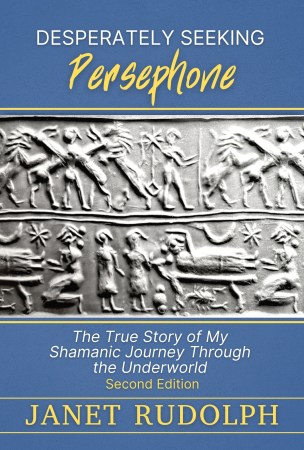
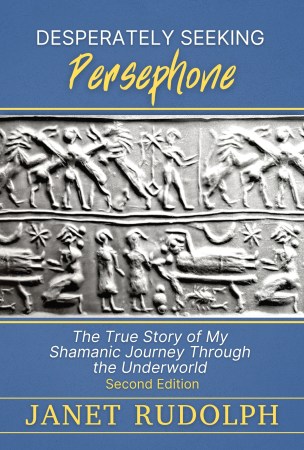
Desperately Seeking Persephone by Janet Rudolph, Book Review by Carolyn Lee Boyd, Part Two

In Part One of this review (posted yesterday), we learned how Janet descended into the Underworld, like Inanna and Persephone, after child abuse and rape, and how she began a decades-long journey back to our own world, healed and empowered. To learn more about her return from the Underworld and how she became the shaman and author she is today, I invite you to join the journey in Part Two as we continue to explore “Signposts” that marked her ascent.

Signpost #3. Be aware, be free, be focused, be here, be loved, be strong, be healed.

Janet’s teachers at the Mystery School had brought together shamanic traditions from throughout then world. Among them was Huna, or Hawaiian Adventure Shamanism as practiced by Serge Kahili King. A summary of Huna is shown in a mantra: Be aware, be free, be focused, be here, be loved, be strong, be healed (114) and “focus on the gifts that come to us through adversity” (116). 

Continue reading “Desperately Seeking Persephone by Janet Rudolph, Book Review by Carolyn Lee Boyd, Part Two”

Desperately Seeking Persephone by Janet Rudolph, Book Review by Carolyn Lee Boyd, Part One

The myths of the descents of the Sumerian Inanna and the Greek Persephone to the underworld have fascinated and inspired women for millennia with their violence and betrayal, leaving behind all you love and that hold you up, and facing your deepest fears, even death. We recognize our own traumas in their struggles and seek guidance as to how to navigate our ascents back to wholeness and well being in their stories.

After her own experience of childhood abuse and stranger rape as a young woman, Janet Rudolph, one of FAR’s co-weavers, also pored over the myths in hopes of finding a helpful account of their journey home. “Once I had tumbled metaphorically, literally and mythically into the thorny quagmire of the underworld, it was devilishly hard to escape. I felt lost. I needed a guide, a role model to find my path outward”(xii). The problem is, Janet says, “The stories of their return are glossed over. There is no detailed story called From the Great Below Back to the Great Above” (15). Until now in Janet’s recently re-published book, Desperately Seeking Persephone.

Continue reading “Desperately Seeking Persephone by Janet Rudolph, Book Review by Carolyn Lee Boyd, Part One”

Mayflower Crowning by Sara Wright

I sit under the snowy crabapple as fragile flower petals drift one by one to the ground, covering my hair in white butterflies, soon to become the first mulch of the year. Our Lady is always nourishing new life…

 The hum of a thousand bees is deafening – bumblebees – glorious golden rotund bodies swarming from one tree to another with so many relatives – everyone seeking sweet nectar.

The scent is beyond description – intoxicating – a poignant perfume lasting only a few days and keeping me rooted to my bench every single morning to soak in the sweetness under impossible heat. Heavily polluted air is thick and metallic but here I inhale a plethora of fragrances so intense they drown out poisoned air.

Continue reading “Mayflower Crowning by Sara Wright”

Legacy of Carol P. Christ: “Am I Crazy?” Loving Laura Dern

This was originally posted on April 1, 2013

“Am I crazy?”

“No, just full of hope. You got more hope than most people do. It’s a beautiful thing to have a little hope for the world, you know.”

This question was posed by Amy Jellicoe, played by Laura Dern, at the end of the HBO television series Enlightened.  Unemployed, single, and in debt after she was fired for “whistle-blowing” on the corrupt activities of the corporation where she worked, Amy wondered if she had done the right thing.  The answer of her ex-husband Levi  brought tears to my eyes.

In many ways, I am Amy.

Continue reading “Legacy of Carol P. Christ: “Am I Crazy?” Loving Laura Dern”

From the Archives: Book review: Merlin Stone Remembered: Her Life and Works by Barbara Ardinger

This was originally posted on June 7, 2015

When Merlin Stone’s book, When God Was a Woman, was published in 1976, it was a lightning bolt of feminist scholarship that told the world that before there was a Judeo-Christian god there were goddesses, and before there were goddesses, there was the Goddess. If you’re reading this review and you have not read When God Was a Woman, buy the book. Right now. As you sink into Stone’s book, try to imagine what it was like before we knew about Isis or Inanna or Astarte, before we knew that the tree in the Garden of Eden was probably a sacred fig and that the serpent was a symbol or aspect of the Goddess and that people (mostly women) who ate figs or worked with serpents were honored priestesses and prophets. Just imagine! The work of the second wave feminists added to the work of scholars like Merlin Stone and Marija Gimbutas, but it didn’t begin until the second half of the 20th century. Before that? All there was, was God the Father, maker of heaven and earth. Yes, Merlin Stone hurled lightning bolts into our hearts and minds and bookshelves.

Continue reading “From the Archives: Book review: Merlin Stone Remembered: Her Life and Works by Barbara Ardinger”

Processing my experiences of patriarchy has changed my faith for the better by Liz Cooledge Jenkins

As my first book, Nice Churchy Patriarchy, approaches six months of being out there in the world, I find myself reflecting on the journey. The process of unpacking all the ways patriarchy shows up in faith communities—and, in particular, the ways patriarchy has impacted my experience of church—has been a long one, and a winding one. It is no easy path.

How could a person travel this road and have their faith remain unscathed? Or perhaps a better question is this: How could one’s faith remain unchanged? And is this even a desirable goal?

After spending eleven years in “complementarian” (that is, explicitly patriarchal) evangelical church spaces and then two years in evangelical spaces that were egalitarian in theory but still had a long way to go to reach full gender equity—and, especially, after spending four years intentionally reflecting on these experiences and writing about them—I certainly see questions about gender roles and women in leadership differently. But it’s not only that. I see everything differently.

Continue reading “Processing my experiences of patriarchy has changed my faith for the better by Liz Cooledge Jenkins”

A Feminist Reading of Saint Wilgefortis by Sofia Meskhidze

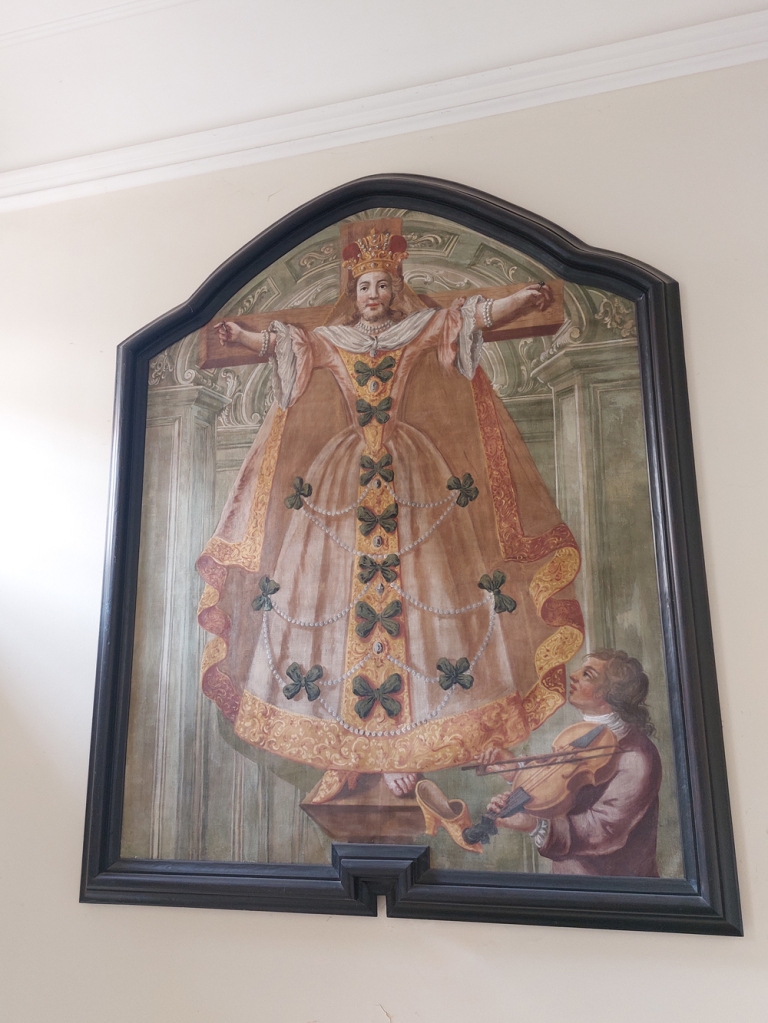
The legend of Saint Wilgefortis tells the story of a Christian woman who was martyred for her faith. While there are numerous women martyrs in the Christian tradition, Wilgefortis is distinguished by her gender non-conformity. She is often referred to as female Christ[1] and is almost always depicted with a beard, in a dress, and nailed to a cross. According to the legend, she was a Christian princess from Portugal whose father had promised her to the pagan king of Sicily. Wilgefortis, refusing to marry, prayed all night for God to make her unmarriable and as a result miraculously grew a beard, causing her father’s rage, after which he had her tortured and crucified[2]. The origin of the legend is thought to be the Volto Santo sculpture in Lucca, Italy, one of the most well-known examples of a clothed crucifix[3]. Misinterpretation or not, it is without doubt that the legend spread wide and Wilgefortis was in medieval times venerated almost as much as the Virgin Mary. In fact, this popularity displeased the Catholic Church, who actively discouraged it and even removed Wilgefortis from the official list of saints in 1969[4]. Here I argue for the importance of Wilgefortis to feminist theology, feminist and queer Christians, and her potential as a non-binary/gender non-conforming icon.

Continue reading “A Feminist Reading of Saint Wilgefortis by Sofia Meskhidze”

Rhiannon as Midlife Queen Mother by Kelle BanDea

We tend to think of Rhiannon as the fairy maiden on the white horse who entices Pwyll, the King and her future husband, into the Otherworld. Or she is the young mother who is unfairly blamed for the death of her own child until he is restored to her. This is Rhiannon’s story as it is most well-known, and she has become a beloved figure due to it. The image of the beautiful fairy woman on the white horse has become equated, to modern neopagan folks and Goddess-women, with the ancient Celtic and Indo-European horse goddesses. Of all the women in the medieval Welsh lore that we know as the four story ‘branches’ of the Mabinogi, Rhiannon is perhaps the most beloved.

But this is only half of the story.

Continue reading “Rhiannon as Midlife Queen Mother by Kelle BanDea”