The Cuyamungue Institute, part 1 by Janet Maika’i Rudolph

Director Paul Robear in a pose based on this artifact from Chichen Itza

The Cuyamungue Institute was founded in 1978, in Santa Fe New Mexico by Dr. Felicitas Goodman. It is based on work that Dr. Goodman was doing with ritual trance poses as a means to encourage ecstatic states, gain knowledge, and have otherworldly communications and experiences.  The poses Dr. Goodman studied are based on early statues and images found in various cultures. She became aware that these poses of ancient sculptures and drawings were often ritual instructions that people could replicate. By holding these positions in a ritualist manner, she found that people had these common or related experiences which she characterized loosely as healing, divination, metamorphosis, and/or spirit journeys.  This 2-part blogpost is about her journey and what she discovered. It is based on an interview I did with Laura Lee, who along with her husband Paul, are directors of the Cuyamungue Institute.

Continue reading “The Cuyamungue Institute, part 1 by Janet Maika’i Rudolph”

Changes, part 2 by Sara Wright

part 1 was posted yesterday

Returning home, I peered around my house; most of my wildflowers are seeding up – only a few columbine, celandine, wild bleeding heart and a riot of Canada anemones are shining their white faces upturned to the sky. What used to be my cultivated garden has gone wild, and I have let my vegetable garden go. As more and more trees shade the house, (A blessing during these hot dry summers) I feel a tremendous sense of contentment. I am doing research on wild plants for some folks, spending time in the woods when I can. Being surrounded by so much diversity offers me hope that even now some wild places will survive – at least for now.

Because one of my beloved dogs is in heart failure, Lucy’s health is my first priority, so we walk as early as possible to avoid Lucy’s coughing and shortness of breath. Later, I walk by myself, grateful that I have this little patch of land to cover a few miles without having to leave the property. It helps that I rise so early. When I can, I head for the forests I love, but the woods and my writing life have had to take a backseat to Lucy’s illness. Since my dogs have helped me survive my life – like nature has, they will always come first.

Continue reading “Changes, part 2 by Sara Wright”

Changes, part 1 by Sara Wright

A Reflection

Two days ago, I climbed a nearby mountain on a quest to check on some wildflowers that have been disappearing. I noted the leaves in the hardwood forest were crackling under my feet and the two small brooks were dry. When I reached my destination, I felt discouraged. Not again. A whole series of trees had been cut to open a view that made no sense. Across the horizon some trees, but no mountains or water ‘views’ although I was standing on a mountain ledge (and just how many mountain views do we need here in the mountains anyway)? After perusing the area with keen attention, I was convinced. The wildflower I was seeking had been burned to a crisp under a solstice sun after the protective trees were cut, and I had to accept that this jewel was gone for good.  Worst of all this travesty occurred in what was supposed to be a protected “recreational community forest.” (translation: human centered – nature is just being used).

Continue reading “Changes, part 1 by Sara Wright”

Legacy of Carol P. Christ: Remembering Audre Lorde and “The Uses Of The Erotic”

This was originally posted on March 18, 2013

Moderator’s Note: Carol’s original essay had links to the essay which are no longer active. The essay can be found in Sister Outsider.

I was  given a copy of Audre Lorde’s essay “The Uses of the Erotic” in my first year of teaching at San Jose State by a young white lesbian M.A. student named Terry.  It was 1978.  I was in my early 30s.  This essay came into my life and the lives of my students, friends, and colleagues at “the right time.”  It became a kind of “sacred text” that authorized us to continue to explore the feelings of our bodies and to take them seriously.

The second wave of the women’s movement was about to enter its second decade. We had already been through years of consciousness raising groups.  There we learned to “hear each other to speech” about feelings we had learned to suppress because we had been told they were not acceptable for us as women to have or to express.  Those early days of the women’s movement were one big “coming out” movement.  We were bringing our feelings and ourselves out of the closet.

Continue reading “Legacy of Carol P. Christ: Remembering Audre Lorde and “The Uses Of The Erotic””

From the Archives: The Tree of Life and the Forest of Friendship: Circle Dance to Restore our Hope by Laura Shannon

This was originally posted on May 6, 2017

Tree and Goddess motifs on the ‘Wall of the Foremothers’ (Ahninnenwand), Bodensee, Germany, 4th Millenium BCE

Yes, times are tough. But a better understanding of our interconnectedness can help us move beyond the cynicism, frustration, and despair we may be feeling in the modern world. A closer look at trees, and at women’s traditional circle dances, can offer valuable lessons about friendship, community, and the interconnectedness of all life.

Continue reading “From the Archives: The Tree of Life and the Forest of Friendship: Circle Dance to Restore our Hope by Laura Shannon”

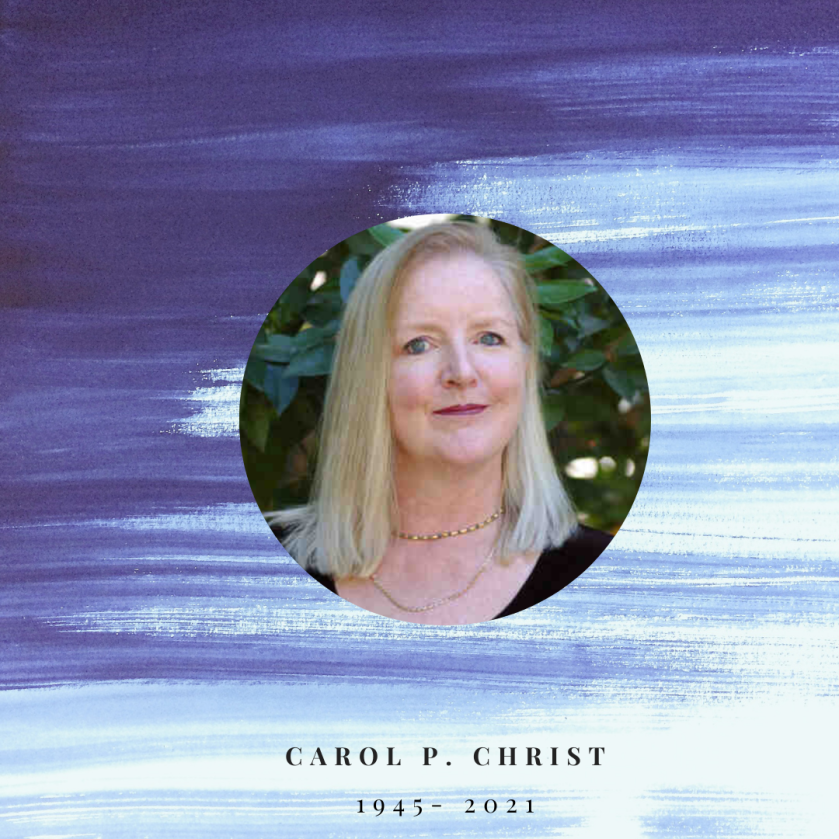
Remembering Carol P. Christ by Joyce Zonana

July 14, 2023

It’s been two years since Carol P. Christ suddenly “disappeared,” as the French  say when they speak of someone who has died. And indeed, that is how I experience her passing,–an abrupt disappearance of someone who loomed so large in my life. I think of her daily, and  this morning morning,  not consciously aware that today is her Jahrzeit, I turned to  my husband while we sat in a hospital waiting room, and said, “I miss Carol so much.”

Continue reading “Remembering Carol P. Christ by Joyce Zonana”

From the Archives: Artemis As Artemisia: Ancient Female Spirituality & Modern Medicine by Stuart Dean

This was originally posted on November 29, 2015

Detail of Artemis from a 5th century BCE Attic Vase

The 2015 Nobel Prize for Medicine was awarded in part to a Chinese woman (Tu) for her identification and isolation to treat malaria of a chemical known as Artemisinin.  The name of that chemical derives from the fact that it is found in varying amounts in the ‘family’ (technically, genus) of plants known as Artemisia.  The name of that family derives from its association with the goddess Artemis.

Because Tu’s work began in China in the 1960s it is understandable that even if she knew this about Artemisia (a term I use to refer to any one plant or all of the plants of that family) it would not have been a ‘careerbuilder’ for her to point it out to those for whom she was working.  It was bad enough that she was a woman.  At that place and time, however, if she had said or done something that could be associated with Western culture her name might not even be known today.


Continue reading “From the Archives: Artemis As Artemisia: Ancient Female Spirituality & Modern Medicine by Stuart Dean”

The Importance of Finding a Local Sacred Circle or Event by Caryn MacGrandle

What not many know that the founder Caryn MacGrandle (aka Karen Lee Moon), who is a soul-sister to me, has devoted her life to the building, developing and promoting of this app, in service to the Rising Feminine … “ Jonita D’Souza, Rising Feminine

I came back this weekend from my land in North Carolina to two email messages about women finding divinely feminine events through the divine feminine app. I cannot even begin to tell you how happy this makes me. After nine years of nurturing, developing, daily work and pouring my personal funds into the app, it is truly working.

Continue reading “The Importance of Finding a Local Sacred Circle or Event by Caryn MacGrandle”

A GOOD HEART by Esther Nelson

In spite of organizations such as “Black Lives Matter” and the three or four waves of feminism over the past century, both racism and misogyny remain stubbornly alive.  We’ve made positive strides on both fronts, yet much remains to be done.  Curiously enough, I’ve noticed more sensitivity in our current society regarding racism than misogyny.  People claiming to be “woke” seem more inclined to be woke to the manifestations of racism—not so much to misogyny.

According to Merriam-Webster, the term woke is about being “aware of and actively attentive to important societal facts and issues (especially issues of racial and social justice).”  Merriam-Webster’s second definition of the term is “politically liberal (as in matters of racial and social justice) especially in a way that is considered unreasonable or extreme.” 

Continue reading “A GOOD HEART by Esther Nelson”

Firefly Night by Sara Wright

Warm nights
stir
sweet
moist air
waft
through
open windows
golden lights
begin to
blink

Continue reading “Firefly Night by Sara Wright”