My cat is a hunter. You can see it in her eyes. She plays fetch considerably better than the dog and seems to enjoy playing with her “kill” – throwing it up in the air, batting it around and pouncing on it – long after it is “dead.” If we forget to clean up her toys before bedtime, her prowess invades the night. For such a tiny cat, she can meow at almost deafening volumes.
Yesterday I sat in my car, buckled and ready to reverse just when I looked out my side window to see the people getting into their car next to mine.
There was a very elderly lady being seated in the back ever so gingerly. Her caretaker (that is what she appeared to be) carefully buckled her in, and then offered her a sip of ice water. Meanwhile I was in mid reverse, my engine running, on the go, and yet the ladies didn’t notice anything around them.
Simultaneously the elderly lady’s wheelchair didn’t have its brakes on and rolled into my rear side door. Instantly, I thought OK a little rude, these people aren’t really being considerate of the tight space we are sharing, should I roll down my window and say with as much patience as I can “excuse me”? Or should I let it go? I let it go. Those immediate feelings of impatience and annoyance washed over me, because I made myself stop and observe the situation, and the details of these ladies. Continue reading “Consideration by Valentina Khan”
I was talking to an old friend the other day, and when I asked how he was, he said, “I’m getting by.” “Getting by? Not tearing it up, not taking ‘em down, and taking names?” I joked. “No,” he replied too dryly, “not at my age.”
“Well, how old are you now?” I inquired playfully. “Eighty-three,” he said. “Oh,” I paused. “And, I tell you, Nat,” he continued, “I don’t know about these last twenty years. I just don’t know what happened to me. Never imagined my life would turn out like this…” he spoke, trailing off.
His talk prompted me to wonder about the girl I once was, the woman I used to be, the mother I had imagined in myself at the outset, the scholar I prepared, the indefatigable friend I was to my peers as a teenager, the filial duty I felt in my youth, the honor I ascribed to my vocation as an educator, the family I tried to create. I have changed too, I realized. These last twenty years have been markedly transformational for me as well. As I considered, I saw in all of the things I tried to do how my spirit and my faith walked alongside my life unfolding as companion and guide and interlocutor.
At each step along the way, my faith both informed and framed the meaning of my choices and my disposition toward the outcomes of my efforts. For a long time, there was a harmony and an alignment between my meaning, my disposition, and my experience of living purposefully. But then, sure as rain, the wheel turned, and I began to lose clarity on that alignment. The idealism I had brought to each of my roles and endeavors was tested and tried as a matter of course. But, in some instances, the trial was egregious.
I concluded that some disappointments run so deep they change who we are. Some wounds are structural enough that they scar the tissue permanently and alter the curvature of our spines. Some blows are so devastating that our speech transforms and our thinking must be rewired to survive. Whether they are inflicted by the self or by others, whether by accident or intent or illness, injury has a common thread – it calls the Spirit to awaken and challenges it with the question: “How do you feel about me now?” Continue reading “How do you feel about me now? by Natalie Weaver”
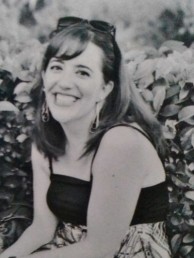
Society has created this vortex of fear surrounding women aging. Yet, as I turn 30, I am only feeling awe. Awe over everything I accomplished in my twenties and awe in all the things yet to be realized in my thirties. The interesting thing is how other people are experiencing me turning thirty. Some are reminiscent of their twenties or how their experienced their thirties. Others start to bring up certain things which are apparently still lacking in my life. The biggest ones are a husband and children. They look at my eve of thirty-hood as the clock ticking away on me finding love and most definitely on my biological clock.
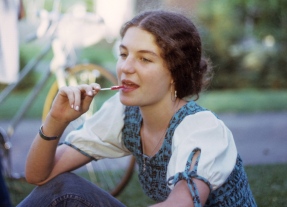
As you read this, dear FAR community, it will be my 59th birthday. I was born February 27, 1956. I have one year to go before I turn 60. For this last year I desperately wanted to dye my hair blue, purple and green and let the roots go gray.
However in a long conversation with my hair stylist she helped me realize that I have spent so many years dying my hair various shades of brown, dark brown and burgundy that if I bleach the hair out to white (so that I can then go blue, purple and green) the hair will fry and fall out—ah, Ok. I will live with my brown, black and burgundy hair until I am ready to go completely gray and watch it grow out (my hairdresser tells me it will take three years). Or I will decide to live with the choice I made to dye my hair since I was 35 or so and let it be and keep dying it – and have that be the choice I made. Continue reading “On Not Being A Big Hollywood Film Director, and Other Life Choices by Marie Cartier”
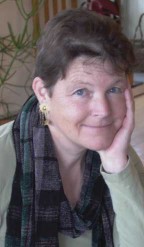
Before Olga Eunice Quintero Smyth died on December 4, 2014 at age 101 and 10 months, I was tempted to believe she was immortal, literally. I knew Olga for forty-five years (from age 16 to 61). For thirty-five of those years she was my mother-in-law. Our history began when I was kicked out of high school and went to work at her free-wheeling school, her utter lack of any interest in reforming me a blast of fresh air. It ended with me sitting beside her as she was dying, softly singing “Row, Row, Row Your Boat.”
Olga was named for a Russian princess her mother encountered when she was a babe in her arms en route to Trinidad from her native Venezuela. Olga took for granted her descent from Incan royalty as well. Her mother moved the family to New York when she was eleven. A few years later, she won a scholarship to Mount Holyoke College. She married a classmate’s brother, Julian Smyth, great grandson to Nathaniel Hawthorne. If that weren’t enough, Olga claimed for Julian’s line direct descent from the first century Celtic Queen Boadicea. As long as she could speak, she spun tales. “Where in Africa was she born?” one of her nurses asked me. “What kind of a dancer was she?” Continue reading “My Immortal Mother-in-Law by Elizabeth Cunningham”
First of all a Crone is a woman. She has lived most of her life already and has accumulated many life experiences and therefore, can relate to those younger than her with greater understanding. She has acquired the wisdom associated with having had those life experiences. She has reached a place in her life when she may be slowing down. She may have retired from her career. She may want to devote more time to herself, serving more as an advisor rather than as the doer. We can read the poem, Warning by Jenny Joseph to get an idea, or watch her read it here or below…
“When I am an old woman I shall wear purple
With a red hat which doesn’t go, and doesn’t suit me.
And I shall spend my pension on brandy and summer gloves
And satin sandals, and say we’ve no money for butter.
I shall sit down on the pavement when I’m tired
And gobble up samples in shops and press alarm bells
And run my stick along the public railings
And make up for the sobriety of my youth.
I shall go out in my slippers in the rain
And pick flowers in other people’s gardens
And learn to spit.
You can wear terrible shirts and grow more fat
And eat three pounds of sausages at a go
Or only bread and pickle for a week
And hoard pens and pencils and beermats and things in boxes.
But now we must have clothes that keep us dry
And pay our rent and not swear in the street
And set a good example for the children.
We must have friends to dinner and read the papers.
But maybe I ought to practice a little now?
So people who know me are not too shocked and surprised
When suddenly I am old, and start to wear purple.”
My mother-in-law, quoting her mother, has often said, “a woman who tells her age will tell you anything.” I think the “anything” here she is referring to is sexual disclosure. She may be correct because I am not above or below talking about that, but that is not what I am talking about today. Today, I am talking about age, since I am on the cusp of my fortieth birthday.
Still two months out, I am surprised that this birthday registers for me as much as it does. The experience has caused me to plumb my mind in search for vanities that I had not previously noticed. In the depths as on the surface, I have observed, for example, subtle changes in my skin and muscle tone. I will catch a glimpse of my profile and see my mother or my sister, occasionally even one of my grandmothers. My feet look a little, well, bonier somehow. I had to buy glasses recently. However, when I go spelunking, it is not really these things that trouble me. I actually like myself more as an adult than I did as a child or very young woman. I developed a wonderful sense of my body’s strength when I bore and nursed children as well as a compassion for its limitations when I had surgery. I seem more suited to my own flesh these days, and sometimes I actually feel sorry for my younger self who did not know how to appreciate herself. In twilight moments, I occasionally drift backward mentally to a previous iteration just to offer her a little affirmation. It is not really the getting older that I find myself snagging upon nor (and I think I am being honest here) the loss of youth per se. What is it then? Continue reading “Mid-Life Genesis by Natalie Weaver”
“Spring passes and one remembers one’s innocence.
Summer passes and one remembers one’s exuberance.
Autumn passes and one remembers one’s reverence.
Winter passes and one remembers one’s perseverance.”
― Yoko Ono
If you are reading this on February 28, 2014, then you are reading it on the day after my birthday—I am 58 years old now. I wrote previously about aging and feminism and reclaiming our bodies—my fears of wrinkles—well, not fear…my surprising distaste/revulsion of them, and then yes, fear. My ability to maintain peace inside my aging body came about because I have a life-long history of feminism and I practice yoga. I explored all of this in one of my first blog posts for this site, “If You’re Lucky, You Get Old.” That was two years ago.
I am happy to say that I am no longer scared by my face—by its changes. I believe that “if we are lucky, we get old.” Now—I don’t want to just “get old,” I want to get old and be healthy—and by healthy I mean I want to keep my mind.
This past month I went back to the East Coast to attend the funeral of my mother. She died of Alzheimer’s. Yes. Feminism and Alzheimer’s. Women get Alzheimer’s more than men—women constitute 2/3 of those who get the disease. I know many friends who are afraid now—their mothers had it—are we going to get it? There is a lot of research on Alzheimer’s and little information. There is however the information that women get it more often than men. Some of the things that can prevent Alzheimer’s are physical exercise, healthy diet and social activity. Are these harder for women to attain than men? Continue reading “Birthdays and Aging and Feminism and Religion by Marie Cartier”
Lady Death is knocking on my dear old Poppy’s door. His health has been getting progressively worse with each day and it is a sad and trying time for all of the family. Naturally, with death, comes reflection, unresolved issues are stirred up and we are inevitably confronted with our own mortality. I have been reflecting and reminiscing about times spent with my Pop as a child. So many wonderful memories are warmly held in my heart.
Visiting Pop and Nanna’s house as a child was always very exciting, namely because of all the lollies Pop had hidden in his cupboards – XXXX mints and licorice all sorts his favourites. I remember him Irish jigging in his blue tartan dressing gown around the campfire, and the times he would stick out his false teeth, roar and scare us silly. Slim Dusty, an Australian country music icon was one of his favourite singers, he would play his records on the old player as loud as can be, I knew the words to “I’d love to have a beer with Duncan” back to front. Every weekend the horse races would blare out of his little radio in the kitchen, I would listen along and try to pick a winner for him.
My sister and I would stay at Nanna and Pops house most school holidays and we would both wait at the front gate for him to come home from work, we were always so happy to see him coming down the path, covered in concrete and dirt, his skin so tanned from being in the sun all day. He always greeted us with a big smile and a pat on the head. We would have dinner early and no matter what was on the menu, much to Nanna’s disappointment, he would cover his food in a river of ‘black horse,’ slang for Worceteshire sauce. We would then watch the goings on in the neighbourhood from the back verandah; Pop could, and still can, tell you what everyone else was up to! He was, and still is a cheeky old thing, as stubborn as an ox, and I love him so very much.
Death of one of my family members is not something I have any experience with. Knowing that the time will soon be nigh however, has me naturally thinking about the cycle of life and death. As an avid gardener I witness this cycle daily. I plant seeds, watch them grow, set seed, decay then watch their progeny pop up all over the place. I find cocoons where caterpillars will eventually emerge as beautiful butterflies, only to flutter for two days and pass on. On my early morning bug hunts I find all sorts of larvae waiting to hatch, the strongest survivors grow; have a grand feast on my veggies, only to become a meal or compost themselves. Leaves and branches fall to the ground, animals perish and decay, feeding the earth and maintaining the fertility of the soil in the process.
This Life/Death/Life cycle is no new concept. Since time beginning human life was directly linked to the cycle of the seasons and the cycle of life and death. Humans were inextricably linked and connected with their natural environments. They imitated animals and worshipped the sun, moon, trees, rivers and mountains, elaborate rituals and ceremonies were created concerning these cycles and transitions. It was understood by careful observation of nature, that death was a natural part of the life cycle.
But why, in much of our Western culture is there so much fear and denial over death when religions and philosophies the world over have endeavoured to offer solace to humans in the face of our mortality by promising eternal life? Dr. Estes says that, “In much of Western culture, the original character of the death nature has been covered over by various dogmas and doctrines until it is split off from its other half, Life”. This is not how it is, for “death is always in the process of incubating new life”. This is life’s greatest paradox; even in our state of living, we are in fact dying and it is this dance between the two and the nature of the Life/Death/Life cycle that has been contaminated by a fear of death. This splitting in two of life and death, I feel, is largely a result of our disconnection from nurture and nature. This disconnection has impacted on every aspect of society, our ability to flow with these cycles is often weak and as a result impacts all kinds of relationships and structures, particularly that of family and community.
I am not sure what my pop believes about the nature of death as he is not religious, nor does he have any faith in an after life. He doesn’t even want a funeral of any kind. I do remember him though, saying to me as a child rather emphatically, “when you’re dead, you’re dead: food for the worms!” This has stayed with me for life and in it’s simplicity shows an understanding of the cycle. He was an avid gardener too, growing plenty of vegies for the household, and if I look deeper into his comment, which he made on more than one occasion, he was really saying that we become compost, teeming with new life, we feed the earth (the worms) and so the cycle continues.
I am certain though, that Pop fears death, and I know that he fears leaving the living, and while we can talk about, have faith in, and come to accept the Life/Death/Life cycle, it doesn’t mean that it is ever going to be easy. Surrendering to death, not just the physical death of our bodies, but any kind of death, I think, is life’s greatest lesson.
Lady Death is waiting for pop to answer the door, she has come to embrace him and comfort him in his pain and ease his transition. He is not quite ready, but the time will come soon and I feel strong in my knowing that despite how much suffering can accompany the dying, this is the way it is meant to be. From his death new life will emerge.
He will forever live in my heart and memories.
Returning, by Jassy Watson
Jassy Watson, who lives on the sub-tropical coast of Queensland Australia, is a mother of four, a passionate organic gardener, an artist, teacher of the Colour of Woman Method, and a student of ancient history and religion at Macquarie University, Sydney. She runs a small business Goddesses Garden and Studio to keep women’s sacred circles, art, music and gardening practices alive. Jassy teaches regular painting workshops based around themes exploring the feminine.


 My cat is a hunter. You can see it in her eyes. She plays fetch considerably better than the dog and seems to enjoy playing with her “kill” – throwing it up in the air, batting it around and pouncing on it – long after it is “dead.” If we forget to clean up her toys before bedtime, her prowess invades the night. For such a tiny cat, she can meow at almost deafening volumes.
 Yesterday I sat in my car, buckled and ready to reverse just when I looked out my side window to see the people getting into their car next to mine.
 Society has created this vortex of fear surrounding women aging. Yet, as I turn 30, I am only feeling awe. Awe over everything I accomplished in my twenties and awe in all the things yet to be realized in my thirties. The interesting thing is how other people are experiencing me turning thirty. Some are reminiscent of their twenties or how their experienced their thirties. Others start to bring up certain things which are apparently still lacking in my life. The biggest ones are a husband and children. They look at my eve of thirty-hood as the clock ticking away on me finding love and most definitely on my biological clock.
 As you read this, dear FAR community, it will be my 59th birthday. I was born February 27, 1956. I have one year to go before I turn 60. For this last year I desperately wanted to dye my hair blue, purple and green and let the roots go gray.
 live with my brown, black and burgundy hair until I am ready to go completely gray and watch it grow out (my hairdresser tells me it will take three years). Or I will decide to live with the choice I made to dye my hair since I was 35 or so and let it be and keep dying it – and have that be the choice I made.
  Before Olga Eunice Quintero Smyth died on December 4, 2014 at age 101 and 10 months, I was tempted to believe she was immortal, literally. I knew Olga for forty-five years (from age 16 to 61). For thirty-five of those years she was my mother-in-law. Our history began when I was kicked out of high school and went to work at her free-wheeling school, her utter lack of any interest in reforming me a blast of fresh air. It ended with me sitting beside her as she was dying, softly singing “Row, Row, Row Your Boat.”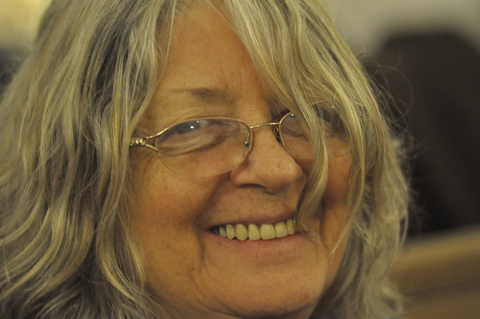



 Feminism and Religion