Female Wisdom in Eden: A Guide for Faith-Formed Feminists By Susie Austin

If you were taught that “men lead” is God’s design, this is your permission slip to ask a harder question: what if that teaching was never Eden’s plan — but a wound the world mistook for a rule?

Many of us grew up inside churches that loved us, baptized us, and gave us language for hope—while also wrapping womanhood in shrinking instructions: be agreeable, be modest, be quiet, be helpful. We learned to make ourselves small so that men could feel large. We learned to translate our leadership as “support,” our wisdom as “intuition,” and our authority as “being difficult.” We learned to carry the room’s temperature without ever touching the thermostat.

Feminism — and the women who lived it before it had a name — has always asked religion to remember itself. Not to abandon Scripture or tradition, but to recover what was true before fear called itself theology. Before we rewrite our lives, let’s reread the beginning.

A forgotten reading of the oldest story

Look again at Genesis: the woman sees that the fruit is “desirable to make one wise” (Gen. 3:6). In Scripture’s own poetry, Wisdom is feminine—personified as Lady Wisdom (Hebrew: Chokma) calling us to life (Prov. 8:1-4, 22-31). And Genesis 3:6 ends with four words we usually skip: “who was with her.” Translation: she leads; he lingers.

Continue reading “Female Wisdom in Eden: A Guide for Faith-Formed Feminists By Susie Austin”

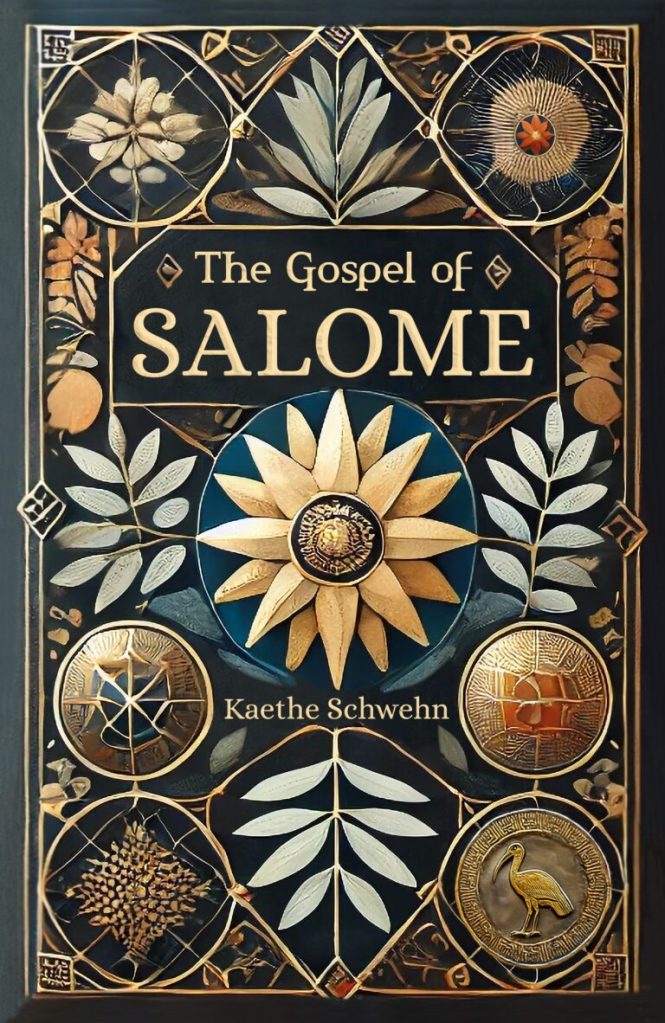
The Gospel of Salome by Kaethe Schwehn, Book Review by Michelle Bodle

What would happen if you were a disciple of Jesus and you had an encounter with someone who told you a different narrative than what you had heard in the past? How would you react? What would you preserve? How would you reconcile the stories you have been told and have told others as an apostle with what someone is now proclaiming?

            The Gospel of Salome is a work of Biblical fiction focused on Salome, a character who we hear of being present at the crucifixion and the empty tomb in the Gospel of Mark. Some scholars have connected her with “the mother of Zebedee’s children” in the Gospel of Matthew or “his mother’s sister” (i.e. Mary’s sister) in the Gospel of John. Schwehn takes a different approach, portraying Salome as a woman who was sought out for her skills in medicine, finds herself in the presence of John Mark, one of Jesus’s disciples who has come to Alexandria.

            Going back and forth between speaking to John Mark in the present and living in her memories of the past, Salome tells the apostle that she is the true mother of Jesus. However, there is another factor to consider in her proclamation – Salome’s dementia, which is threatening to steal her memories. Memories about Salome’s agreements with Mary about Jesus’s desire to learn how to heal or Mary asking Salome to not be present in Jesus’s life. Memories of being at the cross and the empty tomb.

Continue reading “The Gospel of Salome by Kaethe Schwehn, Book Review by Michelle Bodle”

Did We Ask for a King? by Esther Nelson

Northrop Frye (1912-1991), a Canadian literary critic, is probably best known for his book THE GREAT CODE: THE BIBLE AND LITERATURE (1983). In it, he demonstrates how the Bible is foundational for our understanding of Western literature, a body of work replete with Biblical allusions. 

Today, most of us are not familiar enough with the Bible to appreciate where many literary themes take root. We fail to see how its stories—gathered over centuries—relate to us. Not only does Western literature mine from Biblical text, our lives as we experience them mirror much of Biblical story and narrative.   

I was raised on the Protestant Bible. To this day, I experience the world through Biblical story. There is nothing sacrosanct (to me) about the familiar text. The Bible is not unique. 

Continue reading “Did We Ask for a King? by Esther Nelson”

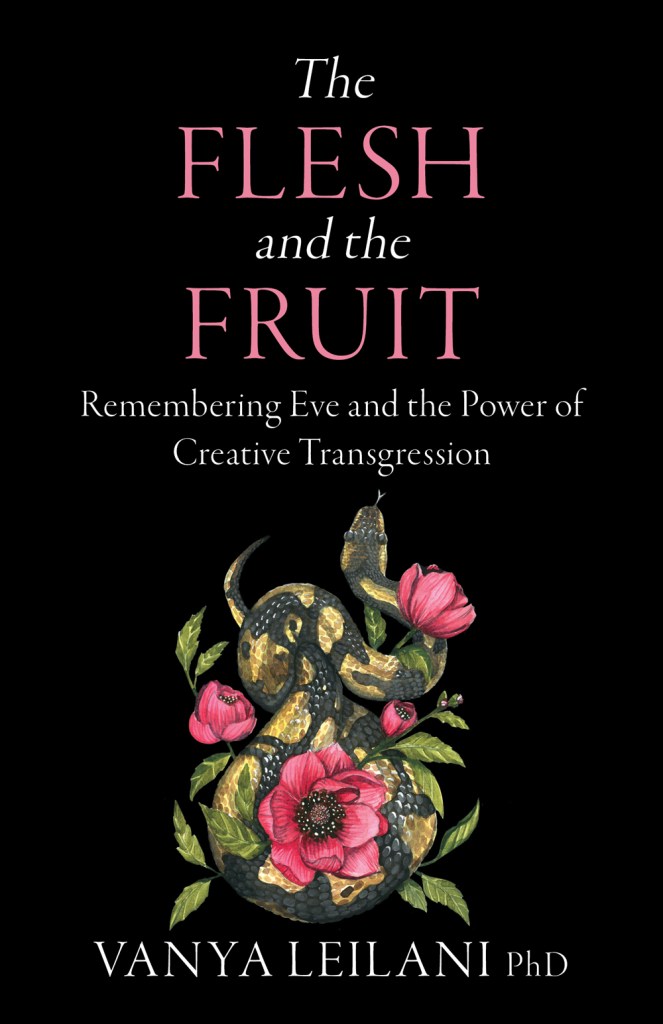
The Flesh and the Fruit by Vanya Leilani, PhD: Book Review by Janet Maika’i Rudolph

Subtitle: Remembering Eve and the Power of Creative Transgression

I have learned that every good story of spirit has many layers of meaning and pathways of understanding. Dr Leilani has found particularly relevant and even beautiful aspects of the biblical story of Eve. She uses Eve’s actions as a template of her own spiritual journey. Her pathway begins in obedience (listening to the voice of authority), travels through transgressive acts (eating of the fruit), and finally results in a self-knowing that had not been possible at the beginning of her journey.  In this book we follow along on her quest to learn about herself with Eve as her inspiration.

This is a luscious book. Vanya Leilani’s insights are not only profound but are written with a poetic sensibility. I found myself speaking some of her passages out loud because the vibration of her words are powerful and feel so sensuous on the tongue. I wanted to take them into my body, as well as read them on the page.

Continue reading “The Flesh and the Fruit by Vanya Leilani, PhD: Book Review by Janet Maika’i Rudolph”

From the Archives: I Sing Asherah Exalted! by Janet Maika’i Rudolph

This was originally posted Dec. 16th, 2021

With this season of the festivals of light upon us (Hanukkah, Christmas, Solstice, Kwanzaa), I wanted to focus on the more joyful aspects of our lives. For that, I have been diving into passages about joy and singing in the bible.

Sometimes when I write these posts, they take me in directions I never thought to go. This post is one of them. The surprise direction I found is in the Psalm below:

Sing unto him, sing psalms unto him: talk ye of all his wondrous works.
Glory ye in his holy name: let the heart of them rejoice that seek the LORD.
Psalm 105:2-3 KJV

Continue reading “From the Archives: I Sing Asherah Exalted! by Janet Maika’i Rudolph”

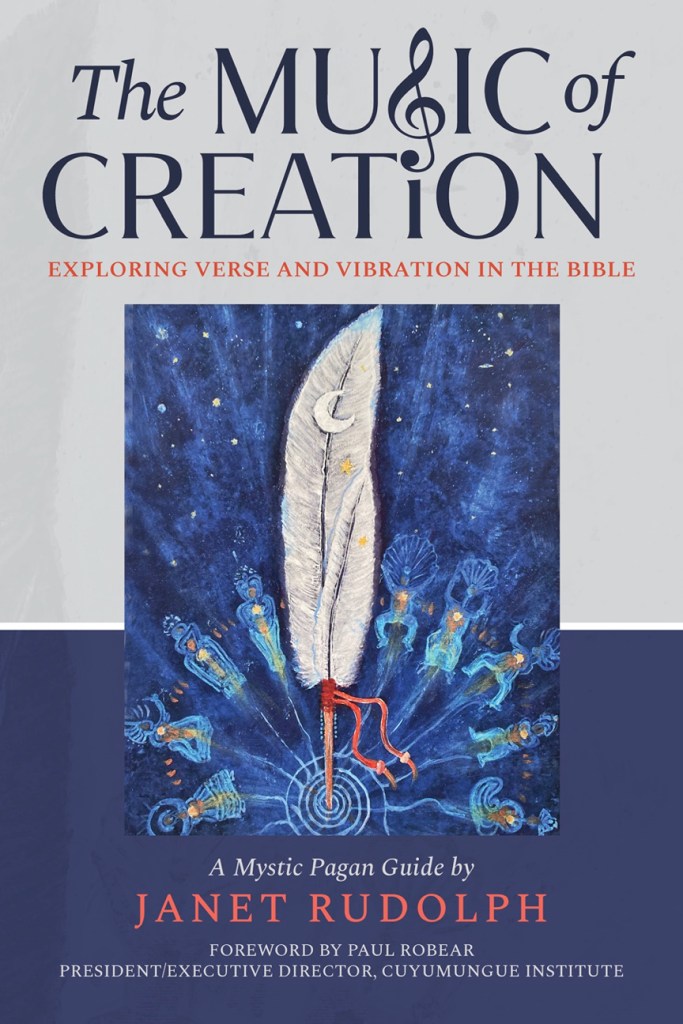
By Song, All Was Created by Janet Maika’i Rudolph

This blogpost is part of an on-going collaborative project between myself and my dear friend Ecuadorian elder and medicine woman, Susana Tapia Leon. The purpose of the project is to illuminate in word and images the underlying pagan meanings of biblical verses. There are many rich verses that got hidden within translations. This has had the effect of erasing their original meanings or at least making them very difficult to uncover. I have come to call these hidden gems because they were not erased completely. In this post, I am offering alternative translations of 3 verses that focus on song.  

Susana Tapia Léon, Cantadora 1
“She came alive after a month of work
She was always inside waiting to be revealed.”
Continue reading “By Song, All Was Created by Janet Maika’i Rudolph”

The Place of All Possibility: Cultivating Creativity Through Ancient Jewish Wisdom by Rabbi Adina Allen

In her book Pentimento, author and playwright Lillian Hellman describes a phenomenon that often occurs when we return to a piece of art we once worked on after much time has passed: “Old paint on a canvas, as it ages, sometimes becomes transparent. When that happens it is possible, in some pictures, to see the original lines: a tree will show through a woman’s dress, a child makes way for a dog, a large boat is no longer on an open sea.” Hellman speaks of the way the aging paint allows for older layers to show through, offering an opportunity to see, in her words, “what was there for me once, what is there for me now.”

Like the painting Hellman describes, Torah, too, is a work in process. Layers and layers of interpretation have been added to it over time, according to the needs, desires, fears, and longings of those who devoted their lives to making meaning out of these sacred words. Some layers add to the beauty and power of the overall piece, strokes and shapes that bring the picture more clearly and compellingly into focus. And some accrue like varnish, making the painting hard and impenetrable. Each one of us is invited into this process of excavation, of peeling back layers of what we have been taught or what we think we know, and seeing, as Hellman writes, what is there for us now. And each of us is called to our creativity — to bring our brush back to the canvas anew, reencountering and reworking the stories, ideas, and images that lie at the very foundation of who we are and who we could be.

Continue reading “The Place of All Possibility: Cultivating Creativity Through Ancient Jewish Wisdom by Rabbi Adina Allen”

What an Outdoor Movie Taught me about Biblical Women By Alicia Jo Rabins

Once I went to a free outdoor movie in Miami Beach. The film was projected on the side of the giant concert hall. There was a grassy park with palm trees stretching out from the wall; families brought picnic dinners and cans of beer and stretched out to watch the movie once the sky darkened.

The movie was Star Wars, but as Princess Leah appeared, I was thinking about a different mythic canon. For over twenty years I’ve been studying and teaching stories of Biblical women from a feminist Jewish perspective, and after all this time, I was surprised to find that the way I feel while interacting with these stories was oddly, powerfully similar to the feeling of watching Star Wars projected on the side of a building on this Miami night.

Continue reading “What an Outdoor Movie Taught me about Biblical Women By Alicia Jo Rabins”

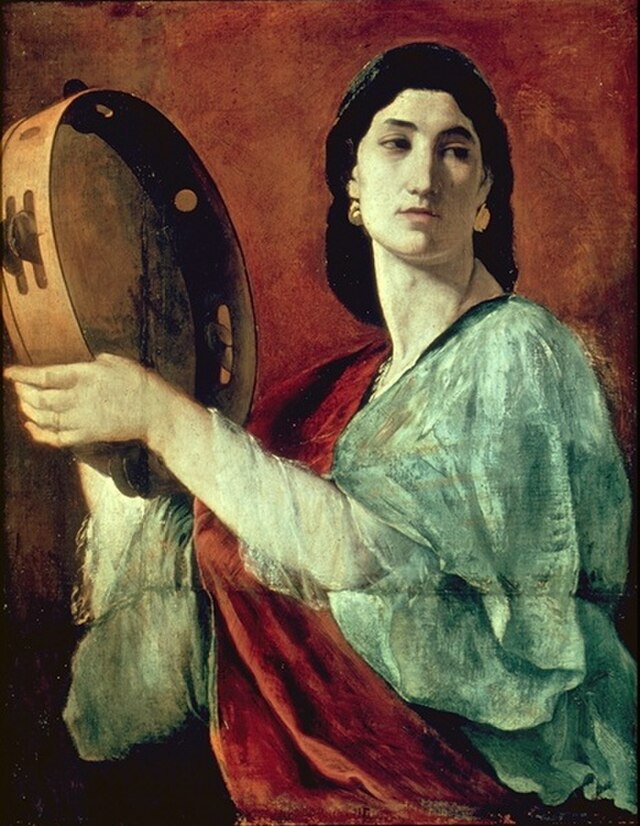
Miriam Speaks by Janet Maika’i Rudolph

Wikimedia Commons: Anselm Feuerbach

Intro:  I have been working on a project inspired by Charlene Spretnak and her book Lost Goddesses of Early Greece. I am writing biblical stories through the eyes and words of the women. The scribes who wrote down the tales of the bible, wrote mostly from men’s point of view. And they had their own which was to destroy evidence of the Goddesses. I tell Noah’s story through Naamah, his wife. Abram and Sarai’s journey to Egypt through the eyes of Sarah. Exodus in Miriam’s voice. In my telling, Miriam went to Midian with Moses and, while there, experienced the Burning Bush and worked with Moses’ wife Zipporah to protect knowledge of the Goddesses. Below is an abridged version of this section of Miriam’s tale.  

I look around at your world today. You, yes you, are my descendants. My beloveds. I mourn for what you’ve lost. No, I am angry, how could things have gotten this bad? I dare you, I dare any of you to challenge my work. We did everything we could. It should not have taken this long to find our clues. But then I see the job the scribes did. It was better and more thorough than even we, who saw so much, could have imagined. I look around at this precious earth we bequeathed to you and see how damaged it is.

Continue reading “Miriam Speaks by Janet Maika’i Rudolph”

Jacob’s Ladder, A Feminist Perspective by Janet Maika’i Rudolph

Today, I embark on my retelling of the biblical story of Jacob, the section usually referred to Jacob’s ladder or Jacob’s pillow. The entire story-arc of Jacob is filled with mystery and a sense of shamanic-style questing. What is the goal of a shamanic quest? There are many but the foundation is to open gateways to travel amidst thresholds. It is through these passages that we can gain knowledge of ourselves, have ecstatic experiences, do healing work, divination . . 

I believe this is a feminist issue because when we look at Jacob’s story more holistically, we can strip away the patriarchal assumptions inherent in the tale as it’s come down to us. For example, in my retelling, there is no male grand deity standing above, judging and dictating human actions and interactions. 

Continue reading “Jacob’s Ladder, A Feminist Perspective by Janet Maika’i Rudolph”