Jesus, the Woman at the Well, and the Meaning of ‘Man’ by Stuart Dean

 Stuart WordPress photoThe story in the Gospel of John of the encounter Jesus has with a Samaritan woman (hereafter, ‘the Samaritan’) at Jacob’s well (4:7-29) has attracted considerable scholarly attention.  For an overview of some of the interpretive issues raised by it there is a video of a conversation about it between H. W. Attridge and D. L. Bartlett of Yale Divinity School available on Youtube here.  I intend to focus primarily on only four verses, John 4:16-19.

Here is my translation (the underlying Greek and links to interpretive resources can be found here):

16 [Jesus] said: “go tell your ‘man’ and come back here.”
17 The Samaritan answered, “I do not have a ‘man.”’ Jesus said to her “Beautifully you said ‘I do not have a man.’
18 You have had five ‘men,’ and the one whom you have now is not your ‘man.’  You spoke truthfully.”
19 The Samaritan said to him: “Sir, I see you are a wise listener.”

My translation is intended to bring out what I take to be a play on the meaning of the underlying Greek word for man.  Before I explain exactly what the play on meaning is about I want to justify the assumption that there is some sort of play in the first place. Some have argued that the reference to the bride and bridegroom at John 3:29 foreshadows the meeting of Jesus and the Samaritan as a spiritual wedding.  The theme of a spiritual wedding is arguably also foreshadowed in how John starts the book itself, for ‘beginning’ is a feminine noun in Greek and ‘word’ is masculine, making ‘in the beginning was the word’ sexually symbolic; that, in turn, suggests that the well before which Jesus and the Samaritan stand, or the water in it, symbolizes God, or at least the spirit of God. Continue reading “Jesus, the Woman at the Well, and the Meaning of ‘Man’ by Stuart Dean”

The Purity Complex: Are Men Really Less Affected Than Women? by Andreea Nica

Andreea Nica, pentecostalismWomen’s bodies continue to receive an inexhaustible amount of attention. As a society, we have glorified, scrutinized, degraded, hypersexualized, underrepresented, and misunderstood the female body. Purity culture has orchestrated a movement around the management, perception, and regulation of women’s bodies. As a former Pentecostalist, I grew up knowing there was more focus on my body versus those of my  brothers in Christ. There was a bodily divergence between men and women that I did not fully comprehend but felt obligated to adhere to; the ideological basis of this difference was filled with much ambiguity.

Each time the church organized a sexual purity event and/or discussion, boys and girls were unfailingly segregated. I was always so curious about what was discussed in the boy’s group so I would ask my brother, Christian boyfriend, and male friends at the church to fill me in on the gossip. In my teens, I didn’t know how to perceive the information relayed to me. Looking back now, I am surprised at the discourse around purity culture and masculinity in the church. During my earlier years at college, I convened with the male pastoral leadership, and they confirmed the following main themes taught to men during sexual purity discussions. Continue reading “The Purity Complex: Are Men Really Less Affected Than Women? by Andreea Nica”

Patriarchy As An Integral System of Male Dominance Created at the Intersection of the Control of Women, Private Property, and War, Part 3 by Carol P. Christ

carol p. christ 2002 colorPatriarchy is a system of male dominance, rooted in the ethos of war which legitimates violence, sanctified by religious symbols, in which men dominate women through the control of female sexuality, with the intent of passing property to male heirs, and in which men who are heroes of war are told to kill men, and are permitted to rape women, to seize land and treasures, to exploit resources, and to own or otherwise dominate conquered people.

As the discussion of patriarchy* I began last week and the week before shows, patriarchy is not simply the domination of women by men. Patriarchy is an integral system in which men’s control of women’s sexuality, private property, and war (including violence, conquest, rape, and slavery) each play a part. These different elements are so intertwined that it is impossible to separate one as the cause of the others.  Patriarchy is an integral system of interlocking oppressions, enforced through violence, and legitimated by religions.

The model of patriarchy I have proposed argues that the control of female sexuality is fundamental to the patriarchal system.  This explains why there is so much controversy about the “simple matter” of access to birth control and abortion in the US today. It also explains why so much vicious anger is directed at single mothers by politicians and commentators.  Any woman who dares to control her own sexuality is questioning the foundations of the patriarchal system. Continue reading “Patriarchy As An Integral System of Male Dominance Created at the Intersection of the Control of Women, Private Property, and War, Part 3 by Carol P. Christ”

My Mother and My God by Erin Lane

Erin LaneI met Jesus at the age of four.

In my memory it happened like this: I’m lying on my back with the faded rose and ivy comforter of my parent’s four-post bed beneath me, and my head is dangling off the edge. Charlie is there, just a few years older than I but already my idol. And my recently born-again Mom. She is glowing, and talking fast, giddy but sane as day.

She tells me about this Jesus,  this Jesus who I can talk to, this Jesus who already talks to her. I do not know her exact words. But I know that if she loves him, I can, too. Continue reading “My Mother and My God by Erin Lane”

Patriarchy as a System of Male Dominance Created at the Intersection of the Control of Women, Private Property, and War, Part 1 by Carol P. Christ

carol p. christ 2002 color

Recently feminist scholar Vicki Noble commented that this is the best definition of patriarchy she has read–but she hadn’t read it earlier. I am reposting it now in the hopes that all of you will share it with your social media so that it will be more widely known.

Patriarchy is often defined as a system of male dominance. This definition does not illuminate, but rather obscures, the complex set of factors that function together in the patriarchal system.  We need more complex definition if we are to understand and challenge the the patriarchal system in all of its aspects.

Patriarchy is a system of male dominance, rooted in the ethos of war which legitimates violence, sanctified by religious symbols, in which men dominate women through the control of female sexuality, with the intent of passing property to male heirs, and in which men who are heroes of war are told to kill men, and are permitted to rape women, to seize land and treasures, to exploit resources, and to own or otherwise dominate conquered people.*

Marx and Engels said that the patriarchal family, private property, and the state arose together. Though their understanding of the societies that preceded “patriarchy” was flawed, their intuition that patriarchy is connected to private property and to domination in the name of the state was correct.  It has long seemed to me that patriarchy cannot be separated from war and the kings who take power in the wake of war.  Many years ago I was stunned by Merlin Stone’s allegation that in matrilineal societies there are no illegitimate children, because all children have mothers. Lately, I have been trying to figure out why the Roman Catholic and other churches and the American Republican party are so strongly opposed to women’s right to control our own bodies and are trying to prevent access to birth control and abortion. In the above definition of patriarchy, I bring all of these lines of thought together in a definition which describes the origins of patriarchy and the interconnections between patriarchy, the control of female sexuality, private property, violence, war, conquest, rape in war, and slavery.  Continue reading “Patriarchy as a System of Male Dominance Created at the Intersection of the Control of Women, Private Property, and War, Part 1 by Carol P. Christ”

On Pronouns and Liberation in the Classroom by Ivy Helman

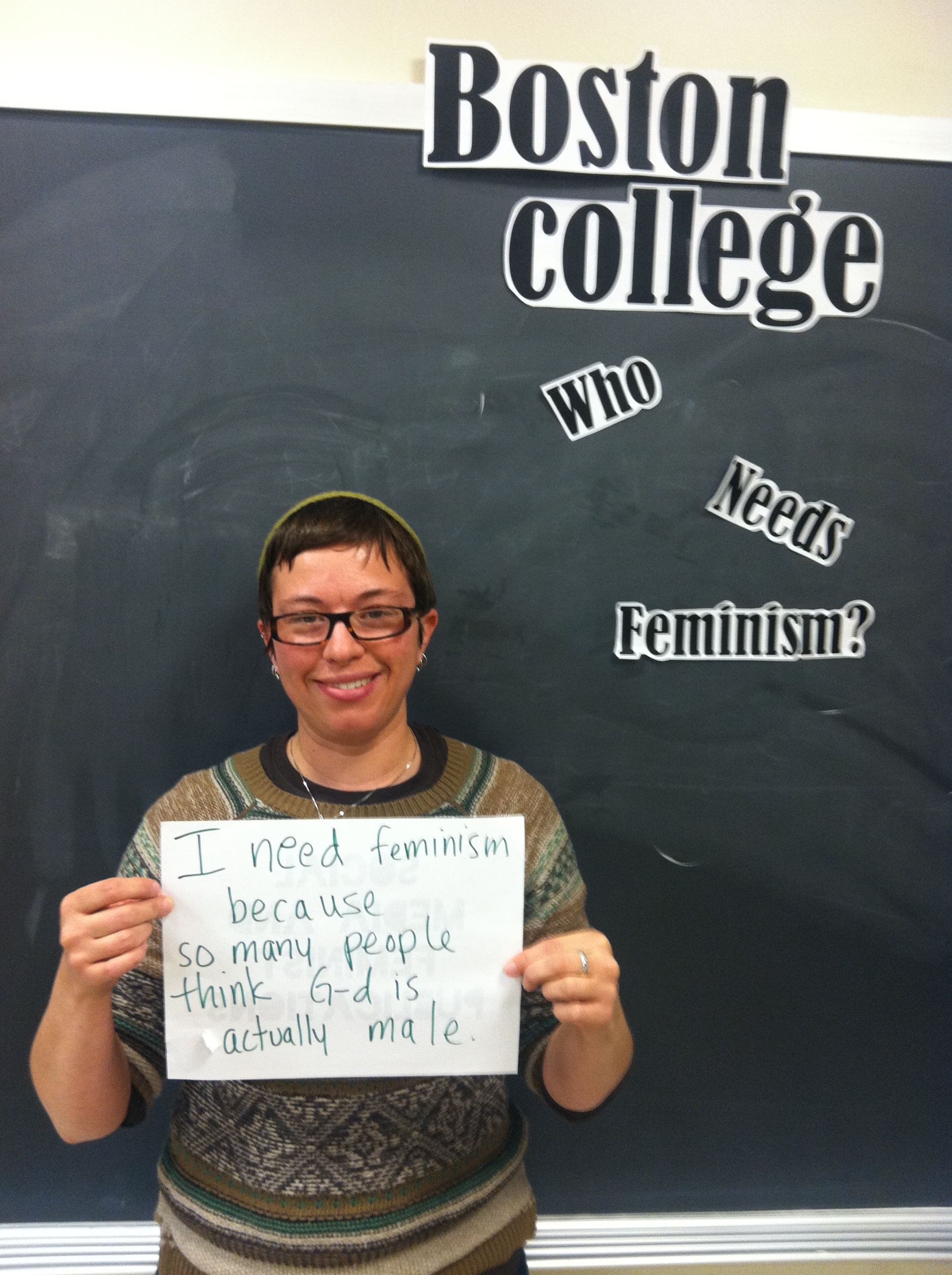
photoIn my introduction to Christianity class, almost every one of my students (who come from diverse religious backgrounds – primarily Roman Catholic, Protestant and Muslim), continues to believe that the best image if not the only appropriate image for G-d is male.  When probed they may speak generically about G-d as genderless, an entity or spiritual presence of some kind, yet conclude by affirming their belief that G-d is male often by adding something along the lines that G-d is best described as Father.  Some go so far in these affirmations that they articulate G-d’s maleness as fact.  It never fails that every semester I struggle with how to address this basic feminist issue within the classroom.

At least as early as 1973, Mary Daly, in Beyond G-d the Father: Towards a Philosophy of Women’s Liberation, articulated the problematic basis of the relationship between gender and divine imagery.  She argues that “If G-d in ‘his’ heaven is a father ruling ‘his’ people, then it is in the ‘nature’ of things and according to divine plan and the order of the universe that society be male-dominated.”  In other words, if maleness is associated with divinity, then the power, domination and running of society by men seems to be divinely ordained. Continue reading “On Pronouns and Liberation in the Classroom by Ivy Helman”

Voice of Wisdom: What Hildegard Means Now by Mary Sharratt

sharratt$mary_lresHildegard von Bingen (1098–1179) was a visionary abbess and polymath. She composed an entire corpus of sacred music and wrote nine books on subjects as diverse as theology, cosmology, botany, medicine, linguistics, and human sexuality, a prodigious intellectual outpouring that was unprecedented for a 12th-century woman. Her prophecies earned her the title Sybil of the Rhine.

Pope Benedict XVI canonized Hildegard on May 10, 2012—over eight centuries after her death. In October 2012, she was elevated to Doctor of the Church, a rare and solemn title reserved for theologians who have significantly impacted Church doctrine. Hildegard is the fourth woman in the entire history of the Church to receive this distinction.

But what does Hildegard mean for a wider interfaith audience today?  Continue reading “Voice of Wisdom: What Hildegard Means Now by Mary Sharratt”

What It’s Like to Be a Woman in the Academy by Linn Marie Tonstad

Linn Marie TonstadLast fall, I was asked to sit in on the women’s pre-doctoral colloquium at the divinity school where I teach. In the course of a wide-ranging lunchtime conversation, the central question to which the students wanted an answer was: “what is it like to be a woman in the academy?” The question took me by surprise at the time – mostly because I’d expected to be asked more nitty-gritty questions about applying to graduate school, writing samples, and personal statements – but it has stayed with me in the weeks since the lunch as I’ve found myself trying out answers from different directions.

The first answer, and perhaps the most obvious one, is this: there is no such thing as being “a [generic] woman” in the academy (or anywhere else). Continue reading “What It’s Like to Be a Woman in the Academy by Linn Marie Tonstad”

This is Why I Don’t Pray by Erin Lane

Like most Americans, I hold the overblown belief that a book about my life would be worth reading.  And, like most Americans, I have had the gumption to title it before I’ve even lifted a finger. It’s called “Should I Be Praying Now?”

Erin LaneAs if you’re surprised, it has an obnoxious subtitle that helps marketers at Barnes & Noble know whether to put it on the Christian living shelf with the likes of Beth Moore or drop it behind the David Sedaris memoir with the naked barbie on the cover. It will read, “Moments of indecision during mealtime, bedtime, teeth-brushing, love-making, test-taking, baptisms, funerals, and the opening few minutes of small group.” It’ll be like Anne Lamott’s “doesn’t that make you feel better about  your own spiritual life” kind of writing but more pedestrian. Continue reading “This is Why I Don’t Pray by Erin Lane”

Breaking Up with Chick-fil-A by Gina Messina-Dysert

I haven’t eaten fast food in many years; however as a new mom Chick-fil-A offered something quite different than other fast food chains: healthy options, freshly made food, clean space, and a great spot for play dates; not to mention the organization’s commitment to the environment.  My daughter and I have made many trips to our local franchise in the last year.  It became a usual spot for play dates, the go to place for dinner when I was on a time crunch (grilled chicken nuggets, fresh fruit, and chocolate milk has saved the day many times over!), and let’s not forget the perfect option for Baby S to get some play time in while Mommy connected to the free Wifi to get some work done.  Yes, Chick-fil-A felt like a mommy’s dream come true.

I am embarrassed to say that I had heard rumors that Chick-fil-A was anti-same sex marriage; but I ignored all the warning signs trying to hold on to the many positives I thought the chicken chain brought to my life.  With the recent blow up of Dan Cathy’s response “guilty as charged,” when asked about Chick-fil-A’s support for families led by heterosexual couples, I can no longer turn a blind eye.     Continue reading “Breaking Up with Chick-fil-A by Gina Messina-Dysert”