On Pronouns and Liberation in the Classroom by Ivy Helman

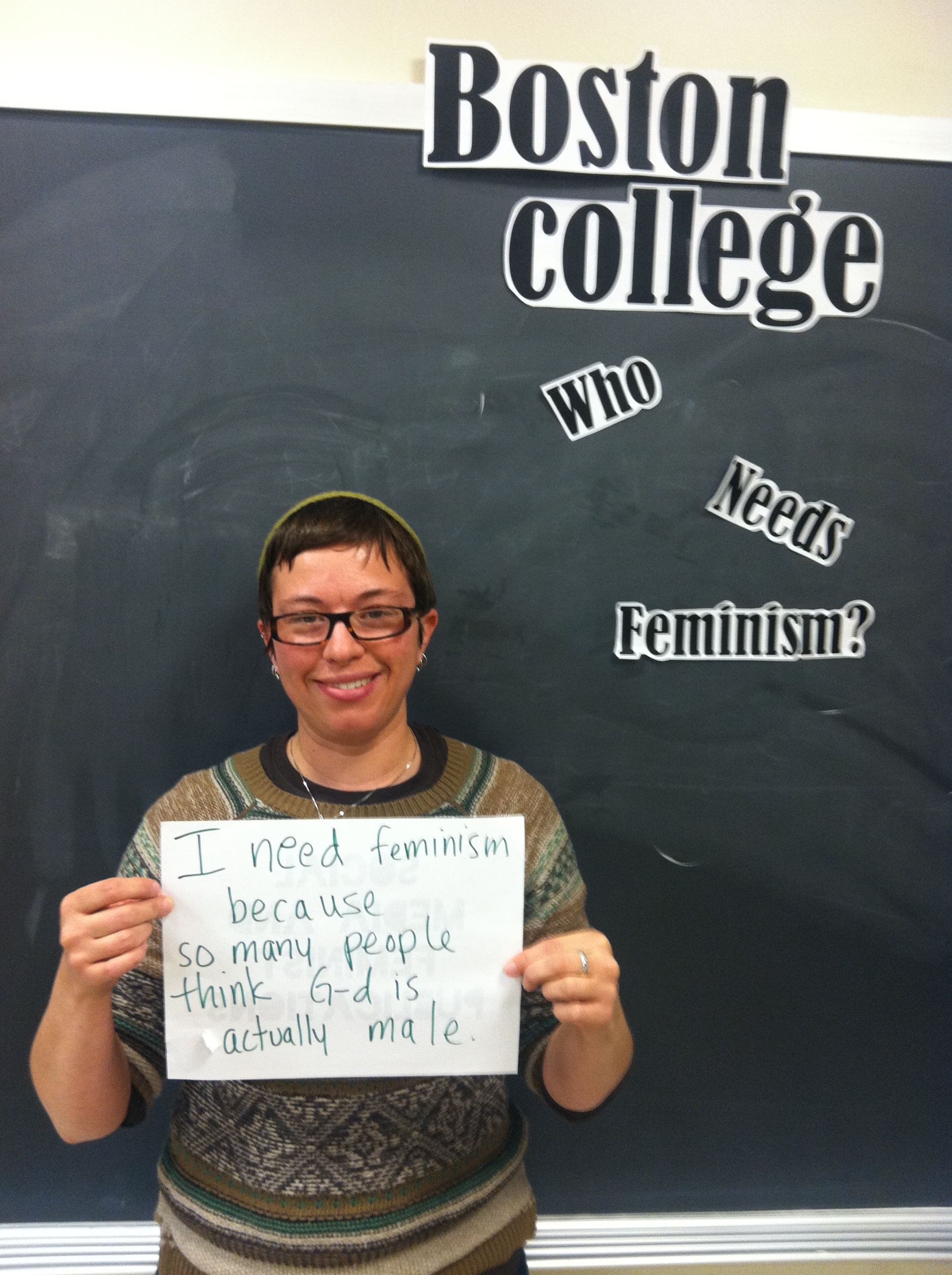
photoIn my introduction to Christianity class, almost every one of my students (who come from diverse religious backgrounds – primarily Roman Catholic, Protestant and Muslim), continues to believe that the best image if not the only appropriate image for G-d is male.  When probed they may speak generically about G-d as genderless, an entity or spiritual presence of some kind, yet conclude by affirming their belief that G-d is male often by adding something along the lines that G-d is best described as Father.  Some go so far in these affirmations that they articulate G-d’s maleness as fact.  It never fails that every semester I struggle with how to address this basic feminist issue within the classroom.

At least as early as 1973, Mary Daly, in Beyond G-d the Father: Towards a Philosophy of Women’s Liberation, articulated the problematic basis of the relationship between gender and divine imagery.  She argues that “If G-d in ‘his’ heaven is a father ruling ‘his’ people, then it is in the ‘nature’ of things and according to divine plan and the order of the universe that society be male-dominated.”  In other words, if maleness is associated with divinity, then the power, domination and running of society by men seems to be divinely ordained. Continue reading “On Pronouns and Liberation in the Classroom by Ivy Helman”

Voice of Wisdom: What Hildegard Means Now by Mary Sharratt

sharratt$mary_lresHildegard von Bingen (1098–1179) was a visionary abbess and polymath. She composed an entire corpus of sacred music and wrote nine books on subjects as diverse as theology, cosmology, botany, medicine, linguistics, and human sexuality, a prodigious intellectual outpouring that was unprecedented for a 12th-century woman. Her prophecies earned her the title Sybil of the Rhine.

Pope Benedict XVI canonized Hildegard on May 10, 2012—over eight centuries after her death. In October 2012, she was elevated to Doctor of the Church, a rare and solemn title reserved for theologians who have significantly impacted Church doctrine. Hildegard is the fourth woman in the entire history of the Church to receive this distinction.

But what does Hildegard mean for a wider interfaith audience today?  Continue reading “Voice of Wisdom: What Hildegard Means Now by Mary Sharratt”

What It’s Like to Be a Woman in the Academy by Linn Marie Tonstad

Linn Marie TonstadLast fall, I was asked to sit in on the women’s pre-doctoral colloquium at the divinity school where I teach. In the course of a wide-ranging lunchtime conversation, the central question to which the students wanted an answer was: “what is it like to be a woman in the academy?” The question took me by surprise at the time – mostly because I’d expected to be asked more nitty-gritty questions about applying to graduate school, writing samples, and personal statements – but it has stayed with me in the weeks since the lunch as I’ve found myself trying out answers from different directions.

The first answer, and perhaps the most obvious one, is this: there is no such thing as being “a [generic] woman” in the academy (or anywhere else). Continue reading “What It’s Like to Be a Woman in the Academy by Linn Marie Tonstad”

This is Why I Don’t Pray by Erin Lane

Like most Americans, I hold the overblown belief that a book about my life would be worth reading.  And, like most Americans, I have had the gumption to title it before I’ve even lifted a finger. It’s called “Should I Be Praying Now?”

Erin LaneAs if you’re surprised, it has an obnoxious subtitle that helps marketers at Barnes & Noble know whether to put it on the Christian living shelf with the likes of Beth Moore or drop it behind the David Sedaris memoir with the naked barbie on the cover. It will read, “Moments of indecision during mealtime, bedtime, teeth-brushing, love-making, test-taking, baptisms, funerals, and the opening few minutes of small group.” It’ll be like Anne Lamott’s “doesn’t that make you feel better about  your own spiritual life” kind of writing but more pedestrian. Continue reading “This is Why I Don’t Pray by Erin Lane”

Breaking Up with Chick-fil-A by Gina Messina-Dysert

I haven’t eaten fast food in many years; however as a new mom Chick-fil-A offered something quite different than other fast food chains: healthy options, freshly made food, clean space, and a great spot for play dates; not to mention the organization’s commitment to the environment.  My daughter and I have made many trips to our local franchise in the last year.  It became a usual spot for play dates, the go to place for dinner when I was on a time crunch (grilled chicken nuggets, fresh fruit, and chocolate milk has saved the day many times over!), and let’s not forget the perfect option for Baby S to get some play time in while Mommy connected to the free Wifi to get some work done.  Yes, Chick-fil-A felt like a mommy’s dream come true.

I am embarrassed to say that I had heard rumors that Chick-fil-A was anti-same sex marriage; but I ignored all the warning signs trying to hold on to the many positives I thought the chicken chain brought to my life.  With the recent blow up of Dan Cathy’s response “guilty as charged,” when asked about Chick-fil-A’s support for families led by heterosexual couples, I can no longer turn a blind eye.     Continue reading “Breaking Up with Chick-fil-A by Gina Messina-Dysert”

BOOK REVIEW: Jonathan Merritt’s A Faith of Our Own by Gina Messina-Dysert

Have you been a victim of the “Culture Wars”?  Jonathan Merritt was, and it inspired him to write his latest book A Faith of Our Own: Following Jesus Beyond the Culture Wars.  According to Merritt, the culture wars have led each of us (who identify as Christian) to define Christ in terms of our political party.  The Religious Right have claimed a political and pietistic Christ who must be protected from liberals who have sought to chase Jesus out of our “God-Blessed” nation.  And Christians on the left have fought against the oppressive theocracy they believe the right wing seeks to implement.  Neither side’s Jesus likes the other, and according to Merritt, neither represents the Jesus of the Bible.

Merritt argues that participating in politics foolishly gets churches into trouble and results in a divide within community.  Christians must answer Jesus’ question, “Who do you say I am?” for themselves.  By transcending the culture wars, we can return to the Bible, see Jesus with “fresh eyes,” and find a “faith of our own.”  Merritt explains Christians who are reclaiming their faith are doing so in search of life transformation and unity among those once divided by politics. Continue reading “BOOK REVIEW: Jonathan Merritt’s A Faith of Our Own by Gina Messina-Dysert”

Celebrating Asian American and Pacific Islander Heritage Month by Grace Yia-Hei Kao

“Did you know that…the Asian population grew faster than any other race group in the United States between 2000 and 2010…[and that] Chinese is the second most widely spoken non-English language in the country (behind Spanish)”?

Continue reading “Celebrating Asian American and Pacific Islander Heritage Month by Grace Yia-Hei Kao”

Power and Wealth in The Hunger Games by Lisa Galek

Unless you have been living in grim, dystopian world for the past few months, you’ve no doubt seen or heard something about The Hunger Games. The movie, which is based on the first in a best-selling trilogy of novels by Suzanne Collins, debuted several weeks ago to mass acclaim. It has already had the biggest opening weekend ever for a non-sequel and its advanced ticket sales eclipsed that of the most recent installment in the Twilight Saga.

Feminists can rejoice a little in the fact that this movie, which tells the story of strong, female protagonist, Katniss Everdeen, has surpassed the Twilight movies in ticket sales. Unlike the Twilight movies, the plot of The Hunger Games does not revolve entirely around a romantic love triangle. Though two suitors do vie for Katniss’s attentions, the heroine has much more pressing concerns – like whether or not she will be able to survive until morning.

But, aside from the good news that tough, well-drawn female characters can perform well at the box office, the movie has also spawned some interesting discussions about government and politics. In fact, both liberal and conservative commentators have claimed The Hunger Games supports their personal viewpoints (See “Liberal, conservatives embrace ‘Hunger Games’ for very different reasons”). For me, the books and movie fall more squarely onto the liberal side of the fence for one reason – they call into question wealth and power and those who are unwilling to change existing structures of oppression. Continue reading “Power and Wealth in The Hunger Games by Lisa Galek”

Where do Cats Go?: Reflections on Death Post Patriarchal Christianity by Sara Frykenberg

The reason I am speaking about death today is two-fold.  First, I have been somewhat preoccupied with the concept of death since entering a new decade of my life.  I no longer believe in the evangelical vision of heaven I learned about in my youth; but as an uncomfortable “un”-Christian, I also have no satisfactory vision to replace it.  Or rather, there are many visions I find appealing, but none that I “believe in,” as I had believed in heaven.  My family is getting older, my parents have been sick in the last few years, and I often feel that I have more to lose now than I used to.

My second reason for considering death today is that last Wednesday, Mimi, our family cat of 24 years—yes, 24—passed away.  After spending all nine of her lives living, Mimi could no longer eat and was suffering.  My mother had her put down after we all said goodbye; we held a funeral for her and buried her among the lilies in our yard, her home.

My sisters and myself were very, very saddened by Mimi’s passing; but my mother took it hardest of all.  Mimi had been her companion, her friend, her lap warmer, her snuggle buddy, her alarm clock and, we often joked, her favorite child for over two decades.  I wanted to comfort my mother; but my protest that it didn’t matter what the (her) Church said, Mimi was with the God/dess, was maybe, not very helpful.  It perhaps, only reminded her that in her view, I too am not going to heaven.

I remember sitting in church, as a child being told that animals did not have souls and that there was no “kitty heaven.”  That was perhaps, one of the first times in my life that I thought, “that’s just ridiculous,” in a church.  Not just ridiculous, but mean and cruel even.  “What,” I thought, “is the point in saying such a thing?”  Continue reading “Where do Cats Go?: Reflections on Death Post Patriarchal Christianity by Sara Frykenberg”

Body, Nature, Ancestors by Carol P. Christ

Some years ago, womanist theologian Karen Baker–Fletcher asked about ancestors following a lecture I gave on the body and nature.  I have since come to realize that ancestors are a missing link between the two:  we cannot speak adequately of embodiment and interdependence in the web of life without recognizing the ancestors whose lives made ours possible.  Our mothers quite literally gave us our bodies.  All of our ancestors gave us their genes.  Care and callousness with origins going back longer than conscious memory was imprinted on the psyches of our parents and grandparents and transmitted to us.  All of our ancestors give us connections to place.  While many black people in America can recite oral histories that begin with slavery in the United States, I come from a family where stories of origin for the most part were not valued or told.  Both of my father’s parents lost their fathers when they were very young, and my father, who was raised Catholic at a time when Catholics were discriminated against, preferred to think of our family as “American now.”  Like the hero of the film Lost in America, most members of my family dreamed of “melting right into that pot.” In the process we lost stories we need to help us to understand ourselves and the complex realities that “becoming American” involved.   Continue reading “Body, Nature, Ancestors by Carol P. Christ”