Breaking the Silence by Chris Ash

Christy CroftYesterday, Time Magazine announced that its “Person of the Year” for 2017 would be “The Silence Breakers” – the name it has given to those women who helped launch and made headlines in the #metoo movement. This movement was started by activist Tarana Burke in 2006 to highlight the sexual abuse of women of color and was sent viral by actor Alyssa Milano in 2017. It speaks volumes that this designation falls exactly one year after Time awarded this honor to Donald Trump for the political shift heralded by his defeat of Hillary Clinton.

This defeat that was fueled, at least in part, by the way Trump’s own normalization of sexism, harassment, and assault played on the fears and bitterness of misogynist voters hell-bent on preserving what racial, gender, and economic privilege they could continue to hoard for themselves and those like them. This defeat, and the ensuing glorification of a sexual predator and rampant misogynist, in turn fueled a movement of people, mostly women, tired of being scared into silence to protect the powerful who abuse. Continue reading “Breaking the Silence by Chris Ash”

Forgiveness and Faith by Chris Ash

Christy CroftSome of the most brutal weapons ever used against me were crafted and wielded by my own hands, forged in grief and self-loathing out of the words of others. In my better moments, I recognize that while another’s frustration with me frequently may be justified, any cruel words towards me never are, and are more a reflection of their speakers’ relationship with themselves than of any facts about me.

The parent who criticized me for being a “crybaby” saw in me a freedom of emotion that challenged the stoic denial of their own pain. The friend who criticized my optimism as “naïveté” and ignorance resented their own lack of hope about their future. The loved one who lashed out against my precious family deeply wished to experience that profound sense of belonging and acceptance that they’d not yet allowed themselves to feel.

In my heavier moments, when I’m questioning my choices and feeling the weight of responsibility that comes with adulthood, parenthood, and awareness, those words slither back into my brain, taking hold of my memory and trying to convince me of my own inadequacy and brokenness. Hopeful Me looks at my traits – my sensitivity, optimism, and devotion to loved ones – as strengths to be honed into tools I can use for my good and that of the world. Overwhelmed Me looks as these same traits as evidence of my damage – artifacts left behind by childhood trauma and occasional adulthood bouts of depression and anxiety. Continue reading “Forgiveness and Faith by Chris Ash”

Family, Interdependence, and Mutual Support by Chris Ash

Christy CroftOver the past few months, a precious person has come closer into my family’s life in such a way that their presence in my home, among my loved ones, has come to feel natural and easy. This is someone I love, someone who adores my children and appreciates my partner of 18 years and whose sweet spirit and vibrant laughter have added joy and mirth to our family home.

Yesterday, they rode with me to drop my freshly-mohawked teenager off at a farm to help with preparations for an upcoming arts camp. I introduced them by name to the camp assistant and walked over to chat with the camp director for a bit. Later, as we got back into the car to head to lunch, I asked what they thought of the farm.

“It was nice,” they said. “I’m glad your children have a place like that. Also, while I was chatting with the camp assistant, she asked if I was family.”

“What did you say?”

“I said yes.”

They weren’t wrong.

The meaning the word “family” holds for me is something I’ve given much consideration over the years. For generations, many of us have been expected to turn a blind eye to the ways patriarchal domination of women’s and children’s bodies perpetuates abuse in our own family systems. My inability to sweep these abuses under the carpet, to keep silence and pretend all is well, has led to my estrangement from one entire side of my family. It’s an estrangement I feel will be permanent, and while I grieve the loss of an ideal I never had, I welcome the opportunity to live authentically and boldly, confident in my dedication to my ideals, which include honesty, justice, and the unconditional protection of children and vulnerable populations.

For a while, I sat with the gap this estrangement created in my life, unwilling to fill it with harmful relationships with those to whom I am blood-related, yet hesitant to broadly redefine it in a way that negates the importance of those who have chosen to love and raise up a child, however imperfectly. Continue reading “Family, Interdependence, and Mutual Support by Chris Ash”

Holding Two Truths by Chris Ash

Christy CroftLast month, I attended a series of workshops on self-care, family dynamics, and recovery from complex trauma. In one session, someone asked the facilitator, a counselor with over 30 years of experience in mental health fields, how to balance faith, confidence, and belief in recovery with the reality that sometimes healing can be a rocky road, with missteps, false starts, and restarts. The counselor noted that one of the key concepts he’s reinforced in working with people on their recoveries is that to keep moving forward – to forgive ourselves when we make mistakes, to not give up on ourselves when old patterns resurface, to sustain the energy needed to continue The Work in the face of obstacles, doubt, and fear – we need to be able to hold two truths at once. We need to expand ourselves such that we can hold two realities – that our hope in ourselves is not misplaced, that we are strong and can overcome adversity, and that we can move through our lives with grace and skill; and also that we may slip up and fall short of our ideals, that we sometimes may feel fragile and overwhelmed, and that recovery (from trauma, grief, substance abuse, or illness) may include steps backward intermixed with the forward movement.

This concept was especially powerful for me. As someone who spent my childhood and young adult years mired in black-or-white thinking, my personal healing and much of my spiritual practice has been built around reconciling seeming opposites, not by blurring difference such that the unlike becomes like, but by digging into the ways in which the tension between opposites is itself fertile soil for the activity of creation and growth, art and brilliance. Since creation is, for me, the sacred in action, and understanding of self in the context of the cosmos is sacred practice, this gives the tension of two truths a spiritual meaning and the fluid give-and-take that holds them in balance a spiritual wisdom. Continue reading “Holding Two Truths by Chris Ash”

Making Space for the Joy and the Grief by Chris Ash

Christy CroftLast week, I made a day trip on short notice to fly with a friend to Orlando. As we said our goodbyes, my friend encouraged me to try to catch an earlier flight to avoid arriving home too late in the evening. I briefly considered it, but instead grabbed a late lunch in the Orlando airport, sat down with a journal, and spent some time writing. It had been a stressful few weeks, and I relished the opportunity to put my heart to paper, to allow the pen to help me sort out the mix of emotions that were rolling over me.

Later that evening, during a two-hour layover in Baltimore, my friend called. “Are you home yet?” they asked, hopeful. Continue reading “Making Space for the Joy and the Grief by Chris Ash”

Eros, Caritas, and Relationship by Chris Ash

Christy CroftIn 2011, the Anglican Theological Review published arguments for and against same-sex marriage. “A Theology of Marriage including Same-Sex Couples: A View from the Liberals,” co-written by Deirdre Good, Cynthia Kittredge, Eugene Rogers, and Willis Jenkins, presents a rationale for same-sex marriage that is surprisingly traditional, grounded in scripture and doctrine, understood and interpreted “in the company of patristic interpreters as well as in the company of readers long silenced by the tradition.” Part of the liberal view explores the relationship between eros and caritas, and how the marriage vows, which “mark marriage as an arduous form of training in virtue,” teach us to love and “offer a means by which God may turn eros into charity.”

As someone for whom eros is both a modality of intimate communion and manifest expression of divine love, the idea that it would need to be transformed into something less sensual, more socially acceptable, seems an arbitrary sanitization that positions eros as untamed and dangerous, in need of redemption by sexless ideals of Christian charity. Admittedly, my aversion to scrubbing eros of its rawness likely comes from my own understanding of the word, which might differ from that of traditional Christian theology, and which is inherently tied to the ways in which I’ve known the divine more deeply through expansive, mystical, erotic experiences that engaged my every sense in the coolness of rivers and grazing touch of mountain breezes.

We know through the body; we sense through our skin and parts and cells and perceive through nerves and fibers and tissue – seismic shocks of color and sound reverberating through our beings in the abstract, or the specific, deep, and warming awareness of divine love washing over our grief, fear, or loneliness. Each of these teaches us about the nature of the universe and of love, about bodies and subjectivity, and (by extension) about God and God’s action in the cosmos. My experience of eros – of the sensual explosion of erotic energy that makes me tremble, lays gooseflesh across every inch of me, and takes my breath as it rises inside my chest and belly – is not limited to sexuality, but comes through nature, art, song, movement, and touch. It is my primary way of experiencing divine love, and needs no purification. Continue reading “Eros, Caritas, and Relationship by Chris Ash”

Redeeming Gender, Softening Extremes by Chris Ash

Christy CroftLast month, I attended a lecture by Anglican theologian Adrian Thatcher on his recent book, Redeeming Gender. In this book, Thatcher draws upon the one sex and two sex theories described by Thomas Laqueur in his book, Making Sex: Body and Gender from the Greeks to Freud. Laqueur posits that until the eighteenth century, it was believed that women and men were two expressions of the same basic sex – that women were men whose reproductive organs were similar but found in the “wrong” places. Ovaries were internal testes, the vagina an inverted penis, and the labia a parallel for the scrotum – all making women flawed expressions of man.

This sets up a continuum in which there is one sex rather than two, with men as more perfect expressions of man, and women as inferior expressions. Thatcher argues that if the language, liturgy, and doctrines of the church arose in the context of the one sex theory, then Christianity’s foundational beliefs and practices are already compatible with acceptance of a spectrum of gender identity within a one-sex model, opening up new interpretations that allow for full participation of women and LGBTQ+ people within the church. While the old one sex theory as described by Laqueur is a spectrum from more to less perfection, from more to less like God, the spectrum Thatcher proposes is clearly progressive – one in which all places along the spectrum share in the same equality.

And yet it is still a linear spectrum, with extremes envisioned as opposites, as distant from each other. Continue reading “Redeeming Gender, Softening Extremes by Chris Ash”

On Being an Occasion of Joy by Chris Ash

Christy CroftWhen I was 19, I fell hard into the kind of deep depression that hits college kids whose unstable upbringings, rife with inconsistency and trauma, left them ill-prepared to face the self-direction and responsibility of independence. I didn’t grow up religious despite my father’s attempts to turn visitation weeks into conversions, but had started attending the local Episcopal cathedral months earlier after seeing its stunningly beautiful windows on a historic tour. Having taken basic stained glass courses when I was 18, I’d been mesmerized by the artistry and would sit in a different pew each week, drifting into and out of awareness of the service, eyes trained on the nearest window, lost in contemplation, love pouring in.

When the darkness became too much and I sought more of that love through spiritual care and reflection, I walked into the church library and thumbed through the directory looking for resources, and was hopeful to discover that the Episcopal Church had convents. That afternoon, I dialed the number for the nearest convent, and in that especially dramatic way of depressed 19-year-old artist types with backgrounds in theater, I declared that I couldn’t handle life in the world anymore and that I might want to become a nun. Sister Ann told me that their order was less an escape from the world than a new way of being fully present in it, but invited me to spend Christmas at the convent.

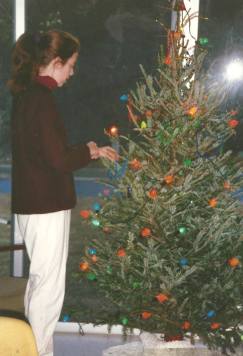
Decorating the tree in the convent's guest house
Decorating the tree in the guest house

What started out as a holiday visit became several months of me spending every day that I wasn’t in class or at work at the convent, living in the guest house, attending five services a day, helping with maintaining the grounds, and spending as many waking hours as I could in the library, face buried in the works of medieval women mystics. Over the coming years, I’d spend many long weekends in retreat at the convent, and the sisters became my second family. I visited with women I was dating and later with a Muslim boyfriend, and everyone was always welcomed with love. When my first child almost died as a newborn and I called to ask for prayer, two sisters drove to be with me in the hospital. I still cry now, twenty years later, when I tell people the story of a parish priest leading the small group gathered in my hospital room in prayer after my son’s first surgery, and how my heart swelled when halfway through the Lord’s Prayer, teary eyes closed, I began to hear the familiar lilt of women’s chanting over our soft-speaking voices. Continue reading “On Being an Occasion of Joy by Chris Ash”

Present in Our Bodies: Sensuality, Movement, Feelings, and Joy by Chris Ash

Christy CroftChristmas morning. I don’t usually have Sundays free and our family holiday celebrations lean nontraditional, so I’d come to a special ecstatic dance celebration and brought my 9-year-old daughter with me. As the music started and people all around us began to flow and move, I reached out to touch her hand. As if she’d been doing it for years, she shifted into a beautiful contact improv flow with me, rolling her arm down and across mine as she beamed love and radiance right into my heart.

This child brings up so many feelings in me as I watch her grow.

On many occasions at ecstatic dance, I’ve looked around the room and been overwhelmed by the beauty of the dancers and their joyful embodiment. When delight, peace, and ease are conditioned out of many of our bodily relationships through past traumas, body issues, or simply living in a disembodied or misembodied culture, feeling comfortable in our own skins is simultaneously an intentional act of cultural resistance and a profound act of self-care and self-love. Being present in the ecstatic dance space with lovely people moving confidently in fluid, sensual, emphatic, and silly ways fills my heart to overflowing on any given dance day.

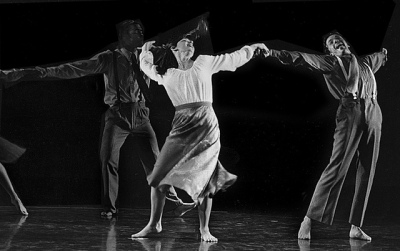
Joyful dancers move ecstatically
Photo by Flickr user dannysoar

Being present in that space with my daughter, looking around the room and imagining what it must look like through the eyes of a 9-year-old girl, gave it a whole new hue of meaning. People danced alone or with partners, men danced with men and women with women, all without shame over their bodies or feelings. The occasional dancer who slipped off to sit on the periphery, nursing tears that flow in the way holidays bring for some, was joined, held, hugged, cried with. My little girl danced with joyful abandon surrounded by men and women of all ages and shapes, present in their bodies and feelings, moving in ways that felt good, glowing with presence and the freedom of acceptance. Continue reading “Present in Our Bodies: Sensuality, Movement, Feelings, and Joy by Chris Ash”

Positive Presence in Tiring Times by Chris Ash

Christy CroftI am tired.

I’m tired in that way that happens when mind-overload, followed incautiously into concrete corners, limits the ability to conceive of solutions and dig up hope. I’m tired of reading commentary and I’m tired of thinking about the seeming impossibility of resolution, though I seem to be doing both compulsively. I read the news and it is overwhelming. I read theory and it is immobilizing: the more I learn, the more I realize how every possible choice of action is complicated by its impact on some person or power structure.

I’m tired in that way that happens to people who take in the world just as fully through their bodies – through touch, sound, breath, feeling, and movement – as they do through their minds. I’m tired in the way of those whose hearts well love and grief that flow up in gentle washes or powerful surges until they must escape in sighs and sometimes tears.

We live in tiring times.

We love in tiring times.

For several years, I was a leader in New Thought churches that held strict adherence to the “Law of Mind-Action” – that we change the blueprint of the universe to manifest according to our thoughts and beliefs – and the “Law of Attraction” – that we attract all experiences into our lives based on our thoughts and beliefs, whether conscious or unconscious. Under both of these principles, the material world, and thus the body, are subject to the will of the mind – subservient, docile, and reactive – just as women (traditionally associated in many cultures with the land and processes of the body) were considered inferior to and expected to remain subservient to men. Continue reading “Positive Presence in Tiring Times by Chris Ash”