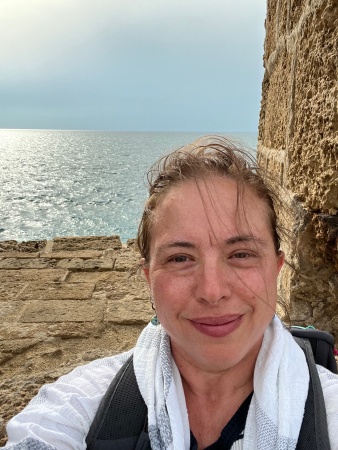
Return to the Wild by Caryn MacGrandle

Everything is connected.

My son is into Alan Watts. He was speaking about him to me yesterday.  It made me think of an old blog I had from 2014 where I quoted Alan Watts.  

“Advice? I don’t have advice. Stop aspiring and start writing. If you’re writing, you’re a writer. Write like you’re a goddamn death row inmate and the governor is out of the country and there’s no chance for a pardon. Write like you’re clinging to the edge of a cliff, white knuckles, on your last breath, and you’ve got just one last thing to say, like you’re a bird flying over us and you can see everything, and please, for God’s sake, tell us something that will save us from ourselves. Take a deep breath and tell us your deepest, darkest secret, so we can wipe our brow and know that we’re not alone.”

– Alan Wilson Watts | 29 Best Quotes about Writing: We are Legion

Continue reading “Return to the Wild by Caryn MacGrandle”

Beth March and the Courage of the Gentle Giver by Cathleen F

As someone who spent my prepubescent years watching director Gillian Armstrong’s “Little Women”, I was eager to see Greta Gerwig’s newly released version. Previously unexplored contours of each character, and of my changed perceptions, were made visible through this iteration. The most difficult and touching part of the film that lingers with me is the story of Beth, pianist and caretaker. Beth’s untimely death brings grief into the center of the March family narrative, and Gerwig’s portrayal brought up grief in me about my experiences with invisibility as a paced introvert in a culture that celebrates speed and extroversion.

I grew up wanting to be like Jo March, the outspoken, reactive protagonist. Jo was the rebel, the obvious feminist, and, mostly importantly to me, the brave one. Beth seemed to me to be boring, relegated to a life at home, bound by illness and a preoccupation with the needs of neighbors. Her steadiness looked to me like obedience; she could not fight away the disease that eventually killed her, and I wished to be everything besides her, the introvert who observed and cared and loved music and then died. As I grew into my own introverted, observant, caregiving tendencies, I began to wonder if I had been tricked by my culture, by my upbringing, to think I was Beth when I was really Jo! While social pressures certainly influenced my personality, as they do for us all, I didn’t want to believe that perhaps I was growing into my natural temperament, endowed by the Universe, expressed in my mind and body. As a woman in the 21st century, as a feminist, I was supposed to be like Jo, not the way I was (am). To have a deliberate or tender nature was, in my subconscious perception, to betray the spontaneous, assertive natures of those more worthwhile feminists who got things done. Continue reading “Beth March and the Courage of the Gentle Giver by Cathleen F”

Movement of Moving and Spiritual Journey by Elisabeth Schilling

It looks like it is time again for me to pack up and drive a few hundred or more miles to a new destination, a place I will finally try to plant roots, this time offering commitment + endurance, hoping to build a life of more balance and authenticity. I assume I will need a constant reminder of gratitude, quelling the entitlement that can bubble up when I think “this should be easier.” I’m not sure when, why, or where I’ve picked up that refrain, but I see it in others and myself and wish for an alternative.

With the help of several people, I’ve secured a full-time college teaching position on a beautiful college campus of a kind of institution I am certain is doing its part to heal the world. At least that is what I feel when I serve at a community college, a place where I feel inspired and challenged by students who have a diversity of needs. I’ve been teaching in such institutions for so long, I’ve fallen in love and know, by experience, that I can help in such spaces.

Continue reading “Movement of Moving and Spiritual Journey by Elisabeth Schilling”

Resurrections by Elizabeth Cunningham

Photo by: Douglas C. Smyth

As a minister’s daughter, I grew up almost literally in the church, its red door and ivied walls across the driveway from the rectory. On Easter the church was packed; every family received a pink or red geranium. There were Easter egg hunts, baskets stocked with chocolate rabbits and the jelly beans these magical creatures laid. The church rang with triumphant hymns: Jesus Christ is risen today. Although like all children I reveled in holidays involving excessive sweets, it was not the candy or the or the requisite rejoicing that moved me most.

It was the women, or in the Gospel according to John, the woman, bereft and brave, who went to the tomb to tend Jesus’s body. The male disciples had scattered and gone into hiding. In the Protestant Episcopal Church, Christmas Eve and Easter were the only times women played a prominent role in the story. Those were not the loud, triumphant moments. They lived in my child’s imagination as the quiet, mysterious times, Mary giving birth in the night attended by cows, donkeys, and stars. Dawn in a garden, wet with dew, the only sound birds waking and singing, the only people, the women, or the one woman who captured my imagination and, in my story, has her own apotheosis on that morning.

I did not question the miracle of resurrection. Miracles and magic made sense to me as a child. Theology didn’t. My father liked to expound on Jesus’s utterance from the cross “My God, my God why hast though forsaken me.” He insisted that Jesus was not crying out in despair but quoting Psalm 22, which ends in triumph. The Gospel narratives emphasize Jesus’s rising again “in accordance with the scriptures,” implying that he knew he would come back to life on the third day.

Continue reading “Resurrections by Elizabeth Cunningham”

When Disappointment Stings by Katey Zeh

shane-colella-37-unsplash (1)

Disappointment seemed like the theme of 2017–and not just because of the results of the U.S. Presidential election. It was more personal than that. At least that was how it felt. Over and over again I got this close to an opportunity before it was awarded to someone else. It happened so much that it almost become comical. Almost.

“Always a finalist, never an offer.” It’s a painful, soul-crushing position to find yourself in, but one that’s inevitable if we are ever to go after anything in life: a new job, a new relationship, a new faith community. There’s always the possibility that disappointment awaits us.

I have trouble managing my expectations. If I’ve mustered up the courage to try for something, I’ve surely convinced myself that I might actually achieve it. And if it’s in the realm of possibility, then I’ve certainly gone down the path of imagining it working out the way I’d hoped. Then it begins to feel inevitable that things will go my way. Continue reading “When Disappointment Stings by Katey Zeh”

Feminist Freedom: Finding, Following, and Painting Freya Stark by Angela Yarber

“There can be no happiness if the things we believe in are different from the things we do.” –Freya Stark

angelaOk. I’ll admit it. We all have our secret indulgences, don’t we? It is Valentine’s Day, after all. Shouldn’t we indulge a moment? After years of having my mind mired in the esoteric quandaries of the academy and the heart-yearnings of ministry, I needed an outlet, an escape. And when I couldn’t literally escape to some beautiful far-flung land via travel, I found my freedom nestled up with a good travel memoir. Travel essays, memoirs of finding oneself in another land, became my way of wandering, wondering, and learning about the world. A shelf full of dusty travel essays became my secret indulgence.

Along the way I decided to support feminist and women writers, pouring through every edition of The Best Women’s Travel Writing, sometimes in one sitting. Over and over I found these thoughtful writers referring back to one person, the pioneer of women’s travel, the founder of this far-flung freedom. Her name was Freya Stark. Years ago I began researching her life, reading The Passionate Nomad, and some of her many writings based on her travels all over the world.

Born in Paris in 1893, she was one of the first European women to travel and write about the Middle East, adding Arabic and Persian to the English, French, Italian, and Latin she already knew. There are tales of her riding camels through rebel territory, taking refuge in Bedouin camps, diving into shark-infested waters off the coast of Turkey simply because the water called to her and was too beautiful to avoid immersion, or in her old age (she lived to age 100), driving wildly in her hand-crafted “camper” through the Italian countryside. She lived boldly, going where few women had gone. She lived wildly, caring little about the restraints of decorum. She claimed, “It is the beckoning that counts, not the clicking latch behind you.” It’s no wonder that she inspired and empowered the many women travel writers that have followed in her fearless footsteps. Continue reading “Feminist Freedom: Finding, Following, and Painting Freya Stark by Angela Yarber”

November, A Silent Month? by Barbara Ardinger

Barbara ArdingerNovember, which begins with All Saints Day (yesterday) and All Souls Day (today), gives us a quiet, welcome break between the loud make-believe of Halloween and the incessant caroling of the winter solstice season with its popular holidays. In the Northern Hemisphere, the days are noticeably shorter and darker now. Where I grew up, it’s gray, cloudy, and often rainy. It has always seemed to me that people are turning inward and the month is closing in on itself. Even today in southern California, I feel a delicious melancholy composed of silence and rest from hard work.


giant head

For two millennia, the standard-brand churches have admonished women to be silent. As it is written, “Let the woman learn in silence with all subjection. But I suffer not a woman to teach, nor to usurp authority over the man, but to be in silence” (1 Timothy 2: 11-12).

Let’s say that today is a typically gloomy November day. The sun is lazy and clouds are floating mysteriously across the sky. Look, they’re gathering over there in the east. As clouds often do, they begin to assume shapes. Let’s look closer…and we begin to see a fiery mountain. Above that fiery mountain floats a giant head. Listen! The head is speaking. “I am One, the Great and Powerful. Thou shalt not take My Name in vain. Thou shalt have no other gods before me for I am a jealous God—”

But the silence of this gloomy November day is suddenly broken as the women standing in the mud at the foot of the fiery mountain suddenly begin to shout back at the preaching giant head. “There’s been plenty of gods before you,” one woman shouts. “And even more goddesses came before you,” calls another woman. Continue reading “November, A Silent Month? by Barbara Ardinger”

A New Perspective on the Story of Ruth by Ivy Helman

20140903_180423When I think about having returned to the Judaism of my family, I often think about a short phrase that is on almost all of the conversion documents I’ve seen. “Your people shall be my people and your G-d shall be my G-d.”  It comes from the Book of Ruth and is a powerful phrase in and of itself.  Imagine choosing a journey to a foreign land and being so committed to the person you are traveling with that you are willing to forsake the religion and practices of your people to join hers, even when she extorts you to return to your home.   Think about the kind of trust one needs in another to be able to leave everything behind and follow another path.  That is ideally what the convert to Judaism has chosen: to leave behind their past, setting out on a new religious path.  In fact, it is often frowned upon to ask a convert about their religious past because it is as if it never existed.

Besides these documents, I’ve also encountered the Book of Ruth early in my training as a feminist scholar of religion.  I read many commentaries on the story of Ruth, but what I read never spoke to me.  Yes,  two women were bonded in a deep friendship (perhaps as lovers) struggling to survive and avoid bouts of harassment from men. They also defied patriarchal standards of the day.  Sweet and touching, yes.  A good example of the importance of friendship between women, definitely!   What I 20140904_125500didn’t get then that I do now are the values elevated in these two women.

First, what struck me is just how much our pasts are an important part of who we are.  In many ways, they help to shape our futures.  Ruth’s past built within her the values necessary to make the decision to journey to a foreign land with another woman and without what, could be thought of, as adequate protections.

Continue reading “A New Perspective on the Story of Ruth by Ivy Helman”

Purim and the Value of Courage by Ivy Helman

Ivy HelmanThe Jewish Festival of Purim and the book of Esther offer us an opportunity to reflect on the value of courage from a feminist perspective. The online Webster’s Dictionary defines courage as, “mental or moral strength to venture, persevere, and withstand danger, fear, or difficulty.” In religious discourse, courage is often categorized as a virtue or a moral principle. Aristotle (384BCE – 322BCE), one of the most famous of the virtue ethicists, believed a virtue like courage should be practiced according to the mean or the right amount. Too much courage leaves one rash, possibly too reactionary and hot-headed while too little makes one cowardly and weak, but just the right amount in a given situation leads to moral behavior. Virtuous living leads to happiness, or perhaps is itself happiness, for Aristotle.  Yet, as a feminist, I understand the worth of courage differently.  To me, the value of courage lies not in individualistic gains nor in personal happiness but in its use toward achieving justice and equality in society.

In the book of Esther, we read about Queen Vashti and Esther both of whom demonstrate courage. (There are many feminist commentaries on the inherent sexism of the book of Esther. While I acknowledge the need for such critique, I am not approaching Esther from this perspective as much as I am approaching it from what we can gain from the actions of the women in the story.) As the book opens, King Achashverosh asks Queen Vashti to parade her beauty at a feast for him and his guests. She refuses to be paraded and thus objectified. Men in the king’s royal court react harshly telling the king that if he lets her get away with such disobedience other women will surely follow suit. This is surely problematic for the kingdom as well as their households. Vashti is replaced as punishment. Continue reading “Purim and the Value of Courage by Ivy Helman”

Lucy Burns, A Look at a Catholic American Suffragette by Michele Stopera Freyhauf

As we approach the election period infused with controversy, saturated by television commercials, as well as endless advertisements on the radio, Internet, and yes, even Facebook, we must remember the sacrifices made by our foremothers during the suffrage movement, which gave women the right to vote.  While all elections are important, this one has targeted issues involving women in a way that could negatively impact our rights – to the point of rewinding the clock on progress made in women’s equality during the last 40+ years.  This election needs the voice of all informed voters.  However,  it is imperative for all women to make their voices heard this year by casting a vote.  To turn a blind eye to these issues diminishes the sacrifices our foremothers made for us. To not cast a vote takes away your voice, makes you a silent bystander – something that was tried by the government and patriarchal system during the suffrage movement.

To illustrate this, I would like to highlight Lucy Burns and the Night of Terror endured at the Occoquan Workhouse by her and many of her friends.   Of all Suffragettes, Lucy Burns spent more time in jail then any other protesters.  Born 1879 in Brooklyn, Lucy was raised in the Roman Catholic tradition by a father who believed that his sons and daughters should be educated equally.  Burns gradated from Vassar College in 1902, then attended Yale Graduate School studying linguistics.  She eventually went to Oxford University in England to resume her studies.  It was at Oxford that she became involved with activism and the suffrage movement. Continue reading “Lucy Burns, A Look at a Catholic American Suffragette by Michele Stopera Freyhauf”