This set of poems reflects on ways we humans have responded creatively, expansively and artistically to the challenges of our times. Of course, two of the poems center upon music, one of the strongest themes of my own life. The first and last poems are ways that the natural world is always knocking at the door, saying, “pay attention.”
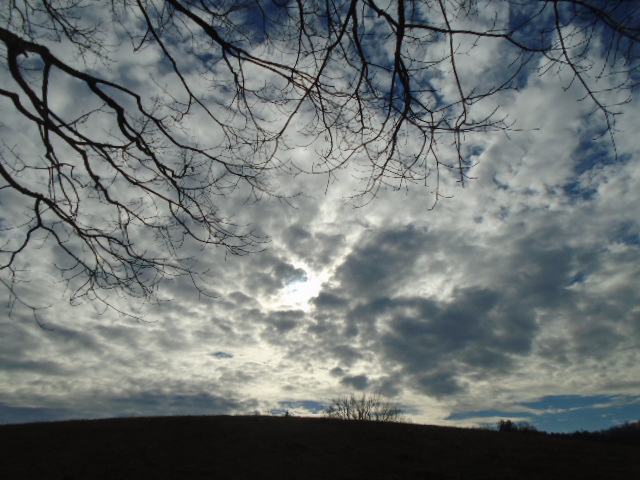
Winter Sky
Like this
“Like this,” says the titmouse, hanging upside down to get at the suet. “If you really want it, there it is.” “Like this,” says the January sun, one day icing us to our bones, and today like Spring, warm enough for rides on little boys’ new scooters. “Like this,” say the squirrels, entranced with each other, whirling ’round the branches, twining fluffy tails, intent on making new Squirrel babies. “Like this,” says the chickadee, landing near my toe, tiny and brave, ready to eat, scolding me to get out of the way. “You are here to live, so live.”
In her book Pentimento, author and playwright Lillian Hellman describes a phenomenon that often occurs when we return to a piece of art we once worked on after much time has passed: “Old paint on a canvas, as it ages, sometimes becomes transparent. When that happens it is possible, in some pictures, to see the original lines: a tree will show through a woman’s dress, a child makes way for a dog, a large boat is no longer on an open sea.” Hellman speaks of the way the aging paint allows for older layers to show through, offering an opportunity to see, in her words, “what was there for me once, what is there for me now.”
Like the painting Hellman describes, Torah, too, is a work in process. Layers and layers of interpretation have been added to it over time, according to the needs, desires, fears, and longings of those who devoted their lives to making meaning out of these sacred words. Some layers add to the beauty and power of the overall piece, strokes and shapes that bring the picture more clearly and compellingly into focus. And some accrue like varnish, making the painting hard and impenetrable. Each one of us is invited into this process of excavation, of peeling back layers of what we have been taught or what we think we know, and seeing, as Hellman writes, what is there for us now. And each of us is called to our creativity — to bring our brush back to the canvas anew, reencountering and reworking the stories, ideas, and images that lie at the very foundation of who we are and who we could be.
We live in difficult times. Daily we hear of culture wars, real wars, mass shootings, floods, fires and multiple other climate disasters and human clashes.
How on Earth can one maintain a positive outlook and experience genuine happiness? I’ve discovered a few activities that effectively pull me out of dwelling on past challenges or worrying about future uncertainties. These activities consistently guide me back to a state of inner peace and contentment.
Last year, I completed a life-changing yoga teacher training and spiritual development program at Supreme Peace Yoga and Wellness in Louisville, KY. One of its components was the creation of Soul Collage cards which were prompted by facilitator Jodie Tingle-Willis’s guided meditations.
The Soul Collage process is not only a profound way of connecting to the divine within and around us; for me, it is also a powerful vehicle for channeling poetry from this same source. My results from this multi-step creative process have led me to explore some pleasantly surprising spiritual terrain.
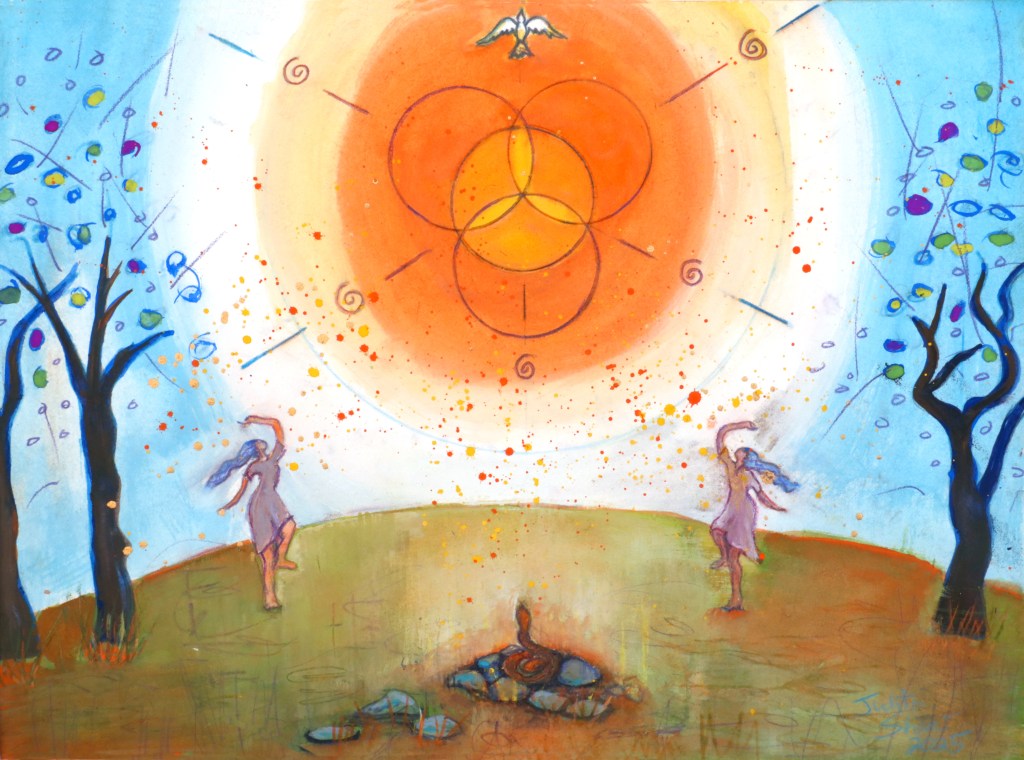
As an example, the card above was created after a visualization exercise around the idea of community—specifically, the small cohort of women in our training program, and the influence they had on me as we worked and learned together:
After some time had passed, I revisited the card and asked it once again to inspire me creatively. The result was this poem, which evokes an indigenous vision quest—an experience I have not had outside of this creative journey.
Moderator’s Note: Margot reads each of her poems aloud. They can be heard through the links in the titles.
“And what then is poetry?” We ask this time and time and time again. And poetry HERself answers. SHE needs no descriptor. Mimetic sagacity spells HER clarity. ~~~ Dreams be Fed I am a body that remembers
The joys of falling into hues of
Brilliant blues and greens.
I am a soul that trades in Cinnamon and spices.
Elevating chance. Caressing mystery. I am a will that conceives fat Ebullient Moon as Golden Goddess. Divine.
I love my new life in Portugal and I’m so happy and grateful to be here. However, I have encountered one major roadblock–I simply cannot replicate my daily writing routine that I’d relied on in the UK for nearly twenty years. I used to get up and leap right on the page, but now I keep horses on my property and their care and feeding come first, before I even get my human breakfast. And horse care is the last thing I do before sunset. If once I was a morning writer, now I’m a late morning/early afternoon writer. Writing gets sandwiched between horse care. Creative ideas bubble up as I ruminate while picking poo in the early morning. I’ve had to find a new rhythm that fits my new life.
Many of us, particularly many women, are struggling to find their daily rhythm while balancing the demands of remote-working with childcare, home schooling, and elder care as we enter the eleventh month of our global pandemic. This can be depleting, to say the least. To make matters worse, the old boundaries between work, family life, and “leisure” have unravelled and become impossibly blurred. Many of us feel under even greater pressure to be productive during this time.
Experts preach that we need to manage our time, plan every minute of the day by making little boxes for each task in our daily planner. I have tried to do this, but always rebel in the end. It seems a pointless task to try to force the flow of my day into orderly boxes. Instead I try to find what rhythms work for me so it feels organic rather than forced.
Now as a woman in my mid-fifties, I feel I have arrived at the other side of the mountain. I moved to Portugal, in part, to slow down. To be less frantically obsessed about work and career. To take a step back from the whole competitiveness of the writing world that can be soul-destroying and completely antithetical to the creative process. I’m done running myself ragged in some misguided attempt to get ahead. Perhaps I’m losing my “edge.” Perhaps this is what it means to be literally “over the hill.” You’ve come so far on your journey that it’s too late to return to old ways of doing things or old ways of seeing the world–the view is completely different up here.
Due to the radical reset of the pandemic, I think that a lot of people are arriving at this place, regardless of their chronological age. At some point we reach a peak of life experience beyond which there is no going back. We have entered a new landscape, brand new territory where the old maps will not get us anywhere. We have to seek a new direction. We have arrived in the place where we can claim our power, our inner sovereignty, and live our life to the rhythms that work for us.
For me this means abandoning the cult of productivity, the pervasive belief that living to work makes us virtuous. That our worth is determined by our output. This cult is particularly damaging to women who still carry the bulk of childcare and domestic work–the whole second shift of wife work that goes unrecognized, unvalued, and unpaid. I believe the majority of male productivity gurus can only adhere to their monastically rigid schedules because they have an unpaid woman in the background doing all the childcare and mopping up all the mess.
One thing I’ve learned the hard way is that, if we let it, the cult of productivity will completely poison both our creativity and our spirituality.
The cult of productivity diminishes our daily spiritual practice as yet another demanding task on our to-do list, a result-oriented form of competitive striving. “I’m not a serious spiritual seeker unless I get up at 5:00 am to meditate. How else will I be on track to achieve enlightenment?”
Spiritual practice is by its very nature the precise opposite of doing or striving. It’s letting go, surrendering to a state of pure being and receptivity, relaxing into the divine luminosity welling up in our hearts.
As for creativity, international best-selling author Hilary Mantel, one of my great idols, has written one of the best essays on the writing process I have ever read. Writing world-class literature, for her, is not a matter of locking herself in her office for eight hours a day or adhering to a rigid word count but of finding the right rhythm.
“I have to grab a notebook and write before I am properly awake,” she writes. “The day’s writing starts to unroll in my head. It’s fragile and often a matter of rhythm rather than words.”
Mantel stresses the importance of writers trusting themselves, trusting their creative flow, rather than obsessing about productivity. Good writing is not a matter of “persecuting paper with ink or pounding the keys. . . . You can’t measure your productivity day-to-day in any way the world recognizes.”
Then Mantel spills her secret that cuts the productivity gurus down to size:
I feel shy of saying this, because to non-writers it sounds lazy–but if, seven days a week, you can cut out two hours for yourself, when you are undistracted and on-song, you will soon have a book. Unoriginally, I call these “the golden hours.” It doesn’t much matter where I find them, as long as I do. I usually work many more hours. But sometimes I wonder why.
When we step into flow, either creative or spiritual flow, we enter a realm of timelessness, where our calendars and clocks dissolve into oblivion. We lose ourselves in that rich inner world. And it’s not forced. It’s not imposed upon us. The flow carries us. May we all be blessed with golden hours.
Mary Sharratt is on a mission to write women back into history. Her acclaimed novel Illuminations, drawn from the dramatic life of Hildegard von Bingen, is published by Mariner. Her new novelRevelations, about the globe-trotting mystic and rabble-rouser, Margery Kempe, will be published in April 2021. Visit her website.
In the ancient world, snakes represented fertility, creativity, rebirth, wisdom and, even, death. They were often closely connected to female goddesses, priestesses and powerful human females who were the embodiment of such powers. For example, there is the Minoan goddess/priestess holding the two snakes in her outstretched arms. She is closely linked with fertility and domesticity. Similar figurines, with similar associations and dating to approximately 1200 BCE, have also been founded in the land of what once was Canaan, where Israelites also lived. Medusa, in whose hair lived venomous snakes, turned men who looked at her to stone. Ovid’s account of the creation of Medusa credits the Greek goddess Athena with Medusa’s lively hair. Another Greek legend says Perseus, after killing Medusa, gave her head to Athena who incorporated it into her shield. Athena, the goddess of wisdom, is portrayed often with snakes wrapped around her as a belt and/or on the floor next to her. Continue reading “On Snakes by Ivy Helman”
The world at large might view artists and writers as free spirits rocking la vie bohème, but creative people know that it’s much more complicated than that, especially if we’re striving to earn even a modest living from our work. As a writer, I often fall into the trap of measuring my success or failure on factors completely beyond my control, such as the ups and downs of a fickle book buying market.
I know that I’ve often wrestled with the feeling that I’ll never be enough. Never be big enough, never be a bestseller. Sometimes it’s hard not to succumb to a flailing sense of helplessness—why are any of us doing all this? Worst of all is my fear of creative dryness—that my inspiration will turn to dust and I’ll never write—let alone publish—another book.
Thus through an enormous network of mythological narrative, every aspect of culture is cloaked in the relationship of ruler and ruled, creator and created. . . . [Sumerian] legend endows the Sumerian ruler-gods with creative power; their subjects are recreated as servants. . . . [This new narrative was] deployed with the purpose of conditioning the mind anew.(20, italics added)




 In the ancient world, snakes represented fertility, creativity, rebirth, wisdom and, even, death. They were often closely connected to female goddesses, priestesses and powerful human females who were the embodiment of such powers. For example, there is the Minoan goddess/priestess holding the two snakes in her outstretched arms. She is closely linked with fertility and domesticity. Similar figurines, with similar associations and dating to approximately 1200 BCE, have also been founded in the land of what once was Canaan, where Israelites also lived. Medusa, in whose hair lived venomous snakes, turned men who looked at her to stone. Ovid’s account of the creation of Medusa credits the Greek goddess Athena with Medusa’s lively hair. Another Greek legend says Perseus, after killing Medusa, gave her head to Athena who incorporated it into her shield. Athena, the goddess of wisdom, is portrayed often with snakes wrapped around her as a belt and/or on the floor next to her.
  The world at large might view artists and writers as free spirits rocking la vie bohème, but creative people know that it’s much more complicated than that, especially if we’re striving to earn even a modest living from our work. As a writer, I often fall into the trap of measuring my success or failure on factors completely beyond my control, such as the ups and downs of a fickle book buying market.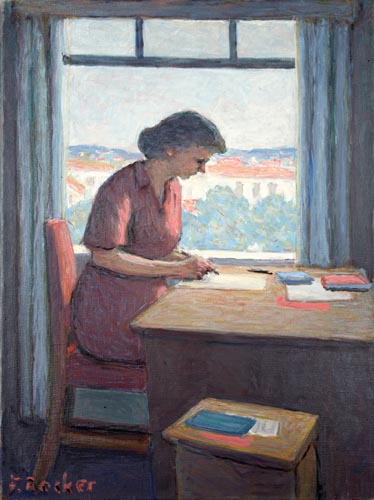
 Thus through an enormous network of mythological narrative, every aspect of culture is cloaked in the relationship of ruler and ruled, creator and created. . . . [Sumerian] legend endows the Sumerian ruler-gods with creative power; their subjects are recreated as servants. . . . [This new narrative was] deployed with the purpose of conditioning the mind anew.(20, italics added)
 Feminism and Religion