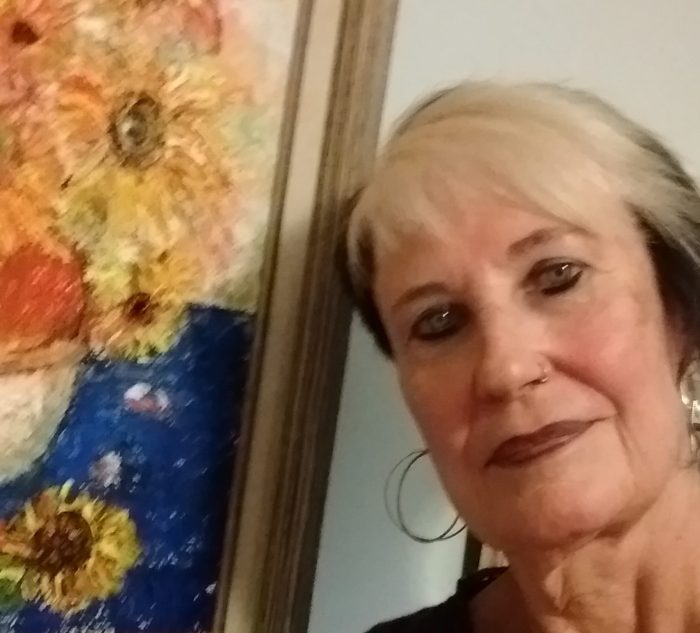
Abortion Rights (?) by Esther Nelson

Slowly, yet systematically, women, men, and everybody else along the gender continuum, are losing access to a timely, legal, and safe abortion. This is not breaking news. Pushback in the United States against abortion “rights” has been happening in various state legislatures for decades.  These days we find ourselves more and more constricted as laws across the country reflect a tightening of accessibility to what some people refer to as a “scourge” in the land.

My first-ever blog post on FAR (March 2014) wrestled with the subject of abortion.  In that essay (one that’s still relevant), I suggest we broaden our thinking about a subject that has polarized Americans. Is abortion (a) right?  Is it wrong? The two sides have become entrenched.


Continue reading “Abortion Rights (?) by Esther Nelson”

My Funny, Queer Valentine by Marie Cartier

I wrote a short story in the spirit of both my book Baby, You Are My Religion and Valentine’s Day for this month’s blog. Happy Valentines’ month. <3 Marie

She remembered that is what it had said, “To my funny, queer valentine.” She had thought then, as she squatted on the toilet at the If Club in downtown Los Angeles, 1963, trying to read the graffiti in front of her that yes, that is what it said. She thought to herself, Shirl, that is some graffiti. It read, “To my funny, queer valentine: I’ll miss you. I’ll always miss you.” Shirl could hear in the background Lesley Gore singing her new hit, “It’s My Party.”

Continue reading “My Funny, Queer Valentine by Marie Cartier”

Transitions by Esther Nelson

It’s been a rough couple of years.  Even though thousands of miles distanced us from the first-discovered Covid-19 outbreak (late 2019) in China, the virus soon traveled the world, doing what viruses do best—infect us, spread, morph, and then infect us, spread, morph all over again.  More than five million people worldwide, including close to one million Americans, have died as a result.  Shutdowns affected us economically and socially, making it difficult (sometimes impossible) to stay connected with family and friends.  

An effective vaccine arrived on the scene in early 2021, yet many Americans (half?) eligible for vaccination have refused the life-saving injections, citing a variety of reasons:  distrust of the vaccine—“It was developed too quickly;” invincibility—“I never get sick, never even had the flu;” and individualism—“Nobody gets to tell me what to do with my body.”  (Many of those “hands off my body” people, though, have no problem telling those of us who have a uterus what we can and cannot do with its contents.)

Continue reading “Transitions by Esther Nelson”

Professors, Sex, and the Academy by Esther Nelson

Amia Srinivasan (b. 1984) is a professor of philosophy at the University of Oxford.  Her recently released book, THE RIGHT TO SEX: FEMINISM IN THE TWENTY-FIRST CENTURY, is a series of essays, drawing on earlier feminist tradition, dealing with topics such as pornography, power, desire and more. 

The following New York Times opinion piece authored by Srinivasan, “What’s Wrong with Sex Between Professors and Students? It’s Not What You Think,” sheds light on that thorny question, pushing us to think further and differently about the stereotypical older male professor/younger female student sexual alliances at colleges and universities.  Although Srinivasan focuses on heterosexual relationships in her article, she also gives an example of a relationship between a lesbian professor and female student in an academic institution.

Continue reading “Professors, Sex, and the Academy by Esther Nelson”

Looking for Home by Esther Nelson

For as long as I can remember, I’ve been looking for home—home being both a beautiful, comfortable, geographic space as well as a peaceful state of mind/being.  For most of my life, I’ve “made do,” settling for wherever or whatever appeared before me.  I thought that was “good” and selfless behavior—shrinking my desires and wants to a size that made other people happy.  For women in our patriarchal society, shrinkage is a highly-prized quality, useful not just as a survival skill, but as a way of being in the world that allows things to run smoothly for somebody other than yourself. 

Recently, I’ve been trying to find some kind of balance while slogging through several major changes in my life that include loss of family, friends, and job.  Part of that balancing act involves looking for an esthetically-pleasing shelter/home in a place surrounded with natural beauty.  In addition, I would like to live in community with people who are adventurous, open to new ideas, and kind.

Continue reading “Looking for Home by Esther Nelson”

All We Have is Our Heart by Esther Nelson

One of my former students recommended UNFOLLOW to me, a memoir written by Megan Phelps-Roper, granddaughter of Fred Phelps (1929 – 2014), the (in)famous pastor of Westboro Baptist Church, Topeka, Kansas.

Some people may not be aware that Fred Phelps began his career as a civil rights attorney—someone who, in the 1960s, took on racial discrimination cases no other lawyer would touch.  Today, he is best remembered as a preacher who vociferously opposed homosexuality, spreading his message “God Hates Fags” both in the pulpit and while picketing in public spaces.  He and his followers also picketed the funerals of fallen soldiers with signs that read “Thank God for Dead Soldiers.” Phelps believed soldiers’ deaths (as well as natural disasters) to be God’s punishment for the country’s “bankrupt values,” especially the “sin” of homosexuality.  Hence, God unleashes calamity and catastrophe on the United States, a nation in dire need of repentance.

Continue reading “All We Have is Our Heart by Esther Nelson”

What Does a Woman Want? by Esther Nelson


Sigmund Freud (1856–1939), well-known Austrian neurologist and founder of psychoanalysis, “…said once to Marie Bonaparte: ‘The great question that has never been answered, and which I have not yet been able to answer, despite my thirty years of research into the feminine soul is, ‘What does a woman want?’” (“Was will das Weib?”) ― Sigmund Freud: Life and Work (Hogarth Press, 1953) by Ernest Jones.


I don’t believe Freud ever answered the question posed here satisfactorily.  Women’s desire—even today—hovers in the taboo category.  After all, in our hierarchal, patriarchal society women’s wants/desires are mediated through social structures and institutions that favor men.  It’s easy to overlook since we all are spawned and then swim in those patriarchal waters.

Continue reading “What Does a Woman Want? by Esther Nelson”

Anorexia Nervosa Take 2 by Esther Nelson

This past year (2020) has been a year of tremendous upheaval and unwelcome change for most of us due in large part to the COVID-19 pandemic. It’s the second time in my life (first time I was in my 40s) where I’ve responded to stress with anorexic behavior—not consuming enough calories to sustain a healthy weight.

Continue reading “Anorexia Nervosa Take 2 by Esther Nelson”

Is Authoritarianism a Christian Value? by Esther Nelson


Many Americans described the recent (January 6, 2021) attack on the Capitol in Washington DC as shocking.  I believe the event reflected one of the many times we’ve reaped the fruit of what we’ve sown throughout the course of American history.  Thomas Edsall, in a New York Times article (1/28/21), wrote an excellent piece titled, “The Capitol Insurrection is as Christian Nationalist as it Gets.”  He quotes a variety of experts on religion and other disciplines while contextualizing the incident within a religious narrative—something that is sorely lacking from our news outlets.

I think many people think of religion as something inherently good or at least as a neutral phenomenon belonging for the most part to an unearthly, apolitical realm.  Charles Kimball writes in his book When Religion Becomes Evil: “History clearly shows that religion has often been linked directly to the worst examples of human behavior… more wars have been waged, more people killed…in the name of religion than by any other institutional force in human history.” Continue reading “Is Authoritarianism a Christian Value? by Esther Nelson”

Good(?) Grief by Esther Nelson

The current pandemic has kicked our collective butt by putting a huge dent in our ability to maintain relationships so necessary for keeping our social gears greased and running smoothly.  Grabbing coffee with a friend or meeting up for lunch in order to “catch up” with one another are activities that in times past we took for granted.  Meetings nowadays (both work related and social) are done primarily via Zoom.  Even a doctor’s visit can be accomplished electronically—a mode that, in my opinion, leaves much to be desired.

Besides feeing socially deprived over the past year, I’ve experienced a number of other losses.  I’ll mention a few of them, but am not prepared to write about the ones that sting the most. I gave up my house in Richmond, Virginia, and moved to a high-rise condominium just down the road.  I’ve yet to make it “home.”  Halfway through the Spring semester, all classes at the university where I taught went online. The Fall semester followed suit, delivering classes (mainly) online.  I didn’t want to box myself in on a screen.  I find classroom interaction meaningful in a way that I cannot replicate on Zoom.  I gave up teaching.  In August, I drove to Las Cruces, New Mexico, and have been here ever since except for a brief visit in September to New Jersey for my brother’s funeral—another loss. Continue reading “Good(?) Grief by Esther Nelson”