From the Archives, Herstory Profiles: Irish Women of Faith, Activism and Politics by Anjeanette LeBoeuf

As it is March, and March is a month for me that is always devoted to celebrating my Irish roots and women, my Herstory Profiles will be on a few exemplary women from Ireland: Brigid (Irish Goddess and Catholic Saint), Margaret O’ Carroll of Éile (Paragon of Leadership, Strength, and Compassion), and Mary Robinson (Historic Leader, Activist, and Humanitarian.)

We look first to one of the most known religious, divine females in Ireland – Brigid. She plays a fascinating role as she is both in the Celtic Religion (Predates Christianity and can be considered part of the indigenous religion of the Celtic Isles) and as a Christian monastic/saint. She has many variations of names and celebrations but she is first and foremost  crucial and important enough to last through the ages and changes in religious traditions.

Brig, Brigid, Brigit – the Celtic Goddess of wisdom, poetry, healing, protection, smithing, and domesticated animals. There is evidence that she was considered at times, a triple deity; Brigid the Poet, Brigid the healer, and Brigid the Smith.

Continue reading “From the Archives, Herstory Profiles: Irish Women of Faith, Activism and Politics by Anjeanette LeBoeuf”

Legacy of Carol P. Christ: Maiden, Mother, Crone: Ancient Tradition or New Creative Synthesis?

This was originally posted on August 8, 2016

Carol P. Christ by Michael Bakas high resoultion

The image of the Goddess as Maiden, Mother, Crone is widespread in contemporary Goddess Spirituality. The Triple Goddess honors three ages of women, in contrast to the wider culture that: affirms young women as sex objects while shaming them as sluts; celebrates mothers on Mother’s Day, while providing few legal and economic protections for mothers; and ignores older women.

Though Goddess feminists have created rituals for menstruation and birth, I suspect that a greater number of rituals have celebrated “croning.” The reasons for this are twofold. One is that women have time and space to reflect on the meaning of life in middle age. The other is that aging women are not honored and respected in the wider culture–creating a need for rituals that do just that. Many women I know have spoken of the empowerment they felt in their croning rituals.

On the other hand, many women I know have not been particularly interested in a croning ritual.

Continue reading “Legacy of Carol P. Christ: Maiden, Mother, Crone: Ancient Tradition or New Creative Synthesis?”

From the Archives: Fireless Altars and Crone Encounters By Barbara Ardinger

This was originally posted on Nov 10, 2021

We’ve just entered November, the beginning of winter, the season of darkness. Twenty-odd years ago, I led a group of students through the Wheel of the Year in a class I called Practicing the Presence of the Goddess. (I also wrote a book with the same title.

At Imbolc (February 1), we held a divination party at Louise’s house. At Beltane (May 1), we met at Rose’s house, painted our faces, created wreaths of fresh flowers to embody our summer wishes, and then carried our wreaths of flowers through the streets of Huntington Beach to the ocean, where we cast them into the tide. At Lammas (August 1), we harvested our gardens and cooked a feast in my kitchen.

Continue reading “From the Archives: Fireless Altars and Crone Encounters By Barbara Ardinger”

From the Archives: The Daughter, the Alliance-Maker (Women in the Book of Daniel, part 2) by Liz Cooledge Jenkins

Note: This is the second in a two-part series reflecting on women in the biblical book of Daniel. This was originally posted on May 21, 2023

The second female character I noticed while taking a deep dive into the book of Daniel appears even more briefly. Daniel 11:6-7 includes her story: “The daughter of the king of the South will go to the king of the North to make an alliance, but she will not retain her power, and he and his power will not last. In those days she will be betrayed, together with her royal escort and her father and the one who supported her. One from her family line will arise to take her place” (NIV). It is a brief story—and not a happy one, in the end. But I think it’s worth reflecting on.

In this chapter of Daniel, an unnamed supernatural messenger gives Daniel a detailed account of a long series of violent power struggles between various kings. Empires accumulate and then are broken up (vv. 3-4). One king is strong, but his commander proves stronger and overtakes him (v. 5). Attacks are victorious, and valuables are seized and carried off (vv. 7-8). Retreats are made (v. 9). Great armies are assembled (v. 10). Kings “march out in a rage” toward battle (v. 11). Armies are carried off, and thousands are slaughtered (v. 12). You get the idea. Everything is violent. Everything is bloody. Everything is one brutal war after another, one brutal kingdom after another, one brutal ruler after another. It all starts to blur together.

Continue reading “From the Archives: The Daughter, the Alliance-Maker (Women in the Book of Daniel, part 2) by Liz Cooledge Jenkins”

Feminism – the small and the large of it by Xochitl Alvizo

Feminism’s critical principle is the affirmation and promotion of the full humanity of women; an assertion that must be made in light of a world that diminishes women’s dignity and autonomy thereby authorizing their subjugation. Sexism is the word we use to name the attitudes, prejudices, and actions that work to diminish women’s dignity and autonomy for their subjugation. Patriarchy is the resultant ossified system of those attitudes, prejudices, and actions as they become the norm. 

Continue reading “Feminism – the small and the large of it by Xochitl Alvizo”

Legacy of Carol P. Christ: Patriarchy As An Integral System of Male Dominance Created at the Intersection of the Control of Women, Private Property, and War, Part 3

carol p. christ 2002 colorPatriarchy is a system of male dominance, rooted in the ethos of war which legitimates violence, sanctified by religious symbols, in which men dominate women through the control of female sexuality, with the intent of passing property to male heirs, and in which men who are heroes of war are told to kill men, and are permitted to rape women, to seize land and treasures, to exploit resources, and to own or otherwise dominate conquered people.

As the discussion of patriarchy* I began last week and the week before shows, patriarchy is not simply the domination of women by men. Patriarchy is an integral system in which men’s control of women’s sexuality, private property, and war (including violence, conquest, rape, and slavery) each play a part. These different elements are so intertwined that it is impossible to separate one as the cause of the others.  Patriarchy is an integral system of interlocking oppressions, enforced through violence, and legitimated by religions.

The model of patriarchy I have proposed argues that the control of female sexuality is fundamental to the patriarchal system.  This explains why there is so much controversy about the “simple matter” of access to birth control and abortion in the US today. It also explains why so much vicious anger is directed at single mothers by politicians and commentators.  Any woman who dares to control her own sexuality is questioning the foundations of the patriarchal system. Continue reading “Legacy of Carol P. Christ: Patriarchy As An Integral System of Male Dominance Created at the Intersection of the Control of Women, Private Property, and War, Part 3”

Legacy of Carol P. Christ: Patriarchy as a System of Male Dominance Created at the Intersection of the Control of Women, Private Property, and War, Part 1

Moderator’s Note:  We here at FAR have been so lucky to work along side of Carol P. Christ.  She died July 14, 2021.  We have been reprinting her blogposts every Monday as that was her “day” for many years. This year we have decided that in honor of Carol we would reprint her important three part series on Patriarchy on three consecutive days. We plan to do this each year. In a world that seems to have gone mad, we feel that this series is crucial to understanding so much of our patriarchal world and it should not be forgotten. 

Recently feminist scholar Vicki Noble commented that this is the best definition of patriarchy she has read–but she hadn’t read it earlier. I am reposting it now in the hopes that all of you will share it with your social media so that it will be more widely known.

Patriarchy is often defined as a system of male dominance. This definition does not illuminate, but rather obscures, the complex set of factors that function together in the patriarchal system.  We need more complex definition if we are to understand and challenge the the patriarchal system in all of its aspects.

Patriarchy is a system of male dominance, rooted in the ethos of war which legitimates violence, sanctified by religious symbols, in which men dominate women through the control of female sexuality, with the intent of passing property to male heirs, and in which men who are heroes of war are told to kill men, and are permitted to rape women, to seize land and treasures, to exploit resources, and to own or otherwise dominate conquered people.*

Marx and Engels said that the patriarchal family, private property, and the state arose together. Though their understanding of the societies that preceded “patriarchy” was flawed, their intuition that patriarchy is connected to private property and to domination in the name of the state was correct.  It has long seemed to me that patriarchy cannot be separated from war and the kings who take power in the wake of war.  Many years ago I was stunned by Merlin Stone’s allegation that in matrilineal societies there are no illegitimate children, because all children have mothers. Lately, I have been trying to figure out why the Roman Catholic and other churches and the American Republican party are so strongly opposed to women’s right to control our own bodies and are trying to prevent access to birth control and abortion. In the above definition of patriarchy, I bring all of these lines of thought together in a definition which describes the origins of patriarchy and the interconnections between patriarchy, the control of female sexuality, private property, violence, war, conquest, rape in war, and slavery.  Continue reading “Legacy of Carol P. Christ: Patriarchy as a System of Male Dominance Created at the Intersection of the Control of Women, Private Property, and War, Part 1”

Herstory Profiles: Bletchley Park, the 6888th, and Communication by Anjeanette LeBoeuf

There is so much going on in our current state of affairs, that I found myself reaching for some sort of touchstone, centering agent, even some sort of calming force. As a scholar, as someone drawn to the humanities, I knew the path forward had to include our histories. This post will look at three examples of extraordinary women during WWII and beyond: the 6888th Unit, the women of Bletchley Park, and Julie Moore.

All three were introduced to me through popular culture, storytelling, and our dedication to preserving whole histories. At a time where we are seeing an active attack on our histories, humanities, arts, and our education systems it is even more vital that we continue to tell the stories, remember their names, and continue to walk the paths they have forged.

Continue reading “Herstory Profiles: Bletchley Park, the 6888th, and Communication by Anjeanette LeBoeuf”

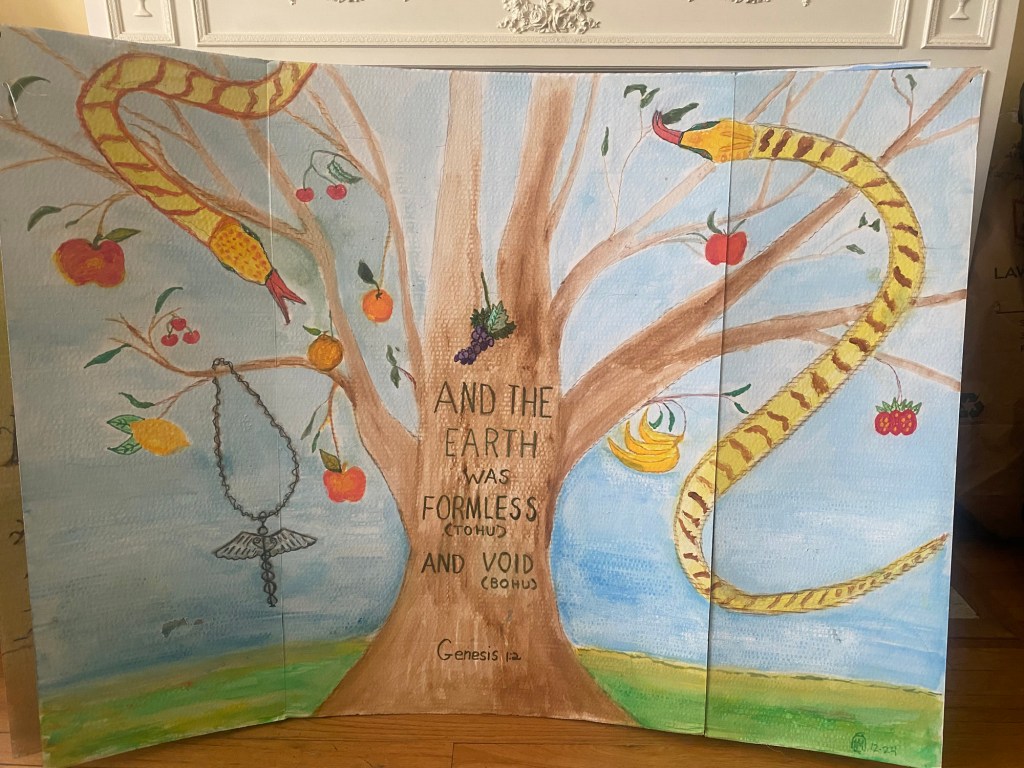
SheSpeaks! Eve by Janet Maika’i Rudolph

Author’s Note: I have begun a project called She Speaks! Women of the Bible Have Their Say. As part of this project, I have done five films with some very dedicated actors (friends of mine) who have dubbed themselves the SheSpeaks!Ensemble. I showed 4 of the films at the recent Yerusha Symposium. Based on the comments and reception, the project is now expanding. I am looking to create longer films that include story arcs. The first one will be of Eve. Below is the script for Eve along with the link to the video.

EVE speaks:

Why hello I don’t get visitors very often! Welcome. Come, come sit under my tree, let’s share some tea. I have the most wonderful and flavorful herbs here in my garden.

Look around at my most marvelous paradise. It is all filled with magical treasure. I’ll tell you a secret, the treasure I care for spans both the heavens and the earth. You see, we are at the place where spirit, breath and matter intersect. Where the living beings of earth and the animating forces of the divine join in harmony.

It is so hard to look at your holy book. I can’t imagine why I keep getting blamed for . . .well . . . just about everything.  It’s strange that your world wants to connect me with curses as I am the giver of life. In fact, did you know that my name Eve means life. I don’t understand what has become of you, my children. It is said that I brought a curse to humanity. Do you see life as a curse?  Let me tell you a bit about myself. Perhaps then you will see me differently.

Continue reading “SheSpeaks! Eve by Janet Maika’i Rudolph”

So, You Think You’re a Feminist? The Culturally Palatable ‘Feminism’ of The Barbie Movie by Tallessyn Zawn Grenfell-Lee

People are often surprised to learn that I actually love Barbie. Years ago, I heard a BBC interview with Ruth Handler, the creator of Barbie. In a world of baby dolls for mothering creative play, she wanted her daughter – Barbara – to have the opportunity to imagine other things, too. A computer scientist. A top executive. An astronaut. (The film shows a bit of this early intent.) Of course, no one would support her idea. Then, one day in Switzerland, she was walking past a toy shop and saw a small, plastic, adult, female doll. She had finally found a prototype! 

Unfortunately, this original Lilli doll had been created to depict an alluring, sassy, provocative “golddigger, exhibitionist, and floozy.” And Ruth specifically didn’t want her doll to be stereotypically ‘beautiful,’ because she didn’t want it to hurt girls’ self-esteem. But the only manufacturer willing to create the dolls was in Japan; their English was so limited, she finally picked up a file and literally filed off the plastic nipples in order to explain that she didn’t want the doll to have nipples. 

Continue reading “So, You Think You’re a Feminist? The Culturally Palatable ‘Feminism’ of The Barbie Movie by Tallessyn Zawn Grenfell-Lee”