Feeling Weary about US Politics by Carol P. Christ

Carol by Honegger cropped

Like many of you, I was anxious and angry during most of the Trump administration years. I watched MSNBC avidly, hoping against hope that a) he could be stopped or b) he would be impeached. Now that he is gone, it would be nice to be able to take a “breather” (I wasn’t breathing regularly during the Trump years), a break from thinking about US politics all the time, but sadly, the political situation in the United States continues to require attention.

President Biden has pleasantly surprised me with his progressive domestic agenda and his decision to remove troops from the heretofore endless war in Afghanistan. Nonetheless, he has proposed an increase in the military budget. Dwight David Eisenhower, who warned of the increasing power of “the military-industrial complex” as he left office, must be turning over in his grave.

Most worrying of all is the fact that so many Americans voted for Donald Trump, believe that the election was stolen from him, and support white supremacy, while the Republican party refuses to deviate from the Trumpian worldview.

As if it could not be any worse, police killings of innocent black men by white officers and mass killings by young white men with easy access to automatic weapons are proliferating. Moreover, Republican-inspired voting restriction legislation is once again threatening the foundations of our democracy. Continue reading “Feeling Weary about US Politics by Carol P. Christ”

THE DIVINE DRAMA AND THE UNIVERSALITY OF DEATH* by Carol P. Christ

In Greece the liturgies of lent and especially of the week before Easter are known as the “divine drama,” in Greek theodrama.  This may refer to the “drama” of the capture, crucifixion, and resurrection of Jesus and to the suffering of God the Father and Mary.

However, it is important to recall that the drama in ancient Greece referred to both the tragedies and comedies, most specifically, those that were performed in the theater of Dionysios in Athens.  While we have been taught that the Greek tragedies celebrated “downfall of the hero” due to his “tragic flaw,” it is important to remember that Dionysios was the original protagonist of the Greek tragedy: it was his death and rebirth that was first celebrated.

Some have argued that the Greek tragedies should never be “read” alone, for they were always “performed” in tandem with the comedies, which were followed by the bawdy phallic humor of the satyr plays.  The tragedies end in death and irreparable loss.  But if the comedies and satyr plays are considered an integral part of the cycle, death is followed by the resurgence of life.

Continue reading “THE DIVINE DRAMA AND THE UNIVERSALITY OF DEATH* by Carol P. Christ”

Out with the Old: In with the New by Carol P. Christ

A few days ago, a Greek friend told me she was going to bring holy water from a church so that we could bless my house. Ever since I moved to my new apartment in Heraklion, I have intended to do a house blessing, following rituals I learned from Z Budapest. But with unpacking and settling in interrupted by illness, I never got around to it. I did burn frankincense early on to clear out vibes left by the previous inhabitants of my space, but nothing more. I have slowly made the house a home, but I have been waiting for the renovations to be finished before doing a final blessing. As I still anticipate remodeling the kitchen island, I did not proceed.

Before my friend arrived, I incensed the house again, musing that now that I have finished my chemotherapy and am on the road to recovery, it is high time to clear out all the lingering feelings and memories of the time I was very ill. When my friend arrived bearing a small plastic bag filled with water from a church spring, she asked if she could water the plants on my balcony. I had watered them the day before, but I didn’t mention that.

Announcing that she loved to play with water, she doused the plants, then hosed the balcony tiles and sprayed the windows which were covered with dust following a recent dirty rain. As there are balconies surrounding all of my rooms, that completed the cleansing. Watering the plants signaled the renewal of life.

Continue reading “Out with the Old: In with the New by Carol P. Christ”

Aren’t We All Divine Children? by Janet MaiKa’i Rudolph


Consider the following four birth stories:

  1. A high priestess became pregnant in a manner that was forbidden in her society. She gave birth to a baby boy. Fearing for her child’s life, she fashioned a basket of rushes and cast him into a river. He was retrieved by a man named Akki whose name means “the drawer of water.” Akki raised the boy.
  2. A son was born to a young princess who had been forced to keep her pregnancy a secret because it was forbidden. When her son was born, she placed him in a basket and floated him down the river. He was found and raised by foster parents. He grew up to become a noted warrior, speaker and eventually a king. 
  3. A young boy accidentally ingested some drops of star-studded wisdom from the cauldron of a goddess and, in this manner, was suddenly awakened to divine knowledge. The goddess grew furious that her divine wisdom was stolen. Desperate to escape her life-threatening wrath, a wild chase ensued. The boy turned himself into a rabbit, but the goddess turned herself into a dog to chase him down. The boy turned himself into a fish to swim away but the goddess became an otter to continue the chase. The boy then turned himself into a bird, but the goddess became a hawk. Finally, the boy turned himself into a seed and hid in a large pile of grain. The goddess turned herself into a hen and ate up all the grain including the boy-as-seed. In this manner she found herself pregnant. She planned to kill the baby when he was born, but when she saw him, he was so beautiful that she fell in love and she could not bring herself to do so. The goddess sewed the baby into a leather sack and threw him into the river. He was retrieved by a man named Elphin who renamed and raised him.
  4. A woman of the priestly caste of her tribe gave birth to a baby boy. At the time, all boys born to her tribe were under a decree of death. To save her son’s life, she created a basket of reeds and floated him down the river. He was found by a royal princess who retrieved him from the water, gave him a new name and raised him to adulthood.

Continue reading “Aren’t We All Divine Children? by Janet MaiKa’i Rudolph”

What If We Begin from the Hypothesis that Ancient Crete Was Matriarchal, Matrifocal, and Matrilineal? by Carol P. Christ

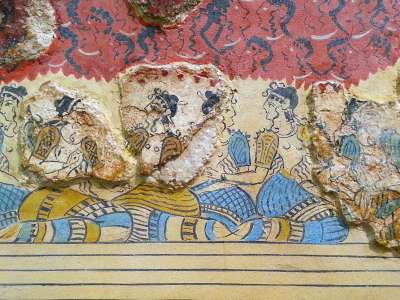
If we begin from the hypothesis ancient Crete was matriarchal, matrifocal, and matrilineal, what would we expect to be the central focus of the its religion?* Harriet Boyd Hawes and her colleague Blanche E. Williams presented an incipiently feminist, woman-centered, analysis of the religion of ancient Crete in Gournia, the book describing their excavation of a Minoan village at the beginning of the twentieth century. Boyd Hawes argued that the archaeological evidence showed not only the pre-eminence of the Goddess, a conclusion with which Williams agreed, but also the strength and independence of women in a culture she defined as matriarchal and matrilineal, centered around the Mother family. If ancient Crete was matrilineal, matrifocal, and matriarchal, we should expect to find evidence that women were not only strong and independent, but also that they had leadership roles in religion and culture. Williams noted the presence of priestesses. The miniature frescoes from Knossos show a group of older women sitting in the place of honor and a group of women performing a ritual dance. Where evidence concerning leadership roles is lacking, it should not be assumed that leadership must have been in the hands of men.
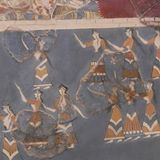
We should not be surprised to find the Goddess or mother earth to be at the center of rituals and ceremonies in ancient Crete. However, to say that the Goddess is central begs the question of what we mean when we say Goddess. In the west, deity is understood to be transcendent of the world, imaged as a dominant male other, and as the judge of the living and the dead. Citing the Oxford English Dictionary, archaeologist Colin Renfrew bases his discussion of Minoan religion on the idea of divine transcendence. But if we accept Marija Gimbutas’ insight that the Goddess represents the powers of birth, death, and regeneration in all forms of life, a different picture emerges. The Goddess is immanent in, rather than transcendent of the world. She is the enlivening force in human beings and all of nature. She is not the judge of the living and the dead, for the dead are returned to her body. Unlike later Greek deities, the Goddesses of Old Europe and ancient Crete are not generally portrayed as idealized human beings. Though they often have eyes, breasts, and sacred triangles, they also have beaks and wings, are shaped like mountains, and decorated with flowing lines symbolizing rivers or streams. These hybrid forms suggest that all of life is in the image of divinity and that humans are not higher, better, or separate from other life forms. Hybrid images celebrate the connection of all beings in the web of life and call human beings to participate in and enjoy this world, not to seek to escape or rise above it. A religion centered around gratitude for life in this world is very different from one that centers around fear and judgment and a longing for life after death. Jacquetta Hawkes’ insight that the religion of ancient Crete celebrated “the grace of life” is exactly right.
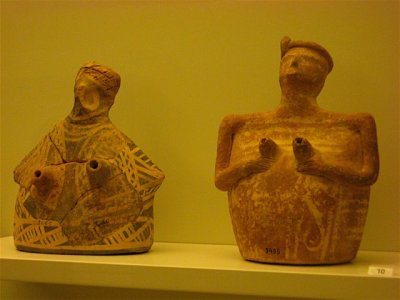
Is the Old European or Minoan Goddess one or many? Monotheists have insisted that there can be only one God, yet polytheists revere a plurality of images, while animists celebrate the spirits of (perceived) living beings such as rivers and trees, mountains and caves. The terms monotheism and polytheism are not neutral. Both were developed by monotheists: monotheism describes the correct beliefs of the self; polytheism, the false beliefs of the other. I find theologian and liturgist Marcia Falk’s distinction between exclusive and inclusive monotheism helpful in resolving the question of the one and the many. According to Falk, inclusive monotheism is an intuition of the unity of being within the diversity of the world: celebrating the unity of being, it welcomes a plurality of images to represent diversity and difference in the world. From this point of view, the boundaries between monotheism and polytheism are porous. When Gimbutas spoke of the powers of birth, death, and regeneration in all of life, she was referring to the unity of being underlying the diversity of life forms, including plants, animals, and human beings. Similarly, when indigenous peoples speak of mother earth as the giver of all and all beings as relatives, they recognize that all life is sustained by a single source. The fact that ancient Cretans imaged divinity in different ways and with different characteristics does not require the conclusion that they worshipped many discrete deities as some archaeologists argue: I suggest that they intuited a unity of being while celebrating the diversity of life. This appears to have been the conclusion of Williams who wrote of “the prominence of a goddess under various aspects.”

If matrilineal, matrifocal, and matriarchal cultures tend to view the earth as a great and giving mother, we can expect this insight to be expressed in rituals and ceremonies. Gratitude is the appropriate response to gifts freely given. I suggest that gratitude for the gift and gifts of life was not only a focus, but the central focus, of religion in ancient Crete. If this is so, we should expect to find rituals celebrating the gift of life in the birth of babies, the coming-of-age of girls, as well as in as well as in death rituals honoring the ancestors. We can also expect to find rituals honoring the mother line and expressing gratitude for the wisdom of ancestors. Many of these rituals would have taken place in the matrilineal House as archaeologist Jan Driessen suggests. Rituals for the ancestors might also have taken place in cemeteries. We should also expect to find rituals expressing gratitude for the food that sustains life, for example, in offerings of first fruits to mother earth and in the pouring of libations that are absorbed back into her body. If, women invented agriculture, and if as Gimbutas argued, Old European religion celebrated the processes of birth, death, and regeneration in all of life, we should find rituals focused on planting, harvesting, and storing seeds. Some of these rituals might have taken place in the matrilineal Houses, while others surely took place in nature and in the fields. If pottery-making and weaving were understood to be mysteries of transformation involving birth, death, and regeneration, we might find evidence of rituals associated with these activities in the Houses or in workshops. It is known that rites in ancient Crete involved trees, mountains, and caves, as well as water sources. We must ask if and how such ceremonies expressed gratitude to the mother earth, the source of life, and the cycles of birth, death, and regeneration.

*These musings are part of an early draft of the methodological prologue to an essay I have been asked to write on Religion in a Minoan Village to be published in the archaeological report on recent excavations at Gournia. In the preceding part of the prologue, I discuss the theories about matriarchal, matrifocal, and matrilineal cultures of Harriet Boyd Hawes, Blanche E. Williams, Marija Gimbutas, Heide Goettner-Abendroth, and others.

Carol P. Christ is an internationally known feminist and ecofeminist writer, activist, and educator who lives in Heraklion, Crete. Carol’s recent book is Goddess and God in the World: Conversations in Embodied Theology. Carol has been leading Goddess Pilgrimage to Crete for over twenty years: join her in Crete. Carol’s photo by Michael Honneger.

Listen to Carol’s a-mazing interview with Mary Hynes on CBC’s Tapestry recorded in conjunction with her keynote address to the Parliament of World’s Religions.

The Last Chemo by Carol P. Christ

When I went to the hospital for chemo on Thursday, the doctor told me it would be my last one. That was a surprise. I thought I would have at least one more. But it was a good surprise, because I had felt more tired than usual after my most recent treatment. Apparently, I had started to feel a bit better when my cancer became inactive, but chemo is cumulative, and it caught up with me.

I slept well on Thursday night. On Friday morning I felt great relief and joy thinking that my chemo was ending. I called a number of friends to tell them the good news. I suspected that I might feel very tired for a few weeks from the last dose of chemo. But after that, all of the symptoms caused by the chemo would begin to lessen—including numbness in my right foot, instability, lack of energy, shortness of breath, anemia, and hair loss.

By the mid-afternoon the tiredness set in again. This time I did not get the few good days that I have attributed to a prescribed dose of cortisone to counter the effects of the chemo. Even though I predicted that the last chemo would make me very tired, there is a part of me that wants this all to be over—and now! 

But in truth it will not be. Not for months. Continue reading “The Last Chemo by Carol P. Christ”

The Sacred Face of Death by Eirini Delaki

The archetype of the Weaver is being widely activated. Thousands of women and men come forth to incarnate it by creating webs of spiritual awakening, by honoring ancestral ways of being, and by promoting practical and sustainable ways of living and thriving.

However, many of these efforts collapse due to a lack of genuine communication inside the group.  How can we direct our intentions into grounding a vision that is broader than ourselves? How can we weave together in such a way that each feels heard and, at the same time, willing to deeply listen and feel into, not only the group as a set of individuals, but also to what is making its way into birth out of the group as a unit?

Although it seems easy, group synchronization is not a light task and, in order for this to happen at a substantial level, one has to start from oneself.  It is necessary for a kind of initiation to take place, an initiation called “soul individuation.” Soul individuation is a deep dive into one´s own underworld in order to unearth and liberate experiences that have caused one´s soul to fragment. Until this is achieved, one can communicate only from that broken place, not from a place of wholeness and authenticity.  Journeying to the underworld is not a pleasant process but, it is a necessary step towards balance and integrity. Continue reading “The Sacred Face of Death by Eirini Delaki”

Living with Cancer Treatment by Carol P. Christ

At the end of July 2020, I was diagnosed with stage 3 aggressive cancer. As of this week, I will have been receiving a very high dose of chemo (5 hours on the drip every 3 weeks) for 6 months, with 2 treatments to go. When I was diagnosed with cancer, I was in a state of shock. As I was about to leave the oncologist’s office, I said to the doctor, “stage 3 is pretty bad, isn’t it?” He responded, “Well, it could have been stage 4.”

As I understand it, the prognosis for becoming cancer free for stages 1 and 2 is good, for stage 4 it is unlikely, while for stage 3, the chances are something like 50-50. Although my primary oncologist declines to make predictions, I was told by a junior doctor that with the type of cancer I have, my chances were about 40% that the surgery that would follow chemo would remove all of the cancer.

Despite the fact that my chances were less than 50-50, for the most part I remained optimistic that I would be one of the lucky ones. I have not suffered depression, nor have I been overcome with anxiety. Although my primary doctor and the others I have seen are not interested in discussing the effects of prayer, meditation, and visualization, to a one they have said that “attitude” makes a big difference.

I attribute my ability to remain optimistic to several factors. I am not afraid of death. Continue reading “Living with Cancer Treatment by Carol P. Christ”

Delilah Reclaimed by Janet Maika’i Rudolph

*This post includes a call for stories at the end.

In my previous blogpost, I wrote about the Biblical tale of Samson and Delilah and why it was likely written in a manner to hide older pagan mythos. You can read it here: Delilah Lost. I promised to share my own myth about the story and tell it as best as I can.  Here it is:

Samson was known as one of the strongest forces in the galaxy, a shining light in the sky. Humans would one day recognize his rays of light as his hair. In the infinity of time, his attention was drawn to movement in the star system known as Sorek. Looking more closely, he saw a woman dancing in dazzling motion while draped in star dust and star light. He could hear the slight tinkle of bells as she shimmered. It was as if the heavens themselves were shouting ha-la-hu-ya at her beauty. She noticed his gaze and winked back at him, tempting him with her swirls and her sparkling eyes. He was enthralled. Continue reading “Delilah Reclaimed by Janet Maika’i Rudolph”

It’s Time to Thank Stacey Abrams Again by Carol P. Christ

The insurrection in the Capitol on January 6 has dominated the news ever since. Coverage of the Democrats’ victories in the two Senate runoffs in Georgia has been virtually nil. Now that it seems that at least as long as the National Guard is deployed to defend the national and state capitols, the insurrectionists have been stopped, it is time to thank Raphael Warnock and Jon Ossoff–and most of all to Stacey Abrams–for returning control of the Senate to the Democrats.

As is well-known to most readers of FAR, Stacey Abrams narrowly lost the election for Governor of Georgia in 2018 due to voter suppression.

Voter suppression of voters of color and young voters is a scourge our country faces in states across the nation.  Georgia’s 2018 elections shone a bright light on the issue with elections that were rife with mismanagement, irregularities, unbelievably long lines and more, exposing both recent and also decades-long actions and inactions by the state to thwart the right to vote. 

In response to widespread nation-wide efforts of Republican dominated states to suppress the vote, Stacey Abrams founded Fair Fight. Continue reading “It’s Time to Thank Stacey Abrams Again by Carol P. Christ”