Why Are You So Angry? by Vanessa Rivera de la Fuente

32809382544_f804118009_b

Please be warned, this post details violence against women.

A new March 8.
Another year protesting
Another evening taking the streets of our cities around the world
In Rome, in Lima and Santander
A new slogan, a new banner, for the same rage

A decent man, one of those who define himself as a good citizen and father stands in front of me asking: “Why are you so angry? …. Why are feminists so angry? I am asking you: Why are you so fucking angry?”

Why are you angry?
Because my friend went to the police to put a complaint that her husband beat her and they did not take the complaint. When she returned home, her husband hit her again.

Why are you angry?
Because I am 16 years old and every day after school, older men shout sexual things to me in the street, they even follow me and when I get upset and tell them not to do it they say that I am being rude … I am afraid to walk in the street. Continue reading “Why Are You So Angry? by Vanessa Rivera de la Fuente”

A Feminist Retelling of Cain and Abel by Trelawney Grenfell-Muir

Eve and Adam had many children. Two of them, the sisters Cain and Abel, were best friends. When they grew up, Cain became a farmer, and Abel became a shepherd. In their community, people shared what they had with each other. They shared this way in order to help the community be strong, and to practice gratitude. They shared with each other in sacred, holy ceremonies, in which they put their communal offerings onto an altar for Sister God/ess, to be blessed. One day, both Cain and Abel brought an offering to their community. Cain brought some food she had grown, and Abel brought a sheep. The community gathered for the ceremony. They prayed prayers of gratitude and blessing, and thanked the Earth for its abundance. They each laid hands on the sheep and thanked her for her life, blessed her spirit that it might journey peacefully and joyfully to reunite with Sister God/ess, and praised her for giving her body to feed the community.  Then they killed the sheep, as quickly and carefully as they could, and set the meat in the sacred fire to cook. Abel was glad that she could help her community be fed and healthy with the sheep she had given.

Continue reading “A Feminist Retelling of Cain and Abel by Trelawney Grenfell-Muir”

The Feminist-O-Meter by Vanessa Rivera de la Fuente


Not my way to see Feminism_ then that's NOT Feminism_

Have you heard about, applied or received the Feminist-O-Meter lately?

The Feminist-O-Meter is a tool that often appears in feminisms and women rights activisms, fostering power struggles, cliques, jealousies and -if that is not enough – encouraging the reproduction of mainstream socialization that fosters competition and alienation among women.

It can be summed in the expression:

“Not my way to see Feminism? Then, that’s NOT Feminism”

I see feminisms as revolutions of subjectivities based on the radical idea that women are people … and it turns out that people are diverse, we are the result of our experience and the way we interpret them.

So, I do not understand why there is so much drama, judgment, outrage and social punishment in feminist spaces when those involved are undertaking the process of discovery, of claiming back our personhood by legitimizing our different ways of thinking, our understandings of liberation, and our acknowledgment of what makes us happy and makes us feel feminist.

Continue reading “The Feminist-O-Meter by Vanessa Rivera de la Fuente”

Breaking the Silence by Chris Ash

Christy CroftYesterday, Time Magazine announced that its “Person of the Year” for 2017 would be “The Silence Breakers” – the name it has given to those women who helped launch and made headlines in the #metoo movement. This movement was started by activist Tarana Burke in 2006 to highlight the sexual abuse of women of color and was sent viral by actor Alyssa Milano in 2017. It speaks volumes that this designation falls exactly one year after Time awarded this honor to Donald Trump for the political shift heralded by his defeat of Hillary Clinton.
This defeat that was fueled, at least in part, by the way Trump’s own normalization of sexism, harassment, and assault played on the fears and bitterness of misogynist voters hell-bent on preserving what racial, gender, and economic privilege they could continue to hoard for themselves and those like them. This defeat, and the ensuing glorification of a sexual predator and rampant misogynist, in turn fueled a movement of people, mostly women, tired of being scared into silence to protect the powerful who abuse. Continue reading “Breaking the Silence by Chris Ash”

Kintsugi for the Soul – Part I – by Vanessa Rivera de la Fuente

Kintsugi2

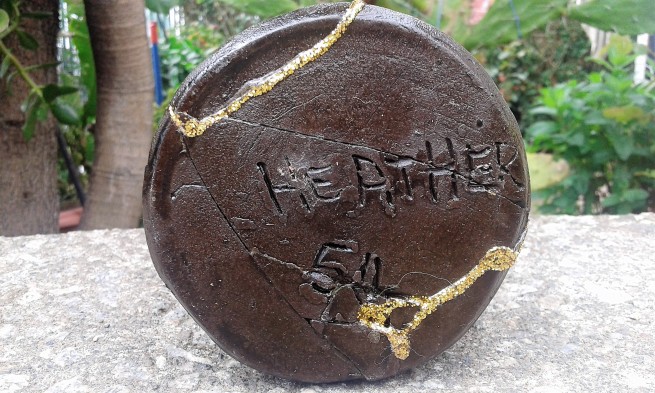
Kintsugi is a Japanese art technique that consists of repairing broken porcelain or pottery with resin varnish dusted or mixed with gold, silver or platinum powder. It is the art of fixing what has been broken with a precious metal that gives a greater value than that which the piece originally had. Kintsugi makes objects become a testimony of a particular journey.

In September 2015, in Cape Town, my fiance and I went to have lunch and listen to a concert at the Waterfront. Walking through the artisan market, we were struck by a stand where simple mugs of clay and pottery were displayed. Each one of them had been made by a woman survivor of some type of violence or trauma, which put her name and the imprint of her hands. Mugs had no handle, the way to take it was to put your hands in the hands of the woman. So, she connected with you and became part of your daily journey. Moved by the deep transcendence of the initiative, we got a pair. Mine was made by Heather, 54 years old. Continue reading “Kintsugi for the Soul – Part I – by Vanessa Rivera de la Fuente”

Asking for Help by Carol P. Christ

I climbed trees and rode my bike and roller skated on sidewalks for hours on end when I was a child. As an adult, I have always been physically strong without having to work at it. Nor have I had to think much about my health. I have been able to trust my body to do pretty much everything I wanted it to do. I am also fiercely independent. And I don’t always like to be touched because my body is extremely sensitive to other people’s energies.

On the Goddess Pilgrimage to Crete I was always the first one in and out of the caves and usually the first or one of the first up and down the mountains too. This changed when I injured my knee a few years ago in one of the caves and then six months later re-injured it in a fall on my front steps. I was told not to stress my knee by the pharmacist, and as a consequence stopped walking and doing yoga. I began to lose my physical strength. Continue reading “Asking for Help by Carol P. Christ”

Please Keep It in Your Pants by Carol P. Christ

Trigger warning: this post describes sexual abuse

Last week while responding to a comment on my blog, I suddenly remembered a series of incidents in which men I did not know exposed themselves to me in public places. The first time occurred at a park around dusk during an outing with a group of girls. I was about 11, I may have wandered away from the group, or I may have been with others. What I remember is seeing a man with his pants down sitting on a park bench, possibly the first time I ever saw an adult man’s penis. I told or we told, but the man was not reported by the adults. Fast forward to the beautiful gardens of the Palace Schoenbrunn in Vienna where I was confronted by a penis while lost in thought when I was 19. I ran, but said nothing. In my 20s at the early showing of movies in New York City men would sit next to me and jerk off into paper bags. Continue reading “Please Keep It in Your Pants by Carol P. Christ”

Rest and Renewal: Gifts of Women’s Ritual Dance by Laura Shannon

 Samhain is past, and we in the northern hemisphere are once again entering the final outbreath of the solar year. At the winter solstice, light will be reborn. Until then, it is important to embrace the time of rest and renewal which is the great gift of this season. Like the falling leaves and the drying seeds, we too can relax and release old burdens. This is the best way, perhaps the only way, to draw new strength for the next active phase in the ever-changing cycles of our lives.
Many of us no longer follow the rhythms of the year and consequently subsist in an ongoing state of near-exhaustion. But rather than letting our energies get too depleted, we can learn to thrive within the limits of our available resources. As well as vastly improving the quality of our lives, this may lead to solutions for sustainable living in the long term – perhaps the most important skill humanity needs to develop now.  Continue reading “Rest and Renewal: Gifts of Women’s Ritual Dance by Laura Shannon”

Women and the Ethics of Conflict by Vanessa Rivera de la Fuente

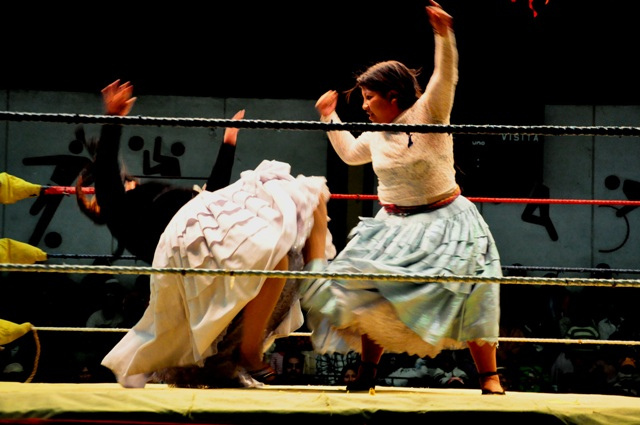
Cholitas wrestling

Some time ago, trans-activist F.  was the target of bullying and harassment via social networks that lasted months and included defamation on Twitter and Facebook, articles in feminist blogs and web sites, and letters to women’s organizations and public institutions to request they ban the presence of F. from feminists spaces. Who did this? Feminists who had been F. friends. Why? For a disagreement with F.

In fact, F. was obliterated from women’s movements and even lost job opportunities. The most serious, perhaps, was the deep depression that affected her and the loneliness in which she had to live this experience.

Cases like these are examples of a behavior that is not strange, but instead is pitiful and very harmful — the destructive socialization of females to please patriarchy and to reproduce patriarchy and oppression at the expense of our integrity as women.

Women fight with the guns of patriarchy

We have been domesticated, trained to obtain the approval of a man and of the patriarchal system at any cost, to do whatever it takes to have a place at his side. We are the result of centuries of pedagogy that creates mistrust between women, and the validation and reproduction of our oppression and conditioning towards mutual competition. This is the root of our inability to deal with conflicts between us in a constructive and non-dehumanizing way. We can only give of what we have and as long as we have an identity as objects instead of individual people, women will be expert agents of misogyny.

Being a feminist, an scholar in gender studies doesn’t excuse or free anyone from this, at all. Continue reading “Women and the Ethics of Conflict by Vanessa Rivera de la Fuente”

Reflections on Marriage by Ivy Helman

studyMy partner and I are getting married in a little over a month.  She, a lawyer, and I, a professor, live in the Czech Republic.  Technically, we aren’t getting married because the Czech Republic doesn’t have marriage equality.  Our relationship will not be recognized in the U.S.  For that, we need to be married in a state or nation that has marriage equality.  Germany might soon.  Other options would be a number of EU countries or the United States, but that doesn’t affect our status in the Czech Republic.  Finally, our marriage will also not be recognized by some in Jewish circles as well since the ketubah, the Jewish marriage document which possesses legal status in Jewish courts, is between two women.

There is nothing legal about our Jewish wedding except one could argue its Jewishness. So, the day after our wedding our relationship will have the same recognition as it had the day before and the day before that.   This would not be the case if we were a heterosexual couple.  It reminds me of the countless commitment ceremonies that took place before marriage equality in the United States.  They were not prohibited (like the marriages that slaves had because slaves weren’t considered people under the law or eligible to enter into legal contracts while in bondage (see pages 301-302).  Yet, similar to the “contubernal relationships” of slaves performed by their masters or other slaves (page 302), they weren’t particularly legal either.  Despite the ceremony, there was no change in status of the couple within society.  Yet, recognition was and still is an important component of both struggles for rights.  In fact, according to Darlene Goring in “The History of Slave Marriage in the United States,” (345-346), the process of gaining legal recognition was very similar for both ex-slaves and the marriage equality community in the United States. Continue reading “Reflections on Marriage by Ivy Helman”