BARBARA LEE SPEAKS FOR ME by Carol P. Christ

carol christWhile I was in Crete on the Goddess Pilgrimage teaching about and experiencing a Society of Peace where violence and domination were neither celebrated nor encouraged, another war broke out in Iraq, breaking my heart, breaking all of our hearts—yet again. When will we ever learn, oh when will we ever learn?

Barbara Lee was the only member of Congress to vote against the US war powers authorized after 9/11 which were used to launch war in Afghanistan; she also voted against authorization for the Iraq war in 2002. Hillary Clinton voted for the Iraq war, despite clear indications that the US administration was lying about weapons of mass destruction—which were never found in Iraq. I voted for Barack Obama because he opposed this war. Then he listened to General Petraeus and expanded the war in Iraq. Barbara Lee speaks for me. Hillary Clinton and Barack Obama do not.

The Iraqi people are once again living in fear of their lives as reports surface that armies and militias are engaging in mass executions of their so-called “rivals.” Is there any cause that could justify this? Continue reading “BARBARA LEE SPEAKS FOR ME by Carol P. Christ”

Inner and Outer Darkness in the Skoteino Cave by Coleen Clare

Coleen ClaireLast fall I undertook the Ariadne Goddess Pilgrimage to Crete and saw many wonders. Foremost for me was our descent into the Skoteino Cave, following in the footsteps of ancient Cretans who understood the cave to be the Source of Life, the womb of the Goddess, and a place of transformation. I ventured down tentatively taking very wary steps, protecting my two new hip replacements, determined to join our sacred ritual in the cave with my sisters. My hips called a stop to my descent half-way down. I perched perilously on a small rock ledge and there I confronted inner and outer darkness. It was indeed a profound transformation. Continue reading “Inner and Outer Darkness in the Skoteino Cave by Coleen Clare”

GIVING BACK TO THE MOTHER by Carol P. Christ

carol-christOne of the inspirations for the Goddess Pilgrimage to Crete was the spiritual power and energy I felt at the monastery of Paliani with its Sacred Myrtle Tree.  The Panagia, She Who Is All Holy, is said to live in the tree, and the nuns who tend the tree follow customs far older than Christianity.  When I first visited Paliani, I asked Her to heal my broken heart and help me find my true love.

panagia palianiOver the years, I have offered many other prayers:  for my books and tours, for health, for citizenship that would enable me to stay in Greece.   I tell other pilgrims that the Panagia of Paliani has performed many miracles and repeat the story of the doctors who desperately wanted to have a child, who had tried everything, and who had a son a year to the day after making a prayer at Paliani. I point to the many “tamas,” including gifts of precious jewelry, crutches and body braces that have been given in honor of the power of the Panagia of Paliani.

In the fall of 2012 one of our members prayed that a heavy flow of menstrual blood that often lasted for more than half of every month be stopped so that she would have the strength to participate fully in the pilgrimage. She had been bleeding for 5 weeks when she came on the tour, and her bleeding stopped the moment she touched the tree.  Continue reading “GIVING BACK TO THE MOTHER by Carol P. Christ”

IS THE SPIRIT OF GREAT GENEROSITY IN CRETE A SURVIVAL OF ANCIENT MATRIARCHAL VALUES? by Carol P. Christ

carol-christAt a coffee shop in Agios Thomas, Crete last month a perfect stranger offered to pay for the coffees and sodas of the 16 women on the Goddess Pilgrimage to Crete. This spirit of great generosity is rarely experienced in the United States or other parts of Europe, but it is still common in rural Crete and some parts of Greece.

 In fact our group was in Agios Thomas because our bus driver Babis, also in a spirit of great generosity, insisted on stopping to show us his village when we were passing nearby. He guided us to see Roman rock cut tombs and arranged for the early Byzantine church to be opened. At the end of the our pilgrimage, Babis stopped the bus at a wooded glen beside a small church where he offered us his own homemake raki, wine, and olives, accompanied by local sheep cheese he had purchased while we were climbing a mountain. After every meal that we ate in local tavernas, we were offered bottles of cold raki, fruit, and sweets.

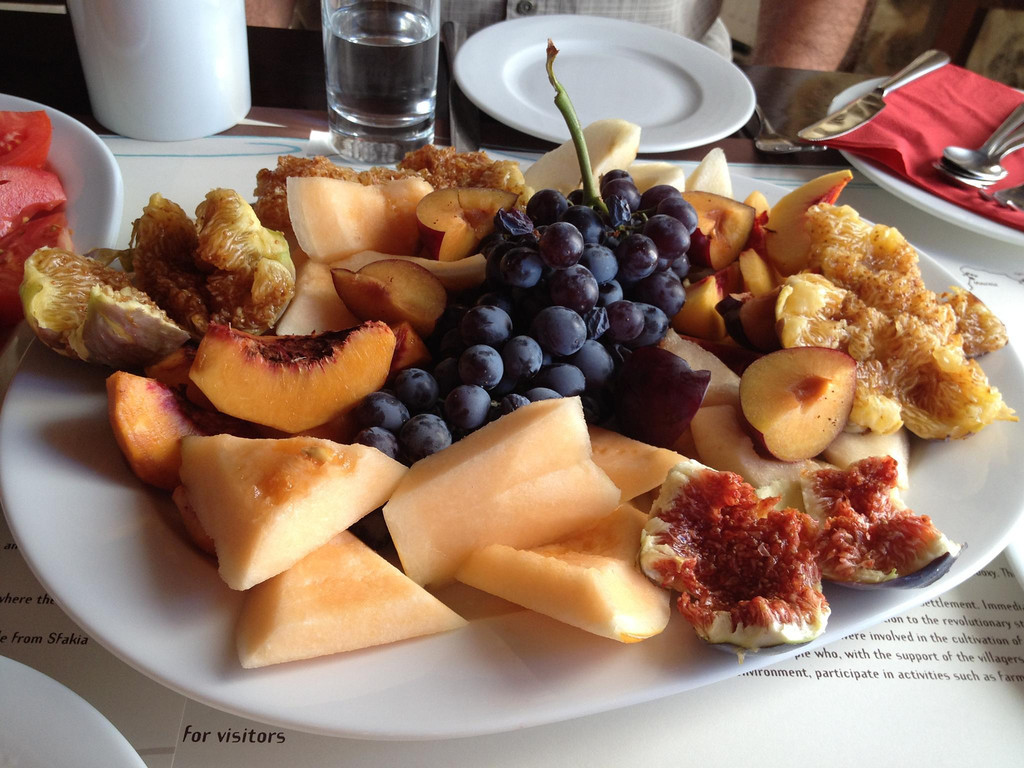
crete fruitsThis spirit of great generosity has long been commented on by travelers in Greece, who often speak of it as unexpected (for them) hospitality to the stranger or traveler. That it is, of course. Through the work of Heidi Goettner-Abendroth, I now understand that the famous Greek hospitality to the stranger has deep roots in matriarchal cultures. According to Goettner-Abendroth, equality of wealth is assured through the widely-practiced custom of gift-giving in matriarchal cultures. Continue reading “IS THE SPIRIT OF GREAT GENEROSITY IN CRETE A SURVIVAL OF ANCIENT MATRIARCHAL VALUES? by Carol P. Christ”

She Who Has Faith in the Unknown by Jassy Watson

Jassy_Agora1-150x150I am sharing the following story, that with a few recent alterations, I wrote as a university paper last year in a course on Ancient Religions. It is significant for me presently because it is a year almost to the day that I embarked on Carol Christ’s Goddess Pilgrimage to Crete. Seeds of transformation were planted on Greece, therefore naturally I have been reflecting and reminiscing not only on my Odyssey, but also on the full circle I have come since.

Today, from my hometown of Delphi, I will make pilgrimage to the Temple of Apollo. I will make this journey alone for I seek answers to questions of a personal nature. I have waited patiently through the cold and barren days of winter, even coming summer and autumn past, failing to see the Pythia with each visit, for during these times of uncertainty the Temple has been busy with representatives from many cities. All recognise the importance of Apollo as a mediator of disputes and a champion of law and stability. Everyday concerns like mine are least important compared to those matters of war and men. I come however, not seeking answers from Apollo, but rather from our great mother Gaia, for all know that it is she who has resided here since the beginning. I feel it in my heart that I will be heard today, for spring has arrived, and concerns over battle have been put aside for the festival ‘Theophania’, a celebration of Apollo’s return. The countryside is bursting with new life, the sky is clear and the womb of the great mother is abundant; I sense blessings for a brighter future. Continue reading “She Who Has Faith in the Unknown by Jassy Watson”

THE LABRYS: A RIVER OF BIRDS IN MIGRATION by Carol P. Christ

carol-christ“There’s a river of birds in migration, a nation of women with wings.” Goddess chant, Libanalabrys seal ring

On the Goddess Pilgrimage to Crete, I explain that many of the names given to “Minoan” (c. 3000-1450 BCE) Cretan artifacts and architecture are products of patriarchal and Eurocentric imaginations, and as such, are misleading.  For example the name “Minoan” was given to the culture of Bronze Age Crete in honor of “King Minos,” who was said to have ruled in Crete a few generations before the Trojan War–several hundred years after the end of the culture to which his name was attached.  In fact, despite his eagerness to find evidence that King Minos ruled at Knossos, the excavator Sir Arthur Evans finally had to concede that the best he could do was to produce a fresco of a “Prince of the Lilies” which he identifed as the image of the male ruler of the culture he called “Minoan.”  Evans’ Prince had white skin, a fact that Evans conveniently overlooked–because according to his own interpretation of “Minoan” iconography, white skin would mark the figure as female.  Mark Cameron, who reviewed Evans’ reconstruction of the fresco, suggested that the Prince is more likely to be a young woman who is perhaps leading a bull to take part in the bull-leaping games.  He also stated that the “crown” belonged to another fresco altogether.

Evans’ failure to find evidence of a King or for that matter a Queen at the complex of buildings he called “The Palace of Knossos” calls into question his idea that these structures were palaces.  Nanno Marinatos argued that the “palace” was instead a ritual center for the surrounding village, as well as a community gathering place, a place for storing grain, wine, and oil in a sacred way, and a place where ritual objects were fashioned of clay, bronze, stone, and gold.  Following her lead, I renamed the “Palaces” “Sacred Centers.” In this blog I will experiment with renaming the “Minoan” culture “Ariadnian,” after the pre-Greek name Ariadne, which may be one of the names of the Goddess of Bronze Age Crete.

One of the most pervasive–and many would say–most enigmatic symbols of the Ariadnian culture is the labrys.  Continue reading “THE LABRYS: A RIVER OF BIRDS IN MIGRATION by Carol P. Christ”

A Gift Economy: Could It Be Better To Give Than To Receive? by Carol P. Christ

carol p. christ 2002 colorIn a gift economy inequalities are balanced out by the cultural practice of gift-giving. If you have more, then you give more, if you have little, you still feel it is better to give than to receive.  A person who hoards wealth is not viewed positively.

The worldview of a gift-giving economy is so far from our own that we can barely comprehend it.

marika's rakiIn Skoteino, Crete, eighty-seven year old Marika awaits eagerly for the arrival of our group. She does not come empty-handed to join us after we have finished a meal lovingly prepared by Christina.  Marika brings a bottle of raki and urges us all to join her in downing a small glass of her homemade moonshine.  Often she offers us nuts she has cracked or raisins she has prepared as well .  She has almost nothing and lives without many modern conveniences, but she would not consider joining us without bringing a gift.

In Zaros, we arrive at our favorite hotel only to be told that the taverna that serves fresh trout is closed because the owner’s son will be getting married in the evening. When I complain that we have come to eat the special trout, our whole group is invited to the wedding.  Outside the taverna the grandmothers light fires under massive copper pots where they prepare the food. Over 600 people have been invited to the wedding. We are first served macaroni with virgin olive oil and goat cheese, then lamb, then goat, and salad. When the wine runs out, bottles of raki are brought to the tables. We dance all night long in a kind of a frenzy. Continue reading “A Gift Economy: Could It Be Better To Give Than To Receive? by Carol P. Christ”

What Is Love? by Jassy Watson

Jassy_Agora1-150x150I asked this question at the family dinner table, on facebook, and by e-mail.  Many heartfelt responses were offered, all insightful. Some spoke of romantic love, sexual love (eros), self-love, spiritual love, the love a parent has for a child, unconditional love (agape), primal love, authentic love, universal love, divine love, the source of love, friendship (philia), love of nature, and love of a pet, while others considered the destructive nature of love. What was demonstrated by these conversations was that not only are the possibilities of love’s expressions endless, but there can ultimately be no right or wrong answer when it comes to the meaning of love. Our cultural, familial, religious and spiritual backgrounds all play a part in the way we think and feel about love.

I was raised in a secular, middle-class, two parent, two children, cat, and sometimes a dog kind of family. Despite the usual ups and downs, our family life was full of love. I remember having feelings of love as a child that were so incredibly overwhelming I would be brought to tears. I loved everything and everybody. Mum still reminds me that if I could have, I would have brought every elderly person along with every stray animal home to look after. After reading about the process view in Carol Christ’s book She Who Changes: Re-Imagining the Divine in the World, I see now that this love I felt was born out of feelings of deep sympathy.

Because we did not have a religious or spiritual background, I had no idea what divine love meant. My idea of the divine was the male, Christian, biblical God that our family rejected. It is said that Christian love is selfless and is best seen in actions such as compassion and kindness. This may be so. But selflessness, compassion and kindness are not limited to Christian values. They are human values. In his book The Art of Happiness, the Dalai Lama says that “love and compassion are necessities, not luxuries. Without them humanity cannot survive”. All religious, spiritual and philosophical traditions speak of the values of love. They say that love encompass compassion, kindness, selflessness, acceptance, gratitude, sympathy, sharing, grace, justice, charity, and liberation. They also speak of tension, wrath, discomfort, unkindness, loss, and judgement. For me, love is all these things and more.

Ancient myths address these values of love through tales of passion and devotion. Diane Wolkstein celebrates some of these myths in her book The First Love Stories. Each story expresses a distinct aspect of love. For instance: the tale of Isis and Osiris represents love that is stronger than the forces of nature, Innana and Dumuzi expresses the cyclical quality of love; Shiva and Sati reveals the eruption of passion and the taming of the mind; the Song of Songs celebrates love’s yearning; the story of Psyche and Eros portrays the forging of the self. All of these stories emphasize the sacred nature of love.

For me, having children awakened a love so very deep within. When I gazed into the eyes of my first born son at the tender age of 18, I was so overwhelmed by love I thought my heart would burst. I now have four children a husband and a loving extended family and friends who all teach me much about the true nature of love. They teach me above all else that love is patient, non-judgmental, and unconditional. It is through the growing awareness of my spiritual being and my journey with the Goddess that love has become something deeper than I ever thought possible. Love, for me has become a union with something higher than my individual self. My love extends beyond the family to include every living being on this planet and beyond. It is not just all about giving and receiving, but rather it is a state of being. It is personal yet universal and comes from deep within my sub-conscious. Love for me, not unlike the tales woven in ancient myth, is profoundly sacred.

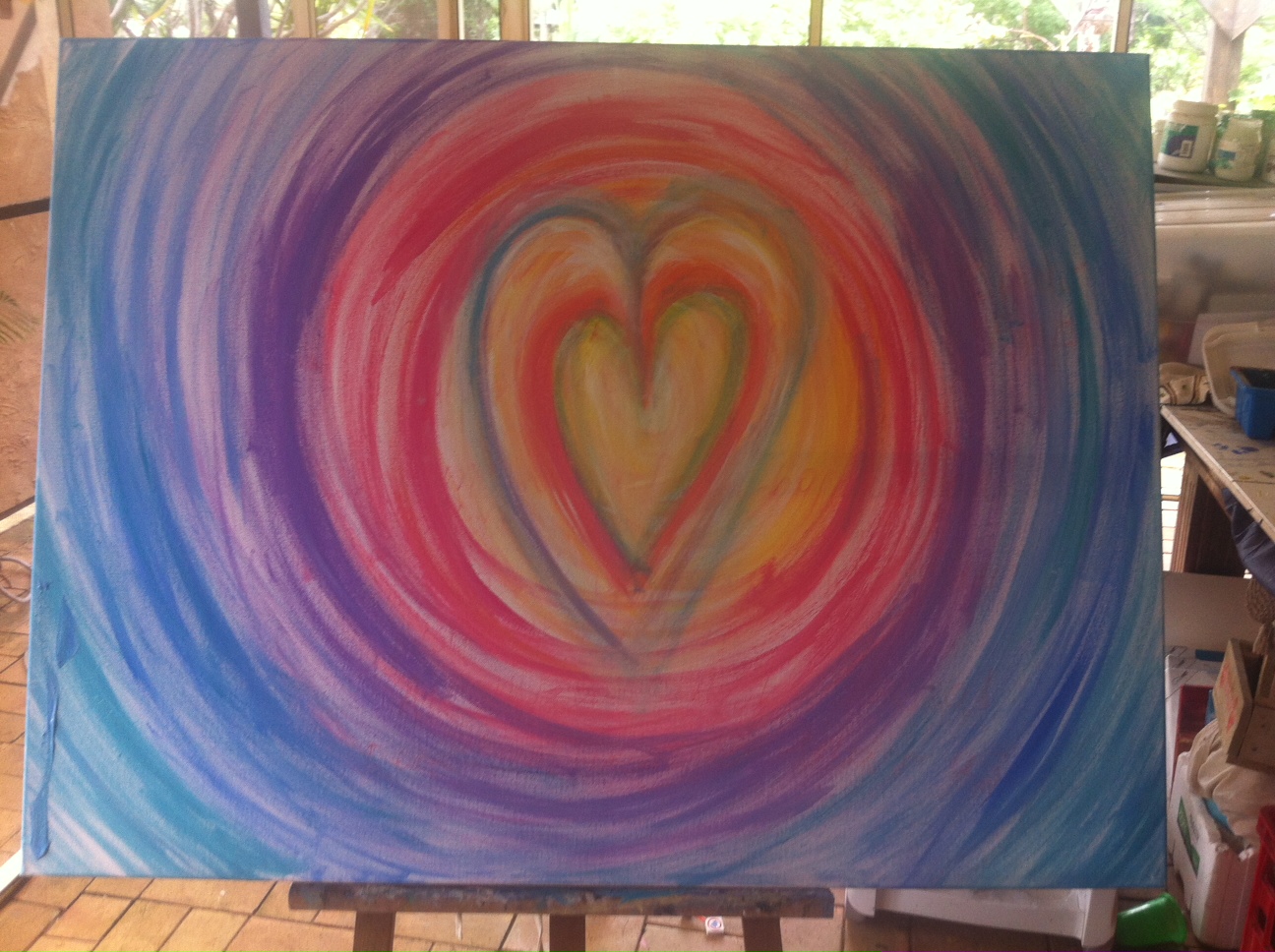
Embodied with love I set out to create my next painting. Out of this portal of love:
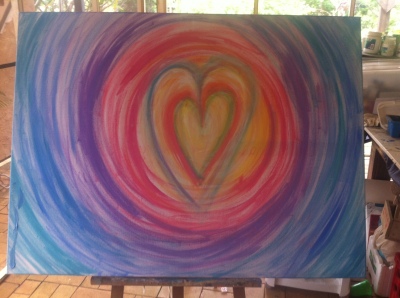

Portal of love, WHAT IS LOVE?  by Jassy Watson

Aphrodite, Goddess of love, pleasure and relationships, in all her glory was born. Continue reading “What Is Love? by Jassy Watson”

Gratitude and Sharing: Two Fundamental Principles of Goddess Spirituality by Carol P. Christ

carol p. christThe more I practice the spirituality of the Goddess, the more I understand that earth-based spiritualities are rooted in two fundamental principles:  gratitude and sharing.  We give thanks to the earth for the gift of life. As we recognize our interdependence and interconnection in the web of life, we are moved to share what has been given to us with others. *

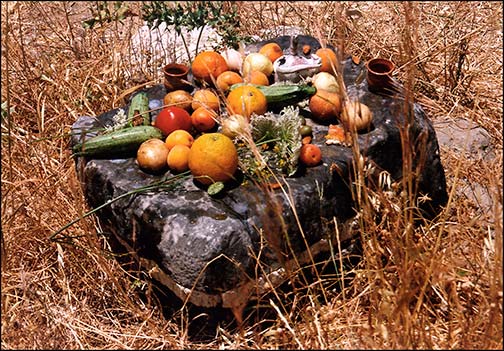
When I first began to lead Goddess Pilgrimages in Crete, I was inspired by a line in Homer to begin a pilgrimage tradition of pouring libations of milk, honey, water, and wine on ancient stones. At first I knew the form, but not its deeper meaning.  It gradually dawned on me as I thought about the large number of pouring vessels in the museums, the altar stones, and the Procession Fresco from Knossos, that an important part of Minoan rituals involved processions in which people offered first fruits back to the Mother whose body had produced them, and poured libations on altars.

kernos stone kay keys

Over twenty years of performing the ritual of pouring libations has convinced me that this was not “a” but “the” central Minoan ritual.  Its purpose is to thank Mother Earth for the bounty She has bestowed on us. Continue reading “Gratitude and Sharing: Two Fundamental Principles of Goddess Spirituality by Carol P. Christ”

Miracles Of The Great Mother by Jassy Watson

Jassy under the Holy Myrtle tree Paliani conventjassy Panagia in tree

I was brought up in a household where attitudes to God and church were quite negative. My Nanna, however, was deeply religious, and I can still remember sitting in her dining room as a very young child staring up in awe at a painting of  ‘The Last Supper.’ I was completely mesmerised, there was something haunting about that painting that left a lifelong impression. Art became a passion very early on in life, and whenever I came into contact with images of a religious nature emotions stirred. I was spellbound by divine mystery. The most profound feelings were engendered when I met with images of Mother Mary and the infant Jesus. Continue reading “Miracles Of The Great Mother by Jassy Watson”