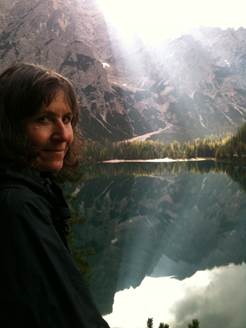
Remembering Carol P. Christ: Online Memorial Gathering, December 20, 2021

Dear FAR community,

It’s been wonderful to read so many posts remembering Carol Christ. The FAR community was so important to Carol: as has been pointed out, she not only offered her own posts each Monday, she also read and responded to every post, every day. Through the FAR ‘family’ I feel comforted by connecting with others who knew and loved her and miss her as as I do.

Online Memorial Gathering On December 20, Carol’s birthday, all friends of Carol and friends of FAR are warmly invited to an online Memorial Gathering and ritual in Carol’s honour. Many of Carol’s friends will share cherished memories (please email me if you would like to say a few words) and I will show some photographs from her personal archive. (If you have photos of Carol you would like to share, please email them to me at laura@laurashannon.net.) We’ll also talk about the future of Carol’s Goddess Pilgrimage in Crete. Please register with your email address at this link.

Continue reading “Remembering Carol P. Christ: Online Memorial Gathering, December 20, 2021”

Trial by Fire, Healing by Water by Carol P. Christ

It wasn’t really fire. I came home to Lesbos from a soulful Goddess Pilgrimage to Crete and a discouraging emergency meeting of the Green Party Greece totally exhausted and wanting nothing more than to rest. It was the hottest June on record and my house with its many windows felt like a furnace. Due to a dispute with the installer, it took eleven days to get the air-conditioning fixed. My little dog who could see when I left for Crete, was blind when I returned. I wondered if I would have to put her down and could not bear the thought. I was so tired and so hot that I could not think straight. It was beyond my capacity to even consider moving to a hotel. I didn’t have the energy to unpack. And I didn’t have a car as the old one had been sold and the new one was still at the dealership in Crete. So I couldn’t escape. Instead I tried to hold back tears.
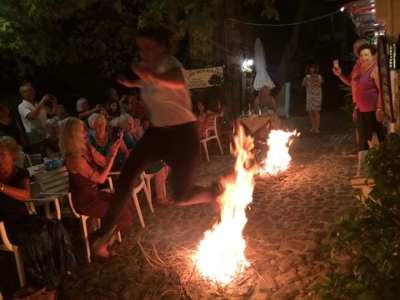
After the air-conditioning was finally fixed, I was able to unpack, wash my clothes, and repack for my return to Crete. The night before I was to leave, I jumped the St. John’s day (midsummer) fires. The locals say they jump the fires for fertility (jumping fires does warm the nether parts) and health. In the photo I am sitting at a table directly behind the first fire, but I soon got up and jumped all three of them, affirming the powers of birth, death, and regeneration.

Continue reading “Trial by Fire, Healing by Water by Carol P. Christ”

The Lost Is Found by Carol P. Christ

Since I wrote “Claiming the Power to Choose to Our Lovers” and “Choosing to End Love” in the spring, my beloved and I came back together and parted again, not once, but twice.  At the end of the summer, believing our separation to be final, I decided to drop a miniature copy of the Minoan bee pendant, symbol of my desire to “let go of a beautiful dream,” into a crevice in the Skoteino Cave while on the Goddess Pilgrimage to Crete.

I don’t believe in divine intervention, but something happened to stop me. The day before the ritual, the pendant disappeared. It was not in my jewelry case, not in my handbag, not anywhere in my suitcase or my hotel room: it was nowhere to be found. That same day I received a gift of a large jar of honey from a local shopkeeper. In the end, I dropped a sugar-coated almond into the crevice and poured every bit of the honey onto the altar of the cave, asking for transformation and love. Continue reading “The Lost Is Found by Carol P. Christ”

Learning Gratitude for the Gifts of Life on the Goddess Pilgrimage to Crete by Carol P. Christ

In Crete we are always being given gifts—fresh cherries, ice cold bottles of raki, yogurt swimming in honey, and so much more. Over the years it finally hit me that this spirit of great generosity is a living remnant of the ancient Cretan egalitarian matriarchal tradition of gift-giving.

In egalitarian matriarchal cultures gift-giving is not something reserved for birthdays and holidays. It is a way of life rooted in the primary understanding that life is a gift that is meant to be shared.

Our lives are a gift from our mothers. Our individual lives have are not something we create or created for ourselves. We all emerged from the body of a mother. We were all given the gift of care and feeding by a mother or others. Our mothers did not create themselves. They emerged from the bodies of mothers and were cared for and fed by mothers or others. And so on back to the original mother of the human race, known as the African Eve.

Continue reading “Learning Gratitude for the Gifts of Life on the Goddess Pilgrimage to Crete by Carol P. Christ”

Honey: A Thousand Flowers by Mary Beth Moser

Today I am finishing the last bit of the honey I hand-carried home from my most recent trip to Trentino. Sun yellow in color, it is made from the nectar of mountain flowers. Its label tells its origin—di montagna, of the mountains, and its type — mille fiore, often translated as “wildflowers.” Literally, however, it means “a thousand flowers.”

The valley where my maternal grandmother was born, Val di Sole, is renowned for its honey. In Croviana, one of the villages in the valley, new honey is celebrated in July with a sagra, a communal food festival. There are more than a dozen different types of honey from Trentino, including apple, chestnut, and rhododendron. These are plants of place – nature’s gifts that appear in the folk stories and are present in everyday life. Continue reading “Honey: A Thousand Flowers by Mary Beth Moser”

Woman and Nature: Our Bodies Are Ourselves by Carol P. Christ

This earth is my sister; I love her daily grace, her silent daring, and how loved I am how we admire the strength in each other, all that we have suffered, all that we have lost, all that we know. We are stunned by this beauty, and I do not forget: what she is to me, what I am to her.

These words are from Susan Griffin’s Woman and Nature which I often recommend as one of my favorite books. Over the years I have read this passage and others from Woman and Nature aloud with my students, and we have always been moved, most  of us to tears. More recently these words have become the center of the “Morning Blessing” on the Goddess Pilgrimage to Crete.

In the epigraph to the book Griffin writes,

These words are written for those of us whose language is not heard, whose words have been stolen or erased, those robbed of language, who are called voiceless or mute, even the earthworms, even the shellfish and the sponges, for those of us who speak our own language . . .

Continue reading “Woman and Nature: Our Bodies Are Ourselves by Carol P. Christ”

FAR Press Publishes A Serpentine Path: Mysteries of the Goddess by Carol P. Christ

carol-p-christ-photo-michael-bakasThis is a great day for me as I announce the publication of A Serpentine Path: Mysteries of the Goddess. It is the first —but certainly not the last—book from the new FAR Press, directed by Gina Messina and Xochitl Alvizo, two of the founders of www.feminismandreligion.com. The release of my book is the fruit of friendship and collaboration that has been nourished in the blog community. I hope you will join with us in celebrating our joint venture by ordering the book, telling your friends about it, sharing it Facebook and Twitter (links below), reviewing it on Amazon, and letting Gina and Xochitl know if you can review in a magazine, journal, or blog.
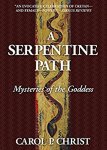
Here is an excerpt from the preface to whet your appetite.

*

A Serpentine Path is a story that begins in despair and ends in rebirth and regeneration. It depicts a turning point in my life, a psychological and spiritual breakthrough that opened me to living the rest of my life in grace and joy. Though I am tempted to say it was a journey from darkness to light, that would be inaccurate, for mine was a journey into the darkness and out again. The path of life is never straight or narrow, and the circle of light and darkness is never-ending.

When I began the journey described in A Serpentine Path, I did not feel loved, I did not want to live, I could not write, and I believed the Goddess had betrayed my faith. As I completed the book, I knew I was loved, I wanted to live, I was writing, and I understood that the Goddess had never abandoned me. Though my life has had its ups and downs since then—as all lives do—I have never forgotten that I am loved, I have wanted to live, I have not stopped writing, and I feel the Goddess ever-present in my body, in my breath, and in my connections with the living and the dead. Though my story is deeply personal, my struggles with love and death, trust and control, are widely shared.

A story of finding the Goddess, A Serpentine Path is part of a growing genre that is developing as women explain to themselves and others why they left the patriarchal religions of their origins for a more nourishing spiritual vision that affirms both women and the earth. A Serpentine Path documents the first of the Goddess Pilgrimages to Crete I have been leading twice a year since then. For the women who have traveled with me, it will evoke many memories. For those who have dreamed of a pilgrimage to the Goddess, it offers an opportunity to imagine the journey. I now know a great deal more about ancient Crete, the folklore and customs of traditional Crete, and the rocks, trees and plants of Crete, than I did when I began. But I learned the mystery on my first pilgrimage. Because we are all deeply connected to each other, I know that the path to the mystery I discovered is not mine alone.


a-serpentine-path-amazon-coverBe among the first to order A Serpentine Path, Carol P. Christ’s moving memoir of transformation. Carol’s other new book written with Judith Plaskow is Goddess and God in the World: Conversations in Embodied Theology. Carol also wrote the first Goddess feminist theology, Rebirth of the Goddess.

Join Carol on a Goddess Pilgrimage to Crete in 2017. Save $200.

Read two of the chapters in the book: Mysteries and Dionysian Rites.

Thanks to Judith Shaw for the cover art “Downward Serpent”

Announcing A Serpentine Path: Mysteries of the Goddess by Carol P. Christ

carol p. christ photo michael bakas“The serpentine path is the path of life, a snakelike, meandering path, winding in and out, up and down, with no beginning and no end, into the darkness and into the light.”

As the year draws to a close, I am putting the finishing touches on A Serpentine Path: Mysteries of the Goddess. In the spring of 2016 it will be published by the Far Press, founded by Gina Messina-Dysert.  A Serpentine Path is the original title of the memoir of my journey from despair to the joy of life on the first Goddess Pilgrimage to Crete. It was published in 1995 as Odyssey with the Goddess, a title chosen by the publisher.

A Serpentine Path marked a turning point in my life and in my career as a writer. During the time described in my memoir I had fallen into a deep despair, sparked by the end of a marriage, the end of a love affair, and disappointment in my career. Hoping to make a fresh start, I moved to Greece. Not surprisingly, my despair followed me there. Nonetheless, as I would learn, I made the right decision, for as my Greek therapist was to tell me, I needed to learn to live in my body, not my head, and Greece was the place to learn that.

I was at a crossroads in my spiritual quest. I left Christianity for Goddess feminism, yet I felt the Goddess had abandoned me. I had a contract to write the first Goddess thealogy, but as I said in a speech at I gave at Harvard Divinity School just before I made the decision to move to Greece, I was not sure of the meaning of the symbol of the Goddess. Is Goddess a personal being who cares about the world? Or the name we give to the cycles of birth, death, and regeneration in nature? My inability to answer this question led my editors to return draft of my Goddess thealogy with the comment that something was missing. Continue reading “Announcing A Serpentine Path: Mysteries of the Goddess by Carol P. Christ”

No Longer Moved … by Symbols that Once Moved Me Profoundly by Carol P. Christ

Carol in Crete croppedThis week Judith Plaskow and I submitted the final version of our new book Goddess and God in the World to our publisher at Fortress Press. Just before completion, I added a shorter version of the following passage to my final chapter. In it I tried to describe the odd feeling of not being moved any longer by a religion that once moved me profoundly. Our book, which explores an embodied theological method, will be out in the summer of 2016.

I have never regretted my decision to leave Christianity. Although I have a sentimental attachment to Christmas trees, Christmas dinners, Christmas carols, and some hymns, I miss little else about Christianity. At a distance of several decades, I find that I quite simply have no feeling for the Christian edifice of doctrines and rituals based on the life and death of a single individual. Jesus was a visionary, but there have been many others like him—including Martin Luther King, Elizabeth Cady Stanton, and Gandhi, all of them flawed, as Jesus must have been as well.

A few years ago, I decided to participate in the Greek Orthodox Easter week services, because they are attended by so many of my neighbors. But while enjoying the company of the women who decorated the epitaphios (tomb for Jesus), the procession through the streets of our town on Friday night, and the lighting of candles at midnight on Saturday, I came to a clear understanding that the Easter drama is no longer my drama. During the Thursday night services, I realized that many of the women were openly grieving the death of Jesus. Though intellectually I could understand that the Easter drama allowed my friends to release pent-up and repressed feelings, I found their deeply emotional response to the re-enactment of the death of Jesus bizarre.

P6115475
Idean Cave

In leaving Christianity, I had gained the freedom to name the sacred in my own experience, confirmed my deep inner knowing about the human connection to nature, and found the power to create and participate in rituals that have meaning in my life. For me now, the rituals on the Goddess Pilgrimage to Crete are at the center of my spiritual life. To listen to Alice Walker’s words, “We have a beautiful/mother/Her green lap/immense/Her brown embrace/eternal/Her blue body/everything we know”* on a mountaintop or to repeat Ntozake Shange’s cry, “we need a god who bleeds now/whose wounds are not the end of anything”** at the mouth of a cave, moves me more than any passage from the Bible.

Singing “Light and Darkness” in the depths of caves is an embodied act of reclaiming the womb as a symbol of creation and the darkness as a place of transformation. I still enjoy singing the Doxology (Hymn of Praise)—and doing so connects me to my history. But I now sing it in front of altars laden with summer fruits or winter vegetables and with words that express my spirituality: “Praise Her from whom all blessings flow/Praise Her all creatures here below/Praise Her above in wings of flight/Praise Her in darkness and in light.”***

*Alice Walker, “We Have a Beautiful Mother,” Her Blue Body Everything We Know: Earthling Poems 1965-1990 (New York City and Orlando, FL: Harcourt Books, 1991), 459-460.
**Ntozake Shange, “we need a god who bleeds now,” A Daughter’s Geography (New York: St. Martin’s, 1983), 51.
***See Carol P. Christ, She Who Changes: Re-imagining God in the World (New York: Palgrave Macmillian, 2003), 238, for a discussion of the meaning of the new words.

Carol P. Christ leads the life-transforming Goddess Pilgrimage to Crete (facebook and twitter).  Carol’s books include She Who Changes and and Rebirth of the Goddess; with Judith Plaskow, the widely-used anthologies Womanspirit Rising and Weaving the Visions and forthcoming in 2016 from Fortress Press, Goddess and God in the World: Conversations in Embodied Theology. Explore Carol’s writing. Photo of Carol by Maureen Murphy. Photo of Idean Cave by PJ Livingstone.

Who Is Gender Queer? by Carol P. Christ

carol p. christ photo michael bakas“It seems to me that calling oneself queer can be a way of affirming the parts (or all) of oneself that do not fit into the heteronormative paradigm. In my case, though I am white and straight, I am too tall, too smart, too assertive, too strong, too bold, too flashy, too unwilling to be controlled by men to fit the heteronormative paradigm of woman as in every way a little less than man–not as tall, not as smart, not disagreeing too much, not putting herself forward too much, not taking too many risks, not standing out in a crowd, and at least letting men think they are in charge. From this perspective, a whole lot of women are queer.”*

I wrote the above statement in response to a question posed to Vanessa de la Fuente after she called herself a gender queer Muslim feminist. Ivy Hellman asked if it is appropriation for a woman who does not herself identify as LGBTI to identify herself as queer: “where have you left room for queer individuals in their specificity and with their concerns? As a queer person (who happens to be Jewish and not Muslim), I have a problem with this because you end up losing what is particular about a certain group of people and their contributions as well as their particular gifts, struggles and perspectives within Islam (in your case) and Judaism (in mine).”

Vanessa responded that she claimed the term gender queer to describe herself as a feminist Muslim convert with dark skin who along with the “the women who participated in the mosque of women project” was about to “march along with feminist collectives, women theologians, trans women, lesbians, immigrant women, rural women, sex workers women, indigenous women, housemaids unions, all together to call for the early adoption and passing of the bill that legalizing abortion and ask on behalf of all women of Chile that our government hears each of our particular demands .”

I agree with Ivy that it is wrong for others to claim lesbian, gay, Jewish, or Muslim identities as a way of supporting struggles to end discrimination against particular groups. But am not so sure about the term “gender queer.” Though queer theory originally called attention to the ways in which butch lesbians and drag queens challenge gender stereotypes, the word “queer” has broader connotations, including “strange” or “different.”

*

Not long ago my friend Cristina called me “eccentric,” and I cringed. When I was very young, very tall, and very thin, my mother used to say to me, “You should be careful never to  gain weight because then you will not only be taller than the other girls, you will be bigger too.” While recognizing that in many ways I do not fit the “norms” that define the ideal female, I have spent a lifetime trying to pretend that I am “normal.” The idea I might be able to affirm that I am not normal but that I am nonetheless fine just as I am was an idea that my mother and I simply were not able to consider.

When I asked Cristina please not to call me “eccentric,” she responded that for her eccentric is a positive term because the last thing she would want to be is normal. Cristina’s embrace of her eccentricity caused me to wonder why I was still expending so much energy trying to claim my normality.

These questions were in my mind when in a ritual at the Skoteino Cave on the recent Goddess Pilgrimage to Crete, I dropped a stone down a deep hole affirming my desire to let go of my fear of being different. While sitting in meditation in darkness of the cave, I was surprised to hear the words from a Sesame Street song my little brother used to sing form in my mind: “One of these things is not like the others. One of these things just isn’t the same. If you can tell me which thing is not like the others, then we’ll finish our game.”**

As the words from the song swirled in my mind, I found myself physically raising my hand like a school child and while answering silently, “I am. I am the one who is not like the others.” This meditation was powerful because being taunted, excluded, or categorized because of my difference had caused me to spend a life time wanting to be like the others.

*

Before I posted my response to Ivy and Vanessa, I asked my theological pal Judith Plaskow (who like Ivy identifies as lesbian) if she would categorize me as gender queer because I am so much taller than women are supposed to be. She said yes. She went on to say that she gets tired of insisting that a woman can be as smart as she is and still be a woman. Sometimes, she mused, it is easier just to acknowledge that she is gender queer.

I was reminded that identity theories and politics name the experiences of excluded groups in order to call attention to injustice and to offer more inclusive theories. My work on women’s experiences is situated in this framework. While it can be exhausting to explain that women are, can be, and have been different than gender norms have dictated, I (along with Judith) continue to insist that our theories and our politics take account of and value all of women’s multifaceted and intersectional experiences.

Queer theory challenges identity theory by asking whether there are any fixed identities at all. Vanessa speaks to this point when she writes, “I think the beauty of being human is being able to flow, to mutate, to be free of categories and asserting oneself to embrace our quirks and our dark areas and our sorrows and doubts, without wanting to be anyone but myself and without wishing to be anywhere else than in the present moment . . . I am a queer person for many reasons . . . I surrender to the possibilities of life, of my body, of my mind, of my soul.”

As Vanessa states so eloquently, identifying as queer means no longer having to try to fit in, to be like the others, to be normal. Identifying as queer means that it is fine to be different, eccentric, not like the others. It means telling the gender police to “go jump in a lake and swallow a snake and come out with a belly ache.”***

*

Before beginning to write this piece, I watched the most recent episode of Grey’s Anatomy. I was delighted to see the camera focus on the way the character played by Geena Davis (who is six feet tall) “towered over” Arizona, Amelia, and Bailey. I hope Davis’s character will survive her brain surgery because it is such a rare treat for me to see a woman who is different in the way I am different have a part on television program. Thanks to Shonda Rhimes for creating a series where women who are not like the others are celebrated in their difference.

*The quote is edited slightly from the way it appears in the responses to Vanessa’s post.

**The Sesame Street game taught children to identify difference: for example, colors or apples and oranges.

***A children’s rhyme used to respond to being taunted.

Carol leads the life-transforming Goddess Pilgrimage to Crete (facebook and twitter)–space available on the spring and fall 2015 tours.  Carol’s books include She Who Changes and and Rebirth of the Goddess; with Judith Plaskow, the widely-used anthologies Womanspirit Rising and Weaving the Visions; and forthcoming next year, Goddess and God in the World: Conversations in Embodied Theology. Photo of Carol by Michael Bakas.