Who is God? by Gina Messina

I often say I am a theologian who is uncomfortable with prayer and does not have a relationship with God. What I mean is that I am still trying to figure out how I understand the divine; conventional prayers feel exclusionary and that is not something I want to participate in. Instead, I believe there is so much more to these concepts than traditional theology offers.

I find comfort in Mary, mother of Jesus, Mary of Magdala, Maria Goretti, my grandmothers, and my own mother — in communing with the saints. I feel connected to them. I know what it means to be a woman, a mother, a daughter, and to live in a misogynistic world. Growing up with patriarchal imagery of God continues to influence my perceptions about the divine and I have not yet found a way to develop a sacred relationship with a being I have struggled to view as anything other than oppressive. I am on a journey, and one that often gets pushed to the side in favor of teaching, grading, parenting, writing, cooking, cleaning, laundry…and when I can get it, sleep.

It seems that my nine-year old daughter is also on a journey and having her first crisis of faith. She has come to me with many questions about God lately. Initially she asked if God is real and how we can know. Then she moved on to other questions…and then assumptions. Last week, Sarah came home from school and told me that God is a white man. My heart broke a little. I asked her why she thought that and she responded, “Haven’t you seen all the pictures of God? Duh.”  Continue reading “Who is God? by Gina Messina”

The Mud and the Lotus: What India Is Teaching Me by Vanessa Soriano

About 5 years ago, I began a consistent yoga practice.  Right around the same time, I started a PhD program in Women’s Spirituality at the California Institute of Integral Studies where I eventually wrote my dissertation on Women’s Spiritual Leadership.  Throughout my studies, I realized that the path of the Divine Feminine is an intricate journey that accentuates the mind, body, soul connection.  The yogic path does the same.  In late 2018, I enrolled in an intensive 5-week 300-hour yoga teacher training in India where I continued my spiritual explorations.  Hindu culture reveres the Divine Feminine and Divine Masculine and yoga is viewed as a pathway into God/dess through the body.  Here’s the first part of the story…

I’m in India and it’s 5:30 a.m. and an hour of pranayama awaits me.  The yogis define prana as the life force that animates the entire body and yama relates to discipline.  The practice of pranayama consists of breathing techniques that aim to control the breath in order to connect to the life force that resides within.  Accessing this life force can invoke feelings of bliss and a connection to the Divine.

Class starts, I’m officially starving, and I haven’t had enough coffee. Continue reading “The Mud and the Lotus: What India Is Teaching Me by Vanessa Soriano”

Generosity and Community: the Alternative Worldview of Women’s Ritual Dance, Part 1 by Laura Shannon

My life’s work with traditional women’s circle dances of Eastern Europe and the Near East has been a natural interweaving of feminism, activism and Goddess spirituality. In more than thirty years of experience, my students and I have gained valuable insight into their potential as tools for healing and transformation.

These simple and ancient dances connect us with women’s ritual practices from the past which are rooted in a Goddess-reverent paradigm honouring the earth, the body and the female face of the divine. In the present day, the practice of mindfully dancing traditional circle dances which embody this worldview can help us imagine and create a more equitable society in the future.

Continue reading “Generosity and Community: the Alternative Worldview of Women’s Ritual Dance, Part 1 by Laura Shannon”

“Old South Asia” and “Old Europe”: New DNA Research Suggests Tantalizing Relationships by Carol P. Christ

When European scholars began to study Sanskrit they were surprised to discover linguistic similarities between Sanskrit and Greek and Latin. Old Persian was found to be even closer to Sanskrit. Scholars thus began to speak of related groups of Indo-European languages stemming from an earlier language they called Proto-Indo-European.
Tracing the earliest incursions of Indo-European speakers into Europe from the north along the Danube River, Marija Gimbutas hypothesized that the Indo-European homeland was in the steppes north of the Black and Caspian Seas. DNA research has confirmed Gimbutas’ view: Indo-European-speaking men from the Yamnaya cultural group who carried the YDNA gene R1b–which now is the largest YDNA group in Europe–arrived in large numbers about 2500 BCE from a homeland north of the Black and Caspian Seas.

Until now DNA evidence confirming the Indo-European incursion into India has been lacking. Hindu nationalist groups and some scholars have rejected the Indo-European hypothesis because it suggested that Hinduism and by extension “Indian culture” had a “foreign” origin.

Recent DNA research forwarded to me by Goddess scholar, iconographer, and bibliographer Max Dashu confirms that Indo-European-speaking Yamnaya men carrying the R1a gene entered Persia (Iran) and India in the second millennium (2000-1000 BCE). Moreover, this new DNA study finds the R1a gene in India to be located primarily in the Brahmin or priestly caste associated with the introduction and preservation of the Vedic religion and the Sanskrit texts. Continue reading ““Old South Asia” and “Old Europe”: New DNA Research Suggests Tantalizing Relationships by Carol P. Christ”

The Santa Goddess from The Goddess Project: Made in Her Image by Colette Numajiri

Frau Holda Poem

Hail to Frau Holda, the beautiful and bright,
Crowned and clothed, all in glistening Winter white.
Ay seeking and searching, She sweeps o’er the land,
Scourge for the slovenly, held firmly in hand.
As Holda fares forth, with Her own Holy Host,
May She deem distaffs full, befitting a Yule boast.
For when all is cleanly, content She shall be,
Thus Her bedding she flaps, with a whirlwind flurry.
Soon crisp snowflakes, come falling feather light,
Cleverly She shakes, cloaking the clutter with white.
‘Til Earth is enclosed, by a fine fluffy down,
A bedecked beauty, in Her sparkling snow gown.
Heed well and hear, when Holda’s housework doth end,
A faint satisfied sigh, for the mess Frau did mend.
© Rhonda Turner


Once I became a mother I found the demands as well as my own expectations for holiday gifting, decor and celebrations to be SO taxing that I quickly felt a bit of resentment toward Santa Claus for getting all of the credit. Now I tell my children that Santa Goddess is posing as homekeeping MRS. CLAUSE and that SHE and the elves do all of the work, and that “Santa” is merely their courier. Engulfed in modern society, I don’t think my young children hear me as they still dance with glee at any mention of Santa Claus.

Continue reading “The Santa Goddess from The Goddess Project: Made in Her Image by Colette Numajiri”

Honoring the Completion of the Year, by Molly Remer

“Beginnings and endings are so very sacred, to give honor to all that has transpired, every experience, every joy, every pain, is a doorway to the magical. Hold your entire year between your hands, every day, every thought, every breath. Now bless it with gratitude, love and humility. You have done more to transform this new year than a thousand resolutions.” 

 –K. Allen Kay

Two years ago, at the end of the year, I was supposed to hold a closing ceremony for a year-long Ariadne’s Thread study group I had been guiding throughout the year. Every member of the circle ended up backing out of the closing circle at the last minute, but I held the ceremony in full anyway, alone in my front yard, just for myself, and expanding it to include acknowledging and appreciating all the work I had completed in 2016, including my D.Min degree. People’s reasons for backing out of the ceremony were very valid and while on a cognitive level I understood why they couldn’t come, on an emotional level I still felt let down and disappointed at being “abandoned” by them. Holding the closing ceremony for myself anyway and acknowledging that I kept my own commitment to doing a full year of this work in circle, felt like a powerful declaration and affirmation of my own worth. In fact, it was such a validating and powerful experience that I continued the practice with a personal year-end closing ceremony for 2017 as well and I will do the same for myself this year too. Continue reading “Honoring the Completion of the Year, by Molly Remer”

My Original Uncultured Mother by Deanne Quarrie

Deanne Quarrie

In the earliest of times, I believe humans did not see themselves as separate from all that was around them.  All of life was interdependent.  I see this in my own practice today.  When we are born, we are born to a mother.  Our lives are solely dependent on her for survival.  We are birthed by her, nourished by her, protected by her, and sometimes forced out to experience on our own, by her.  She is at first, our own Original Uncultured Mother.  Once we move from her shelter, we begin to experience our world in the same way, looking not only for what nourishes, what protects and what shelters, but also for what we need to be mindful of for our own safety, those forces far out of our control.  Those forces, which were uncontrollable, the ancients held in high esteem, and honored with reverence.

Continue reading “My Original Uncultured Mother by Deanne Quarrie”

Let Us Proclaim the God Who Bleeds Now by Carol P. Christ

we need a god who bleeds now

we need a god who bleeds now
a god whose wounds are not
some small male vengeance
some pitiful concession to humility
a desert swept with dryin marrow in honor of the lord

we need a god who bleeds
spreads her lunar vulva & showers us in shades of scarlet
thick & warm like the breath of her
our mothers tearing to let us in
this place breaks open
like our mothers bleeding
the planet is heaving mourning our ignorance
the moon tugs the seas
to hold her/to hold her
embrace swelling hills/i am
not wounded i am bleeding to life

we need a god who bleeds now
whose wounds are not the end of anything

–Ntozake Shange

Continue reading “Let Us Proclaim the God Who Bleeds Now by Carol P. Christ”

Women’s Ritual Dances and the Nine Touchstones of Goddess Spirituality-Part Three by Laura Shannon

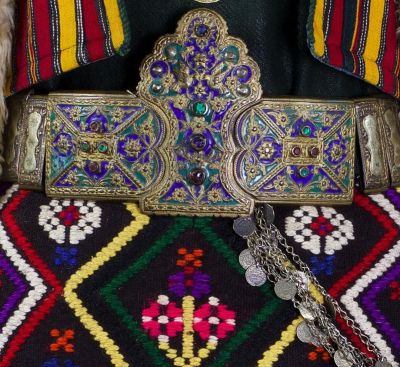
Women’s apron from Pentalofos, Greek Thrace

In Rebirth of the Goddess, Carol P Christ offered Nine Touchstones of Goddess Spirituality as an alternative to the Ten Commandments. The Nine Touchstones are intended to inform all our relationships, whether personal, communal, social, or political.[1] In this series of blogs I am exploring ways in which these Nine Touchstones are embodied in the traditional women’s ritual dances of the Balkans, which I have studied as a spiritual practice for more than thirty years.

Carol P Christ’s Second Touchstone is: ‘Walk in love and beauty.’ As she says, ‘love and beauty are the great gifts of bounteous earth’.[2] Dancing women of the Balkans walk in love and beauty each time they put on their festive dress to dance together in the courtyard or the village square. Their ceremonial costumes are created from the bounty of the earth – just a couple of generations ago, this was literally the case, as the women tended the sheep, prepared and spun the wool, wove, sewed, embroidered and ornamented their garments with the work of their own hands. Even now, the cloth they buy is purchased with money they have earned from working and harvesting the land.

Continue reading “Women’s Ritual Dances and the Nine Touchstones of Goddess Spirituality-Part Three by Laura Shannon”

Women’s Ritual Dances and the Nine Touchstones of Goddess Spirituality-Part Two by Laura Shannon

In the first part of this article, I looked at how Carol P Christ’s Nine Touchstones of Goddess Spirituality from Rebirth of the Goddess are related to traditional women’s ritual dances of the Balkans. After more than thirty years of researching and teaching these dances and the way that they pass on information in encoded symbolic ways, I have come to see them as an educational system, a women’s mystery school.[1] The main message which the dances convey is an ethic of community, partnership, mutual support, and other life-enhancing values aligned with the Nine Touchstones, which can be directly experienced in the dance.

We know from the research of Marija Gimbutas that these values were central to the Old European civilizations which honoured the Goddess, while Yosef Garfinkel and Elizabeth Wayland Barber show that circle dances have their roots in these same early Neolithic cultures of Eastern Europe and the Near East. This leads me to suggest that Balkan women’s circle dances surviving today may have their origin in early egalitarian matriarchal cultures of Neolithic Europe. The Nine Touchstones of Goddess Spirituality provide an perfect template through which to explore the ethics of women’s ritual dances.

Continue reading “Women’s Ritual Dances and the Nine Touchstones of Goddess Spirituality-Part Two by Laura Shannon”