

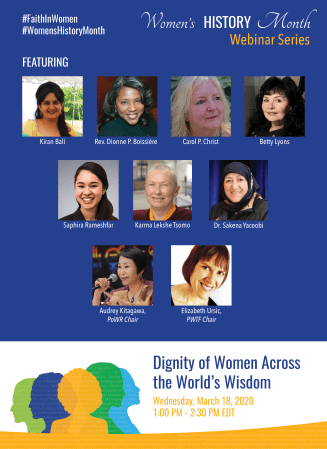
 I have been asked to post my contribution to the Parliament of World Religions Webinar: Dignity of Women Across World’s Wisdom.
I am participating in this discussion as a representative of women who are on a Goddess path. I do not represent any established or newly formed religious or spiritual tradition. Rather I speak for an increasingly large number of women who are seeking alternatives to established traditions that celebrate and legitimate male power as power over or domination. We do not follow leaders or gurus and we place no trust in any sacred texts.
Most of us have grown up in cultures where the most prominent religious traditions feature male Gods, male teachers, and male religious leaders. We agree with Mary Daly who said that when God is male the male is God. In traditions where God is male, male teachers and religious leaders are viewed as reflecting or being in the image of the male divinity. We do not assume that images of God as male are never valid, but we do assert the need for images of God as female.
As I said in my often re-published essay, “Why Women Need the Goddess,” the most important meaning conveyed by the symbol of Goddess as the ultimate creative power in the universe is that female power is legitimate and good. This does not mean that female power is always good, but it clearly undermines the widely held view that female power exercised apart from male control is always evil or bad. This view is reinforced by images of women as evil in religious traditions, for example, Eve seduced by the snake. Continue reading “Dignity of Women Across the World’s Wisdom: Parliament of World Religions Webinar by Carol P. Christ”

 It wasn’t really fire. I came home to Lesbos from a soulful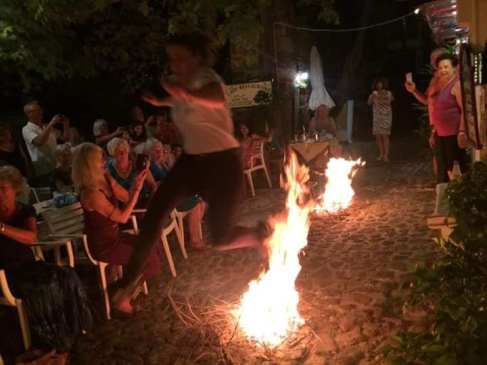

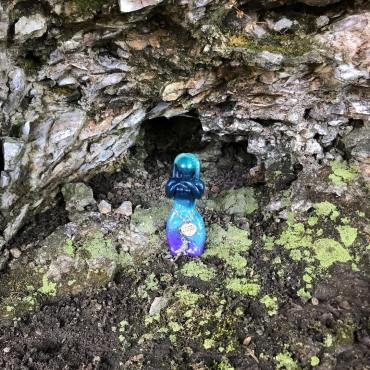 “Please prepare me
 I often say I am a theologian who is uncomfortable with prayer and does not have a relationship with God. What I mean is that I am still trying to figure out how I understand the divine; conventional prayers feel exclusionary and that is not something I want to participate in. Instead, I believe there is so much more to these concepts than traditional theology offers.
 About 5 years ago, I began a consistent yoga practice. Right around the same time, I started a PhD program in Women’s Spirituality at the California Institute of Integral Studies where I eventually wrote my dissertation on Women’s Spiritual Leadership. Throughout my studies, I realized that the path of the Divine Feminine is an intricate journey that accentuates the mind, body, soul connection. The yogic path does the same. In late 2018, I enrolled in an intensive 5-week 300-hour yoga teacher training in India where I continued my spiritual explorations. Hindu culture reveres the Divine Feminine and Divine Masculine and yoga is viewed as a pathway into God/dess through the body. Here’s the first part of the story…
