From the Archives: Is Baptism a Male Birthing Ritual? By Michele Stopera Freyhauf

This was originally posted on March 22, 2012

Quite a number of years ago I had a conversation with one of my professors, a feminist theologian, who posed the question “Why do I need a man to purify my baby with the waters of baptism?  Is there something wrong or impure about the blood and water from a mother’s womb – my womb?”  Before you jump and shout the words Sacrament or removal of original sin, this question bears merit in exploring, especially in today’s world where women are taking a serious beating religiously, politically, and socially.  In today’s world, violations and rants are causing women to stand up and say STOP!  This is MY Body.  This outcry was provoked by chants of ethical slurs against women– Slut! Prostitute! Whore!  The cry got even louder when the issue of religion and government was raised in the fight of healthcare coverage of contraception. The cry got even louder with the enactment of the laws in Virginia and Texas (and many other states to follow suit) that forces women to undergo transvaginal ultrasounds in early stage abortions.  The mandatory insertion of a wand into a woman’s vagina (mandated by the government, mind you), is a violation and has women crying RAPE!

Continue reading “From the Archives: Is Baptism a Male Birthing Ritual? By Michele Stopera Freyhauf”
Initiation and Descent part 1 by Terry Folks

Review: In my first two posts about my recent Goddess Pilgrimage to Crete, I invited you to consider your stage in your current Heroine’s Journey as you followed me.

In my hybrid of Joseph Campbell’s mono-myth with feminist scholar Maureen Murdock’s version, the first six stages of the Heroine’s journey are: Ordinary World, the Call to Adventure, Refusal of the Call, Arrival of Mentors, Crossing the First Threshold, and Encounters with Tests, Allies, and Enemies. These archetypal stages were overlaid with Murdock’s Separation from the Feminine, Identification with the Masculine, Gathering of Allies, Road of Trials, Meeting Ogres and Dragons, Finding the Boon of Success, and Awakening to Feelings of Spiritual Aridity and Death.

Briefly: At home on Vancouver Island, Canada, I was overworked, other-focused, burnt out and overwhelmed with horrific family crises. I was terrified of doing the Goddess Pilgrimage on my own. I finally accepted divine assistance and flew to Crete. I tested positive for COVID on the first day of the pilgrimage.

Continue reading “Initiation and Descent part 1 by Terry Folks”

From the Archives: Answering the Call by Joyce Zonana

This was originally posted on April 30, 2020

Very early in Henri Bosco’s 1948 novel Malicroix, a young man, Martial de Mégremut, living placidly amid fruitful orchards in a tame Provençal village, receives a letter informing him he has inherited “some marshland, a few livestock, a ramshackle house” from a reclusive great-uncle, Cornélius de Malicroix. Against his family’s strenuous objections–with alarm they speak of “marshes, mosquitoes, miasmas”–Mégremut resolves to travel alone to the remote Camargue to claim his “wild” Malicroix inheritance. The house is on an island, and to reach it Mégremut must cross a rough river, at night, in a frail wooden boat piloted by a taciturn old man who meets him at dusk in the middle of a vast plain.
So begins a deeply internal quest narrative, an initiatory journey that forces Mégremut to come to terms with himself and with the elements–earth, water, wind, and fire–that are ever-present, sometimes terrifyingly so, on the island. For once he arrives, he learns that he must remain there alone for a full three months if he wishes to obtain the inheritance. Torn about whether to stay or leave, he finds that the decision to stay is made of its “own accord,” unconsciously.

Continue reading “From the Archives: Answering the Call by Joyce Zonana”

Answering the Call by Joyce Zonana

All along, I’ve believed that Malicroix had something important to offer English-speaking readers: an embrace of solitude, a profound connection with nature, a bold exploration of dream-states. And right now it seems to resonate with our current moment of introspection and reassessment of priorities.

202002_Zonana_JoyceVery early in Henri Bosco’s 1948 novel Malicroix, a young man, Martial de Mégremut, living placidly amid fruitful orchards in a tame Provençal village, receives a letter informing him he has inherited “some marshland, a few livestock, a ramshackle house” from a reclusive great-uncle, Cornélius de Malicroix. Against his family’s strenuous objections–with alarm they speak of “marshes, mosquitoes, miasmas”–Mégremut resolves to travel alone to the remote Camargue to claim his “wild” Malicroix inheritance. The house is on an island, and to reach it Mégremut must cross a rough river, at night, in a frail wooden boat piloted by a taciturn old man who meets him at dusk in the middle of a vast plain.

So begins a deeply internal quest narrative, an initiatory journey that forces Mégremut to come to terms with himself and with the elements–earth, water, wind, and fire–that are ever-present, sometimes terrifyingly so, on the island. For once he arrives, he learns that he must remain there alone for a full three months if he wishes to obtain the inheritance. Torn about whether to stay or leave, he finds that the decision to stay is made of its “own accord,” unconsciously.

Continue reading “Answering the Call by Joyce Zonana”

O Madre Nostra Cara by Kaalii Cargill

kaalii-pic-edit

My historical novel, DAUGHTERS OF TIME, traces a line of mothers and daughters through 4000 years as they carry the way of the Goddess from ancient Sumer to the present day. In 1926, a daughter in the lineage is born in Southern Italy:

“Marias family had lived in the village and surrounding area for longer than anyone could remember. Like all the girls of her village, she grew up a Catholic, yet on Christmas Eve she gathered with the other women to perform a ritual in the Church that no man was allowed to see. The words she spoke would have been familiar to her many, many times great grandmother, Meh-tan, who once met a Queen in Ursalimmu.It did not occur to Maria that the ritual was not in keeping with the teachings of the Church; it was what her mother and all the mothers before her had done on Christmas Eve to honour the Great Mother.

Five years after writing about my fictional Maria, I stood in the church in Calabria where my grandmother Carmella once met with the other women on Christmas Eve. And the Great Mother was still there – the Madonna del Carmine a Varapodio, whom the people call “O Madre nostra cara.”

Kargill

The transition from Goddess to Madonna is very tangible in Calabria . . . Continue reading “O Madre Nostra Cara by Kaalii Cargill”

Magic Names by Barbara Ardinger

Many modern pagans adopt magical names. I think I’ve found one for myself. It’s a good motto, and even saying it aloud reminds me of the daily blessings of the Goddess to her children. The Latin name I’d choose is Beata elle. “Blessed is she.” 

When I attended a pagan studies conference recently to read from Secret Lives (and sign and sell a few copies), I listened very carefully to another presenter who spoke about magical names. When we go through an initiation, he said, we receive a new name. It’s a custom that is familiar to people through the ages and around the world. The presenter spoke about why people adopted magical names during the 19th-century European occult revival and why pagans still take magical names. And he set me to thinking. When you earn your Ph.D., you don’t get a new name. The Ph.D. is indeed an initiatory experience. Ask anyone who’s done it. You go through multitudinous ordeals both physical and intellectual. You face judges, speak what you’ve learned, and finally attain gnosis. But all you get for all your work and suffering are those nifty letters to put after your name. But I digress. Continue reading “Magic Names by Barbara Ardinger”

Is Baptism a Male Birthing Ritual? By Michele Stopera Freyhauf

Quite a number of years ago I had a conversation with one of my professors, a feminist theologian, who posed the question “Why do I need a man to purify my baby with the waters of baptism?  Is there something wrong or impure about the blood and water from a mother’s womb – my womb?”  Before you jump and shout the words Sacrament or removal of original sin, this question bears merit in exploring, especially in today’s world where women are taking a serious beating religiously, politically, and socially.  In today’s world, violations and rants are causing women to stand up and say STOP!  This is MY Body.  This outcry was provoked by chants of ethical slurs against women– Slut! Prostitute! Whore!  The cry got even louder when the issue of religion and government was raised in the fight of healthcare coverage of contraception. The cry got even louder with the enactment of the laws in Virginia and Texas (and many other states to follow suit) that forces women to undergo transvaginal ultrasounds in early stage abortions.  The mandatory insertion of a wand into a woman’s vagina (mandated by the government, mind you), is a violation and has women crying RAPE!

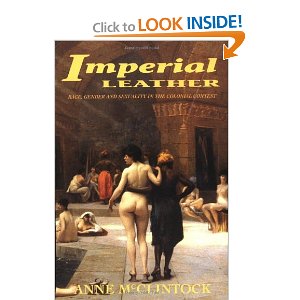
The memory of this conversation did not re-appear by chance, it was prompted by a book I read for my History of Sexuality Class – Imperial Leather: Race, Gender, and Sexuality in the Colonial Context by Anne McClintock who addresses the notion of baptism through origins, property, and power.  So many things are currently being taken away from women and reading McClintock’s assertion regarding male baptism is perplexing.  She believes that male baptism or baptism by a man takes women’s role in child bearing and diminishes it.  These are the same men who historically treated and regarded women as vessels.  She further asserts that this act is a proactive removal of creative agency with respect to a woman’s ability to have the power to name.  That is, the last name of the child belongs to the husband.  A point that supports the notion that patrimony marks the denial of women.  Anyone doing genealogy encounters a perplexing struggle to identify mothers because their names are essentially erased from memory and rarely attached to a child’s name. Continue reading “Is Baptism a Male Birthing Ritual? By Michele Stopera Freyhauf”