Bo: On Passing Over.

On August 12, 2018, I announced that I would begin my feminist reflections on Torah portions. I have seven left, but the timing of them are all in the beginning months of the year. This means, that the following seven posts about the parshot will not be aligned with the actual calendar dates in which they are read, especially since I only post once a month. But, in each post, I will note when they will be read next (in 2025). I hope that is not too much of a bother for the reader as I complete this project.

The parshah for Feburary 1, 2025 is Bo. It covers the final three plagues (locusts, darkness, and death of the firstborn males), the instructions for Pesach (Passover), and the beginning of the flight out of Egypt. The parshah makes two mentions of women. First, Moses includes the daughters of Israel among those who will leave Egypt (10:19). This mention comes in a list of opposites: young and old, sons and daughters, and (what I assume to have been considered opposites at the time) flocks and cattle. To me, this stylistic set-up signals that the entirety of the Israelite community would leave Egypt – a combination of seeming opposites thus represent the whole (that would be an interesting post for another time!). The second mention of women is in verse 11:2; men and women will ‘borrow’ gold and silver items from their (Egyptian) friends. This borrowing allows them to later leave Egypt with the items and thus rob Egypt of its riches (13:35). I do not find this necessarily all that interesting except to note that it helps to tell the story of how an oppressed, enslaved people had enough gold to build a golden calf (Ki Tisa), Exodus 32:2-3. 

Continue reading “Bo: On Passing Over.”

The US Election Results and Justice: What Will You Do? A Jewish Feminist Perspective by Ivy Helman

I met with a new friend/colleague of mine this past week.  We were discussing the election results, and I was discussing the work I do in the field of religion.  Living and teaching in Central Europe, I have quite a lot of experience navigating the study of religion in a place that is quite atheist and/or actually anti-religion.  In fact, it has been somewhat of a struggle to have the study program, Gender Studies, in which I teach, recognize its importance.  Many of my colleagues, I think, are under the impression that religion is personally not important and/or just not that important in general.  Yet, as I have mentioned here, and as my new friend brought up as we sat over coffee, religion underpins so many aspects of our patriarchal society.  

Continue reading “The US Election Results and Justice: What Will You Do? A Jewish Feminist Perspective by Ivy Helman”

On Noach and its Ecofeminist Potential.

The Torah portion for November 2, 2024 is Noach.  The portion includes the stories of Noah’s ark and the tower of Babel and ends with Abraham and Sarai settling in the land of Canaan.  In my feminist analysis of Noach, I will focus on the ecofeminist potential of divine acknowledgements and how the divine is portrayed.

As ecofeminists at the intersection with religion, one task we have is to interpret those sacred texts which have something to say about nature and animals.  Within Judaism, there are numerous such texts, and parshah Noah is one of them.  Afterall, most of Noach revolves around a great flood in which the deity destroys the earth and most of its inhabitants, animal and human.  

The divine destruction of the material realm is problematic.  The deity blames the divine decision to destroy creation on the rampant corruption of the flesh: human and animal alike (6:13).  In feminist thinking, linking material existence to corruption is unsettling since patriarchy often disavows material existence by linking it to evil.  In addition, in Noach, an aspect of the material world, water, is used in bringing about that destruction.  However, water is also ironically what all flesh depends on for life.    

Continue reading “On Noach and its Ecofeminist Potential.”

From the Archives: “Is the Divine the Unknowable Unknown? A Feminist Take.”

Author’s note: This blog was originally published on October 16, 2022. As we have just entered the month of Elul, I urge us to consider how the way we understand the divine influences the High Holy Days as well as our approaches to self-reflection, self-doubt, self-blame, wrong-doing and our behaviour in general.

I know it’s a little early, but l’shanah tovah.

I attended a number of High Holy Days services (online) over the past couple of weeks. In one of them, one of the rabbis said that the divine is the unknowable unknown. I cannot remember what the Rabbi said to contextualize or explain their train of thought; I think I was too intrigued by the idea that I got lost in my own thoughts. In fact, I have been thinking about the unknowable unknown ever since.  

As I write this, I’ve come to this conclusion: if the divine is present among us and the world around us, then there is much we can intuit. In addition, there is much that we can experience the more we interact with other humans and nature.  On the other hand, if the divine is understood as a detached, distant being of a completely different essence than humanity, of course, what can we really know about such a divinity?  How would we even know if that divinity even existed? We probably wouldn’t.  Here is the difference between a  feminist understanding of the divine as this-worldly and empowering and a patriarchal conception of a distant divinity wielding power-over. Yet, interestingly, even the most patriarchal image of the divine has insisted on being relatable to human beings. Nonetheless, how we imagine the divine does matter.

Continue reading “From the Archives: “Is the Divine the Unknowable Unknown? A Feminist Take.””

On Persephone and the Racetrack: My Experience at Lake Pergusa.

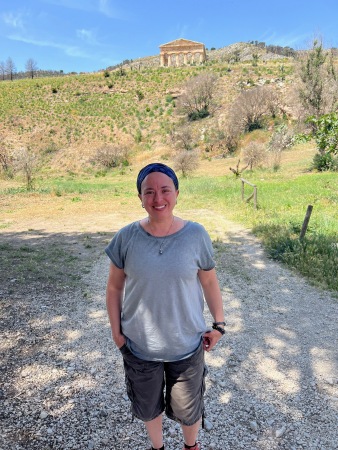
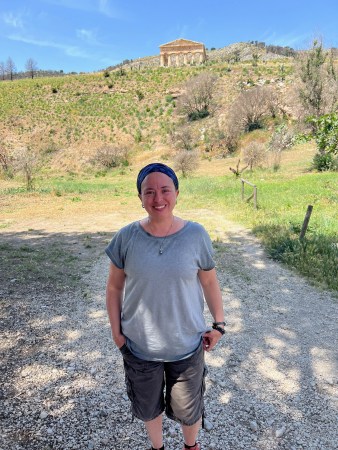
At the Segesta temple.

This May, I visited Sicily to present at the European Academy of Religion’s Annual Meeting. There I saw various historic, religious sites: parts of the city of Siracusa; the Valley of the Temples in Agrigento; mikvot in Palermo; various churches including the Cathedral in Palermo and the Church of St. Cataldo; the Segesta temple; and lake Pergusa where Hades emerges from the land to abduct Persephone. In this blog, I will focus on this lake. As an ecofeminist focusing on religion, this place gave me mixed feelings.

Continue reading “On Persephone and the Racetrack: My Experience at Lake Pergusa.”

Naso: An Invitation for Feminist Imagining.

This week’s Torah portion is Naso (Numbers 4:21-7:89).  The portion discusses who, among the Israelites, carries the components of the Miskan (Tenting of Meeting) while wandering through the desert.  It also entails a census of the tribe of Levi, describes various offerings that were brought to the Tent of Meeting in general and for its twelve days of dedication, decrees keeping the ill and ‘contaminated’ out of Israelite settlements, details the Nazirite vow, gives us the priestly blessing, and proscribes the process through which women are acquitted or found guilty of affairs.  There are many components of this parshah that offer food for thought when it comes to a feminist analysis, but for today, I am going to focus on where there is equality between men and women within the text and where there isn’t.  

Continue reading “Naso: An Invitation for Feminist Imagining.”

From the Archives: Writing: Changing the World and Ourselves. By Ivy Helman

This was originally posted on October 12, 2014

20140903_180423

I still remember the first time I read Mary Daly’s Gyn/Ecology. It awoke something within me. Her use of language, the power of her writing and the ease with which she created new words taught me so much about the world around me and about the way the language, and subsequently its use in writing, shapes lives, choices, abilities and destinies. She also taught me about myself.

I was hooked, but not just on Mary Daly. Shortly after I finished her book, I moved onto other feminists writing about religion like Katie Cannon, Judith Plaskow, Alice Walker, Carol Christ, Rita Gross, Gloria Anzaldua, Audre Lorde, Adrienne Rich, Margaret Farley and Starhawk to name just a few. All of them, in fact every feminist I’ve ever read, has shown me the way in which words have power and how words speak truth to power. Ever since, I’ve wanted to be the kind of writer whose words carry a power that not only affects people but also inspires a more just, more equal, more compassionate and more humane world. In other words, I wanted to be a writer activist.

Continue reading “From the Archives: Writing: Changing the World and Ourselves. By Ivy Helman”

Acharei Mot: Build Each Other Up.

The parshah (Torah portion) for May 4, 2024 is Acharei Mot, Leviticus 16:1-18:30.  It explains how to approach the divine and who should approach the divine in the context of establishing a yearly day of atonement to absolve the people of their sins.  This atonement day proscribes various rituals for the high priest to perform that day including immersions in ritual baths, special clothing, many animal sacrifices and sprinklings of blood, an incense offering, and a goat let loose in the wilderness carrying the sins of the community.  In addition, the parshah warns against idolatry and forbids the drinking and eating of an animal’s blood, as it contains its soul.  The parshah ends with a list of prohibited sexual relations.  This is a tricky parshah as it is often cited as proof that homosexuality is forbidden by the deity, and this has caused much pain and struggle for us within the LGBTQ+ community. 

Continue reading “Acharei Mot: Build Each Other Up.”

Sh’mini: An Egalitarian Argument for Women and Girls

The parshah for April 6, 2024 is Sh’mini (Shemini), Leviticus 9:1-11:47 and since it is also Shabbat Hachodesh, we read Exodus 12:1-20 in addition to Sh’mini.  Sh’mini contains commandments regarding animal sacrifice, the death of two of Aaron’s sons, lists of which animals are kosher and which are not, and distinctions between clean/unclean and holy/profane.  The excerpt from Exodus, read as the maftir, describes the last plague before the Jews were freed from slavery in Egypt, the establishment of Pesach, and the eating of unleavened bread or cakes.  In today’s commentary, I’m focusing on the only mention of femaleness in Sh’mini and by doing so I hope to find more room for women and girls within contemporary Judaism.

Continue reading “Sh’mini: An Egalitarian Argument for Women and Girls”

The Journal Gender a výzkum/ Gender and Research

I would like to introduce this community to Gender a výzkum (in Czech) or Gender and Research (in English), a transdisciplinary, peer-reviewed journal founded in the year 2000 and dedicated to research in Feminist and Gender Studies in the Czech Republic.  While the journal’s main focus is work pertaining to Central and Eastern Europe, it is open to a wide range of geographical locations and topics.  The journal, which publishes articles in Czech and English, often puts out calls for individuals or groups of people to edit monothematic issues.  Past monothematic issues include feminist reflections on Covid, an issue on the use of language concerning sex and gender, gender in popular culture, children, adolescence and sexuality, feminist interpretations of Islam, and postcolonial and decolonial thinking in feminist theory to name just some. If you would like to read them, the journal is available online as well as in print.

Continue reading “The Journal Gender a výzkum/ Gender and Research”