

 I have always had a particular fascination with women warriors—particularly ancient and medieval ones. Joan of Arc was a favorite, as was Artemis, Greek goddess of the hunt. My father had a sword from Spain hanging on his wall in his study and I used to stare at it with curiosity and longing—and once even took it off the wall when a babysitter’s boyfriend scared me. Later on, I learned about the women warriors of Dahomey in West Africa, Mu Lan Hua of China, and the Scythian women who were the real-life inspiration for the legend of the Amazon. The story of Durga, the warrior goddess of India who combats demonic forces and destroys illusion, also compelled me. I think, having felt under siege from relatives and schoolmates early in my life, the image of the woman warrior made me feel safer, even if in real life, my college karate class made me feel uncomfortable.
In my own tradition, I explored the biblical character of Devorah, the prophetess and tribal leader who directed the Israelites in battle. Then I discovered the apocryphal Judith, who defended her city of Bethulia by cutting off the enemy general’s head–Judith is celebrated in art in a variety of European paintings and on Chanukah menorahs. Judith is also celebrated during the North African Jewish holiday ritual of Chag haBanot or Eid Al-Banat—the Festival of the Daughters, a day that honors women and girls. In addition to these legendary women, I was moved by other, non-legendary women who fought for justice and their people in a variety of ways. Continue reading “The Kreismesser: Women and Magic Swords in Jewish Tradition by Jill Hammer”

 My community and many others have been watching in awe as Greta Thunberg makes waves around the world—her lone climate change protest in Sweden growing in a single year into a climate strike with millions of demonstrators around the world. Of course, Greta isn’t asking us to listen to her. She is asking us to listen to the science that will save us. And Greta is not alone: there are young indigenous female protesters like performance poet and peace activist Lyla June Johnston of the Dine (Navajo) and Tsetsehestahese (Cheyenne) peoples and water protector Autumn Peltier of the Anishnaabe people, who are speaking before the UN and in other public settings about global warming, and revitalizing our spiritual relationship with Mother Earth. Yet Greta knows that her fame (and her youth) gives her a platform. She is conscientiously using that platform to testify before Congress and the UN, Tweet, post on Facebook, and do whatever else she can do to make an impact. Recently, I’ve noticed that some people in my home Jewish community, when they post about Greta on social media, have given her a nickname: they call her “the prophetess.”
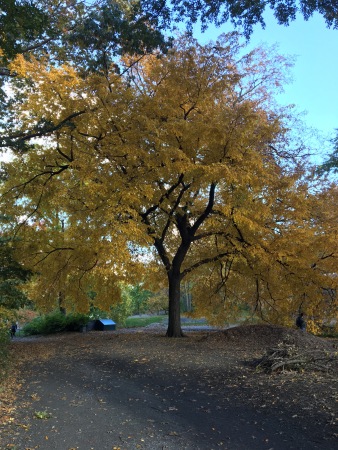
 Every year when the cherries, pears, plums, and apple trees begin to bloom, I go out walking. I look for every spot in my vicinity where white and pink blossoms are blooming in exquisite profusion like foam on an ocean. Every year I take photographs, even though I already have so many. I walk at every hour of the day because, as the light changes, the colors change. I have albums and albums of pictures of my beloveds, the trees.
 This is a time of increased vulnerability for many minority populations in the United States: people of color, immigrants, LGBT people, native peoples. The policies and rhetoric of the current administration have left all these groups exposed to hostility. Women are also feeling the pressure, as the gender split in voting in the past election suggests. And, Jews also are facing increased visibility. In addition to the murders in Pittsburgh, anti-Semitic incidents around the country have increased in the last few years. All this has me thinking about visibility, chosen and unchosen.
 From the 1993 Re-Imagining Conference:
 On Rosh haShanah and Yom Kippur (the Jewish New Year and the Day of Atonement), and on the festivals throughout the year, traditional Jewish liturgy includes the Thirteen Attributes of the Divine. Exodus 34:6-7 is the first to mention these thirteen attributes, or thirteen names really, for God. This Rosh haShanah, as part of my work as a creative liturgist, I offered a new meditation on these thirteen attributes, dedicated to the Shekhinah, the Divine Presence.
 Feminism and Religion