

This was originally posted on Feb. 27th 2021
The first time I came across the phrase, I thought I must be making a mistake. “Que Dieu l’enveloppe dans sa matrice,” the passage read in French, “May God’s womb enfold her,” or possibly, “May God enfold her in His womb.” His womb?
I’d just started translating Ce pays qui te ressemble [A Land Like You], Tobie Nathan’s remarkable novel of Egypt’s Jews in the first half of the twentieth-century, and I couldn’t be sure I was correct in thinking that “womb” was the proper rendering for “matrice.” But a quick search confirmed my hunch. Matrice (from the Latin matrix < mater) might be translated as “matrix” or “mould,” but that made no sense here. “Uterus or womb” was the anatomical meaning, and it was the first meaning listed in my French dictionary.
The phrase, or something very like it, kept turning up, always after a dead person was named:
Que Dieu accueille son âme en sa matrice.
Que Dieu l’enveloppe dans sa matrice.
Que Dieu la berce dans sa matrice.
May God’s womb welcome his soul.
May God’s womb enfold him.
May God’s womb cradle her.
In all, “God’s womb” is mentioned seven times in this novel set in Cairo’s ancient Jewish quarter, Haret al-Yahud. Each time, it’s part of a ritual prayer, a formulaic wish for the wellbeing of a departed soul. But what extraordinary wellbeing is wished for here, what a remarkable envisioning of God as the possessor of a welcoming, warm womb.
I was stunned by the image, which I could not help but take literally. The God invoked by these Egyptian Jews (Dieu, a masculine noun) possessed a uterus (matrice, a feminine noun). So was this deity somehow an androgyne or hermaphrodite, embodying both masculine and feminine attributes? I struggled to grasp what the words led me to see. Could this really be what the author had in mind?
Although I’ve long considered myself a devotee of the Goddess, I’d never actually thought of the Divine as possessing a womb; although I’ve embraced the embodied theology of Carol Christ and others, I’d never thought of the Divine itself in such a strikingly physical way. To imagine God or Goddess as having a womb, a womb from which we are born and to which we might return: somehow, that changed everything for me. I’d previously envisioned the Goddess as a Divine Mother, yes, but I’d always seen that Mother as a separate being, not as the very cradle of existence, the all-encompassing source. Clearly, I hadn’t been paying enough attention. And here it was not Goddess but God who was endowed with a womb.
I asked Tobie Nathan about the phrases I’d found so striking. Was he inventing something? Or was he simply reflecting a reality the Jews of Egypt had taken for granted?
He explained that he had tried to literally translate the Arabic phrase used by Jews and Muslims alike in Egypt when speaking of the dead—Rabena yer’hamou: “Rabena, our god. Yer’hamou from the noun rahem, which literally means womb.”
Yer’hamou, Nathan told me, is usually translated as “compassion,” or “mercy” (miséricorde in French), as in “May God have compassion on her soul,” or “May God grant her mercy” (Que Dieu lui accorde sa miséricorde). But Nathan felt that this missed the deep meaning embedded in the Arabic words. He wanted to return to the source:
The fact is, the Arabic language seems to think that when a man or a god shows mercy or compassion, it’s because they have something within themselves like a woman’s womb.
And, he added, “it’s the same in Hebrew.”
Indeed. Over forty years ago, Phyllis Trible, in her chapter “Journey of a Metaphor,” in God and the Rhetoric of Sexuality, observed how in the Hebrew Bible “an organ unique to the female becomes a vehicle pointing to the compassion of God.” She notes that the singular Hebrew noun rehem means “womb” or “uterus.” But in the plural, rahamim, the “concrete meaning expands to the abstractions of compassion, mercy, and love.” As Trible puts it, there is a clear “semantic movement from a physical organ of the female to a psychic mode of being.” Over and over, throughout the Hebrew scriptures, Yahweh is referred to as rahum—a word usually translated as “merciful” or “gracious,” but a word that also carries the memory of a maternal Goddess, most likely absorbed when patriarchal monotheism triumphed.
The familiar Qu’ranic phrase—bi-smi llāhi r-raḥmāni r-raḥīm, “In the name of God, the Most Gracious, the Most Merciful”—reveals a similar semantic shift: God’s mercy and grace are conveyed through transformations of the root rhm, “womb.” Both Judaism and Islam, then, both in Hebrew and in Arabic, envision a God (male or perhaps transgender) with a female womb, the source of compassion and mercy.
Nathan’s translation of the Arabic—and my translation of his translation—returns us to the literal meaning of the Semitic root rhm. We are invited to see and feel this welcoming, enfolding, cradling womb of God—a place of absolute safety and warmth, nurturance and peace; a place not abstractly metaphorical but concretely physical, a place where one might experience primal oneness. What is implicit in Hebrew and Arabic is made explicit in French and English.
The human womb from which I was born was a place neither of safety nor of peace. Before my conception and birth, my mother had several miscarriages. During her pregnancy with me, she had to remain in bed for most of the nine months to avoid yet another loss. Outside, in Cairo, the first Arab-Israeli war was raging, and her anxiety—about our survival as Jews in Egypt, about this pregnancy that meant so much to her—must have been overwhelming. I’m certain that even while I developed in the warmth and darkness of her womb, I absorbed my mother’s anxiety and fear. I was born from and into a world that never felt safe. Which must be why the image of God’s womb is so striking and comforting to me now.
I’ve learned much from my work on Tobie Nathan’s extraordinary novel–a novel that insistently points to the importance of recognizing and honoring sources, be they linguistic, ancestral, cultural, psychological, or spiritual. Certainly, the novel has returned me to my own history and heritage. But I’m most grateful to Nathan for his stunning image of the Divine womb, an image that returns us all to a vital, healing source.
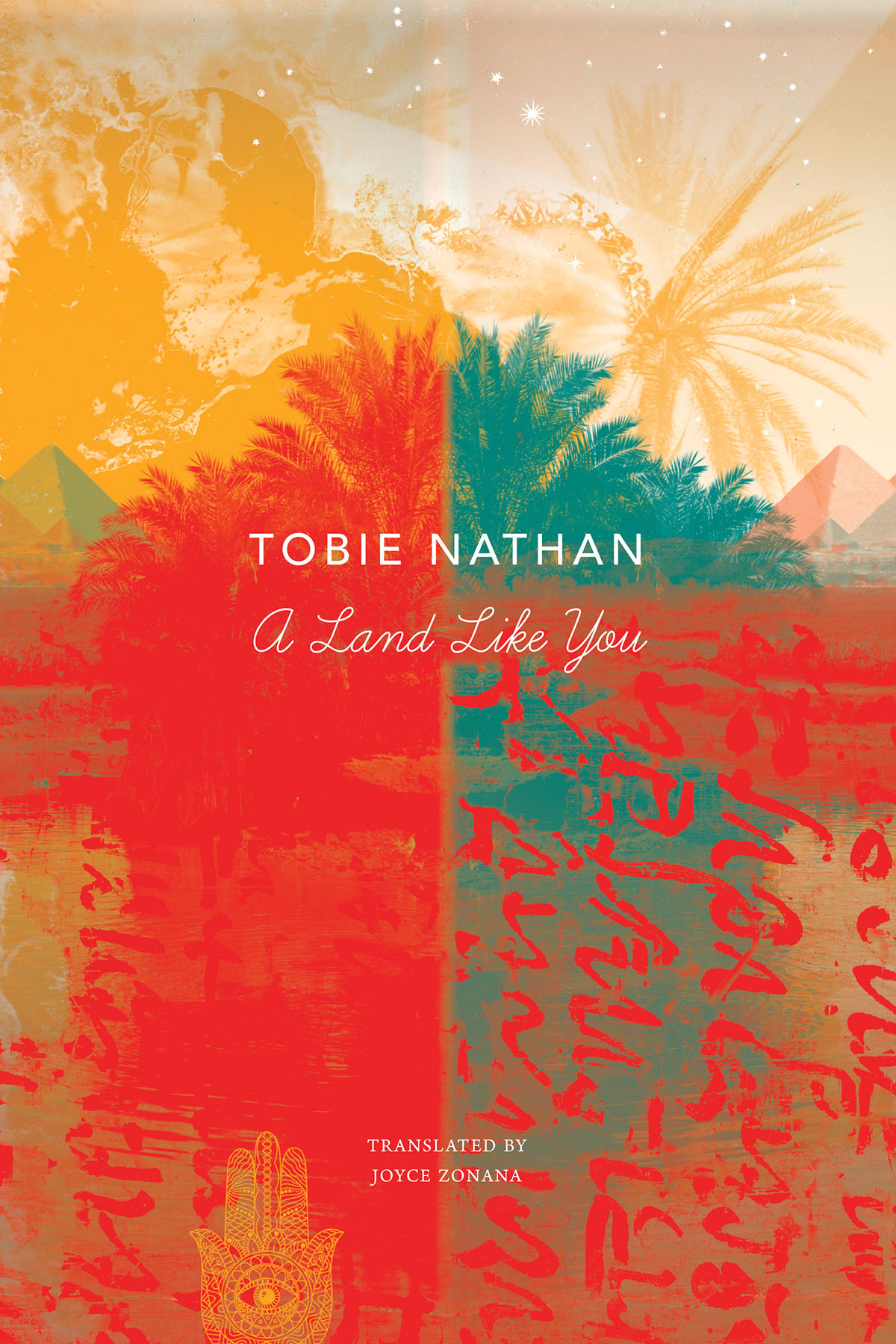
Joyce Zonana‘s translation of Tobie Nathan’s A Land Like You is available from Seagull Books. Joyce is the author of a memoir, Dream Homes: From Cairo to Katrina, an Exile’s Journey. She served for a time as co-Director of the Ariadne Institute for the Study of Myth and Ritual, and is also a contributor to the Abbey of Hope’s Reflectionary.
Discover more from Feminism and Religion
Subscribe to get the latest posts sent to your email.


I think of Earth as Womb of all Life
LikeLike
“Both Judaism and Islam, then, both in Hebrew and in Arabic, envision a God (male or perhaps transgender) with a female womb, the source of compassion and mercy.”
So God is a woman pretending to be a man, perhaps to be more acceptable to the patriarchal cultures that worship a male god? I can see it.
LikeLiked by 1 person
a male god with a womb – mind bending – how did they do it???
LikeLike