


Every year in my course “Feminism and the Environmental Movements,” we take a part of one class session about halfway through the semester and explore what an ecofeminist world should look like. I begin by drawing a large circle on the whiteboard, representing the world and as a class we discuss what belongs in the world. That information goes on the inside of the circle. What we don’t think belongs within an ecofeminist world, I write on the far corners of the board. Then there are those topics about which no consensus can be made. Those I write along the edge of the circle, and we spend considerable class time debating the reasons why those ideas are controversial.
Consistently, various patriarchal institutions, and indeed patriarchy itself, find themselves banished to the far reaches of the whiteboard: racism; sexism; dualistic thinking; homophobia; transphobia; classism; capitalism; (neo)colonialism; and war. Those ideas that make it within the circle often include diversity, responsibility, nature, feminism, interconnection, care, relationality, community, consensus decision-making, animals, and nature. What stays along the edge is often ideas like eating animals, whether religion is necessary or not, violence, and so on. I often push them on the religion issue, reminding them that while it may not be important for them, some people find great sustenance in their spiritual lives. When it comes to violence, the debate often comes down to whether or not humanity can every truly rid the world of violence and whether or not human nature is somehow always minimally violent. Sometimes, the discussion around violence looks at how some animals kill other animals for sustenance and how that kind of violence is deeply connected to their needs. Other times, particularly this year, we discussed how eating animals requires violence if some of us want to continue to do so.
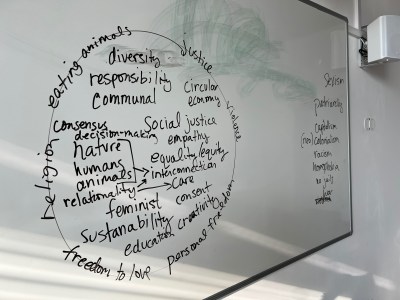
After we have this basic idea on the board and discussion is well exhausted, I will then (time permitting) pose the question: how do we get from where we are to here? This is when the conversation often turns rather pessimistic. Students often cannot think of examples of how to uproot capitalism in any meaningful way. They do not see ways in which they can convince people to stop hating others for the color of their skin, for whom they love, for their gender identity, and so on, nor can they decide how much democracy is or is not a ecofeminist system or failing that, how to have large populations who practice consensus. So, they often say something along the lines of the following: we should recycle, buy second-hand clothing, eat less animals, eat locally, vote for individuals whose values match ecofeminist ones, and participate in activist movements for change. I find that this list often leaves me wanting as many of us do these things already and find it hard to see truly meaningful change to the system.
I thought that perhaps I need to branch out for answers and decided to come to this blog for inspiration. My question for the reader is twofold.
- What do you think needs to be included in our ecofeminist world?
- How do we work to bring about that world?
I would love to hear your suggestions in the comments down below. Thank you.
May an ecofeminist world soon become reality.
Discover more from Feminism and Religion
Subscribe to get the latest posts sent to your email.


Oh, how do we work to bring about that world ? The question I get stuck on every single day. My gut says that If we do not include and bear witness to the way extant Indigenous Peoples live and return sovereignty to their ways of being becoming western STUDENTs in the process I see NO WAY through
LikeLiked by 1 person
Seems to me that the trajectory is already in motion, critically now through people being born in the last roughly 30 years or less. A “genetic” change in the species maybe, but i commonly see many now who instinctively settle into a path of nonviolence, decisions and actions by consensus, avoiding material accumulation for its own sake, full gender equality and expectations, etc. maybe it was always there, but the violence that beat it out of children has been increasingly restrained over the last few generations.
I’m a good generation older than you, Ivy, and have witnessed people born all the way back to the late 1800s. Humanity is, one by one, shifting en masse. As species evolutions go, this is happening at lightning speed. Proving to me that Life Itself is cognizant and self-determining.
That, combined with witnessing over and over the resilience of the natural world (and the “human spirit”), augers for moving confidently and gracefully through the tunnel of our moment.
Beautiful ART with depth at https://lauriegoodhart.net/home.html
Short provocative posts at Sustenanceforawildwoman.com
LikeLike
Ah, I think of this question often. I believe the only way to collapse the system is to starve it completely. Which means withdrawal of participation and sustained boycotting on every level (as boycotting for a day does nothing significant, boycotting forever gets the message across). What would happen to the system if we all stopped paying taxes? What would happen if we stopped relying on voting to save us (in my opinion voting is a token activity to give the common folk the illusion of power). It would mean giving up conveniences and forming local alliances to get needs met. And that’s when I get pessimistic. Because the beauty of life is that no one agrees on anything, and that’s the issue.
LikeLiked by 1 person
Loved your post! I think a good working example is kibbutzim. A shared economy, shared equal responsibilities, and sustainable care of shared natural resources. They are small enough to make it work. Maybe big countries are impossible to maintain… Instead, we should go back to focusing on much smaller communities…
LikeLike
What a beautiful way of teaching! I don’t really have any groundbreaking thoughts. Perhaps acknowledging our diversity. Learning to talk and listen to others. Perhaps the way you teach will make a more fair and ecofeminist world happen.
LikeLike