

This was originally posted on April 21, 2023

Throughout centuries and across continents, women peace weavers have intertwined the threads of diplomacy and connection to make of their societies a harmonious whole amid war, violence, and seemingly endless conflict. James Rupert of the US Institute for Peace notes that, in our time, “Over a decade in countries facing warfare, women have organized more nonviolent campaigns for peace agreements than any other group.” Yet, women are outrageously under-represented in formal, higher-resourced, male-dominated institutions, with only 4% of negotiating positions in the United Nations and governmental organizations held by women. According to the Kroc School of Peace Studies, women-led peacemaking efforts are grievously underfunded and put women peace makers at risk of gender-based violence and online harassment.
Yet, if we look to the past, peace making has traditionally been an honored sphere of influence in which women have used the power of the esteem in which they were held, their ability to envision peaceful ways of being, and their skills as communicators, consensus builders, and relationship makers to bring concord from conflict and positively transform their societies.
In Iroquoian Women: The Gantowisas, Barbara Alice Mann explores the significant roles of women in the Iroquois League in many spheres, including peace making.A gantowisa is “a mature woman acting in her official capacity” (16), though men could also be ceremonially appointed as gantowisas. According to Mann, “because peace was their special concern, in the gendered society of the League, the women controlled the peace by regulating the wars, appointing the warriors, declaring war, and negotiating the peace that followed” (180). They could also choose not to declare war and could only declare war after making three attempts at peace. The honored, powerful gantowisas also acted as judges and mediators, appointed “warriors,” forwarded issues to the men’s Grand Council, determined who would be new citizens and who would hold titles, including the Chiefs, or lose their title, among many other economic, social, and spiritual responsibilities.
Mann also notes in Spirits of Blood, Spirits of Breath, that the “Indigenous gift economy” was the “primary peace mechanism of Turtle Island cultures. Hostile sentiments were soothed away by making the Other into the Self through the sharing of goods, with war never an acceptable response to a gift” (195).
Across the ocean and in a completely different cultural context, medieval European noble women and women religious wove peace in other ways. Some women married a ruler from an enemy nation, creating bonds through the blood ties of their children, teaching her husband her country’s language and customs, bestowing largesse, and passing symbolic cups of wine and gifts to warriors. These women were not political pawns, but were, according to Mary Condren, “distinguished women in Old European times… Such women had great negotiating skills and authority.” Queen Emma of Normandy, for example, was a valued counselor, and cultural educator to first England’s Ælthelred the Unready, then, after his death, to the Danish King Cnut who conquered England, helping to unite the two nations.
Women religious, another powerful group of medieval women, were also peace weavers. According to Lillian Thomas Shank “Anchoresses and recluses settled local quarrels, not from positions of power, but by the authority of their lives of prayer and poverty and by the advice they gave to those who had recourse to them”. Mary Condren notes that “St Brigit caused mists to appear between opposing sides in order to prevent bloodshed. With her nuns she accompanied protesting warriors to the battlefield, rendering them unable to fight.”
In another completely different society, Science reported that recent excavations of the Xiongnu empire in the Eurasian Steppes dating from between 200 BCE and 100 CE show that “princesses helped build the vast, multiethnic alliances central to their centuries-long success” by relocating to far-flung areas of the empire. Trusted with the very continued existence of the empire, these royal women were honored with graves including goods that were not only the most opulent among the graves excavated but were associated with great power.

Closer to our own time, in 1915, the US Women’s Peace Party, linking peace to women’s suffrage, began with a march of 1500 women in New York City, eventually becoming the Women’s International League for Peace and Freedom now representing 40 countries. At the height of the Cold War, 50,000 American women marched in 60 cities in the Women’s Strike for Peace with Bella Abzug, Coretta Scott King, and Dagmar Wilson leading the way. Today women’s reconciliation groups in countries like Angola help their nations heal, women’s organizations lead movements for peace in Middle East, and mothers have formed advocacy groups against street violence in major American cities, among many, many initiatives worldwide.
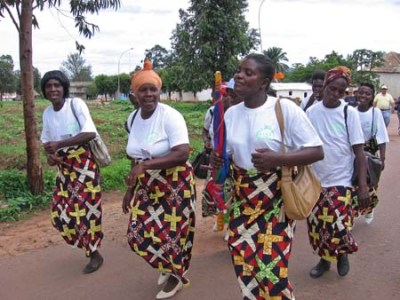
These are just a few examples of the proud legacy of brilliant, brave, and effective peace weavers who can inspire and guide us as we, a global community, work to overcome the violence and divisiveness of our time. Fortunately, the need for the recognition and resources for women peace makers is gaining traction with organizations like US Civil Society Working Group on Women, Peace, and Security, which is, according to the US Institute for Peace, “a non-partisan network of over 60 civil society organizations with expertise on the impacts of conflict on women and their participation in peacebuilding” that supports efforts to enhance the participation in, protection of, and resources of women in formal peacebuilding efforts.
As I think of the work that many of us here at FAR do, I see that it is also peace weaving though we may not always think of it that way. Creating rituals that bring people together to heal, excavating the nonviolent origins of violent myths and stories, renewing religious traditions to value women’s lives and perspectives, raising awareness of ancient and present Societies of Peace, finding new ways to meet basic needs through a gift economy — all these contribute to peace. May we find encouragement and hope in our peace weaving history as we seek to engender the peace we need to survive and thrive in the 21st century.
Sources:
Andrade, Anthea Rebecca, The Anglo-Saxon Peace Weaving Warrior, Thesis, Georgia State University, 2006. https://doi.org/10.57709/1059467, pp. 32-38
Boston Voyager, Meet Monalisa Smith of Mothers for Justice and Equality in Roxbury, September 5, 2017, http://bostonvoyager.com/interview/meet-monalisa-smith-mothers-justice-equality-inc-roxbury/
The British Library, Emma of Normandy, https://www.bl.uk/people/queen-emma
The British Library, Encomium Emmae reginae, https://www.bl.uk/collection-items/encomium-emmae-reginae
Condren, Mary, St Brigit: no better woman for the times we live in, Irish Times, January 31, 2011, https://www.irishtimes.com/life-and-style/people/st-brigit-no-better-woman-for-the-times-we-live-in-1.1280186
Curry, Andrew, Elite women from Xiongnu society solidified alliances among far-flung tribes, Science, April 14, 2023, https://www.science.org/content/article/politically-savvy-princesses-wove-together-vast-ancient-empire
James, Rupert, To Build Peace, Boost the Women Who Lead the Movements: In crises worldwide, women are leading citizens’ campaigns that can resolve conflict,. United States Institute for Peace, September 10, 2019, https://www.usip.org/publications/2019/09/build-peace-boost-women-who-lead-movements
Kroc School of Peace Studies, San Diego University, Investing in Equity: Creating Equitable Funding for Women Peacebuilders, February, 2022, https://catcher.sandiego.edu/items/usd/Investing in Equity Creating Equitable Funding Partnerships for Women Peacebuilders.pdf
Mann, Barbara Alice, Iroquoian Women: The Gantowisas, New York NY: Peter Lang Publishing, 2000
Mann, Barbara Alice, Spirits of Blood, Spirits of Breath: The Twinned Cosmos of Indigenous America, New York, NY: Oxford University Press, 2016.
Robinson, Kathy Crandell, Looking Back: The Power of Women Strike for Peace, Arms Control Today, NOVEMBER 2021, Vol. 51, No. 9 (NOVEMBER 2021), pp. 33-36 Published by: Arms Control Association
Schott, Linda, The Women’s Peace Party and the Moral Basis for Women’s Pacifism, Frontiers: A Journal of Women Studies, 1985, Vol. 8, No. 2, Women and Peace (1985), pp. 18-24
US Institute for Peace, Advancing Women, Peace and Security, U.S. Civil Society Working Group on Women, Peace & Security (U.S. CSWG), https://www.usip.org/programs/advancing-women-peace-and-security
Women’s International League for Peace and Freedom, Who We Are, https://www.wilpf.org/who-we-are/
Photo Credits:
MaestraPeace: Photo by Carol Highsmith, 2012, Public Domain. The Jon B. Lovelace Collection of California Photographs in Carol M. Highsmith’s America Project, Library of Congress, Prints and Photographs Division. Mural painted in 1994 by Juana Alicia, Miranda Bergman, Edythe Boone, Susan Kelk Cervantes, Meera Desai, Yvonne Littleton and Irene Perez, and others
Power to the Peaceful: By Montanasuffragettes – Own work, CC BY-SA 4.0, https://commons.wikimedia.org/w/index.php?curid=65690902
Women’s Reconciliation Group: By USAID Africa Bureau – Members of a womens reconciliation group (Angola)Uploaded by Elitre, Public Domain, https://commons.wikimedia.org/w/index.php?curid=21460383
Discover more from Feminism and Religion
Subscribe to get the latest posts sent to your email.


I can’t help wondering if peace is part of the split human’s carry – it’s opposite is, of course, war… Always ‘either or’…. I look to nature for clues and I don’t see peace ‘ruling’ – what I do see is cooperation – the kind that does not create space for wars – a way of being that allows the living earth to survive as a WHOLE – even after this time passes.
LikeLiked by 1 person
This is a great comment, Sara, thanks! Yes, I was just thinking something along the same lines a couple of weeks ago when I was in northern Michigan on the shores of a lake. There were two ducks on the shore fighting — really violently, biting each other’s necks and such. After a short time one flew off and the other pursued. Last fall I saw the same kind of thing on a local river. There were a bunch of geese just having this big brawl for a while, and then they just stopped. I assume it was a social dominance or territorial kind of thing. I really like your concept of cooperation that “allows the living earth to survive as a whole”. Perhaps part of bringing peace to the human world is actively promoting cooperation, and I would say also reciprocity, rather than simply trying to end conflict alone.
LikeLike
this is normal behavior during breeding! – i think cooperation between humans would be the best we could do – and it could change the world.
LikeLike