Feminist Bookstores and the Disappearance of Sacred Space by Marie Cartier

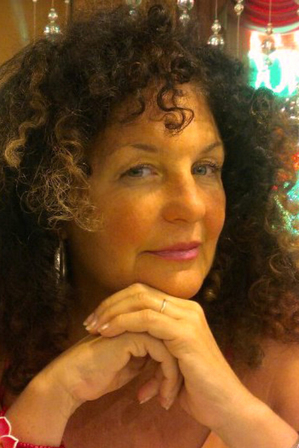
MarieCartierforKCETa-thumb-300x448-72405In my book Baby, You Are my Religion: Women, Gay Bars, and Theology Before Stonewall I talked about the importance of the gay women’s bar (and gay men’s bar) as sacred space for pre-Stonewall homosexuals—how the community space of the gay bar was the only public space for pre-Stonewall homosexuals and how it galvanized and concretized a community that had no other way of connecting. It was “home.”

I was so fortunate to do two readings and signings for People Called Women, the feminist bookstore from Toledo, Ohio — and Ohio’s only feminist bookstore — when they brought their “traveling bookstore” which goes to feminist events (they also have their mortar and brick store in Ohio J which I was thrilled to visit) to Michigan Womyn’s Music Festival last week. I was thrilled that we were able to sell out of all the copies of my book that People Called Women brought “to the land” (Michfest). I was thrilled that so many women showed up to our event, told stories about early bar life, cried, shared hugs and created community — and bought books. It felt radical and “old school” feminist. It felt like something I have missed – that connection with a feminist bookstore–for Los Angeles lost our women’s bookstore in 1999 —15 years ago.

people called women- front of store
Marie Cartier w/ Gina Mercurio, owner of People Called Women, Photo by: Megan Morris

For many of us who came of age post-Stonewall in the mid 70s, 80s and late 90s, the gay women’s bookstores—or rather feminist bookstores — were these sacred “home” spaces. They were our “alternate church,” as I so label the pre-Stonewall bars.

I “came out” as a lesbian and as a feminist — in 1979. One of the first places I visited was New Words Bookstore in Cambridge, MA. New Words really did feel like that—“new words,” like parting the curtain onto a brand new world where I had access to language that finally made sense—a new way of communicating—that is what feminism felt like — like being able to talk and be heard and understood for the very first time. Continue reading “Feminist Bookstores and the Disappearance of Sacred Space by Marie Cartier”

Old and Gay – Dying Alone and Rae’s Friends by Marie Cartier

MarieCartierforKCETa-thumb-300x448-72405A dear friend of mine is dying. Yes, the saying might be true—we all die alone. But we all are not necessarily lonely when we die. How can we die happy…with our self-respect intact?

We are all alone, born alone, die alone …I do not say lonely — at least, not all the time — but essentially, and finally, alone. This is what makes your self-respect so important, and I don’t see how you can respect yourself if you must look in the hearts and minds of others for your happiness. —Hunter S. Thompson

Many of the women that I interviewed in my book Baby, You Are my Religion: Women, Gay Bars, and Theology Before Stonewall lived a closeted gay life. Their respect for their gay self had to be hidden in order to survive. It was how they respected the gay inner self—it is how they protected that self’s very survival.

Many of them, as many of us do, had friends that affirmed their inner identity even as it was hidden to a majority of the outside world. As they grew older, their friends (as many of our friends will do) died. That meant that the friends they had in the gay bars died holding the secret of their gay lives. Many of these women grew up into adulthood without the benefit of a community. For them “gay pride,” “coming out,” and even the word “lesbian” were not words they would ever use in their common conversation. Continue reading “Old and Gay – Dying Alone and Rae’s Friends by Marie Cartier”

The Fault is in Our Stars: Feminism, Sisterhood, and the Fight for Awesome by Marie Cartier

If you haven’t yet read the book The Fault is in Our Stars (or seen the movie) I guess I should begin by saying this blog will contain spoilers.

This story is about having cancer as a teen and dying from it. It’s also about a young woman, Hazel Grace, having cancer, a sense of humor, belief in her ability to have her life on her own terms, fall in love and claim her independence. It’s about a young man, Augustus Waters, falling in love, being insecure as a young man, yet secure enough to cry, and his belief  in making life better for those around him for as long as he can—even after death.

It’s quite remarkable and…its aftermath is also remarkable.  This book and its film and following have created some remarkable trends.

The author, John Green has coined a few phrases that deserve coinage in my every day usage. Among them, Green has proposed we use the phrase: “nerd fighter.” Nerd fighters fight to “increase awesome and decrease suck.”

We fight against suck….we fight for awesome. We fight using our brains, our hearts, our calculators and our trombones.

Continue reading “The Fault is in Our Stars: Feminism, Sisterhood, and the Fight for Awesome by Marie Cartier”

Jesus, Mary and Joseph: Who Are Our Saints? by Marie Cartier

Tomorrow I will be going to a friend’s 7th grade classroom presentation of “famous people in history.” She has 120 students who will be dressing up as someone in history and doing a presentation board about this person—as well as dressing in costume. She asked me to come in costume as Frida Kahlo. As many of you know, I admire/adore Frida Kahlo and wrote a blog last year extolling her praises; actually it was a “valentine towards an ethics of loving women and art.” (And every year I dress as Frida and help a friend do a lively lotería game at an LGBT celebration of Cinco de Mayo at our Church.)

My friend told me that while there would not be a Diego Rivera in her crowd of costumed living historians—there would be Frida’s lover Josephine Baker (someone saw the movie Frida and knew Josephine and Frida were “friends”), and there would be several Guadalupes.

This got me thinking that for children/teens – especially children brought up in religious households (and especially Catholic households, of which I was such a child) – saints and real people are often conflated. And famous real people one admires often are given “sainthood” in one’s imaginary church. Continue reading “Jesus, Mary and Joseph: Who Are Our Saints? by Marie Cartier”

Taking Time to Smell Your Roses: What Are You Grateful for This Spring? by Marie Cartier

MarieCartierforKCETa-thumb-300x448-72405I am taking this space, this month to share two very wonderful pieces of news. And I will make the caveat opening here: this is a blog about the benefits of gratitude and I am reaping them here—with a bit of shameless self-promotion. I am advocating here again for my work, my “book child”, as I did in my birth announcement blog!

As we move into spring, I want to step back and take stock of what I have planted that is coming into bloom. And with this, I hope to suggest to you all, dear readers, that you do the same. I (I’ll speak for myself here) tend to rush so much and feel I have so much to do that sometimes when something amazing happens that I have worked so hard for—it just passes me by, and I am on to the next thing before I get a chance to really acknowledge even what that amazing thing was. Continue reading “Taking Time to Smell Your Roses: What Are You Grateful for This Spring? by Marie Cartier”

I Believe Anita! by Marie Cartier

Marie CartierDuring the past week I attended a Los Angeles premiere of a new documentary Anita: Speaking Truth to Power (Dir: Freida Lee Mock USA, 2013). The screening was sold out and I had great seats saved for me– sitting with a friend who works at Samuel Goldwyn, the distributor of this fine film.

In 1991, Anita Hill provided testimony she hoped would serve to dissemble the nomination of Clarence Thomas as a Supreme Court justice. Although the vote would end up being close (52-48) Hill’s testimony did not serve to dissuade the decision — Clarence Thomas’ nomination was confirmed and he was appointed to a life term on the Supreme Court four days after Hill’s testimony concluded. Here is an outline of the debate. Continue reading “I Believe Anita! by Marie Cartier”

Birthdays and Aging and Feminism and Religion by Marie Cartier

marie candles full“Spring passes and one remembers one’s innocence.
Summer passes and one remembers one’s exuberance.
Autumn passes and one remembers one’s reverence.
Winter passes and one remembers one’s perseverance.”
Yoko Ono

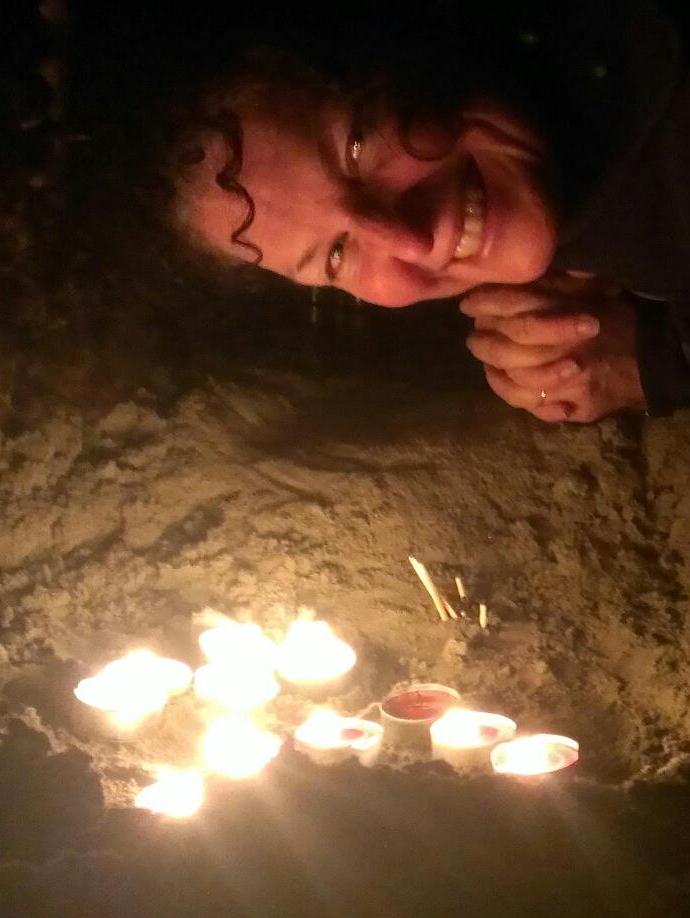
If you are reading this on February 28, 2014, then you are reading it on the day after my birthday—I am 58 years old now. I wrote previously about aging and feminism and reclaiming our bodies—my fears of wrinkles—well, not fear…my surprising distaste/revulsion of them, and then yes, fear. My ability to maintain peace inside my aging body came about because I have a life-long history of feminism and I practice yoga. I explored all of this in one of my first blog posts for this site, “If You’re Lucky, You Get Old.” That was two years ago.

I am happy to say that I am no longer scared by my face—by its changes. I believe that “if we are lucky, we get old.” Now—I don’t want to just “get old,” I want to get old and be healthy—and by healthy I mean I want to keep my mind.

This past month I went back to the East Coast to attend the funeral of my mother. She died of Alzheimer’s. Yes. Feminism and Alzheimer’s. Women get Alzheimer’s more than men—women constitute 2/3 of those who get the disease. I know many friends who are afraid now—their mothers had it—are we going to get it? There is a lot of research on Alzheimer’s and little information. There is however the information that women get it more often than men. Some of the things that can prevent Alzheimer’s are physical exercise, healthy diet and social activity. Are these harder for women to attain than men? Continue reading “Birthdays and Aging and Feminism and Religion by Marie Cartier”

Walking with Gods and Dogs by Marie Cartier

collette): photo by: angela brinskele, long beach pride, Marie Cartier
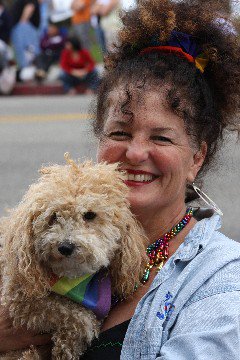
Marie and Collette, photo by Angela Brinskele

“If there are no dogs in Heaven, then when I die I want to go where they went.”      ― Will Rogers

I spend a lot of time with my dogs – Collette and Malibu. This month I am thinking a lot and walking a lot – and it occurs to me that in terms of enlightenment we have no greater teacher than a dog, or in my case, dogs.

Deepak Chopra said, “According to Vedanta, there are only two symptoms of enlightenment, just two indications that a transformation is taking place within you toward a higher consciousness. The first symptom is that you stop worrying. Things don’t bother you anymore. You become light-hearted and full of joy. The second symptom is that you encounter more and more meaningful coincidences in your life, more and more synchronicities. And this accelerates to the point where you actually experience the miraculous,” (quoted by Carol Lynn Pearson in Consider the Butterfly). Continue reading “Walking with Gods and Dogs by Marie Cartier”

What is the Nature of the Hope that Can Trump Despair in the New Year? by Carol P. Christ

carol-christ“All hope abandon, ye who enter here.” These words posted on the gates of hell in Dante’s Inferno have an eerie resonance in our time. 

Marie Cartier recently posted a blog on children and hunger with facts so devastating I could not finish reading it. Earlier in the month Jassy Watson wrote about her deep feelings of grief on hearing Luisah Teish’s “Prayer for Disappearing Species.” Grief, despair, and sadness about the injustices in our world can be overwhelming.

A friend of mine has recently fallen into a deep depression. When I try to talk her out of it, she repeats that they are threatening to cut down the last remaining old growth forest in her home state of Oregon and that she can no longer eat fish because radioactivity released in the Fukishima nuclear plant disaster is reaching the seacoast of Oregon.

When I tell my friend she should not dwell only on these things and that she must remember that the world is still a beautiful place, she responds, “I do not want to give up my feelings. I know I must find a way to acknowledge my sadness and make a place for joy, but I don’t know how to do it.”

I have been in the grip of deep grief about the planet myself, not once but many times. But this happens less frequently than it used to.  When I think about the differences between how I once felt and how I feel now, I think the difference is that I have come to terms with and accepted the likelihood that “the world as we know it” is “going to hell in a handbasket”—as I put it.

I believe that the most likely conclusion of the choices human beings are making on planet earth today is massive environmental destruction leading to great suffering and probable extinction for human and many other species on planet earth. This is what I believe, but I also remind myself that I cannot know for sure. The earth and its species including human beings may have resources of resistance and survival, transformation and adaptation,that I do not know about and cannot imagine.

When I began to accept that the world I know and love (where spring follows winter, where birds sing, and where there is hope that injustice can be rectified) may not exist in the very near future, I had an astonishing insight. The death of the world I know and love will not mean the death of our planet or the end of the evolution of the universe.

Thinking about the disappearance of species and the death of human beings from starvation often feels too much to bear. None of this should be happening. Still, it can be strangely comforting to remind myself that the world I love is not the only possible world. There have been other worlds on this very planet—the time when the first cells were formed, the time of the dinosaurs, and many others. Evolution will continue on planet earth for several billion more years, and when our sun burns out, other suns will most likely still be shining in the universe.

This insight was followed by another. The reason for hope is not the conviction that we will be able to save the world we love. The reason for hope—and the reason to keep trying to save our world—is the deep knowing that it is right to try. Even if we cannot save the world we love for all time, we can savor the gift of life, and we can continue to try to create a world in which the gift of life is shared widely today and tomorrow.

I have written many times that we must learn to love a life that ends in death. I was speaking about accepting that each one of us will surely die. I do not fear death. Overcoming this fear has opened me to a greater and more clear-sighted love for life.

Can we learn to love life while accepting that the world we love may be dying? Can we continue to work to improve the conditions of life for individuals and species knowing that the world as we love it may not survive? Do we have any other choice?

For me the hope that can trump despair in our time begins in gratitude for a life that has been given to us, a life that has come down to us through the generations, and through billions of years of the evolutionary process on our planet.

Let us bless the Source of Life.

Let us bless the Source of Life, and the cycles of birth, death, and regeneration.

Let us turn back from despair.

Let us embrace the gift of life and share it with as many others as possible in the new year.

Carol P. Christ  learned to be grateful for the gift of life in Crete on the Goddess Pilgrimage to Crete she leads through Ariadne Institute.  It is not too early to sign up for the spring or fall pilgrimages for 2014.  Carol can be heard on a WATER Teleconference.  Carol’s books include She Who Changes and Rebirth of the Goddess and the widely-used anthologies Womanspirit Rising and Weaving the Visions. She wishes you great joy in the new year.

Baby, You Are My Religion by Marie Cartier

—it’s a girl and she weighs 240 pages!

I just heard from the United States distributor of my book, Baby, You Are My Religion: Women, Gay Bars, and Theology before Stonewall.

This blog has to be about that. I feel like I am waiting for my child to arrive and, as I’ve already written about in a previous post, I am announcing the “birth” of my book. The book is on the East Coast –  it’s almost here!

The book was published in the United Kingdom by Acumen Publishing and it has taken several weeks for the books to “cross the pond.” So although the book has been in my hands in galley form three times and I know it was published in the U.K. I have yet to see the finished copy! Continue reading “Baby, You Are My Religion by Marie Cartier”