Painting Guadalupe and Mary by Angela Yarber

As we feminists struggle to elevate Mary and Guadalupe, we sometimes forget that speaking of birth and gestation is not always empowering or even essential to womanhood. 

It is early morning on the Hill of Tepeyak on December 9, 1531 when a wondering peasant named Juan Diego first caught a glimpse of her presence.  Diego sees a vision of a teenage girl surrounded by light; the young girl asks that a church be built on the hill in her honor.  After hearing her speak and seeing the light emanating from her presence, Diego recognizes her as the Virgin Mary.  He rushes to the Spanish archbishop who insists on a sign as proof of Diego’s vision.  The young girl instructs Diego to gather flowers from the top of the hill, even though it is past their growing season.  Upon climbing to the top of the Hill of Tepeyak, Diego discovers Castilian roses—a beautiful flower otherwise unheard of in Mexico—which the glowing young woman arranges in his cloak.  When Diego returns to the archbishop, he opens his cloak to reveal the miraculous flowers and they fall to floor; in their place was an image imprinted on the fabric of his cloak.  It was the image of Our Lady of Guadalupe.

Guadalupe is one of Mexico’s most popular religious and cultural images and her icon, now on display at the Basilica of Our Lady of Guadalupe, is one of the most visited Marian shrines in the entire world.  On December 12, countless Christians—particularly Catholics—celebrate her feast day.  Her feast day occurs within the four week celebration of Advent, which is the period of waiting, expectancy, and gestation before the birth of Jesus at Christmas. Continue reading “Painting Guadalupe and Mary by Angela Yarber”

Working to Bring about the End by Elise M. Edwards

I was reminded that the idea of eschatological reversal can be a powerful image in the promotion of justice if we believe that we already are, or that we should be moving towards the ultimate end that remedies current injustices.

I started teaching a course in Introduction to Christian Ethics a couple weeks ago for a class of graduate students who are pursuing their M.Div. and other Masters in religion degrees.  We are spending some time talking about the use of Scripture in ethics, so I reviewed Richard Hays’ 1996 text The Moral Vision of the New Testament: A Contemporary Introduction to New Testament Ethics.  It got me thinking a lot about the role of eschatology in ethics. (Eschatology is the area of theology concerned with “last things,” like the end of the world, heaven, hell, death and eternal judgment.)

Continue reading “Working to Bring about the End by Elise M. Edwards”

Remembering My Grandmother: Not as a Suffering Servant but as a Devoted and Loving Mother By Michele Stopera Freyhauf

The last week-and-a-half has been probably the most heart wrenching time I remember having in my life.  You see, my grandmother passed from this life June 19th and the void in my heart is huge.  I have to admit that I am lucky that my grandmother was a huge part of my life and the last family funeral I attended was in 1983.  Certainly one expects grandparents to pass away, even when they live a healthy long life.  Nothing prepares you for the time that you must say good-bye.  You yearn for one more conversation, one more hug, one more kiss – the thoughts churn and churn robbing you of sleep or peace.  At some point, a level of acceptance or at least the ability to cope will occur – when is a mystery, but for now I just try to be strong – for my mom, my sister, and my children.

Driving home from vacation, I received the news from my sister, Lisa:

Lisa:    Nanny has lymphoma, which they found in her stomach and invaded her spine, paralyzing her from the hips down.  It is fast moving.

Me:     How long?

Lisa:    2-4 weeks. Hospice was called and is making her comfortable.

The news was jolting, but I did not realize that the initial expectation 3 days earlier was 6-8 weeks.  She had tests for a bleeding ulcer, so this diagnosis was jolting.  Over the last year, we dealt with dementia and health issues.  These either were false alarms or cured thanks to the love of her family, care from the people at the nursing home, and her nurse practitioner and physician.  I wished that this was also a false alarm – but it was not, this time it was real and the end was eminent.
Seeing my mother at Father’s Day celebration, the news was even more grim – Nanny is no longer alert, can no longer open her eyes – they are making her comfortable.  The last time her eyes opened was after her priest gave her last rites.  He turned to leave, she opened her eyes, said “Hi Father,” and went back to sleep.  This was the last time her eyes would open.  My mother tells me that she is not expected to live through the week.

I took my children over to say good-bye.  I know I should be grateful that my girls have a close relationship with their great-grandmother, one that spanned 19 years.  I know I should be grateful that I had her in every facet of my life.  It is no secret that family was important to my grandmother, and she adored all of her children, grandchildren, and great-grandchildren.  This is a trait handed to my mother, my sister, and me.  Something I strive to instill in my children.

The good-byes were difficult as she was essentially unconscious and her breathing was noisy.

My sister called, how is she?

Me:     Breathing is labored and gaps between breaths are getting longer.

Lisa:    Will she be o.k. tomorrow?

Me:     I have no idea.  You may want to visit tonight just in case.

My sister and her husband appeared about 10 minutes later.  Wanting to give her time, I left with my family.  Going home was hard.  I was afraid she may not make it through the night.  I hoped with all my heart that this was not the end.

The next morning I returned to work.  She made it through the night.  I was in my office for a few hours before when I received a call from my dad.

Dad:    I am just calling to tell you Nanny is declining pretty fast.  They are saying minutes to hours – we are all here.  No need for you to come, I just wanted to let you know.
Me:     I am on my way.

Depending on traffic, I had a 40 – 60 minute drive.  I had to be with the woman that helped care for me and loved me.  The person that I took trips with, would talk hours on the phone with, cook with.  My grandmother was at every event, every family function, every holiday, and every birthday.  She was a huge part of my life and very important to me.  I needed to get there before she took her last breath – thankfully, I did.

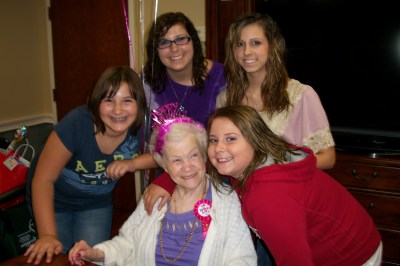
The goodbyes continued.  Staff and residents alike came down to say goodbye. She was loved my so many.  Tears flowed for this petite woman with beautiful blue eyes, a contagious smile, and a heart of gold.  Her three children, my father, my sister, a few friends, and I kept vigil by her bedside.  I held her hand, sponged her neck and forehead to help with the fever, and kissed her forehead.  This went on all day and all night.

It was now midnight.  Everyone left the room to have a snack.  It was a long day and we forgot to eat dinner.  The staff was nice enough to provide us with muffins, water, pop, and coffee but this was no longer enough.  Every time someone would leave to use the restroom, you did not know if she would still be there when you came back.  Even running to a fast-food restaurant to grab a few sandwiches was done with angst and concern. Continue reading “Remembering My Grandmother: Not as a Suffering Servant but as a Devoted and Loving Mother By Michele Stopera Freyhauf”

A Family Conceived, Lost, and Resurrected by Gina Messina-Dysert

As I had written about in a previous post, my husband and I had a very long struggle with infertility.  After nine years, multiple failed rounds of infertility treatments, and much heartache, we decided to look at alternative options to grow our family.  Once we had made the decision to adopt, I felt new hope.  There was a light at the end of the tunnel and I knew a child would be coming home to us before long.  I had a dream that Mary, the mother of Jesus, had come to me and told me that I would be a mother.  She promised that a child was waiting that needed our love and would arrive soon.  I began praying to a shrine of Mary at a local parish near my home; she became my source of strength and solace.

Not long after we had been approved for the adoption waiting list, we took a family trip to Italy to visit my father’s hometown and meet our relatives.  It was quite an adventure and during our excursion I stopped in every church we passed to say a prayer to Mary.  Half way through the trip we received a call that a child had been matched with us.  To say we were overjoyed would be a complete understatement.  We tried to catch an earlier flight home but were unable.  A once in a lifetime trip to Italy was suddenly of no interest to us as we sat around our hotel room looking at baby items, reading parenting info, and preparing for the homecoming of our first child.   Continue reading “A Family Conceived, Lost, and Resurrected by Gina Messina-Dysert”

Do Man-Made Laws Trump the Authority of Jesus? Reflecting on the Meaning of Humility, Priestly Service, and the Issue of Women’s Ordination by Michele Stopera Freyhauf

Maundy Thursday – the imitation of Jesus’ act of service and submission is re-created.  Controversy surrounds the “disciples” – must they be all men?  Are women allowed?  Who steps into Jesus’ role?  Men, women, or both?  Why, when it comes to imitating the act of  humility and priestly service (rooted in our baptismal call), does a distinction of gender need to made at all?

As I progressed towards the intersection, I looked up to witness a grand procession of men dressed in white albs with stoles that often contained subtle hints of gold, worn in a manner to distinguish their role as priests and deacons.  They moved slowly down the sidewalk entering the Cathedral to begin their celebration of the Chrism Mass – a celebration of priesthood and priestly service within the Diocese where all priests and deacons gather to celebrate and re-affirm their commitment to ministry and service to the Church.  It is also during this Mass that the oils used in sacramental celebrations, used by each church, are blessed by the Bishop.

As I continued to watch, I could not help but search the processional line for those with a hair color other than gray.  I wanted to see  how many young priests were in that processional line.  What I found was no surprise –  an aging group of men with the sporadic appearance of younger priests.   The numbers stood as a staunch reminder that we, as a Church, may be faced with a severe shortage of priests in the future.  Something already known and planned for by the Diocese in its campaign to consolidate and close parishes.

Another sad observation was put on public display  –  the absolute absence of women. Continue reading “Do Man-Made Laws Trump the Authority of Jesus? Reflecting on the Meaning of Humility, Priestly Service, and the Issue of Women’s Ordination by Michele Stopera Freyhauf”
My First Experience at a Women-Only Conference by Grace Yia-Hei Kao

“This ain’t your daddy’s conference!”

I knew that I was going to be attending a totally different type of conference than I had ever been to before when I received the following instructions on additional items to pack: (1) my own mug with which to drink coffee or tea (“we will go green in this conference as much as possible”), (2) 3 oz. of water “from a source of nature near your home” to be offered during “opening worship,” and (3) a small, modest, pre-owned, homemade, or inexpensive “earth-honoring gift for exchange.”

Continue reading “My First Experience at a Women-Only Conference by Grace Yia-Hei Kao”

Walking in the Footsteps of Mary by Najeeba Syeed Miller

As I walked into the “House of Mary”http://en.wikipedia.org/wiki/House_of_the_Virgin_Mary
in Turkey, our guide said, “As many Muslims as Christians come to visit this last home of Sayyidah Maryam (form of respectful way to refer to Mary, Mother of Jesus). The veracity of the historical claims of whether this was her home continue to be debated, but the relevance of her role in Muslim narratives continues to inform my community, and is also cherished by those of us who are mothers.

A Mother’s Heart
The verses of Surah Maryam in the Qur’an are oft recited throughout the history of Muslims and at times had great significance. Some scholars point to the bridge that these verses helped to build between the Muslims who were fleeing persecution and the Christian Abyssinian Negus (king) who gave these early Muslims asylum and safety in his Christian country.Beyond the way that the Jesus (or Prophet Esa, upon him be peace is referred to in Arabic and by Muslims) figures into Muslim religious history, so too does his mother hold a place of significance. Continue reading “Walking in the Footsteps of Mary by Najeeba Syeed Miller”

Son of Man: An Updated Gospel Story of Jesus Set in South Africa by Michele Stopera Freyhauf

January 12, 2012

Son of Man is an updated story of the life of Jesus set in the fictional State of Judea that is modern day South Africa – complete with warlords and child soldiers.    It could easily be mistaken for modern day Rwanda or Darfur with its modern issues and political overtonesRoger Ebert stated, “The secret of the movie is that it doesn’t strain to draw parallels with current world events – because it doesn’t have to.”  The director draws parallels between the gospels and 21st century Africa.  According to Dartford-May, “we wanted to look at the Gospels as if they were written by spin doctors and to strip that away and look at the truth.”  The director “captures the rhythms of African life in both rural settings and sprawling townships.”  “Feather-clad young angels offer an eerie echo and reminder of Africa’s lost generations.”

The movie also sticks with what Eric Snider calls “Traditional African trial music, dance, and costumes” as a type of worship or or allusion to Jesus’ godhood.  Judea is in flux; warlords and corruption take center stage.  Poverty, violence, and oppression affect the all of the people.  The key idea is that Jesus is a freedom fighter – one that fights injustice and oppression.  The director does not emphasize “Jesus’ divinity so much as his leadership, good sense and compassion.”  Jesus is not violent and his followers, most of whom were former child soldiers, are encouraged to respond non-violently, which goes against their upbringing and training. Continue reading “Son of Man: An Updated Gospel Story of Jesus Set in South Africa by Michele Stopera Freyhauf”

Birthing God at the Edges of Life, Death, and Beyond: Reflections on Mary, Motherhood, and Kali Part III By Tracy Sayuki Tiemeier

Tracy Sayuki Tiemeier, Ph.D., is Assistant Professor of Theological Studies at Loyola Marymount University in Los Angeles, CA. She teaches and researches in the areas of women and religion, interreligious dialogue, comparative theology, Asian and Asian American theology, and Hindu-Christian studies. Tracy also co-chairs the Los Angeles Hindu-Catholic Dialogue.

When I began my studies of Hinduism, I marveled in a dizzying array of gods and goddesses. While non-Hindus assume that Hinduism is polytheistic because of the multitude of gods and goddesses, the reality is far more interesting and complex. Hinduism really isn’t one religion, but a cluster of them. For some, there is one personal, divine God or Goddess, and all other gods and goddesses are either different forms of the ultimate divine or are lower, created beings (like angels). For others, there is one divine reality, but it isn’t a personal God or Goddess. For them, the different deities illustrate or symbolize different aspects of the divine, but are not themselves the one Ultimate Reality. What all Hindus recognize, however, is that there is one Ultimate, Divine Reality and that that divinity pervades all things. But that divine Oneness is so profound, so deep, so real, that no one image can capture the divine essence. Thus, even as Hindus are more monotheists than polytheists, they resolutely celebrate the multiplicity that inevitably comes when finite humans imagine the infinite divine. Continue reading “Birthing God at the Edges of Life, Death, and Beyond: Reflections on Mary, Motherhood, and Kali Part III By Tracy Sayuki Tiemeier”

Birthing God at the Edges of Life, Death, and Beyond: Reflections on Mary, Motherhood, and Kali Part II By Tracy Sayuki Tiemeier

Tracy Sayuki Tiemeier, Ph.D., is Assistant Professor of Theological Studies at Loyola Marymount University in Los Angeles, CA. She teaches and researches in the areas of women and religion, interreligious dialogue, comparative theology, Asian and Asian American theology, and Hindu-Christian studies. Tracy also co-chairs the Los Angeles Hindu-Catholic Dialogue.

Mary, her purity, and her role as Virgin Mother have become the primary language for talking about women and women’s place in the Church. The late Pope John Paul II held up Mary, both virgin and mother, as the perfect model for women. For the Pope, women’s sexuality and spirituality are united in a vision of woman’s personhood as that of nurturing self-gift. The calling of physical and spiritual motherhood is connected to women’s more receptive and nurturing nature. Men lead the Church, as Christ did, while women receive Christ and others in their homes and in the world, as Mary did. Mary’s receptive openness to God is manifest from the beginning in her consent to Jesus’ conception. Such receptivity is both biologically natural and spiritually essential. Mary as Virgin Mother shows both women and men the value and depth of the receptive, self-giving reality of womanhood. Continue reading “Birthing God at the Edges of Life, Death, and Beyond: Reflections on Mary, Motherhood, and Kali Part II By Tracy Sayuki Tiemeier”