From the Archives: Is Baptism a Male Birthing Ritual? By Michele Stopera Freyhauf

This was originally posted on March 22, 2012

Quite a number of years ago I had a conversation with one of my professors, a feminist theologian, who posed the question “Why do I need a man to purify my baby with the waters of baptism?  Is there something wrong or impure about the blood and water from a mother’s womb – my womb?”  Before you jump and shout the words Sacrament or removal of original sin, this question bears merit in exploring, especially in today’s world where women are taking a serious beating religiously, politically, and socially.  In today’s world, violations and rants are causing women to stand up and say STOP!  This is MY Body.  This outcry was provoked by chants of ethical slurs against women– Slut! Prostitute! Whore!  The cry got even louder when the issue of religion and government was raised in the fight of healthcare coverage of contraception. The cry got even louder with the enactment of the laws in Virginia and Texas (and many other states to follow suit) that forces women to undergo transvaginal ultrasounds in early stage abortions.  The mandatory insertion of a wand into a woman’s vagina (mandated by the government, mind you), is a violation and has women crying RAPE!

Continue reading “From the Archives: Is Baptism a Male Birthing Ritual? By Michele Stopera Freyhauf”
In the Words of the First Poet and Historian: “I am” by Michele Stopera Freyhauf

These days I find it hard to write – I feel plagued with negativity, and the news and violence and overall hateful actions of others have weighed deeply on my soul.  While I personally am ready to celebrate a milestone birthday, am another year closer to completing my Ph.D., witnessed the graduation of one daughter, experienced the independence of another, a milestone for my twins, as well as my father’s successful completing of another orbit around the sun after a year plagued with health issues – rather than joy, my heart is filled with pain – pain of the election, pain of the failure of our political system’s supposed checks and balances, pain of violence and bigotry like that enacted in Charlottesville, pain of terror attacks in England, Spain, Finland, France, etc.  Where we ought to be united, we are divided. Thus, I write from a place of remembering – a place of strength – a place to say I count (as you count) – and I begin this blog in the voice of Enheduanna, where she becomes the first voice in history to reveal herself – her name, by simply stating – – “I AM.” Continue reading “In the Words of the First Poet and Historian: “I am” by Michele Stopera Freyhauf”
Let My People Go! Modern Day Oppression and Exile by Michele Stopera Freyhauf

FreyhaufLet my people go!

Where is the humanity? Why are my sisters and brothers continuously subjected to persecution? Who will help and stop this madness?

I am a member of the human race. Collectively I identify with those who need help and are oppressed. I do not identify with the oppressors, for they are like Pharaoh whose heart was hardened. In identifying with this group, I will provide a label of humanity; for the oppressors do not show care or love but evil and sin towards my people – they cannot be part of this group. As my people flee the boarders from the oppressors, the world has opened their gates to let them in. The world has not turned their back on them. However the oppressors continue to mar their homeland, destroy their culture, and attempt to erase their history, their identity, their footprint on this earth. They are not oppressors but are in fact committing cultural genocide. They are committing genocide against humanity, against anyone who does not follow their ideology, their way of life.

Why should we care? Should we care? For this I say yes. My people need protection and help, but like the Israelites in the story of the Exodus, they yearn for their homeland – a place they were forcibly exiled from. They yearn for food and clean water. They yearn for safety and protection.  While you may think that my people were not forcibly exiled – they were. They fled for their own lives – for their own people, and the community’s hearts became hardened to their pleas for help.

The Syrian crisis is one that we have allowed to repeat over and over again. According to World Vision, nearly 12 million Syrians have been forced from their homes – half of which are children.  At least 7.6 million have been displaced within Syria and more than 4 million have fled the country.  Children affected by this crisis are at risk of becoming ill, malnourished, abused, or exploited.  Save the Children produced a video that shows what happens to a girl after three years of conflict:

Continue reading “Let My People Go! Modern Day Oppression and Exile by Michele Stopera Freyhauf”

Movement Within the Catholic Church – Time for Receptive Ecumenism? by Michele Stopera Freyhauf

Michele Stopera When I originally learned about the concept of receptive ecumenism and the movement to more fully reach across lines of faith traditions as a means of ecclesiastical growth, my first reaction was to ask the question – what about women in the pews?  

Dr. Paul Murray from Durham University conceived of the idea of receptive ecumenism, which had three international conferences of church leaders and theologians working together in a way that looks to learn from each other. The focus is not that our religion is better than yours, rather what can we learn from your faith tradition that could enrich ours without compromising our tradition. With this final conference and after years of lectures, meetings, and publications, Dr. Murray sent this concept out into the world to see if it had legs – and it really does. Pope Francis embraced this concept, so has the Anglican Church. The movement is also thriving in Australia to the point that eighteen delegates were present at June’s meeting in Fairfield, Connecticut. For my part, I raised the question whether or not the Catholic Church was postured to engage fully in this dialogue. Essentially, it boils down to this, how can we have an inter-faith dialogue when we are unwilling, as a church, to have an intra-faith dialogue that includes all voices. The teachings of the Second Vatican Council laid the groundwork for ecumenical dialogue to occur at a multilateral levels. The council mandated us to look inward as well. Continue reading “Movement Within the Catholic Church – Time for Receptive Ecumenism? by Michele Stopera Freyhauf”

Standing in Cautious Optimism with the Election of the First Jesuit Pope by Michele Stopera Freyhauf

Freyhauf, Feminism, Religion, Durham, Old Testament, Blogger, Bible, Gender, Violence, Ursuline, John CarrollFrom the time Benedict’s successor was revealed, I believed that we were witnessing something different – hopefully change.  Pope Francis I embraces many “firsts” – which is probably why the Cardinals chose him.  Change and reconciliation seem to be at the forefront – something the Church so desperately needs today.  Francis is the first Latin American Pope, first Jesuit Pope, first Pope to use the name of Francis after St. Francis of Assisi, a Saint held in high regard by Catholics.  When I heard his chosen name, I immediately thought of St. Francis, to whom my favorite prayer is attributed.  This is a prayer that inspires me and speaks about how I try to live my life –  as one who strives for peace, and provides love, hope, and compassion.  St. Francis’ story is a powerful story of conversion from a life of great wealth to one of voluntary poverty.  Francis received a revelation from Christ to “rebuild my Church,” in a way that embraces peace and love as well as providing protection for all of creation.  The notion of “Protector” was a major theme in Pope Francis’ homily during his inauguration mass.

As an unlikely choice for Pope, mostly due to his age and health, Francis reminds me of another unlikely advocate for the people – a man chosen to be Archbishop because of his passivity and his ill-health – Oscar Romero.  Romero surprised the people who placed him in office and stirred things up when he became a staunch advocate for the people that he served.  Romero’s “moment of conversion” revealed something spectacular that changed Latin America.  In his role as leader, he found his voice and became a defender for the poor and oppressed.  It is because of Romero that I am hopeful that Francis will provide (or at least start the wheels in motion to provide) changes to the Catholic Church. Continue reading “Standing in Cautious Optimism with the Election of the First Jesuit Pope by Michele Stopera Freyhauf”

The Impact of Excommunication in the 21st Century (Part I) – Spiritual Redemption or Hegemonic Power by Michele Stopera Freyhauf

The Lord loves everyone and died for everyone, and He wants all to be saved…the best lesson that can be learned from everything that has happened is that one finds happiness, joy and satisfaction in obedience to the Church.”Bishop Bruskewitz

One of the most misunderstood concepts in the Catholic Church is excommunication.  Many believe that excommunication is a complete termination or separation from the Catholic Church.  To say this another way, if excommunicated, you are no longer Catholic or part (a member) of the Catholic Church.  None of these statements are true.  By baptism, you are a member of the Catholic Church and no one can take that away.

Much of the misunderstanding stems from the way excommunication was used in the Middle Ages; a means of coercion to control kings and other high ranking officials.  Obedience to the Church meant that you will spend eternal life in heaven.  Disobedience to the Church meant a complete separation from the Church; a ban against  receiving Eucharist, a banishment of your soul to the eternal flames of hell.  Excommunication was the highest form of punishment and the most meaningful (and effective) tools of control.  When a person was excommunicated, there was even a public ceremony –  a bell tolled for the excommunicant, as a bell that would chime for the dead, the Gospels were closed, and a (baptismal) candle would be extinguished.  This ceremony signified eternal darkness and death. Continue reading “The Impact of Excommunication in the 21st Century (Part I) – Spiritual Redemption or Hegemonic Power by Michele Stopera Freyhauf”

Validating the Gospel of “Jesus’ Wife” is not Necessary to Prove Female Discipleship by Michele Stopera Freyhauf

The Gospel of “Jesus’ Wife” is certainly at the center of a battle that was last seen when questions of authenticity were raised about the James (Jesus’ brother) ossuary.  In a New York Times article, September 30th, Judith Levitt states that this document adds weight to theological and historical flaws surrounding the issue of the ordination of women.  The Vatican believes that their theology is still sound, calling the document a forgery.

The Gospel of “Jesus’ Wife.” [www.boston.com]
Frankly we do not need this document to validate the existence of female deacons and disciples – we have the biblical text and writings of the early church to validate this position.

Nor do we need this document to show that the standing from the Vatican’s point of view of ordaining women is theologically and historically flawed.

“In 1976, experts of the Pontifical Biblical Commission determined that there were no scriptural reasons preventing women’s ordination. The Congregation for the Doctrine of Faith overturned the commission’s judgment and instead wrote its own statement (Inter Insigniores, 1976) stating that women do not image Jesus who was a man; and therefore only male priests can adequately represent Christ.” – Women’s Ordination Conference

John Ortberg, in the Huffington Post, addressed a bigger issue surrounding female leadership in the Church brilliantly:

“perhaps what matters most in this discussion is the impact Jesus had — not on one woman — but on the status of women as a whole.”

Continue reading “Validating the Gospel of “Jesus’ Wife” is not Necessary to Prove Female Discipleship by Michele Stopera Freyhauf”

The Crime of Being a Girl Scout: The Sin of Raising Strong Female Leaders by Michele Stopera Freyhauf

Cradle Catholic and Woman

Educated by the U. S. Vowed Religious

Support the U. S. Catholic Sisters

Support, Minister, and Live the Social Gospel

Theologian, Feminist, and Critical Thinker

Former Girl Scout Leader of Three Troops

Former Girl Scout

I am all of these things and more.  By the recent attacks by the hierarchy of the Catholic Church, I am beginning to think I am the problem.  I seem to stand for everything the Vatican and USCCB seek to silence.  Is it because of my organizational ties with the U. S. Vowed Religious and Girl Scouts, or my writings as a Feminist and Theologian?  Maybe the answer is simply – because I am a woman.

According to the criticisms launched by the USCCB and the Vatican, I seem to be part of the problem rather than the solution.  Why is this so?  It was not until I started my journey in ministry that my idealistic “Catholic” bubble popped – not so much by me, but by those in ministry and leadership, by those that did not like laity to pose questions and think critically about their faith beliefs, and by  those that do not like people who do not fit within the preconceived mold of what a “good Catholic” should be.  This ideological construct is difficult enough when you are part of a Church community, but when you begin to embrace leadership as a woman, question teachings, exercise your canonical rights, your peers and even people you thought were your friends, no longer talk or associate with you. The betrayal is vicious and runs deep – it is behavior not becoming of a minister or one who professes the Catholic faith.

If the attack on you is not enough, these same people victimize your children through their words and behavior.  It is a difficult position for anyone to survive spiritually.  For children of the Church who bear witness to this hypocritical behavior, a journey begins – they search for meaning within the spiritual realm and become disgruntled with anything that resembles organized religion.  A place where one seeks community and spiritual nourishment becomes a place of oppression and starvation.  If attacking family is not enough, let’s start attacking groups that promote community – groups like the Girl Scouts of America.

So, what is the USCCB’s problem with the Girl Scouts of America?  Basically, this organization is under fire for suspected deviant thinking and positions that stand opposed to Church teaching. Continue reading “The Crime of Being a Girl Scout: The Sin of Raising Strong Female Leaders by Michele Stopera Freyhauf”

Do Man-Made Laws Trump the Authority of Jesus? Reflecting on the Meaning of Humility, Priestly Service, and the Issue of Women’s Ordination by Michele Stopera Freyhauf

Maundy Thursday – the imitation of Jesus’ act of service and submission is re-created.  Controversy surrounds the “disciples” – must they be all men?  Are women allowed?  Who steps into Jesus’ role?  Men, women, or both?  Why, when it comes to imitating the act of  humility and priestly service (rooted in our baptismal call), does a distinction of gender need to made at all?

As I progressed towards the intersection, I looked up to witness a grand procession of men dressed in white albs with stoles that often contained subtle hints of gold, worn in a manner to distinguish their role as priests and deacons.  They moved slowly down the sidewalk entering the Cathedral to begin their celebration of the Chrism Mass – a celebration of priesthood and priestly service within the Diocese where all priests and deacons gather to celebrate and re-affirm their commitment to ministry and service to the Church.  It is also during this Mass that the oils used in sacramental celebrations, used by each church, are blessed by the Bishop.

As I continued to watch, I could not help but search the processional line for those with a hair color other than gray.  I wanted to see  how many young priests were in that processional line.  What I found was no surprise –  an aging group of men with the sporadic appearance of younger priests.   The numbers stood as a staunch reminder that we, as a Church, may be faced with a severe shortage of priests in the future.  Something already known and planned for by the Diocese in its campaign to consolidate and close parishes.

Another sad observation was put on public display  –  the absolute absence of women. Continue reading “Do Man-Made Laws Trump the Authority of Jesus? Reflecting on the Meaning of Humility, Priestly Service, and the Issue of Women’s Ordination by Michele Stopera Freyhauf”

Is Baptism a Male Birthing Ritual? By Michele Stopera Freyhauf

Quite a number of years ago I had a conversation with one of my professors, a feminist theologian, who posed the question “Why do I need a man to purify my baby with the waters of baptism?  Is there something wrong or impure about the blood and water from a mother’s womb – my womb?”  Before you jump and shout the words Sacrament or removal of original sin, this question bears merit in exploring, especially in today’s world where women are taking a serious beating religiously, politically, and socially.  In today’s world, violations and rants are causing women to stand up and say STOP!  This is MY Body.  This outcry was provoked by chants of ethical slurs against women– Slut! Prostitute! Whore!  The cry got even louder when the issue of religion and government was raised in the fight of healthcare coverage of contraception. The cry got even louder with the enactment of the laws in Virginia and Texas (and many other states to follow suit) that forces women to undergo transvaginal ultrasounds in early stage abortions.  The mandatory insertion of a wand into a woman’s vagina (mandated by the government, mind you), is a violation and has women crying RAPE!

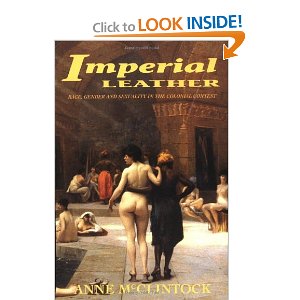
The memory of this conversation did not re-appear by chance, it was prompted by a book I read for my History of Sexuality Class – Imperial Leather: Race, Gender, and Sexuality in the Colonial Context by Anne McClintock who addresses the notion of baptism through origins, property, and power.  So many things are currently being taken away from women and reading McClintock’s assertion regarding male baptism is perplexing.  She believes that male baptism or baptism by a man takes women’s role in child bearing and diminishes it.  These are the same men who historically treated and regarded women as vessels.  She further asserts that this act is a proactive removal of creative agency with respect to a woman’s ability to have the power to name.  That is, the last name of the child belongs to the husband.  A point that supports the notion that patrimony marks the denial of women.  Anyone doing genealogy encounters a perplexing struggle to identify mothers because their names are essentially erased from memory and rarely attached to a child’s name. Continue reading “Is Baptism a Male Birthing Ritual? By Michele Stopera Freyhauf”