All That She Carried by Tiya Miles: Recovering the Untold Stories of Black Women in America, part 2 by Theresa Dintino

Part 1, appeared yesterday.

There are many women named Rose in the ledgers of unfree people in Charleston around 1850. The defining feature to find the Rose mentioned on this sack is that her daughter is named Ashley, not a common name for Black female children of the time. Miles finally locates a Rose and an Ashley in the inventory of Milberry Place Plantation, a country estate of a man named Robert Martin. When Martin died, his estate was liquidated and thus the mention of the sale of Ashley. 

“Ashley is listed among one hundred unfree people in the inventory of Martin’s enslaved property taken in the year 1853. Her attributed value of $300, in comparison to that of other women listed at $500 and $600 in the cotton boom decade of the 1850’s, suggests that she may have been a younger or relatively unskilled worker”(69).

Things were bad enough for unfree people but the disruption that came like a tsunami through their lives when an enslaver died and his property was sold was a fear most carried and trembled at the thought of. Unfree families were always being torn apart in the time that slavery was legal and allowed in this country, but when estates were being divided up, it became particularly excruciating and this is what came to pass for Rose and Ashley. 

Continue reading “All That She Carried by Tiya Miles: Recovering the Untold Stories of Black Women in America, part 2 by Theresa Dintino”

All That She Carried by Tiya Miles: Recovering the Untold Stories of Black Women in America, part 1 by Theresa Dintino

Moderator’s Note: This piece is in co-operation with The Nasty Women Writers Project, a site dedicated to highlighting and amplifying the voices and visions of powerful women. The site was founded by sisters Theresa and Maria Dintino. To quote Theresa, “by doing this work we are expanding our own writer’s web for nourishment and support.” This was originally posted on their site on November 30, 2021. You can see more of their posts here. 

First she was told about a grain sack dating from around 1851 that had these words  embroidered on it:

My great grandmother Rose
mother of Ashley gave her this sack when
she was sold at age 9 in South Carolina
it held a tattered dress 3 handfulls of
pecans a braid of Roses hair. Told her
It be filled with my LOVE always
she never saw her again
Ashley is my grandmother
Ruth Middleton
1921

Continue reading “All That She Carried by Tiya Miles: Recovering the Untold Stories of Black Women in America, part 1 by Theresa Dintino”

Journey to Freedom: Harriet Tubman Still on the Move, part 1 by Maria Dintino

Moderator’s Note: This post is brought to you by a collaboration by FAR and Nasty Women Writers written and hosted by Maria and Theresa Dintino. This post originally appeared on their website on Feb. 20,2024. It has been updated to reflect recent events. the post is subtitled: Nasty Women Writers: Breaking the Bronze Ceiling – Statues of Real Women in Public Spaces

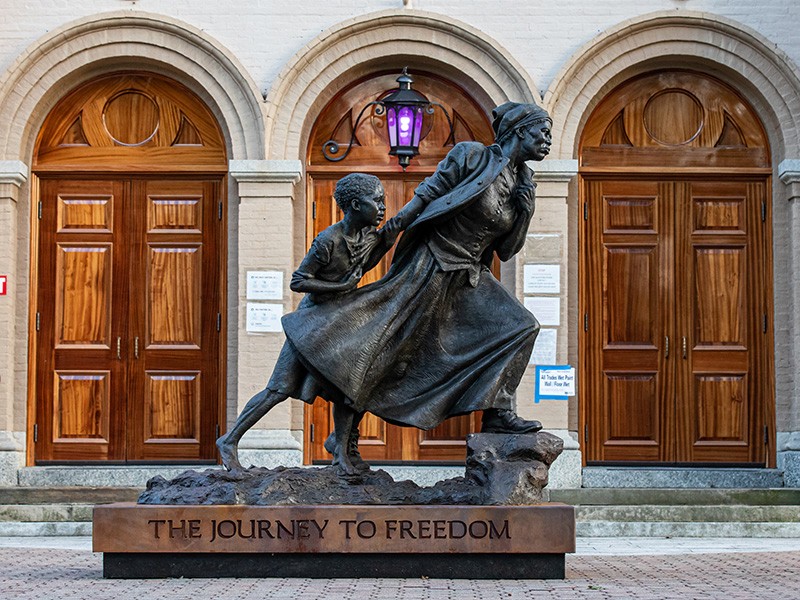
It’s quite fitting that the 9-foot bronze statue of Harriet Tubman, named Journey to Freedom is still on the move, as was Tubman for much of her life.

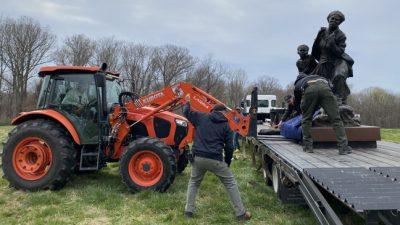
Since 2020, the statue has traveled around the country. It’s currently on Hilton Head Island, South Carolina, in Historic Mitcheville Freedom Park. The monument will remain on Hilton Head through April 2025 and from there be transported to Vienna, Virginia.

Continue reading “Journey to Freedom: Harriet Tubman Still on the Move, part 1 by Maria Dintino”

Sojourner Truth, the photos by Beth Bartlett

Moderator’s Note: We inadvertently left out the photos from Beth’s posts on Sojourner Truth. The photos, all by themselves, pack an emotional punch and so we want to be sure they can be seen. These are Beth’s photos from Sojourner Truth Legacy Plaza in Akron, Ohio

You can see Beth’s posts here. Part 1 and Part 2

close- up of statue

Sojourner Truth: Part Two: The Speech and the Sojourner Truth Legacy Plaza by Beth Bartlett

Part one was posted yesterday.

Most of us are quite familiar with Sojourner Truth’s “Ain’t I a Woman?” speech as recorded by Frances Gage several years later, with its powerful “ain’t I a woman” refrain.  However, the actual speech as transcribed at the time by Marius Robinson, while similar in content, does not contain the refrain. Rather, Truth simply states that she is “a woman’s rights” woman.[i]  It is unlikely that she spoke in the southern dialect Gage used in her transcription, since Truth grew up knowing only Dutch, eventually learning English as spoken in New York, and probably spoke with a Dutch accent. Much of the content in the Gage version was fabricated – such as the statement that she bore thirteen children, when she only had five children, though she did cry out in a mother’s grief when she learned that her only son, Peter, had been illegally sold south to Alabama.[ii]

Continue reading “Sojourner Truth: Part Two: The Speech and the Sojourner Truth Legacy Plaza by Beth Bartlett”

From the Archives: The Story of Juneteenth by Kelly Brown Douglas

This was originally posted June 18, 2013

Tomorrow is a special day for me. It is Juneteenth.  On June 19, 1865, news finally reached Galveston, Texas that slavery had been abolished. This was of course two and a half years after Lincoln issued the Emancipation Proclamation. While the actual impact of the emancipation for the enslaved remains a source of historical discussion if not debate, the fact of the matter  is that the proclamation of emancipation and the reality of freedom for black women and men did not necessarily coincide. To be sure, for a variety of reasons, the Emancipation Proclamation did not have an immediate impact on the daily lives of enslaved women, men and children.  While the “official” historical records marks   January 1, 1863 as a day of emancipation, the historical record for the descendants of enslaved men and women marks June 19, 1865 as the day of freedom. For, it was on this day that the last slaves were free

.

Continue reading “From the Archives: The Story of Juneteenth by Kelly Brown Douglas”

On the Good and the Bad of Behar by Ivy Helman

The Torah portion for May 21, 2022 is Behar (Leviticus 25:1 – 26:2).  In it, the Israelites receive instructions for sh’mita and yovel – two types of sabbatical years.  These years attempt to set up right relations between the community, the inhabitants of the land, and the land itself.  From an ecofeminist perspective, not all is as idyllic as the Torah wishes it to seem.   

Behar begins with sh’mitah, a sabbatical year that takes place every seventh year.  During sh’mitah, the land must lay fallow.  Both humans and animals can eat from what the land will naturally grow.  

Continue reading “On the Good and the Bad of Behar by Ivy Helman”

From the Archives: Slavery and God/dess by amina wadud

Moderator’s note: This marvelous FAR site has been running for 10 years and has had more than 3,600 posts in that time. There are so many treasures that have been posted in this decade. They tend to get lost in the archives. We are beginning this column so that we can revisit some of these gems. Today’s blogpost was originally posted January 28, 2014. You can visit it here to see the original comments.

Well the Golden Globe awards have been handed out.  I don’t have a television, so I didn’t actually watch, but a quick google search gives the results.  Highest honors go to a movie about blacks as slaves and whites as criminals.  That’s appropriate. 

But this is feminism and religion, so let me get to the point.  It’s about a chance discussion on social media about the “merciful god” and historical institutions like slavery (holocaust, or oppressions like misogyny, homophobia, Islamaphobia and others…).

My view of the divine, the cosmos and of the world is shaped by my slave ancestry.  Recent area studies about Islam in America estimate that one third of the Africans forced to the Americas were Muslim.   My first African relative on US soil identified as Moor (another term used for “Muslim”).  But Islam did not survive slavery.

Continue reading “From the Archives: Slavery and God/dess by amina wadud”

Shemot: Women’s Misbehaving and Disobeying as the Key to Liberation by Ivy Helman.

imageThis week’s Torah portion, or parshah, is Shemot (Exodus 1:1-6:1).  This parshah sets the scene for the liberation of the Israelites from slavery both by introducing main characters and elaborating on just how difficult life was for the Isrealites under Pharoah’s rule.  The parshah contains many noteworthy aspects: the death of Joseph and the multiplication of the Isrealites in Egypt; the increasing wrath of the Egptians; the birth and adoption of Moses; Moses’ encounter with the Divine in the form of a burning, yet unconsumed, bush; the revelation of the divine name, G-d’s plan for Moses’ role in the liberation of the Israelites from slavery; Moses’ attempts to get out of his assigned role; and Moses’ first confrontation with Pharoah.   

In addition, there are many women, who are integral to the salvation of the Israelites, in this parshah.  For the most part, Jewish tradition has acknowledged their part when it comes to discussions of this parshah, especially Shifra and Puah.  Yet, their role is often overshadowed by Moses’ varied miracles, the mighty power of the divine, the revelation of the Torah, the wanderings in the desert, and so on.  However, the Israelites’ liberation from slavery would have looked quite different without women.   Continue reading “Shemot: Women’s Misbehaving and Disobeying as the Key to Liberation by Ivy Helman.”

Home: A New Pesach Reflection by Ivy Helman

In ancient times, Pesach was one of three pilgrimage holidays, the others being Sukkot and Shavuot.  According to the the Torah, Israelite men were required to travel to Jerusalem to bring offerings to the temple. Supposedly, this reconnected these Israelites to their religion, to each other and to the deity.  Participating in these pilgrimages brought about a deeper sense of community. In short, three times a year, Jerusalem became a home away from home.

What an interesting and quite awful definition of home: a male-only community focused on slaughtering animals to atone for sins.  Did ancient Israelites think that this religious obligation actually created a better home than where they lived most of the year? Or, was it just a religious obligation?  Did anyone bemoan the massacre of the animals?  In a related fashion, was Pesach alienating for women and children? Did the ancient Israelite home become less important during these festivals? Did women and children feel left out of their own religious traditions if they didn’t live in Jerusalem?  What did they do for Pesach?  Continue reading “Home: A New Pesach Reflection by Ivy Helman”