

During the past week I have been thinking about Greek spring fountains while designing a water fountain for my new apartment in Heraklion, Crete. When the architect sent photos showing that the tiles had been removed from my balconies, I noticed an enclosed niche that could be used for stacking wood, turned into a closet, or as I began to imagine, would be the perfect place for a fountain to bring the soothing sound of running water to my balcony. Continue reading “Designing with the Goddess in Mind: A Meditation on Greek Spring Fountains by Carol P. Christ”
Tag: Source of Life
Coronavirus: The Villain Is Not Mother Nature: It Is Ourselves by Carol P. Christ
 Over the past few weeks of lockdown in Greece, I have asked myself numerous times: if we can shut down the world economy because of a virus, why don’t we shut everything down until we end war or find real solutions to global climate change? In my mind the horrors of war are much worse than the horrors of disease and dying and the threat and reality of global extinctions pose a much greater threat to humanity (not to mention nature) than the Coronavirus.
Why is it that we are willing to take extreme measures to defeat the Coronavirus but we are not willing to take extreme measures to end war or to stop global climate change? A thought keeps creeping into the back of my mind: the fight against disease and death is (understood to be) a fight against Mother Nature and (sadly) we are well used to fighting against Her. If we recognized that human beings have brought the Coronavirus upon ourselves, we would have to face up to our responsibility for it. Continue reading “Coronavirus: The Villain Is Not Mother Nature: It Is Ourselves by Carol P. Christ”
Learning Gratitude for the Gifts of Life on the Goddess Pilgrimage to Crete by Carol P. Christ
In Crete we are always being given gifts—fresh cherries, ice cold bottles of raki, yogurt swimming in honey, and so much more. Over the years it finally hit me that this spirit of great generosity is a living remnant of the ancient Cretan egalitarian matriarchal tradition of gift-giving.
In egalitarian matriarchal cultures gift-giving is not something reserved for birthdays and holidays. It is a way of life rooted in the primary understanding that life is a gift that is meant to be shared.
Our lives are a gift from our mothers. Our individual lives have are not something we create or created for ourselves. We all emerged from the body of a mother. We were all given the gift of care and feeding by a mother or others. Our mothers did not create themselves. They emerged from the bodies of mothers and were cared for and fed by mothers or others. And so on back to the original mother of the human race, known as the African Eve.
As We Bless the Source of Life in Midsummer by Carol P. Christ
 August 1 is the Neo-pagan and Wiccan holiday known as Lammas. For many witches and pagans this is the time when the young male God identified with the harvest of the seasonal wheat crop is sacrificed in the interest of the larger cycles of birth, death, and renewal. Here in Greece August 15 is a major holiday celebrating the Dormition and Assumption (death and rebirth) of the Panagia, She Who Is All Holy.
In her ground-breaking book The Spiral Dance: A Rebirth of the Ancient Religion of the Goddess, Starhawk identified the ancient religion of the great Goddess with Wiccan tradition defined by the Englishman Gerald Gardner and transmitted to her through her initiation into the Faery (or Feri) tradition of the Americans Victor and Cora Anderson. In her vision, the ancient religion of the great Goddess is understood to be a magical tradition in which spells play a prominent role. Continue reading “As We Bless the Source of Life in Midsummer by Carol P. Christ”
The Mountain Mother: Reading the Language of the Goddess in the Symbols of Ancient Crete by Carol P. Christ
 Before he told the story of how his people received the sacred pipe, Black Elk said:
So I know that it is a good thing I am going to do; and because no good thing can be done by any man alone, I will first make an offering and send a voice to the Spirit of the World, that it may help me to be true. See, I fill this sacred pipe with the bark of the red willow; but before we smoke it, you must see how it is made and what it means. These four ribbons hanging here on the stem are the four quarters of the universe. The black one is for the west where the thunder beings live to send us rain; the white one for the north, whence comes the great white cleansing wind; the red one for the east, whence springs the light and where the morning star lives to give men wisdom; the yellow for the south, whence come the summer and the power to grow.
But these four spirits are only one Spirit after all, and this eagle feather here is for that One, which is like a father, and also it is for the thoughts of men that should rise high as eagles do. Is not the sky a father and the earth a mother, and are not all living things with feet or wings or roots their children? And this hide upon the mouthpiece here, which should be bison hide, is for the earth, from whence we came and at whose breast we suck as babies all our lives, along with all the animals and birds and trees and grasses. And because it means all this, and more than any man can understand, the pipe is holy. [italics added]
In this passage Black Elk illustrates the multivalency of symbols: the sacred pipe does not have a single meaning, but many meanings, in fact, more meanings than anyone can understand. Continue reading “The Mountain Mother: Reading the Language of the Goddess in the Symbols of Ancient Crete by Carol P. Christ”
WOMEN AND WEEDING, THE FIRST 10,000 YEARS* by Carol P. Christ
 Mary, Mary, quite contrary, how does your garden grow? With silver bells and cockle shells, and pretty little maids all in a row.
From the beginning of horticulture about 8000 BCE or earlier to the present day, weeding has been women’s work. Women, who were the gatherers and preparers of food in traditional nomadic societies, no doubt were the first to discover that seeds dropped at a campsite one year sometimes sprung up as plants the next year. When this discovery was systematized, agriculture was invented, and human beings began to settle down in the first villages and towns.
In the early days of horticulture (the name for the earliest stage of agriculture before the plow was developed), the cycles of planting and harvest and all the stages in between were understood to have been given to mothers by the Great Mother, the Source of Life. The secrets of planting, seed collection, harvest, and food preparation and preservation were all perceived to be “mysteries” connected to the ongoing cycles of birth, death, and regeneration in the universe.
My grandmother Lena Marie Searing who was born on a farm in Michigan must have learned agricultural secrets from her mother, for she not only created a beautiful garden, she also farmed an orchard and preserved its fruits in glass jars that lined her pantry. It was she who taught me and my brothers and cousins to love nature. My mother learned to garden from her mother, but she did not harvest food crops. I think of both of them whenever I work in my garden.
The past few days I have been weeding my garden after heavy rains that left the soil clumpy and moist. I have weeded before, but I have never enjoyed it so much. My garden has matured over the past seven years, and now the weeds are more “under control.” There aren’t so many of them, and as I have now been weeding them out over the years, their roots are shallow.
As I slide a trowel into the earth the weeds lift up and with my fingers I gently pull the plants with their roots from the soil. The weeds are familiar, though I don’t know all of their names. The “sticky weed” has many tough roots, the clover has many fine ones—both are hard to eradicate. Other weeds are easy to pull up and do not reappear again until the next year.

I am discovering that weeding is a delicate process. Sometimes the roots of plants I want in the garden are entangled with those of the weeds. I work carefully choosing the ones to save and the ones to discard.** I leave poppies, chamomile, yellow daisies, and marigolds where I find them, as I consider them to be wildflowers that will provide beauty in my garden when they bloom in spring. I also take care to “keep the soil in good heart” by not discarding too much of it along with the weeds.
As I weed, I think of the women in my village who harvest greens from the fields, feeling certain that some of the weeds I discard are edible. I marvel at all of the knowledge women have shared and passed down over the past 10,000 years and more, as I realize how little of it I know. My suspicion that some of my weeds could be food is validated when a friend and I order boiled “greens from the mountains” for lunch at a local taverna and are served one of the plants I had thrown into the garbage can.
As I weed, I am reminded of an essay called “Keeping the Soil in Good Heart: Women Weeders, the Environment, and Ecofeminism” by Candice Bradley which was published in Karen J. Warren’s Ecofeminism. Bradley writes that weeding is women’s work in almost all cultures. As I work, I understand that this is so because weeding is delicate work that requires concentration and patience and that must be repeated. Bradley says that in many cultures men disparage weeding as they disparage housework—not considering either to be “real” work.
Horticulture is the most environmentally friendly form of farming, according to Bradley, because it does the least harm to the soil, and because the weeds that are not eaten are burned or composted and turned back into the earth to replenish it.
While weeding by hand has been considered work for women and children, men have generally controlled the plow and its recent successor, the tractor. However, as Bradly states, the plow and the tractor do not eliminate the need for hand-weeding. In many cases they encourage the weeds to regenerate. Women and children still weed.
The chemical gardening and farming industry (“round it up”) is based on the premise that weeds can and must be eradicated. Rachel Carson warned us of the danger this approach to agriculture presents to human and all other forms of life. A by-product of chemical agriculture is that the careful work of women weeders is further discounted.
I do not use chemicals or pesticides in my garden, and I will be out there weeding on a regular basis in the next months. As I put my hands in the earth, I will think of all the women before me who have weeded and planted, weeded and harvested, and weeded again. Blessed be.
*The title of this essay is an homage to Elizabeth Wayland Barber’s Women’s Work: The First 20,000 Years which discusses and celebrates women and weaving.
**I am aware that no plant was born a “weed” and that the designation of some plants as weeds is a by-product of human digestive systems, human taste, agriculture, and the creation of gardens for the celebration of beauty.
Carol P. Christ created a newly released new website for the Goddess Pilgrimage to Crete which she leads through Ariadne Institute. Early bird special for the spring pilgrimage available until February 15. Carol can be heard on a WATER Teleconference. Carol’s books include She Who Changes and Rebirth of the Goddess and the widely-used anthologies Womanspirit Rising and Weaving the Visions.
Who Is Jephthah’s Daughter? The Sacrifice of Women and Girls by Carol P. Christ
Last week I reflected on Angela Yarber’s insightful essay and painting on Jephthah’s daughter. For those who did not read the earlier posts, the story of Jephthah’s daughter is found in the Hebrew Bible. Jephthah’s daughter was sacrificed by her father after he swore in the heat of battle that if his side won, he would sacrifice the first person he would see on returning home. Angela called us to reflect on who Jephthah’s daughter is in our time.
In my earli er midrash on the story, I invoked Daniel Cohen’s powerful retelling of the story of Iphigenia. Cohen concludes that Artemis told Agamemnon that his ships would sail only if he sacrificed his daughter not because she wanted him to do it—but because she hoped this challenge would induce him to realize that the costs of war outweigh any possible gain.
I suggested that these words be spoken whenever the story of Jephthah’s daughter is told: Continue reading “Who Is Jephthah’s Daughter? The Sacrifice of Women and Girls by Carol P. Christ”
WOMEN ARTISTS AND RITUALISTS IN THE GREAT CAVES: THE BEGINNING OF THE END OF INDOLENT ASSUMPTIONS by Carol P. Christ
In an earlier blog, I suggested that women might have blown red ocher around their hands to leave their marks in prehistoric caves.
At the time I thought this was a rather bold suggestion.
Had I been asked why I thought the images were made by women, I might have said that people have understood caves to be the womb of the Great Mother, the Source of All Life, from time immemorial. I might have added that those who performed rituals in the caves cannot have been performing simple “hunting magic,” but must also have been thanking the Source of Life for making life possible for them and for the great beasts they hunted. Still I am not certain that I imagined women as the artists in the Paleolithic caves.

In recent days the news wires have been carrying a story titled “First Cave Artists May Have Been Women, New Study Suggests.” According to retired anthropological archaeologist Dean Snow, the handprints made by Paleolithic ancestors 40,000-20,000 years ago may have been made primarily by women. Snow spent a decade gathering and analyzing photographs of the handprints left in caves. The scientific fact that women’s first and ring fingers are generally of the same length, while men’s ring fingers are generally longer their index fingers, led him to the conclusion that ¾ of the handprints in the caves were made by women! If women were painting their hands on the caves in larger numbers than men, then isn’t likely that they were also painting the images of the great beasts on the walls of the caves? Continue reading “WOMEN ARTISTS AND RITUALISTS IN THE GREAT CAVES: THE BEGINNING OF THE END OF INDOLENT ASSUMPTIONS by Carol P. Christ”
The Turtle Goddess from Myrtos in Ancient Crete by Carol P. Christ
 “As we bless the Source of Life, so we are blessed.” Song by Faith Rogow.
The strange and cheerful figure portrayed in this ancient Cretan vessel comes from the site known as Fournou Korifi near Myrtos, in Crete. Dated before 2000 BCE, she was called the “Goddess of Myrtos” by the excavator, Peter Warren. This little Goddess was found on an altar in a small room in the ritual area of a complex of small rooms on a hill above the sea that was home to up to 120 people. The Goddess of Myrtos is a vessel holding a vessel. In ritual libations, liquid would have been poured from the pitcher she holds onto an altar.
.
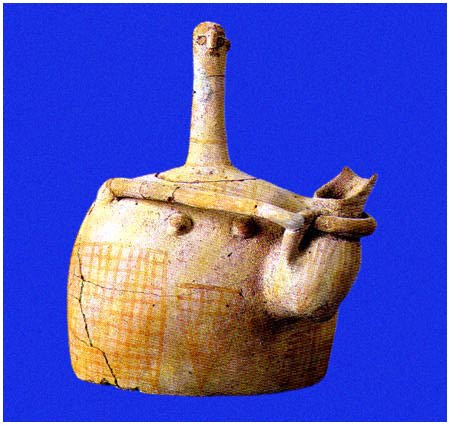
She is obviously female, with breasts and a sacred triangle. Continue reading “The Turtle Goddess from Myrtos in Ancient Crete by Carol P. Christ”
“AS WE BLESS THE SOURCE OF LIFE, SO WE ARE BLESSED” by Carol P. Christ
 Blessing the Source of Life harks back to the time when shrines were built near springs, the very literal sources of life for plants, animals, and humans.
The prayer “As we bless the Source of Life, so we are blessed,” based on a Hebrew metaphor which refers to a water source and set to music in a Jewish feminist context by Faith Rogow, has become one of the bedrocks of my Goddess practice.
In Minoan Crete, seeds were blessed on the altars of the Goddess and the first fruits of every crop were returned to Her. The ancient Minoans piled their altars high with barley, fruits, nuts, and beans, and poured libations of milk and honey, water and wine, over the offerings they placed on altars. Evidence of these actions is found in the large number of pouring vessels stored near altars.

Recreating these rituals on the Goddess Pilgrimage to Crete, and singing together, “As we bless the Source of Life, so we are blessed,” again and again, we begin to understand that the gestures of our ancestors were based in gratitude for Life itself. They understood that the fruits of the earth, the grain, the wine, and the oil, the cherries, the peas, the olives, and everything else that we eat, are gifts of bounteous Mother Earth. Continue reading ““AS WE BLESS THE SOURCE OF LIFE, SO WE ARE BLESSED” by Carol P. Christ”
 Feminism and Religion