Despite halting attempts to live my life with hope, I’ve failed. My experience is not unique. We suffer. The recent pandemic, including its side effects of loss and displacement, is but one example. Suffering can leave a sense of hopelessness in its wake. One place I look for balm is in poetry.
As with most poetry, Emily Dickinson’s (1830-1886) work requires me to pause and ponder. What is being said? Not easy to tell, nonetheless, I often do find meaning in her poems. If I understand her thrust at all, much of the meaning I glean disorients me.
Note: This is based on a podcast which can be heard here.
“Black love exists and Black women deserve love that does not require pain.”
What is love? What’s love got to do with pain and suffering? Are they related? Pain and love? Must one always be present with the other? In this blogpost I explore pain and suffering through a womanist perspective (centering the perspectives and lived experiences of Black women) and discuss how to live into wholeness and wellness. This is especially important because the Black community/women in particular’s experience in the US (and globally) has been and continues to be defined by pain and suffering. What are the theological implications?
How have Christian frameworks at associating love with sacrifice and pain justified the pain and suffering of Black women? How can we decolonize love so that liberated Black women are empowered to embrace a love that does not hurt first with false promises of rewards later in life or afterlife? Black women, pain does not equal love.
As a minister’s daughter, I grew up almost literally in the church, its red door and ivied walls across the driveway from the rectory. On Easter the church was packed; every family received a pink or red geranium. There were Easter egg hunts, baskets stocked with chocolate rabbits and the jelly beans these magical creatures laid. The church rang with triumphant hymns: Jesus Christ is risen today. Although like all children I reveled in holidays involving excessive sweets, it was not the candy or the or the requisite rejoicing that moved me most.
It was the women, or in the Gospel according to John, the woman, bereft and brave, who went to the tomb to tend Jesus’s body. The male disciples had scattered and gone into hiding. In the Protestant Episcopal Church, Christmas Eve and Easter were the only times women played a prominent role in the story. Those were not the loud, triumphant moments. They lived in my child’s imagination as the quiet, mysterious times, Mary giving birth in the night attended by cows, donkeys, and stars. Dawn in a garden, wet with dew, the only sound birds waking and singing, the only people, the women, or the one woman who captured my imagination and, in my story, has her own apotheosis on that morning.
I did not question the miracle of resurrection. Miracles and magic made sense to me as a child. Theology didn’t. My father liked to expound on Jesus’s utterance from the cross “My God, my God why hast though forsaken me.” He insisted that Jesus was not crying out in despair but quoting Psalm 22, which ends in triumph. The Gospel narratives emphasize Jesus’s rising again “in accordance with the scriptures,” implying that he knew he would come back to life on the third day.
My cat is a hunter. You can see it in her eyes. She plays fetch considerably better than the dog and seems to enjoy playing with her “kill” – throwing it up in the air, batting it around and pouncing on it – long after it is “dead.” If we forget to clean up her toys before bedtime, her prowess invades the night. For such a tiny cat, she can meow at almost deafening volumes.
I’m finished with my first semester as a studio arts major at Kent State University. I am not sure whether I’ll be registering for a second one. There were pros and cons about the experience, and I am not sure if one set outweighed the other. Regardless, I am on sabbatical this spring, have two books to complete, and figured I would do well not to be trekking back and forth in an hours worth of snow and ice over the next few months from my home to the school. So, I am taking a semester off, and I have become one of those retention risks. I am grateful for the opportunity to reflect on the experience with only minimal consequence to my bank account and my (laughing) future in the arts.
It wasn’t a bad experience; it wasn’t a good one either, really. I learned some things in drawing, but I am very much on the fence about my experience in sculpture. For starters, I imagined playing with clay and making pinch pots while some Swayzesque spirit from beyond rubbed my shoulders. Instead, I was more Jessica Beal with a welding mask, except, instead of wearing a swanky black leotard and off-the-shoulder-slouch-dance tunic, I was wearing ugly jeans and steal-toed shoes under the green welding suit that had half-dollar size holes in it. The protective gear only partially worked; I was scared of the tools after a classmate almost lost a finger; and the top of my hair went up in smoke when a spark shot under my ill-fitting Vader hat on week two. I put it out quickly, fortunately.
Personal faith often has a huge impact on the lives of survivors of violence. This impact, unfortunately, as can be seen in the other posts as well as in the comments on those posts, is not always a positive one. In her book, Redeeming Memories: A Theology of Healing and Transformation, Flora A. Keshgegian envisions communities of faith as communities of remembrance. A community of remembrance does not ignore or suppress the negative experiences of its members but strives to enable us to embrace personal identity, form our faith, and to nurture hope in order to heal and transform after such experiences.
One question that my dissertation set out to answer was how we might begin the difficult work of moving our communities of faith in this direction. Sadly, the biggest difficulty seems to be the lack of awareness, or the downright denial, that domestic violence is an issue for the average faith community. So many congregation members assume that if their pastor is not talking about an issue then it must not be a problem in their particular community.
Since many of the comments on my last post expressed interest in my dissertation topic I will use my next couple of posts to talk a little bit more about my work and research in that area. When we talk about theories of the atonement we are trying to describe a narrative structure of what took place within the Christian cross event. Generally speaking, Christians believe that atonement serves at the reconciliation between God and humanity and that this reconciliation is realized through the person of Jesus Christ. The three primary theories that try to explain this event are Substitutionary/Satisfaction, Moral Influence, and Christus Victor.
The Substitutionary/Satisfaction theory of atonement suggests that Christ takes on the guilt and punishment that humanity deserves because of our sinfulness and so becomes our substitute, paying the debt we owe for our sins. Because of humanity’s sinfulness we deserve death, but instead of giving us what we deserve God instead offers God’s son as a sacrifice to pay our debt, to atone for our sinfulness, and to save us from the eternal punishment of death.
The Moral Influence theory of the atonement focuses primarily on the life and ministry of Christ rather than on his suffering and death. This theory is centered on the belief that God loves God’s creation so much that God would hold back nothing from us, God would even give God’s own Son in order to save us and remain in relationship with us. As a result this theory encourages Christians to live as Christ lived and focuses on imitating his life and ministry in order to bring about justice in our own world.
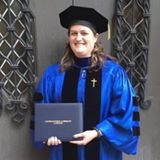
Last weekend was a special one for me. After many years of study and dedication I graduated with my Ph.D. and am now, officially, Dr. Katie Deaver. The weekend was filled with celebrations to mark the completion of a milestone that I have spent years working toward. The amazing outpourings of love, support, and care that I have experienced throughout the last few days is quite humbling. The happiness and pure joy of my family, friends, professors, mentors, and multiple church communities have left me in awe. As I reflect on this love and support it helps to heal the wounds and scars that have accumulated throughout the process of earning this degree.
The undertaking of a Ph.D. program is significantly more difficult than anyone tells you. This difficultly lies not necessarily in the course work or the dedication to constant reading, writing, and learning but rather in the personal growth and vocational affirmation that takes place within the process. My dissertation explored the primary understandings of the doctrine of atonement and addressed how this doctrine can, and has, been used in ways that perpetuate, and in some cases even encourage, domestic violence.
My own fascination with the topic of atonement and its links to domestic violence was brought about at the suggestion of one of my undergraduate professors at Luther College, Dr. Jim Martin-Schramm. From the moment that Dr. Martin-Schramm explained the links between theologies of the cross and domestic violence I knew that I had found my new passion. Writing a dissertation on the topics of domestic violence, theology and women of faith was an extremely personal, and intimate experience for me. This topic forced me to accept my own lived experience. To claim myself… out loud… as a survivor of domestic violence. As a result the writing of my dissertation was particularly personal, and painful, as well as extremely life giving.
I have recently noticed an interesting thing: just like the Buddhist goal of ending suffering requires consideration of others, so often feminist change requires thinking about other women.
I often had conversations with people on both these subjects. I heard actual people say: “I do not want to end my suffering, the reason being…” And the reasons can differ. Some consider suffering to be part of genuine human experience, some find a spiritual advantage in having suffered. While some simply say that they are fine with their suffering; they are used to it; change would bring even more suffering. Continue reading “Ending Suffering for the Sake of Others by Oxana Poberejnaia”
Ecclesiastes 3:14 – I know that whatever God does endures forever; nothing can be added to it, nor anything taken from it; God has done this, so that all that should stand in awe before him.
Nothing can be added or
taken away…
… then why does it feel like everything is lost?
You haul away the bodies while
we watch
— linking arms
— standing fast
against the tide of
grief that churns until
we can find
a distraction that makes us believe
life will return to
normal




 My cat is a hunter. You can see it in her eyes. She plays fetch considerably better than the dog and seems to enjoy playing with her “kill” – throwing it up in the air, batting it around and pouncing on it – long after it is “dead.” If we forget to clean up her toys before bedtime, her prowess invades the night. For such a tiny cat, she can meow at almost deafening volumes.

 I have recently noticed an interesting thing: just like the Buddhist goal of ending suffering requires consideration of others, so often feminist change requires thinking about other women.
 Feminism and Religion