What does this little narrative have to do with feminism you ask? Why everything! It speaks to the journey of one woman from young adulthood into old age, a woman who learns along the way that Nature/ Earth/Immanence is also the Way of the Goddess, and that living a life of meaning (in a finite loving body) is the path the goddess set her upon at birth…
It is the day before thanksgiving. For too many years, this was a time of great sorrowing – a day on which a young motherless woman said goodbye to her grandmother… a grandmother she couldn’t afford to lose, and later, much later, a grandmother she couldn’t become….
{Part 1 was posted yesterday. You can see it here}
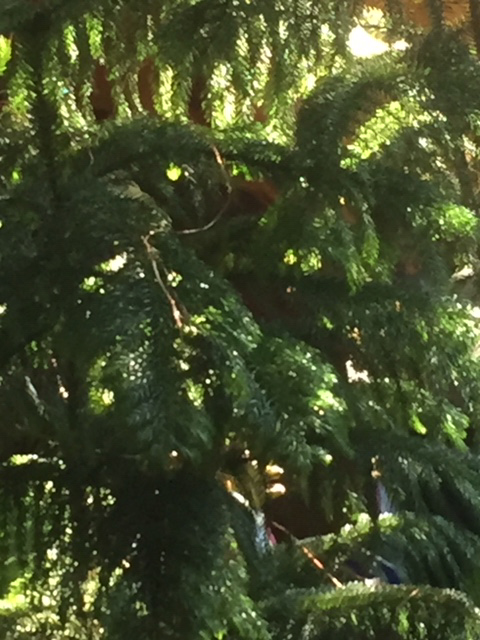
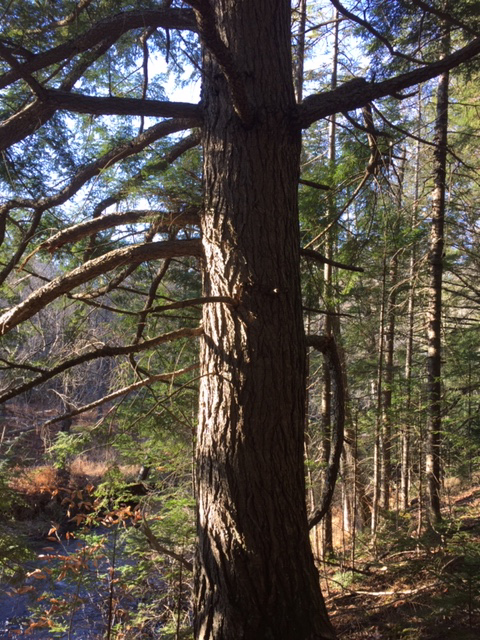
Soon after I began to create little traditions that I follow to this day. November is the month I begin to celebrate my love for every evergreen tree on the earth. The leaves of broadleaf trees have become nature’s mulch, yet forest green stays with us until spring, thanks to the conifers. Thanksgiving week is the time I choose to go into the forest to tip balsam boughs thanking the trees for being, always choosing a mild day when I can enjoy being outdoors. Then I weave fragrant wreaths sitting on my living room floor listening to choral music sung in Latin, a language I don’t understand, thankfully (!) This year my indoor Norfolk Island pines are already lit with rice lights for a few hours each evening lending a festive glow to the soothing cloak of darkness.
Recently I decided to include a dinner for this week of Wintergreen Tree Celebration and it turned out that the foods I wanted to cook were some of the favorite foods I prepared during those exhausting and meaningless thanksgivings, cooking that I did for others, including my children at my own expense. At first this idea of cooking a feast for myself, (after all the trees couldn’t join me) seemed silly until I recalled how much I loved my own food! I am an excellent cook and I can conjure up just about anything without a recipe.
The night before my maternal grandmother died my mother pushed me so hard I fell to the floor and banged my head. My grandfather and I had just walked in the door after spending the day at a New York hospital where my grandmother lay there unconscious as I moistened her lips, rubbed cream on her arms, wept at the sound of her labored breathing. I felt such guilt, such helplessness… My grandfather who was behind me, shocked by my mother’s violent actions and sneering words muttered “Oh, Jane please,” without conviction. He knew his stepdaughter well. No one ever crossed her.
Stunned by the unwarranted physical attack and vicious remarks I picked myself off the floor and went into the dining room. The remains of thanksgiving dinner were still on the table. I don’t remember the conversation – just that my grandmother’s sisters were there. My grandfather and I left soon after, exhausted and depressed returning to his house three miles down the road. At 5AM the next morning the phone rang and I knew… my beloved grandmother was dead.
I was reeling – numb. My brother had killed himself the year before and now this. I remember nothing about the memorial service except that my grandmother was lying in a steel coffin. When my grandmother’s ashes arrived, I opened the door to receive them, took the box upstairs and put it in her closet…that was it. I spent the rest of the winter at my grandfather’s house feeling useless, returning home to Maine in the spring.
All things being relative, remember that collective and individual histories are cyclical but open-ended, and discern the kind of moment you are in and part of.
Remember how to make it better by holding on to all that is dear in life, and becoming more prayerful and thoughtful.
When deprivation comes, return to what is essential— first, beauty, so look for and create beautiful behavior and encourage it.
Will our families gather for Thanksgiving feasts this year? Will aunts and uncles and cousins come from near and far to sit around our dining room tables? Does anyone have a table that’s big enough for social distancing? As I write this before November actually arrives, it seems unlikely that we’ll have few traditional holiday events in our homes (or anywhere else) this year. Well, my friend, who cares? Let’s pretend our feasts will be just like they’ve always been.
Back before the turn of the century, I belonged to a group that met every month in my friend Sandy’s family room for companionship, study (we worked our way through two excellent books by Julia Cameron: The Artist’s Way and The Vein of Gold), celebrations of birthdays and other special events, and rituals honoring various goddesses. We also had potluck suppers. (That was when I found out I can’t even be in the same room with jalapeño chili peppers.) It was a friendly, caring group of about twenty-five women and a few men. Alas, many of these people have moved away, a few have died, and a couple have just disappeared. I miss this group. Continue reading “Happy Thanksgiving by Barbara Ardinger”
Strawberries shaped my view of a world full of gifts simply scattered at your feet. A gift comes to you through no action of your own, free, having moved toward you without your beckoning. It is not a reward, you cannot earn it, or call it to you, or even deserve it. And yet it appears.
Sweetgrass belongs to Mother Earth. Sweetgrass pickers collect properly and respectfully, for their own use and the needs of their community. They return a gift to the earth.
That is the fundamental nature of gifts: they move, and their value increases with their passage. The fields made a gift of berries to us and we made a gift of them to our father. The more something is shared, the greater its value becomes. This is hard to grasp for societies steeped in notions of private property, where others are, by definition, excluded from sharing.
The essence of a gift is that it creates a set of relationships. The currency of a gift economy is, at its root, reciprocity.
Robin Wall Kimmerer, Braiding Sweetgrass, 27-28
Thanksgiving has come and gone. We gave thanks for the food placed on the table and for the family or friends who shared it with us.
In our culture giving thanks can feel forced: I remember how my brothers and cousins and I hated to be asked to say grace at Grandma’s house. When we have not been taught, it can be difficult for us to understand that nothing is ours by right. Continue reading “The Gifts of Life: Do We Remember? by Carol P. Christ”
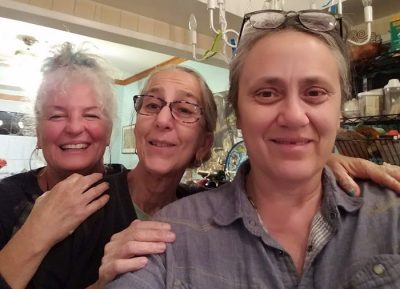
Dear FAR readers—you will be reading this blog the day after Thanksgiving, which is one of my favorite holidays. It didn’t used to be—but it is now.
Over twenty years ago, I remade this holiday for myself. At that time I was in my late thirties and was just coming out of almost a decade of healing from a very rough childhood. I spent a lot of time in those early recovery years yearning for some kind of magical “family” I thought “everyone” had. Once I really opened up about my story, however, I realized everyone doesn’t have any one thing. We all have something different—and everyone has a story.
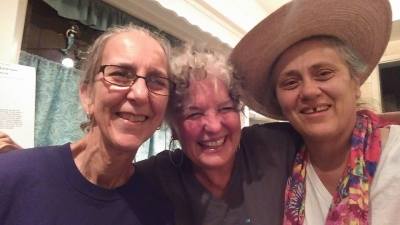
Last week I went out to eat with a group of insightful scholars at the American Academy Religion 2015 Conference held in Atlanta, Georgia. We had just participated on a remarkable panel which was an “Author Meets Critic” session with Bernadette Barton, author of the book Pray the Gay Away: The Extraordinary Lives of Bible Belt Gays. One of our panelists was in Georgia after years of estrangement, not only from his biological family, but also from the geography of his birth because of the biological familial estrangement. He was experiencing the geography of his hometown for the first time in many years. He spoke eloquently in the panel about how much being in the geography itself again was triggering, but also how somatically it was necessary for his own healing. He needed to revisit and be embodied on the actual land—which was very different than re-remembering the hurt from a geographical distance. Also, in order to fully participate in the life of a scholar, which he was now choosing, he had to reconcile being able to revisit this geography in order to attend this particular conference. And frankly, to be able to participate on the panel which was so close to his heart—being a person who was from the Bible Belt and had literally been “prayed” over so that his “gay would go away.”
I have moderated many panels, but this is the first one where I wrote “Congratulations!” on a piece of paper to one of the panelists and passed it to him after his reading.Overall it was a great session of papers and as mentioned we all adjourned for drinks and conviviality. And to celebrate that our gay had not been prayed away.
We began to discuss holiday plans. I said to the young man who had presented his paper so courageously that I was very proud of him not only for his work, but for his ability to return to the geography in which he had experienced so much harm. I said that I was from a very abusive biological home in New England and I had not been north of New York since leaving at age 30 (I am now 59); that for me, putting my embodied self into the actual geography where I had experienced so much harm had not been possible, except for attending my mother’s funeral- its own extreme event.
Some folks at the table expressed surprise and much sadness—how could those of us without biological ties to family handle the holidays? I realized that for me it has been almost thirty years since I began creating “alternatives” to the family I was born in—my biological family- and that I have successfully created chosen family and chosen traditions instead. One of the ways I first learned to deal with holidays which had expected traditions and attendance at biological family functions was to create alternate plans well before the expected day (Thanksgiving, Christmas, etc.) and stick to that plan. I learned that once that day was “here,” I would be triggered and would not be able to create spur of the moment alternatives in the midst of those feelings.
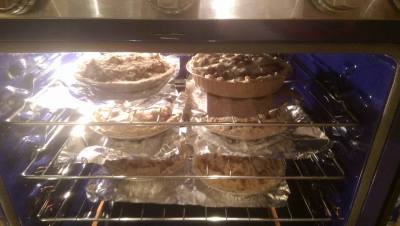
One tradition I created 20 years ago was the tradition of “Pie Day” with a good friend of mine. We realized this year that we have been doing that for 20 years! Now that is my “tradition” and that is my “family.” We bake an inordinate amount of pies on Pie Day—a very specific recipe—green apple with golden raisin reduction— and people and friends come over. We celebrate. We eat pie with cheese (a New England tradition) and salad- I call it “a French meal” after my Canadian heritage. Whoever bakes or drops by, eats. Some folks walk away with a pie. We freeze a bunch and have “pie nights” throughout the year. Various girlfriends, friends and friends of friends have helped throughout the year make our estimated 15-20 pies per year, complete with hand rolled, all butter crusts every year.
For those who are unaware of my research focus and methodology, I try to use history to reconstruct or reclaim the feminine voice through more of an exegetical lens rather than an eisegetical or ideological lens. When it comes to Thanksgiving, I have yet another opportunity to restore credit to or at least bring visibility back to a woman who fought for Thanksgiving to be recognized as a national holiday on the last Thursday of November. Her works, though plentiful and sometimes known only by title, are largely forgotten to history; Sarah Josepha Buell Hale (1788-1879) is responsible for Thanksgiving becoming a national holiday in the United States.
Certainly, I do not have to go into the disparity that befell women during the 1800’s when it came to education and overall fundamental rights – that is a history with which we are all well familiar. Hale was educated through her brother, Horatio Gates Buell, who shared his education while attending Dartmouth College and “seemed very unwilling that [Hale] should be deprived of all his collegiate advantages,” and through her husband, David Hale, a lawyer who helped her cultivate her writing skills in the evenings. They even established a small literary club with their friends that allowed her to write. Hale was left a widow at a very young age with five children, the oldest age 7. Hale, like so many women during that time period, had to find a way to support herself and her family.
Sarah Josepha Buell Hale
After authoring a book of poems with her sister-in-law, The Genius of Oblivion and Other Original Poems, Hale, in 1827, published her first novel called Northwood – a book published the same year as Uncle Tom’s Cabin that also challenged slavery. From fame gained through this novel, Hale obtained a job as an editor of a women’s magazine, Ladies Book (later Godey’s Ladies Book then American Ladies Magazine), where she worked for about 40 years. She wrote about half of the material contained in the magazines, as a means of helping to educated women. Hale helped to discover and promote such authors as Edger Allen Poe, Nathaniel Hawthorne, Harriet Beecher Stowe, Lydia Maria Child, Catherine Sedgwick, Lucretia Mott, Emma Willard, Susan B. Anthony, Henry David Longfellow, Ralph Waldo Emerson, and Oliver Wendell Holmes.
She is credited for helping to establish Vassar College for women and wrote the familiar child’s poem “Mary had a Little Lamb” in 1830 (Poems for Our Children, republished in Juvenile Miscellany), Traits of American Life, which contained the story of “The Thanksgiving of the Heart:”
Growing up in an evangelical Christian church, I was taught that human beings should serve one another and put others before themselves. These two different teachings, paired with patriarchal misogyny, have sometimes been very problematic for me. I tend(ed) to give too much. Too many demands with which I complied were self-negating (which after all, helped me to make other people more important than myself). It took me a long time to learn how to appropriately prioritize my own needs, to stop mistaking self-esteem for the”‘sin of pride,” and how to say no when I needed to… Actually, I am still learning some of these lessons.
Conversely, my ritualized service to the church was sometimes confusing, awkward or embarrassing. I clearly remember having the opportunity to serve as something like an usher during Thanksgiving at our family’s church as a child. This involved wearing a pilgrim costume, which for me meant finding a Puritan style costume in the church’s closet that fit my overweight childhood frame. This was not an easy task and left me feeling ashamed. Later as an adolescent, my youth group asked us to wash one another’s feet as Jesus did for his disciples. Now, don’t misunderstand me here— I do believe that this ritual has the potential to be very powerful and meaningful for those involved. However, my teenage self could not identify with the symbolic gesture beyond realizing that:
1) I thought touching other people’s feet was gross, as was having my dirty feet touched and,
2) I knew I ‘should’ get something out of the ritual but did not, so I felt spiritually guilty or inadequate.


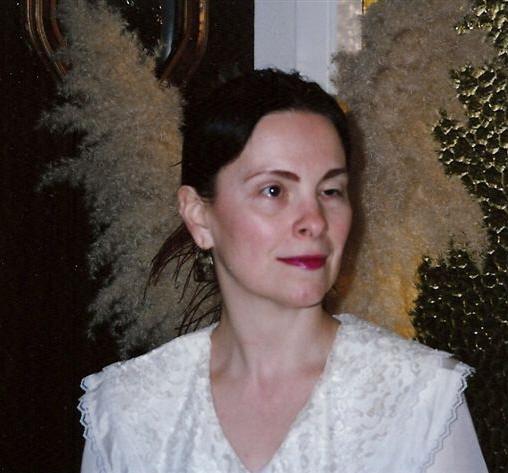
 Will our families gather for Thanksgiving feasts this year? Will aunts and uncles and cousins come from near and far to sit around our dining room tables? Does anyone have a table that’s big enough for social distancing? As I write this before November actually arrives, it seems unlikely that we’ll have few traditional holiday events in our homes (or anywhere else) this year. Well, my friend, who cares? Let’s pretend our feasts will be just like they’ve always been.
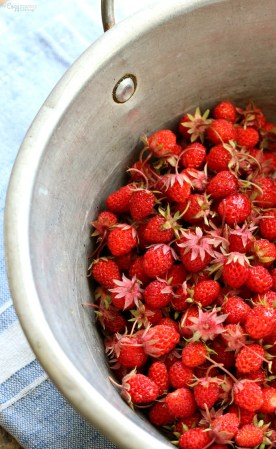 Strawberries shaped my view of a world full of gifts simply scattered at your feet. A gift comes to you through no action of your own, free, having moved toward you without your beckoning. It is not a reward, you cannot earn it, or call it to you, or even deserve it. And yet it appears.
 Dear FAR readers—you will be reading this blog the day after Thanksgiving, which is one of my favorite holidays. It didn’t used to be—but it is now.
 Last week I went out to eat with a group of insightful scholars at the American Academy Religion 2015 Conference
  One tradition I created 20 years ago was the tradition of “Pie Day” with a good friend of mine. We realized this year that we have been doing that for 20 years! Now that is my “tradition” and that is my “family.” We bake an inordinate amount of pies on Pie Day—a very specific recipe—green apple with golden raisin reduction— and people and friends come over. We celebrate. We eat pie with cheese (a New England tradition) and salad- I call it “a French meal”


 Feminism and Religion