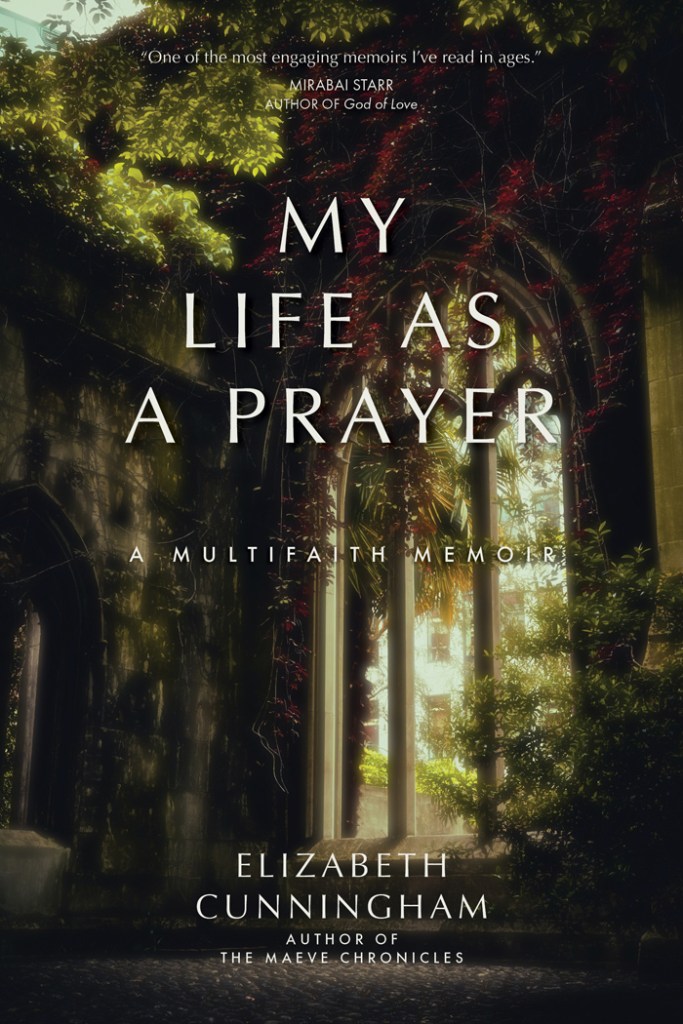
My Life as a Prayer by Elizabeth Cunningham, book review by Janet Maika’i Rudolph

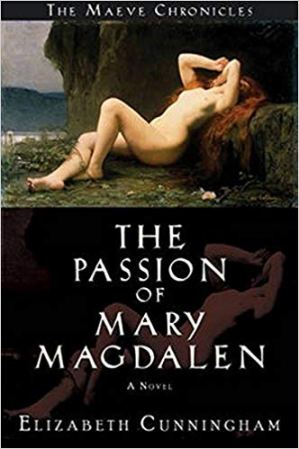
Our own FAR sister, Elizabeth Cunningham has written her marvelous memoir which came out yesterday. It is titled My Life as a Prayer with the subtitle, A Multifaith Memoir. For those of you who may not know Elizabeth, she wrote regularly for FAR for many years. She is the author the The Wild Mother and the award-winning Maeve Chronicles. Her Chronicles envision the Celtic Mary Magdalen named Maeve. Throughout the four books of the Chronicles, Maeve is filled with vivacious energy and her own life of spirit. The books are Magdalen Rising, The Passion of Mary Magdalen, Bright Dark Madonna and Red-Robed Priestess (which in full disclosure is one of my favorite series of all time.)

In My Life as a Prayer, Elizabeth’s writing is lush and poetic, clever and clarifying, multilayered and depthful.  I hope I can convey all those elements in this short blogpost?

Continue reading “My Life as a Prayer by Elizabeth Cunningham, book review by Janet Maika’i Rudolph”
From the Archives: Beyond Clenched Teeth: Reflections on Forgiveness by Elizabeth Cunningham

Moderator’s note: This marvelous FAR site has been running for 10 years and has had more than 3,600 posts in that time. There are so many treasures that have been posted in this decade that they tend to get lost in the archives. We are beginning this column so that we can all revisit some of these gems. Today’s blogpost was originally posted January 19, 2014. You can visit it to see the original comments here.

Elizabeth Cunningham

“I forgive you.”

These words make my teeth buzz like the sound of chalk squeaking on a blackboard. I can vividly recall my sister and myself, as children, saying these words through clenched teeth.  Not only were we Christians, we were the minister’s daughters.  We had no choice. The only other words I hated as much: “I’m sorry,” also forced through clenched teeth.

Oddly enough I cannot recall my older brother being told to ask my forgiveness when he and his friend pummeled me. That fell into the category of: “you egged them on.” My mother did used to say of my brother, mournfully and anxiously: “he doesn’t know his own strength.” Which meant: it isn’t his fault that he hurt you.  But my sister and I were supposed to be nice to each other.

Continue reading “From the Archives: Beyond Clenched Teeth: Reflections on Forgiveness by Elizabeth Cunningham”

All the Perils of this Night: a preview by Elizabeth Cunningham

When I wrote Murder at the Rummage Sale, my agent warned: “You have to have a sequel in mind!” I was supposed to write a second domestic cozy, same setting, same characters, different victim. But what came to mind was a memory. When I was a troubled teen visiting England, my uncle gave me a map and let me go sightseeing in London on my own. It was early winter 1968, the war in Vietnam was raging. I did not want to be an American; so I faked an accent, wore an eccentric hat, and called myself Eliza Doolittle. When a man picked me up, I did not know how to break out of character. I ended up drunk in his flat. I just managed to fight off rape. The man must have figured out that I didn’t add up and could land him in trouble. He took me back to my uncle’s office. The kernel for All the Perils of this Night is: what if he hadn’t? What if, like so many others, I had been trafficked? I couldn’t shake that “what if.”  So I wrote the standalone sequel, no domestic cozy but what I would call a numinous thriller.
In July, in honor of Mary Magdalen’s feast day, I usually post about Maeve, my Celtic Mary Magdalen. This year Maeve urged me to select an excerpt from the new novel. In the scene below Anne, teenaged Katherine’s mother, is searching for her vanished daughter in London’s red light district. A prostitute agrees to speak with her if Anne will pay for her time. Continue reading “All the Perils of this Night: a preview by Elizabeth Cunningham”

Did You Have to Make Her a Prostitute? by Elizabeth Cunningham

When I toured with The Passion of Mary Magdalen, opening by belting out the first paragraphs of the novel’s prologue in song, (ending with the line “when only a whore is awake!”) that question almost always came up.  In celebration of Mary Magdalen’s feast day, I’d like to offer answers that continue to evolve.

There is no scriptural evidence that Mary Magdalen was a prostitute. In a sermon, 6th century Pope Gregory I gave as his opinion: “This woman, whom Luke calls a sinner and John calls Mary, I think is the Mary from whom Mark reports that seven demons were cast out.” (This confusion and proliferation of Marys inspired me to make a joke. Q: How many holy Marys does it take to change a lightbulb? A: I don’t know. I keep losing count.)

In fact, very little is known about Mary Magdalen. There are fourteen references to her in the Gospels, then she disappears from the New Testament. The possibly Gnostic gospel of Mary dates to the 2nd century CE, and there is no scholarly consensus as to which Mary is the source of the tradition. Early on Mary Magdalen gave history the slip and took on an extended life in legends, which take her to Ephesus as well as to France where her alleged fingernails, bones, and skull reside and continue to be venerated.

Continue reading “Did You Have to Make Her a Prostitute? by Elizabeth Cunningham”

Happy Anniversary, Women’s March, with love from Madge by Elizabeth Cunningham

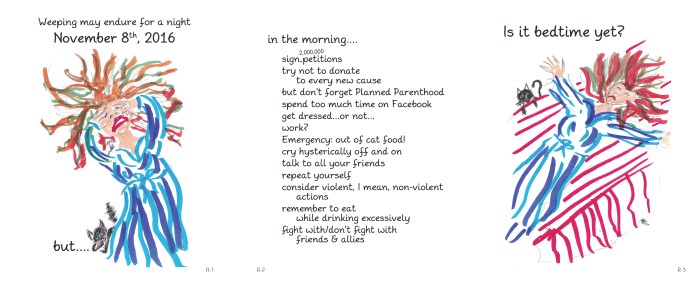
Like many in the FAR community, I participated in the world-wide 2017 Women’s March.  So did Madge, the bodacious cartoon character who took me by surprise in 1990 and went on to become the narrative character of The Maeve Chronicles. Her life in print, as the first century Celtic Magdalen, satisfied her until….November 8th, 2016 when Madge returned, mouthy as ever, to rejoin us in our own times.


On the first anniversary of the historic march, I’d like to share a little of Madge’s millennia-spanning story and a few images from her two books of cartoons, now published in one volume.

Madge first appeared to me in 1990 as a line drawing of an ample woman sitting naked at a kitchen table drinking coffee. I had recently finished writing a novel, The Return of the Goddess, A Divine Comedy, and felt I had nothing more to say. I decided to play with magic markers for a while. Madge, as the naked woman introduced herself, was far from done with words. Fleshed out with peach magic marker, Madge told me she wanted “fiery neon orange” for her hair color. She also required speech balloons for her theological queries. (For example: If we are all members of the body of Christ, who is the twelve-year molar, the kneecap, the colon?) Enchanted with her sass, I invited her to be in my next novel. I pitched ideas to her. She rejected them all as too dull and said, “I want my own book of cartoons first.” Continue reading “Happy Anniversary, Women’s March, with love from Madge by Elizabeth Cunningham”

Who is She? an excerpt (edited for brevity) from the 25th anniversary edition of The Return of the Goddess, A Divine Comedy by Elizabeth Cunningham

Introduction by Maeve: Elizabeth’s July post usually features an excerpt from my Chronicles in honor of my feast day, July 22.  This year the excerpt comes from the novel that opened the way for my story.  Ever since a playdough figure took shape spontaneously in her hands, Esther, a minister’s wife,  has been on a quest to find out Who She Is! Here she encounters the Lady as the Virgin Mary. (For my take on the BVM, aka Ma, the scene stealer, see The Passion of Mary Magdalen and Bright Dark Madonna.)

A kitchen, yes. That’s what a sacristy was: a sacred kitchen, Esther mused as she stood in St. Paul’s sacristy, the light strong but thickened by the plain, stained-glass, lead-fitted windows over the sink—the piscina, if you were high church. The walls, an ancient, graying yellow, did what they could to reflect the filtered light in a gallant effort to create an atmosphere intended to be cheery. Continue reading “Who is She? an excerpt (edited for brevity) from the 25th anniversary edition of The Return of the Goddess, A Divine Comedy by Elizabeth Cunningham”

Nobody’s Disciple by Maeve Rhuad aka the Celtic Magdalen via Elizabeth Cunningham

Elizabeth Cunningham headshot jpegSince beginning her posts for FAR four years ago, Elizabeth has featured an excerpt from my chronicles each July in honor of my feast day on the 22nd.  At least I thought it was my Feast day. It has been brought to our attention that Pope Francis only recently elevated the 22nd to the status of a Feast. Before that, it was merely a Memorial of me as a saint, whether optional or obligatory I am not sure.  The only thing more elevated than a Feast day is a Solemnity.  (Needless to say my mother-in-law, aka the Blessed Virgin Mary, has one of those.)

You may not know me as Maeve, the Celtic Magdalen. Mary Magdalen, who she was (or is) should or could have been is a highly charged subject. Not very much is known about me, really, which is why  legends, novels, and films abound. I’m a storied woman, to borrow Natalie Weaver’s term. There are fourteen references to me in the Gospels. I am associated with the non-canonical Gospel of Mary (I believe the credit for that should go to Mary of Bethany whom many people conflate with me). Pope Gregory is largely responsible for my lugubrious image as a penitent prostitute. Continue reading “Nobody’s Disciple by Maeve Rhuad aka the Celtic Magdalen via Elizabeth Cunningham”

Mary Magdalen’s Cave by Elizabeth Cunningham

Elizabeth Cunningham headshot jpegMy first post for FAR appeared on July 22, 2012, the feast day of Mary Magdalen. I like to dedicate my July posts to her and include an excerpt from The Maeve Chronicles, the novels I spent 20 years writing, which feature a feisty Celtic Magdalen who is no one’s disciple. This year’s excerpt is from Bright Dark Madonna, the third in the series, which follows her (mis)adventures from Pentecostal Jerusalem, to the wilds of Turkey’s Taurus Mountains, the port city of Ephesus, and finally to her legendary cave in France.

While doing research for the novel, I made a pilgrimage to Le Grotte de Marie Madeleine in Southern France. A forty-five minute climb, past a spring leads to a high cliff wall where a spacious cave has been made into a chapel to the saint. There were no other people at the site except my husband and daughter who kindly gave me time alone in the cave—alone with her. As I wrote in FAR’s pages a while back, I have a longing for hermitage that I haven’t allowed myself to fully inhabit. Maeve, on the other hand, goes all out, or rather, in.   Here is what she has to say: Continue reading “Mary Magdalen’s Cave by Elizabeth Cunningham”

The Elements Are Us by Elizabeth Cunningham

Elizabeth Cunningham headshot jpeg

My late uncle, an atheist since age twelve when well-meaning Christians told him his youngest sister was “in a better place,” is now ashes in three red cloth bags. He was the last of my mother’s siblings to die, at the age of ninety-eight, the first being their little sister who died at age four. His children and grandchildren are taking his ashes to be scattered at sea where they will mingle with the bones the pirate Blackbeard, who met a violent end in these same waters almost three centuries earlier. Though most of this memorial weekend is a series of social occasions, and the guests on the boat continue chatting, I am moved by the sight of my cousins taking up spoons and scattering their father and grandfather’s ashes on the wind.

He is returning to the elements that sustained his life: fire, earth, air, water.  When we breathe, drink or eat, sweat or shed a tear, in every moment of our lives, we connect through the elements to all the life that has gone before us and all the life that is to come.  No belief system is necessary to know this truth in our bones.  May we learn to care for the elements—rivers and oceans, air, soil, fuel for light and heat—as we would care for our own bodies. When the elements are degraded, we are degraded; when they are vital, we are vital. The elements are our ancestors, our children. The elements are us. Continue reading “The Elements Are Us by Elizabeth Cunningham”

My Immortal Mother-in-Law by Elizabeth Cunningham

Elizabeth Cunningham headshot jpegBefore Olga Eunice Quintero Smyth died on December 4, 2014 at age 101 and 10 months, I was tempted to believe she was immortal, literally. I knew Olga for forty-five years (from age 16 to 61). For thirty-five of those years she was my mother-in-law. Our history began when I was kicked out of high school and went to work at her free-wheeling school, her utter lack of any interest in reforming me a blast of fresh air. It ended with me sitting beside her as she was dying, softly singing “Row, Row, Row Your Boat.”

Olga was named for a Russian princess her mother encountered when she was a babe in her arms en route to Trinidad from her native Venezuela. Olga took for granted her descent from Incan royalty as well. Her mother moved the family to New York when she was eleven. A few years later, she won a scholarship to Mount Holyoke College. She married a classmate’s brother, Julian Smyth, great grandson to Nathaniel Hawthorne. If that weren’t enough, Olga claimed for Julian’s line direct descent from the first century Celtic Queen Boadicea. As long as she could speak, she spun tales. “Where in Africa was she born?” one of her nurses asked me. “What kind of a dancer was she?” Continue reading “My Immortal Mother-in-Law by Elizabeth Cunningham”