

A story that follows on from my version of Perseus and Medusa…
We are blind now, my sisters and I.
He came to us, the hero, the shining one, Perseus, proud in his strength, bright as the two lightning flashes on his tunic.
There were three of us, three sisters known as the Graiae. We had always had only one eye between us, which we passed from one to another, yet we saw more clearly with that one eye between three than many did with two eyes to themselves.
And we saw him for what he truly was.
“Where is she,” he demanded.
“Who,” I asked, though we knew well what it was he wanted.
“Medusa. She whose snakes creep in and poison our good and wholesome society.”
We laughed at the way he saw the world, and I answered “No.” I spoke for us all, since at the time I had our one tooth.
But then I made a mistake. Wishing my sisters to see him, I took out the eye so as to pass it to one of them. But he grabbed the eye as I tried to hand it on.
“Now you will tell me,” he said triumphantly, holding the eye tight in his hand.
“No.” At that, he began to squeeze the eye in his fist. We all felt the pain.
“Tell me, or else”
“No.” He squeezed the eye more. The pain was intense.
“Tell me where Medusa is.” “No.” Another squeeze. More pain.
“Tell me.” “No.” Squeeze. Pain. “Tell me.” “No.” Squeeze. Pain.
The pain was almost unendurable. But it seemed that our determination not to reveal where our comrade was only grew stronger as the pain increased.
“Then take the consequences.” He crushed the eye in his fist, and strode off.
We are blind now, my sisters and I. But our dear Medusa is still free. And though the tyranny of the strong still remains, it is not secure while her serpents remind the oppressed of their power when joined together. Though we can no longer see the outside world, our inner vision has only been strengthened. And we see into the future. We mourn for and honour all those who remained faithful under torture. There are those whose names we see and many others whose names we do not know. You may recall some from near your own times – if you do not, then search out names, both to honour them and to give yourselves courage.
 We also mourn for and honour those who resisted torture to the limit of their ability, but who found the pain too much and gave in. They did what they could – no-one knows their own limits until they are tested. We will not judge them.
And we remind you who live in future times that tyranny can appear pleasant if one is not suffering personally. It can appear as security and strength, as a barrier against the unknown, as liberation from the pains of the world. And even a good cause can turn into tyranny if the passion of its followers becomes too strong.
We are blind now, my sisters and I. You, the sighted ones, do not let yourself be dazzled by strength and beauty, but see tyranny and oppression for what they are. And, for as long as you can, resist.
(Notes)
“Unhappy the land that has no heroes,” says a character in Bertolt Brecht’s play Galileo. “No,” replies another. “Unhappy the land that needs heroes.”
A very different attitude to heroes from that in most of my stories. I rarely treat heroes negatively, preferring a positive re-vision of their behavour and nature.
This developed from a workshop where we playing with the story of Perseus. It was held at a time when information about tortures in Chile, Argentina and South Africa were in the newspapers. I had been wondering what would have happened if the Graiae had refused to tell Perseus, where Medusa was and I suddenly made the connection. All too often those who torture or commit other crimes in support of a government are regarded as heroes saving society from anarchy.
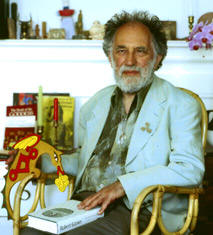
Daniel Cohen has been active in the Goddess movement in Great Britain for many years, and was co-editor of “Wood and Water”, a Goddess-centred, feminist-influenced pagan magazine which ran for over twenty years. He is particularly interested in how Goddess spirituality can open up new ways of behaviour for men, non-oppressive and using their talents to heal rather than harm. He believes that myths and old stories have great power to shape behaviour, and so a valuable tool for change is to find new stories or to tell old stories in new ways. This story is one of his many re-tellings and re-visions. An illustrated collection of twenty-five stories has recently been published under the title “The Labyrinth of the Heart” (ISBN 978-0-9513851-2-8), and can be ordered from both physical and online bookstores. Some of the stories, together with book reviews, articles, and poems, can be found on his website at http://www.decohen.com
Discover more from Feminism and Religion
Subscribe to get the latest posts sent to your email.


I love this! “Heroes” like Alexander the so-called Great in history or like Achilles in myth or like Perseus are dangerous role models. The Goddess, of course, does not teach us to torture and conquer. That came with the storm and thunder gods. Excellent story. Bravo!
LikeLike
Anyone know how to send a copy of this to Chris Hayes who was roundly criticized for wondering if everyone who fought and died in US wars should be called a hero? I agree the category of hero justifies war.
LikeLike
Beautiful! Thank you for this.
LikeLike