


What I realized was that my ability was different from hers and that I really could, as in ‘I had the ability to,’ decrease our time. I carried our arms differently; and it surprised me. I’ve never forgotten this sudden sense of myself and of my own power.
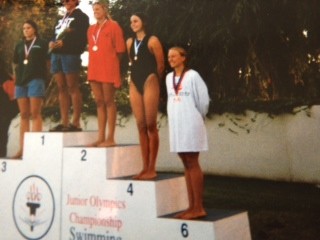
Watching the Olympics this week, I found myself very inspired… and very reflective. You see I was once an athlete. Not an Olympic caliber athlete, but an athlete none-the-less. I swam competitively for eight years. My events were the 100 and 200 freestyle and the 200 and 400 Individual Medley. I started swimming in 8th grade. I worked out 30 hours a week through my last two years of high school; and I was relieved when I started swimming for an NCAA division one team in college because the NCAA limited workout hours to *approximately* 20 per week—so I had more time to study. I was a swimmer and I was completely dedicated to my sport.
But as I got older, my times slowed and I no longer felt successful; so I began to deny myself the title “athlete.” It’s still hard for me to claim this title (even when applying it to the past) because my body has changed so much, as has my competitive drive. I am more comfortable identifying as an academic. Plus, as therapy and my feminist academic studies helped me to realize, I had often used my swimming to physically punish myself, literally. I treated workouts like penance for failure, sinfulness, earthliness and a general lack of deserving. Workouts were a socially acceptable space to push myself harder than I should and wallow in the shame I “deserved” when I performed poorly. I used the competition and hierarchy in sports to see myself as less: to confirm what my abusive context told me was true about myself. Just as I shied from the title “athlete,” I also lost a connection to my genuine love of swimming and sports… which is something it’s taken me a long time to recover.
I love to swim. I started to re-member that I love to swim, to physically work hard and to create mental discipline through physical challenge through my practice of Kundalini yoga and more recent physical training. But watching the Olympics this week, I re-membered something more. Competitive swimming helped me to recognize and tap into a physical power I hadn’t previously known. I forgot this power at the end of my career but I had known it. I had tasted it; and I swam because of this taste, this self-knowledge and this ability to make myself more.
A 15 year-old won gold in the women’s 800 meter freestyle, coming half a second from the world record. England’s men’s gymnastics took bronze causing a tremendous outpouring of joy from British locals. The NBC commentator said, “no one alive,” had seen that happen, as was evident in the crowd’s excitement and pride. Young athletes, teens and children, lit the Olympic torch after embracing their mentors. The Olympics have a complicated history that has played into and worked with classist, racist, capitalist, heterosexist patriarchy. But is also represents one of the few cultural rituals we share with over 200 nations in the world. It also represents real hope for many individuals and something creative in the human spirit.
Watching these games, I remembered that did know what I was capable of creating and being, even in the midst of abuse and struggle. I would like to share some of those memories here, as I work to re-member that ability in my life now.
Swimming in workouts one day, our coach paired us in teams to race while physically holding hands. I can’t remember the explanation my coach gave for this exercise—maybe it was just for fun—but I do remember what it felt like. I, a freestyler, was paired with one of our best breaststrokers, L.M. L.M and I were sprinting a 50-meter free and with about 10-15 meters left, I remember thinking to my partner, “just hold on,” as I took our arm rotation even faster.
I realized at some point during our race that I could do more and could make our team faster and stronger. It wasn’t that I was “better” than L.M, because I wasn’t. We were well matched, though we specialized in different strokes. What I realized was that my ability was different from hers and that I really could, as in ‘I had the ability to,’ decrease our time. I carried our arms differently; and it surprised me. I’ve never forgotten this sudden sense of myself and of my own power. It helped me to know myself in a way I hadn’t before, and it helped my small team.
Swim meets also gave me a sense of myself: sometimes good, sometimes not so good or shameful. I was habitually too hard on myself and too nervous, a product of my not so great self-esteem. I remember ugly competitions—the way people would say to me before racing, “beat your sister” (who also swam), after they had told her the same. These painful comparisons encouraged divisions that my twin sister and I worked hard to resist, so that we could love and support one another. However, I also remember triumphs that weren’t about making others less or worse than myself. I also remember the efforts of teams.
My senior year of high school I swam 3rd in my school’s 4×100 yard freestyle relay and my sister swam second. I was more of a sprinter (my sister swam distance—the 500, 1000 and 1650 free), so my time was faster than hers. Actually my split in the relay was my fastest time ever: 52 __ something. Not at all fast by Olympic standards, but to me, lightning fast. But the fact that everyone’s times mattered was critical to this relay. Everyone had to do her part and everyone did. Our relay broke a 16-year-old record and helped us win our division championships—something our small team wasn’t expected to do.
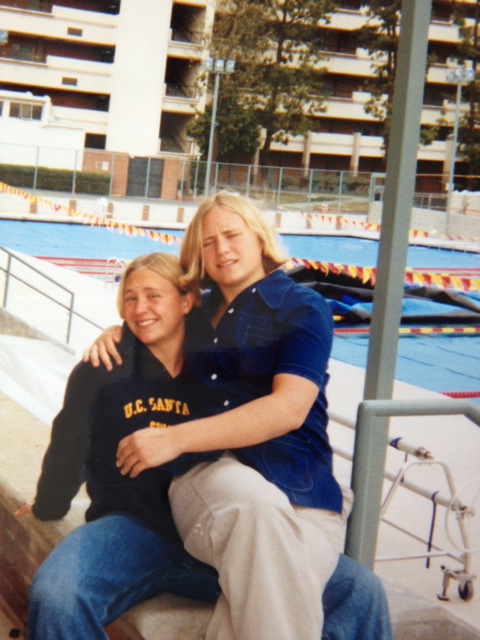
I felt so powerful during the race and anticipating it on the blocks. I could sense the ability of my body. I could feel my muscles moving, my heart beating and my will fighting against the growing lactic acid as I raced. I rejoiced in our victory, but not because the teams we raced against were “worse” than our team. I didn’t revel in their ‘defeat.’ I was glad for my time, but not because I had a faster split than my sister. My sense of power came from the fulfillment of self-knowledge and potential. My joy was a product of something I achieved with my team: a way of being, a capability and yes, a time.
I think there is a cultural concept of victory as “better-ness” that can makes many feminists uncomfortable with sports competition. Why is faster better? Why do we have to “win” all the time? Why do we have to be on top? And I agree that there are real dangers in trying to “be the best” when it means someone else or their humanity needs to be less than you or yours. There are dangers to wanting to be the most powerful when so much of our world celebrates the power of control.
But sometimes sport is about our potential in humanness. Sometimes it is about recognizing our limits or surpassing them. Sometimes sports inspire us to be more of who we are as a community of interconnected humans who can create, change and grow. I re-member the way I can make myself better; and I am grateful to those whose lively competition pushed me towards this recognition.
Sara Frykenberg, Ph.D.: Graduate of the women studies in religion program at Claremont Graduate University, Sara’s research considers the way in which process feminist theo/alogies reveal a kind transitory violence present in the liminal space between abusive paradigms and new non-abusive creations: a counter-necessary violence. In addition to her feminist, theo/alogical and pedagogical pursuits, Sara is also an avid fan of science fiction and fantasy literature, and a level one Kundalini yoga teacher.
Discover more from Feminism and Religion
Subscribe to get the latest posts sent to your email.
 Feminism and Religion
I think some of your best feelings about swimming were probably felt by the Greek girls in the Olympics to Hera Parthenos. See my blog: https://feminismandreligion.com/2012/07/30/when-the-olympics-celebrated-the-strength-of-girls-and-the-renewal-of-life-by-carol-p-christ/
LikeLike
I really enjoyed your blog Carol! :) Thank you!
LikeLike
Sara, this reminds me of my own journey with dance. I have always loved moving and loved my body and the thing she can do. But I was taught very quickly that my body was shameful and nothing to be proud of. The joy and freedom of dance turned into opporunities to compare myself to thinner girls and an increasing desire to hide myself. Eventually I quite dance (and soft ball as well), ostensibly so that I could devote myself to theater and piano instead. But the truth is I was ashamed of my body and in both of those activities I felt big and slow and embarrassed, even though I was always quite good at both. It has taken me years to re-member the joy and freedom of dance and to find delight and pleasure in my body and its many capabilities. This is an ongoing struggle but when I dance I feel my power and creativity blooming. I wish you many blessings as you dis-cover the power and freedom of your body and soul.
LikeLike
Thank you so much and I’m glad that you have taken back your the joy and freedom that you found in dance. Its amazing how things we love can be distorted and make us hate ourselves. Swimming got so bad that near the end of my career I was embarrassed to walk on the pool deck in my bathing suit! I spent half my life in my bathing suit, and yet, I didn’t want to walk on deck because of my ‘ugly,’ ‘unfit,’ body.
Its been a long road walking back to a place of love with sports. (An even longer one to love my body- which I still struggle with). Even writing this post this week brought back old feelings I had to shed; despite the fact that I wrote the post because I was genuinely remembering my power and myself!
Thank you for the encouragement and cheers to you!
LikeLike
Sara, thank you for giving me a different way to understand sports and competition – this was very helpful to me. I am one of those people who often only sees, what I consider to be, the destructive aspects of competition in sports (and the crazy money that goes into them that I find unjustifiable – but that’s whole other thing). I truly appreciate your wisdom and experience of this and am grateful you shared it with us – thank you!
LikeLike
Thank you Xochitl! I definitely agree that sports can play into destruction (and oh my goodness, your right, the money involved is a whole other topic and a very important one!!!). I also definitely think it’s important to honor what sports can be, creatively speaking and for those who love them :)
Thank you again!
LikeLike
Sara, Thank you for your insight into sports and the beauty of pushing our bodies and minds beyond what the self feels it is capable of. Both of my daughters participated in competitive swimming, with the oldest starting at age 6. She was good, very good, but by the age of 11, after every weekend spent at meets and the endless hours of practice, she quit the sport. It broke our hearts (and her coaches) because she was such a contender. I had to pull back and recognize within myself my own level of, at times, unhealthy competitive drive that pushed my daughter too far. By high school she was back in the water, only on her own terms, in love with the team aspect rather than an individual time that only (dis)satisfied the self.
Thank you for sharing such a beautiful part of your life.
LikeLike
Thank you Cynthie! I’m also glad that your daughter made those empowering choices for herself and that you supported her!
And just a note, I totally identify with loving the team aspect of high school swimming. I swam on club teams all the time I was swimming; but participating on my high school team was definitely the best and happiest swimming I ever did. We sang silly cheers, had shaving parties (because as you know, you’re not supposed to shave until the big meet) and one year, even wore tie-dyed orange and white underwear (a gift from the captains) to share team pride! Go Tigers! ;)
Some of if really was beautiful; thank you for that descriptor.
LikeLike
Sara, Your article inspired me to get back into the water after a decade of absence from the pool deck. Just back from my swim of 20 laps, a slow start, but a start none-the-less. Maybe I’ll be able to get strong enough so I can rejoin a Master’s Swim program. Thanks again!
LikeLike
WooHoo!! :D That’s rad! Let me know how it goes!
LikeLike
Hi, I was a swommer until 16 and still practice it when I can since I find relax and time to meditate while being involved for the water around.I liked your stoty and visions. Thanks for sahring
LikeLike