

Sometimes science fictional curiosities paint an image of a larger matrix. Sometimes they project cultural fears, tearing down and minimizing our webs of existence in new world schemes. But whether a positive vision or negative one, science fiction, like feminism, is about crossing boundaries.

A little more than a year ago, I posted a blog in which I lamented the dismantling of NASA’s space shuttle program. I asked my readers and myself, “Do feminists care about the Space Program,” unsure of what response I would receive. Watching the space rover “Curiosity” land on Mars on August 6 of this year, I found myself returning to this question. Re-membering my sincere belief that: “space travel is imagination incarnate,” my answer remains the same.
Yes, the human exploration of outer space matters.
Yes, I believe it is a feminist cosmological and theo/alogical concern.
Yes, yes, yes. Curiosity Matters! And this is why:
1. The possible discovery that there is or was life on other planets in our solar system broadens our understanding of inter-connection and what it means to be a part of a larger “web” of existence.
Curiosity, the “Mars Science Laboratory,” is explicitly concerned with the question, “Could Mars have once harbored life,” according to the NASA missions website. The investigation is a part of ongoing efforts to understand the Martian surface, particularly since scientists discovered the actual existence of frozen water on the planet and the possible existence of “flows of liquid brine.”

Water. It is the necessary “stuff” of our bodies and planet. We, like all of our Earth-creaturely relations, cannot exist without water. Life is amazingly connected by this molecule; and it is amazing to discover this link on Mars. Many feminist theologians and thealogians describe our existence as a kind of web or matrix: a system of difference and relationships that makes up a whole. Life on Mars makes our web larger. It discourages exclusive and human-centered cosmological claims, asking us to consider what other realities and what other experiences define the history of this vast and beautiful universe.
2. “Curiosity” about outer space and interstellar boundaries encourages innovation and creation, pushing the envelope of our imaginations.
If I haven’t mentioned it before, you should know that I am an avid Star Trek fan. I would literally pass out if I were given the opportunity to meet Patrick Stewart, the actor who played Captain Picard in Star Trek The Next Generation. My love of sci-fi, however, does more than satisfy some future leaning curiosity or interest in the worlds beyond our own. I love a great deal of science fiction and Star Trek in particular because of this genre’s ability to respond with curiosity and imagination to the challenges we face today.
Sometimes science fictional curiosities paint an image of a larger matrix. Sometimes they project cultural fears, tearing down and minimizing our webs of existence in new world schemes. But whether a positive vision or negative one, science fiction, like feminism, is about crossing boundaries. It re-presents our cyborg bodies in terms that shock us to re-member ourselves—as much of Donna Haraway’s work grapples with. Sci-Fi re-presents the possible and often challenges political and social oppressions.
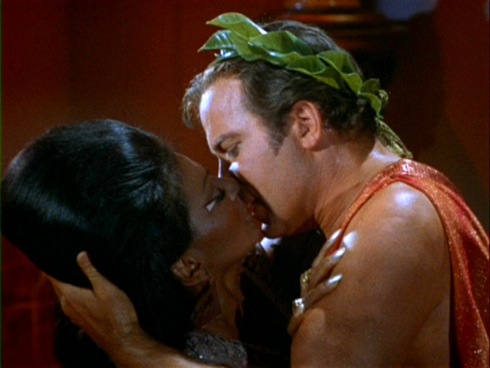 For example, the Star Trek episode “Plato’s Stepchildren” is understood to have shown American television’s first scripted interracial kiss, between Kirk and Uhura. It addresses racism and species-ism again in the 1991 movie, The Undiscovered Country, the backdrop of which is Kirk’s own hatred of the Klingon species and his pointed question, “Spock says this [mission to create peace with the Klingons] could be an historic occasion and I’d like to believe him. But how on Earth can history get past people like me?” Contrastingly, the TNG episode, “The Chain of Command,” responds to present human atrocity with the idea that we might be able to evolve past some forms of hate. Facing his own torture at the hands of a hyper-militaristic species, Captain Picard states, “Torture has never been a reliable means of extracting information. It is ultimately self-defeating as a means of control. One wonders it is still practiced.”
Our interstellar curiosity suggests that, yes, we are still limited human beings, but maybe we can create something new after all.
And therefore:
3. Our relationship to space, to our galaxy and to our universe suggests that we are both small and unique; as well as more than we thought we could be.
Avery Brooks, the actor who played Commander Sisko on the series Deep Space Nine, explains his acceptance of this role in an interview with Nashville Scene. He states, “Certainly the fact you have a black man in a command position is very important. That is something that goes far beyond just having black people working on a show, which itself is also very important. It goes to children being able to see themselves on screen and visualize that in the future they will be doing something of importance to the world at large. It addresses the situation of having all kinds of people interacting and cooperating for the mutual survival of the planet.”
We can have a future—we do have a literal future in the children of our planet. We are important and diverse. We can work together to accomplish amazing goals, like landing on Mars! We are a part of this universe. And personally, I am excited to discover more and more of this space in which we make our home
Discover more from Feminism and Religion
Subscribe to get the latest posts sent to your email.
 Feminism and Religion
Great post Sara. While not a strong Sci-Fi fan, I have noticed the commitment to racial diversity, but what about bodies? Women and men never carry a few extra pounds, instead are lean and near perfect in stature. Apparently the future holds some sort of magic for embodiment with slight silhouettes and gender-ordered height where women are never taller then men. Could this be “the new frontier” of capturing diversity as well?
LikeLike
Hi Cynthie,
You make great points here– I think representing different types of bodies in Sci-Fi is definitely an important goal/ “frontier.” Some Sci-Fi does this, but as Nancy states below, this is not usually the case on TV and in movies.
Shows like Star Trek The Next Generation (TNG), which really push some boundaries, still uphold many exclusive standards for what kinds of bodies are “good” and which are not. I actually think TNG does tend to problematically insinuate that a certain standard of “health,” (that looks a lot like slight silhouettes and particular exclusive notions of what make “sexy” bodies), is achieved in the culture of the 24th century. That said, the characters bodies do change over the 7 year period of the show– quite a bit; and in that sense, their humanness is part of what makes people love them so much.
Age is actually something Star Trek seems to represent quite diversely though, emphasizing again the character’s importance over the actor’s ability to continue to embody oppressive or exclusive social ideals.
Gender– well, that’s a whole other issue as well! Attempts on this series to challenge gender stereotypes often come with very very mixed messages.
Non-human embodiment is also important here– though I’m afraid that might need to be another post!
This is a great issue you raise overall; and you’ve got me thinking about a hundred different things! ;)
Thank you for your response!
LikeLike
Thank you, Sara, for this great post. I, too, am an sff (science fiction and fantasy) fan and loved Star Trek (especially The Next Generation, since it had such great writers). In fact, one of the first classes that I taught at the University of Wisconsin-Madison was the “Women and Science Fiction” class. I’m also old enough to have watched — as a young adult — Neil Armstrong’s first step on the moon in 1969, one of the most awe-inspiring events I’ve ever witnessed.
Space (…”the final frontier”….) and science fiction really do open up our imaginations to new possibilities. And feminists have explored “strange new worlds” and “sought new civilizations” in sff that have investigated gender roles, sex, male-female relations, LGBTQ issues, body image, motherhood, and much more. Of course, this has happened mostly in print fiction. The movie/TV industry is much more tied to mainstream cultural assumptions about women (as Cynthie rightly points out).
Sara, do you know about Wiscon, the only feminist science fiction convention in the world? It takes place on Memorial Day weekend here in Madison, Wisconsin. I think you would love it, and if you come, please get in touch with me. Every other year, Wiscon hosts the presentation of the James Tiptree Award for the best gender-bending sff of the year. I think you would also enjoy the works that have won this award.
Your final statement (“Our relationship to space, to our galaxy and to our universe suggests that we are both small and unique; as well as more than we thought we could be”) reminds me of an experience I had just before the Iraq War in 2003. Everyone I knew was freaking out (and I was also very involved in anti-war demonstrations, letters to the editor, etc., but calm in the face of the impending war). I think the reason for my calm had to do with the fact that I had just moved to the shore of Lake Mendota here in Madison. A friend of mine from Washington called the day before the war broke out and was so ungrounded and upset that I could have gone along with her energy. But I was sitting out in front of the lake on a beautiful spring-like day and realized that the large natural vista in front of me made me feel both bigger and smaller than I usually felt: smaller, because my human concerns were minor in the face of all of life, but larger because I was a part of that interconnect web of existence. Such an understanding allowed me to remain grounded and centered, while working against the impending war.
LikeLike
Thank you so much for your comments Nancy! I would have loved to take your class! Actually, my twin sister is working on her qualifying exams now, one of which focuses on Sci-Fi; and I am very excited to learn more vicariously through her.
I am also a great fan of fantasy literature. Are you reading The Wheel of Time series? There is a very very interesting women’s ritual in this book series that I would love to talk to another feminist about!
Also, I did not know about the conference! This sounds like something I would love! Thank you for letting me know about it; and I will definitely look you up if I am able to attend! :) (Memorial Day weekend I am usually completely focused on Fanime Con in San Jose, so its not surprising I’ve missed other events).
I love the image you paint of your lake as well– this is definitely how I feel when I really think about my place in the universe; and it is a very powerful feeling that I do not explore often enough.
LikeLike
I’ll look into the Wheel of Time series, Sara. I’m always looking for a good fantasy novel, and one with an interesting women’s ritual in it sounds even more promising. Thanks!
LikeLike
Just a warning– the ritual isn’t until about book 12 or 13…. ;) The final book is coming out later this year or early next year. The book is not without its patriarchal underpinnings– quite a bit of patriarchy actually– but is also has very strong female characters and seems to wrestle with power relations some. The ritual (one of sisterhood) in particular, is very interesting. And women in the book definitely have some very important relationships with one another as well. If you read (or listen to) the series, you will have to tell me what you think about the way the author uses violence.
LikeLike
“Where do women “fit in” to this space of stale-mating, this world of wedded deadlock? We are supposed to fit in to the “family pictures” — such as those displayed by the space heroes on their craft— and into the pictures shown on television and printed in the media. In the televised pictures of the return, the wives were shown smiling in frantic euphoria (perhaps with the help of modern medicine) while their masters displayed far less enthusiasm at greeting them. Women are supposed to “fit in” to this picture, as pictures, that is, as projections. At the present stage of technology, the “presence” (absence) of women is re-presented in the form of photographs, or of televised two-dimensional images. The direction of phallotechnic progress is toward the production of three-dimensional, perfectly re-formed “women.” [Gyn/Ecology p.52]
Ah the space program. I always loved Mary Daly’s take on it, how she could get us to see what it was really all about. At one point, one of the astronaughts who went to the moon was asked what the role of women in space would be. He replied that “We would use them very much the way we use them on earth.” “USE THEM” as in recepticals for men. Clueless deadening patriarchs in space. The Mercury program and its rejection of the original women in the program is the truth behind the space screen.
My partner talked about the deadly dull men they chose for these “missions” and how they had so little to say about the experience. Neil Armstrong found himself completely unable to talk about the moon landing— the deadly dull men, who were military men, going out and “conquering” space. Now the garbage that they dumped orbiting the earth is a veritable junk heap. Things that go up must come down, but they never much cared about that.
It was all about “One giant leap for (patriarchal) MANkind” and the wives who said they were “thrilled” with it all. My partner said one reason she could not even bear to watch the original moon landing, is she longed for poets in space, people who could really bring a transcendant joy to the experience. Ah, young lesbians in 1969. She was 11 years old, and refused to watch the moon landing. No wonder I fell in love with her so many years ago!
There is the beauty of the space ship in “2001 A Space Odyssey”— Blue Danube, and then there is the “vision” of the men who created the women characters in the movie. One engineer I knew back in the mid-70s told me NEVER to see 2001 A Space Odyssey again, because the sexism in it would horrify me. Even he was embarrassed at male supremacy back then.
LikeLike
The space program itself definitely participates in patriarchal culture (something I talk about in the year-ago post that precedes this one). Sci-Fi for that matter, does too. But the discursive space of Science Fiction is extremely diverse– and while (particularly in movies and on TV) it still participates in patriarchal culture; Sci-Fi has come a long way from the “Odyssey” of 1968. Stanley Kubrick also brought our culture “Full Metal Jacket,” “A Clockwork Orange,” “Dr. Strangelove” and “The Shining” …. however you feel about his movies they definitely share common threads– and not ones I would call feminist.
Have you read Octavia Butler? Or Ursula K. La Guin? Or Donna Haraway? What about celebrating the successes of women like Dr. Mae Jemison (the first African American woman in space), who Star Trek celebrates, asking her to appear on their show?
Are we supposed to stop caring about the universe and our exploration of it because patriarchal powers tried to take it over for themselves? I refuse to write off our exploration of outer space as just one more patriarchal endeavor that cannot be re-membered to include the whole of humanity.
LikeLike
The problem is that it is a deeply patriarchal endeavor; it is essentially a military program in disguise. You have to know what it is. Science fiction is another thing entirely, it is literature.
I read Ursula K. La Guin, I think in 1979, and also Marion Zimmer Bradley. I especially loved “The Ruins of Isis” which should be made into a movie. And it seemed like Stanley Kubrick just made more and more movies that are women’s horror stories.
We have to take a hard look at science and the propaganda of it all, because it really doesn’t advance the best interests of women. It is still about male conquest of everything. So it doesn’t seem all that awe inspiring anymore than a bunch of men at Facebook make me inspired about their corporate culture or board of directors. If it wasn’t flying around the earth, we would see it for what it was.
What our biggest challenge is now is dealing with all the science of men, and what it has done to the earth as a result of all the science to begin with. And were not even close, because women are still locked out of the process, and even scientific method itself doesn’t see what women can see.
It was very much like a conversation I had last night with a husband and wife. The husband, naturally dominating the entire conversation. At one point, he said that their family had chosen to have him be the breadwinner and his wife committed to raising the children. I just sat there quietly, and even he stepped back and realized the absurdity of his comments. Since there was no choice at all, and I’ll give him credit for stopping while his wife finally spoke for herself.
I don’t see the feminism in any of the moon landings, the laboratories, or even most of the science fiction written. It is simply male supremacy going out to the universe, or the wish fulfillment of destroying the earth. It can have a beauty, it can inspire awe (not in me) but in many people. It can add a token or two—Mae Jamison or Sally Ride. Even the Russians put the first woman in space. But it was largely a military program and remains one. A very very expensive military program. I just don’t see this kind of awe and enthusiam for drones, tactical nuclear weapons, or land mines.
LikeLike
Thank you for this delightful and imaginative post! I am a sister-in-SciFi, and I agree that using our imaginations is a vital component of the Divine Feminine, and thus integral to Feminism and Thealogy. When we can continue to envision a better–more whole and loving–world, then that is wonderful and provides directional energy toward healing. However, I cannot feel comfortable in supporting space exploration at this time; I feel that we are not being responsible in spreading our miasm and disconnect outward into the universe. We need to become whole — heal ourselves (which, again, embracing imagination is vital) — before expanding.
Thank you for recommending The Wheel of Time; never read it — hesitant because I tend these days, as I’ve gotten older, to limit ‘violent’ impressions — but may see if it is available at the library.
Blessings!
LikeLike
I think our shelled woman friend has a good point about the space program – namely, that it involves a vision of progress within a patriarchal model of humanism closely tied to the military industrial complex. This feminist dilemma is expressed well in Haraway’s work. She faces the images/rhetoric/propaganda movements that have come to be associated with scientific ‘progress’ with frank criticism, yet manages not to dispose of the science. Instead, she broadens the definition. This in mind, I ask: are we to dispose of space exploration because the moment of its development is marked by the trappings of its era? Or can we not build on our technology as we do our society – by making change within/on/around/through/underneath/etc. our temporal-spacial locations? To reject space travel on feminist terms is to misapply effect. The cause, the reason we created the space program was (possibly/sure/why not?…) because someone pictured themselves conquering space or reaching new vast ‘frontiers;’ because rockets and missiles were so effective that the military created a corresponding, reciprocally profitable research program where humans and nuclear warheads alike could travel to outer space; and because, well, we could. If the success of say, the moon landing, ratified or in some way affirmed these original sentiments, if it bolstered the patriarchal ego with its fascinating results, does that mean that these self-congratulatory sentiments are the effect of the space program itself? I suggest that this is not the space program’s effect, but merely a perpetuation of the culture that created the program, which accordingly changed as culture changed (i.e. we do have women astronauts today, in 2012). And in opposition to this perpetuation, these trappings of patriarchy tied to the fuselage of our space shuttles, the space program has yet to reveal its true effect – what will it mean in 100 years that we went to space? What if one day sentient beings on earth attain true space travel? These questions are why science fiction is so fascinating, because we can only guess at their answers. One thing these texts agree on is that the effect will be profound.
In the early twentieth century the western world was reeling in the discovery that scientific development effected real change on human abilities, personalities, and moral expressions. (using art as my example:) The trains moved so fast one’s whole perspective changed, once static scenes transformed into blurs and were painted first by Futurists, and then less self-congratulatory painters who were sometimes horrified by the change wrought in society by technology. Instances like these are the beginnings of a paradigm shift that opened the way for the progressive movements of the latter half of the century. The cool thing about science fiction is that it acknowledges this historical fact and anticipates more, and perpetually interesting, changes. Sara’s article joins them in suggesting that the reaches of outer space, exponential to our own experience in space and time, might contain paradigm shifts that we cannot imagine and which are pertinent to the future of the human race. And, refreshingly, she dares to suggest that this might be interesting to an entity other than the military industrial complex. If you don’t like the military dictating the story of space travel to the population, then enter the conversation as a feminist and change the story yourself – curb the tide of effect by taking the issue seriously to begin with.
We are entering an era of private space travel – the means for the everyday person to exit our atmosphere are only becoming easier to acquire. I wonder how long it will take before feminists and other social scientists bother to get involved in the conversation? The space program isn’t some football game (sorry football fans, it was just the most commonplace patriarchal thing I could think of) we can wait until the end of. At least, I hope it isn’t or our planet is doomed.
LikeLike