

 “Am I crazy?”
“No, just full of hope. You got more hope than most people do. It’s a beautiful thing to have a little hope for the world, you know.”
This question was posed by Amy Jellicoe, played by Laura Dern, at the end of the HBO television series Enlightened. Unemployed, single, and in debt after she was fired for “whistle-blowing” on the corrupt activities of the corporation where she worked, Amy wondered if she had done the right thing. The answer of her ex-husband Levi brought tears to my eyes.
In many ways, I am Amy.
Let’s begin with the obvious. When I was young, I was slender and pretty and exceedingly tall, with long blonde hair—I imagine I looked like Amy. I couldn’t take my eyes off Laura Dern. There just aren’t many women in the world as tall as I am. Because of that I don’t know what I look like to others. In the series, Laura Dern is taller than just about everyone else, including the men, and she seems not to care, because she often wears high heels.
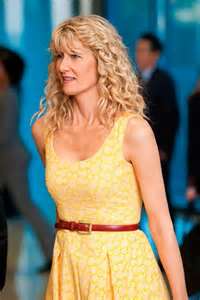 Though probably no one else noticed, I could see that though Dern has a great figure, her dresses and jackets didn’t quite fit her—skirts that would have been below the knees on other women barely grazed hers and the waistlines of her dresses and jackets were a couple of inches above her natural waist. This is just one of the ways Laura Dern and I and other tall women are reminded daily that we will never quite “fit in.” I suspect Dern’s combination of grace and awkwardness in her body is like my own.
I was raised in the suburbs of Los Angeles in tract homes like the one Amy shared with her mother. When I went to college, I learned to feel ashamed of having grown up in “little boxes made of ticky-tacky [that] all look just the same.”* I can think of only one other film portrayal—Erin Brockovich—in which anything good came out of the lower middle class post-war neighborhoods of southern California.
I could also see my relationship with my mother in Amy’s relationship with her mother–-who is played by Diane Ladd, Dern’s real life mother. Like Amy’s mother, my mother loved peace and quiet, roses, and her little dog. Like Amy’s mother, my mother kept her blonde hair in the “bubble cut” style popular in the 1960s. Like Amy’s mother, my mother only wanted her daughter to be happy. Like Amy, I wanted the wholehearted approval and open expression of love my mother was not always able to give.
Our mothers had been trained not to show their feelings too much, except with small children. Because Amy and I got very tall very young, we both may have missed out on the hugs that smaller children our age still received. I remember my mother cringing slightly as Amy’s mother did, when I came home with open arms and hugged her. I loved Diane Ladd’s look of incomprehension when forty-year old, tall Amy climbed into bed with her. I also loved it that Ladd did not pull away.
In another scene Diane Ladd stands behind a distraught and crying Amy. Though Amy can’t see them, Ladd’s hands are hovering about 6 inches from Amy’s shoulders, finally coming to rest in an embrace. After my mother died, one of her friends told me that my mother was in awe of me. In this scene, Diane Ladd seemed to be afraid of the beautiful tall unhappy daughter who was so different from herself. Ladd’s worry that her daughter might never be happy meant that she could not accept Amy as she was. In another episode when Amy is all dressed up and asks her mother how she looks, Ladd responds “Your hair could use a trim”—instead of saying, “You look great.” This happened to me too.
Like Amy I am often perceived by friends and colleagues as too “out there” – too open, too emotional, too confrontational, too passionate about things (like patriarchy, war, and the environment) that they don’t want to think about. I must admit that it was painful for me to watch the first series, during which Amy desperately wanted to change her life, but only succeeded in making one blunder after another with her friends, her former husband, her mother, and her colleagues. I have seen others roll their eyes and wait for me to stop talking—just as Amy’s friends did with her.
In recent weeks, months, and years, I have been having a theological argument with my best friend from graduate school Judith Plaskow about the nature of God and the relation of God to the evil in the world. Judith believes that the great power of creativity that underlies our world is impersonal and amoral, incapable by nature of caring about or loving the world. When Judith wrote that my view that Goddess is love seems to contradict “the facts of the world,” I asked myself, “Am I crazy?” When she said that in my blog on matriarchy I unrealistically imagined “the perfection of human nature,” I asked myself, “Am I crazy?” Am I crazy to believe that there was a time before patriarchy, war, and domination? Am I crazy to believe that we might create a better world?
From now on, when I ask, “Am I crazy,” I will respond to myself: “No, just full of hope. You got more hope than most people do. It’s a beautiful thing to have a little hope for the world, you know.” And I won’t apologize. Thanks Laura.
*This song by Malvina Reynolds which may be considered leftist expresses class contempt for the lives of my parents and grandparents; it was allegedly written about the Dolger homes of Daly City where my grandparents lived. In my graduate and undergraduate years I learned to feel ashamed of where I came from. My father, grandfather, and several uncles were insurance agents, the occupation that symbolized the meaninglessness of American life in Death of a Salesman. In my post-graduate years lower middle class Jews and Italians from the east coast were viewed as “colorful” by intellectuals, but my family background is more often disdained.
Carol P. Christ leads life-transforming Goddess Pilgrimages to Crete through Ariadne Institute. There is still space in the spring tour May 25-June 8. Join her and learn more about the pre-patriarchal Goddess culture of ancient Crete. Carol spoke on a WATER Teleconference recently which you can listen to now if you missed it. Her books include She Who Changes and Rebirth of the Goddess and the widely used anthologies Womanspirit Rising and Weaving the Visions.
Discover more from Feminism and Religion
Subscribe to get the latest posts sent to your email.

 Feminism and Religion
No you are not crazy to think that we might create a better world. We HAVE to create a better world. I’m also full of hope that this can/will happen. x
LikeLike
To borrow and bend a little to my needs: “From now on, when I ask, “Am I crazy,” to remain steadfastly Catholic when the church is so broken, I will respond to myself: “No, just full of hope. You got more hope than most people do. It’s a beautiful thing to have a little hope for the world, you know.” And I won’t apologize. Thanks Carol.
LikeLike
No Karolina. You are NOT crazy! Being different is a good thing as is being tall. (Spoken by someone who has always felt like a square peg in a round hole) xxx
LikeLike
Not crazy, just totally inspired. But another question, why does our physical appearance in this world keep changing?
LikeLike
I believe it is hope that allows us to experience joy! It certainly is not present in hopelessness!
LikeLike
Oh, Carol, thank you for writing this. So many people feel this but don’t say it. I felt left out and alone all my childhood and teen years because I was smart and nerdy. My father dominated my life with science lectures, always making me feel not good enough. Flash forwards over years of therapy and addictions, to now: as I read your contribution, I feel my competitive, less-than fearfulness emerge that blocks me from friendship with teachers. I go into a pained agony of hopelessness. I’ve written poems about it, made it part of my one-woman show. I fight to push through it. Because you are speaking exactly of my own passion against the patriarchy, against the insanity of bringing the world to destruction, and of the belief there was a time of egalitarian matriarchy. And you speak of hope! I so want to have hope, without it we are dead. I forget the exact quote what Tim Robbins character says in The Shawshank Redemption but it’s true. Hope is a wonderful thing. Thank you for writing this. Thea theaiberall@yahoo.com
LikeLike
Brava! Carol, you were not and are not crazy. I grew up WASP, Calvinist, and Republican in post-war St. Louis County. I wasn’t tall (well, I reached my adult height of 5’2 1/2″ at age 12), but I didn’t fit in with the popular girls, either. I guess we survive by learning to be full of hope.
LikeLike
I noticed recently that Kim Bassinger’s daughter with Alec Baldwin stands 6’2″. She is beginning her modeling career. An example of a women in full acceptance and in her power exercising her full creativity is Nicole Kidman. I bet she did not think so when she was growing up. Getting to Self Acceptance is a big streach when growing up, no matter what body type. My Aunt had a miserable time growing up in the 1940’s, she was filled with self loathing for her height of 6 ft. She projected this out into the world. I learned to be especially acceptable to tall persons because it made them feel better and I was born into a family of very tall people. I was a teenager in the 60’s with unlimited freedom to make up my own style and self image…..deliberately away from the traditional look in rebellion. I have always been grateful for the freedom of expression and free speech that the 60’s brought me. I’ve learned to understand my rebel part of myself by understanding what she was teaching me.
I was born and raised in the country on a thousand acres away from the maddening world. I loved it!
I think, self acceptance is sanity. I’ve heard it said that Schizophrenia is called the Women’s Disease because of the left brained male partiarchal projection of “unexceptance” and the lack of emotional understanding….women were not validated for who they were/ or are. Isolation also had a lot to do with it in my Grandmother’s era an me to, until I figured it out.
LikeLike
This is so moving and brave. It brings tears and many thoughts…
LikeLike
Carol, I always learn so much from you. Thank you for your willingness to hope, to be honest and courageous, and to put it in writing for us to read and learn and be transformed. And like Barbara likes to say – Brava, brava!
LikeLike
I don’t think our desire for a better world is crazy at all. I think women are often made to believe we are crazy within patriarchy, but that is classic gaslighting male supremacy. The tactics should be well known to all feminists.
We have been led to believe in a fallen world, or that Eve ate the apple, or that tall women can’t well walk tall. Sure, there will always be people who don’t get it. In the worlds I move in, I can tell pretty quickly who can or cannot understand my need for a driven radical lesbian intellectual rigor, for example.
I could relate on some level to the issues of clothing. Never noticed that Laura Dern was all that tall, just shows what we see or don’t see. I got tired of trying to find clothing that fit my butch self; I wanted pin stripes, I wanted clothing that fit me, not heteronormative women’s clothing. Tailors do what I tell them to do, and it takes you out of the oppressive feminized (read servile) clothing retail chains. Once I had the clothing that fit me, both my desire for pockets, and styling of my design— four buttons on each cuff, and real button holes for each one thank you very much, no flannel on the collars— had to be very aggressive to get the men to obey me on those points, but then aggression has never been difficult for me.
At any rate, it might appear that our actions as feminists are crazy, or even how that movie turned out with the woman who was the whistle blower. Hey it is crazy to come out as a butch lesbian in a corporate world, it is crazy to have this idea that lesbian partnerships deserve the same benefits as hetero couples… crazy to demand this right? And decades ago, the world had no understanding of any of this. If we are intense intellectual women, even most women in the world are not going to get this… the passive aggressive eye rolling is a hetero woman’s standard I have to deal with all the time, for example. As is the condescending erasure of my beliefs. Hey they do it all the time.
But if we aren’t driven to break new ground, and aren’t driven to see a goddess of love, and a world without patriarchy as possible, then well, we aren’t thinking big enough. So I look for the women out there who do get it, and who don’t choke on the words that best describe my philosophy–radical lesbian feminist separatist, for that is my belief in an ideal world. It’s what fuels my sense of power, it is my way of saying NO to male supremacy in all its forms without compromise. That is my power, but it is not the way most women think, and I don’t really give men any role at all in this transformative dream, they don’t exist in it.
Crazy, to others yes, to me no. When we see others like us, like the tall Laura Dern, Carol, it amazes and energizes us. We know we are not crazy when we hear other women say the same things we believe. That is not crazy, that is revolution.
LikeLike
I also was one of the tall, brainy girls that never quite fit in anywhere, but since there’s plenty of affirmation here for us all, that’s not what I want to mention right now.
My thought is more of what Plaskow wrote: of her belief in an impersonal, amoral Great Power — such that the idea of a loving Goddess seems unrealistic to her. As I read this I found myself thinking, “No, Carol, you are not crazy. If anyone appears to be so, it is poor Judith — who appears to me to be being driven crazy by this world we live in; who appears to be desperately and unconsciously crying out to you and everyone for help and hope and love.”
As the Dalai Lama perceptively noted, love and compassion are necessities, not luxuries. On this beautiful, potential-filled spring morning I hope for blessings and love for all of us searching for a more compassionate and tolerante world — and specifically I hope they come in abundance to you and Judith both.
LikeLike
Hi Laughing Collie —
I believe that our thealogical understandings come from many parts of our lives AND that they change depending on the situations we find ourselves in. I wouldn’t be so ready to label Judith Plaskow crazy. I doubt very much — having read several of Judith’s works — that she would disagree with the Dalai Lama’s statement that love and compassion are necessities. She just doesn’t see that quality (which for her is a human quality) reflected in the creative power that undergirds our lives. Depending on what circumstance I’m looking at, I can agree with Judith. I don’t think that a loving Goddess would have allowed my sister to break her neck and spend her life in a wheelchair. When looking at that situation, I think that the power undergirding our lives must be impersonal and amoral, incapable by nature of caring about or loving the world. But sometimes when I’m in trouble and need help, I call on the Goddess and Her love. In fact, I have felt Her kiss me when I most needed a lift. I’m human. My perspective is limited and changeable, and that’s why my understanding of the Goddess changes. I can’t completely understand the Goddess — the everythingness of the universe. But I know what helps me in a variety of situations. For me, that’s more important, since religion for me is a psycho-spiritual response to the world.
LikeLike
I don’t believe that there’s an all-loving Goddess in charge of us and our world. Otherwise, bad things wouldn’t happen to good people (as they often do). Our way of thinking about a “god” or “goddess” is limited by our experience in a culture that dichotomizes everything into an “either-or, black/white, outside/inside, here/there” paradigm, so it’s difficult for us to imagine a truly immanent goddess who is in us and in everything. If we are all sacred and all connected – humans, animals, flowers, stones, etc. – then the divine is in us and around us, and asking for “help” from the goddess is like reaching into the depths of ourselves and reaching out to all that is around us. The “help” that we need is help to deal with life’s difficulties. It’s not a prayer to ask for things to be different in any way – unless the difference is that we become stronger. We must believe that we can make a difference – that we can make the world a better place. Whenever I start to sink under the weight of the problems of the world, I try to invoke the memory and presence of people like Helen Keller, Viktor Frankl, and Stephen Hawking. They could have given up. If they had, the world would have been a much poorer place.
LikeLike
Katharine —
For me the Goddess is immanent as well. But I experience myself as inside Her as well Her being inside of me. For me it’s obvious that the Goddess — who I see as the everythingness of the universe — is a lot bigger than me, and has more resources than I have as a single human being. I certainly don’t believe that She is in charge of us or the world. She IS the world. That being said, there are times when I ask for things to be different (petitionary prayer, if you will), and I don’t feel that’s a cop-out. I have had debilitating back pain several times in my life, and I ask for Her to heal me, because I know She can. Of course, I have to be willing to accept the healing, and that means working to get over the injury. There are times in my life when MY strength is not enough. I need Her strength as well. And I have experienced Her strength/energy in other situations as well — while doing Tai Chi, while doing ritual, etc. — so I know it’s real.
LikeLike
Thank you, Carol, for this courageous post. Telling our stories is a great way to communicate meaningfully.
Like you, I had a fairly cold and distant mother. I, too, believe that my mother was taught (by Dr. Spock) not to be too affectionate. That would have spoiled me in her eyes. Lack of praise was a part of that equation for me as well. On some days, it’s clear to me that the love of the Goddess compensates for this lack. On others, I know that the Goddess is necessary for our world today, so it doesn’t matter why She came into my life. What matters is that I’m passionate about Her and Her ability to change what doesn’t work in our lives.
LikeLike
Thanks for all your responses.
My mother was very loving though she did not express it with hugs easily except to small children.
My friend Judith does experience love in the world very much, but she is also aware (as I am) that people are not always loving. I think it is “reasonable” to conclude from this that the power of creativity that undergirds life is not moral or good. However, for other reasons, I do not come to the this conclusion.
I agree with Nancy and Katharine that an omnipotent and loving God would not allow some of the things that happen in the world to happen if She could have stopped them. The question is, could She have stopped them. I believe that even She could not have stopped them, because omnipotent power, the power to intervene in the world with a mighty arm is not the kind of power Goddess has. The power of Goddess is the power to persuade and to inspire us to love, and when we do not heed that persuasion, She grieves. Some things that happen in the world happen by chance, not by choice. Some people who run over kittens in the road do it by cruel and misguided choice, but others simply do not see or could not see the kitten who chose a certain moment to run into the road. Both because of choices of other individuals in the world, and because of chance, everything that happens in the world is NOT the will of Goddess–at least that is my view, which I write about in She Who Changes and in Rebirth of the Goddess.
In regard to divine power, if the divinity has all of the power and we have none, then everything that happens in the will of divinity. But if we have no power at all, then in fact we do not exist, and the world is an illusion. If any individual other than God has some power, then God is not the cause of everything. I believe not only human beings but other individuals as well have the power to affect the world.
LikeLike
I don’t think you should pound hopefulness into your brain, Carol. Hope is a cop out position. It’s not a position at all. It’s a hedge.
No, you’re not crazy. Trust yourself. Arguments about “god” or “goddess” — or karma for that matter — are merely about human concepts themselves. The nature of the universe and of humanity are better, non-anthropomorphized concepts. The goddess has a symbolic power, which can become real. We are the goddess.
LikeLike
Thanks for the post, Carol. The question for me is, Why worship an “impersonal and amoral” deity who is “incapable by nature of caring about or loving the world?”
LikeLike
Judith —
I think that’s a very good question. And since in an ultimate philosophical sense, I’m probably aligned with the Eastern Wiccans, i.e. the Taoists, on this question — who assume that the Tao is “impersonal and amoral and incapable by nature of caring about or loving the world” — I don’t use the word worship. I also don’t use the word worship, because it implies a separation between me and the Goddess, something I don’t experience.
LikeLike
Nancy, I don’t usually use the word “worship” when speaking of Goddess either. I used it here because Carol was writing about a person’s concepts that, afaik, are still based on Jewish attitudes and therefore the word “worship” seemed appropriate to me. Also, could you explain more about Taoists being “Eastern Wiccans?” I’ve never heard that Taoism is part of Wicca (though some Wiccans may find Taoist concepts attractive), but perhaps I’ve led a sheltered life ;-) Thanks.
LikeLike
Judith —
I should have put quotation marks around “Eastern Wiccans.” Taoism is not a part of Wicca. But I find the philosophical Taoist to be extremely compatible with my understanding of Wicca. Sorry for the confusion.
I think your statement that many people tend toward literalism in religion is important. It will make me stop and think about the language I use in ritual, etc. I don’t use the phrase “Thou art Goddess.” However, I don’t think that I’ll stop talking to the women in my circles with such phrases as Namasté (the divine in me greets the divine in you, a phrase that you probably would have no difficulty with) or thanking the various goddesses who attended, the Carol goddess, the Judith goddess, etc. Those phrases have a certain whimsy that offsets the deeper recognition that each one of us is a “part” of the Goddess. In a patriarchy, we can use all the affirmation we can get.
LikeLike
I can’t speak for Judith here.
For me, I do experience the divine in me and everything else, but I do also experience a separation between me and the divine power. This is the part/whole issue. I am a finite part of an infinite whole. My perspective is limited. For me there is also a moral separation between myself and the divinity. She is always loving and always good. I am not.
The phrase “Thou art Goddess” and its derivations, “I am Goddess” and “You are Goddess” actually make my skin crawl. I understand that for some women these are important affirmations of the goodness of being female and embodied. But I do not think I am Goddess nor would I want to be.
LikeLike
Carol, if the Judith you’re talking about is me (not Judith Plaskow) my concept of the divine is a little different from yours, but I also don’t like using the phrase “Thou art Goddess” and its derivations. Though they don’t make my skin crawl, in addition to what you wrote I understand the phrase(s) to mean that since Goddess is immanent in all things, She is also immanent in individual humans. However, I think this phrase can be easily misunderstood (at least I think it’s a misunderstanding) to mean _literally_ that “I” am the same as the entirety of Goddess. This isn’t true for me and may not even be intended by those who use it, but given the tendency to literalism in religion, I would prefer avoiding it. I think a better statement would be something like “I am part of Goddess” and /or “Goddess is part of me.”
LikeLike
Judith Laura, I can’t speak for you either, but I meant I was not going to defend Judith Plaskow’s position here as she will do that herself in the book. I agree with what you say above.
LikeLike