

 This week has been especially hard. At the high school where I teach, the youth and staff are facing a level of heightened violence, the likes of which, I have not myself personally seen before. Two weeks ago, a young woman was shot in front of the youth center next door, and two days later there was a drive-by in front of the campus targeting one of our young men. Shots flew through the building as youth and teachers hid under desks. I am writing this now as I process the knowledge that one of my own, Olajuwon Clayborn, was shot and murdered this past Sunday around midnight in front of his home while his mother watched.
I’ve been teaching in urban schools for the past eight years (for one of those years I was a sex educator, two a special ed teacher, and the last five an English instructor). In this time I’ve grown tremendously, through having to face the severe struggles of inner-city youth, face what their struggles trigger in me, and then channel that into something that can be helpful, useful, or inspiring to them. What has resulted are new lesson plans, deep relationships, and a constantly transforming work ethic. Above all, I continue to grow into a person who is greater and wiser than I could have ever imagined, all due to the trust and love of the youth, who literally, often give me more than I give them.
This is definitely not the first time I’ve been in the thick of youth violence.
In April 2010, as my seniors were about to graduate and preparing for their senior projects, one of my students’ friends was killed by a friend who was playing with a gun. This young man’s death ricocheted through the school as he was loved and adored by his peers. Young people’s hope was shattered. We were required to pull together as a senior class. Grief and anger have a way of pulling us together, if we channel them that way. Otherwise, we implode or explode. This situation became more traumatic when this young man’s funeral was interrupted by shots.
Intuition was my savior in that moment, as I walked the young women with me outside only a MOMENT before the first shots rang out. “No one was hurt,” is what the papers tend to say. But this is terribly false. The young man’s grandmother was hiding underneath her grandson’s casket as the bullets flew. Another elder had to be hospitalized for cardiac arrest. A woman went into labor, and all of my young people had a very important piece of their innocence, hope, and lifelong sense of safety shattered. Everyone was hurt.
Up until this time, that was the most intensely violent episode I had experienced at the school. I felt my heart drop and my senses numb. There was some time after that when I could not taste food, smell the breeze, or truly feel my life unless I was with the same young people who were there with me at the funeral. It was as if the psyche knows there is some deep healing that can only be done with those who have faced the same terror. I hurled myself into the rest of that year; for at the school was the only place I could still feel and find meaning. We pulled together, all of us, the young people, the staff, myself.
We learned the other side of violence and trauma: when there is the relational love and support to hold us, and the village to welcome us back, we find the elasticity deep within and the creativity we were born with, to respond even to THESE situations. Every single youth that year graduated. There was one in my class who was denied graduation because of a standardized test. But the village we had created responded to this injustice, and we held a Kente graduation for her and anyone else who was being denied.
WE graduated them, because only WE who were the village truly had the authority to celebrate the initiation that these young people had walked through. No one can take that authority from us, when we truly stand in our power. This young lady went on to pass her test in the summer, and she is now in college finishing her four year degree.
My memory takes me back to this experience because I find myself inside of an even more intense experience at Castlemont High School right now. There are some key differences, and I am struggling to find the place where what has been torn can be woven together. My experience in 2010 tells me that this most definitely can be done. I think it requires us adults to support youth in a heart-felt and humble way, a way that opens a space for youth to LEAD in their own healing.
I am not responsible for an entire senior class at Castlemont. I have one small group of amazing leaders, and another small group of creative writers. I also teach academic support classes to another small group of seniors who are fighting for their chance to walk the stage.
Olajuwon Clayborn, our latest flower plucked too soon, was in my class. His death sent a shockwave through the school and reminds me so much of our other loss. Like so many; he had a beautiful playful spirit, a deep sense of who he was that did not require words; he was well loved and adored by his peers; he was all rage and all puppy at the same time. He was an intense joy. And here we are again, grappling to make sense of the deep insensibility, the deep injustice, the deep SPEECHLESSNESS associated with the death of child before its mother, the loss of a youth before his purpose in the earth ever became clear.
Olajuwon was not in gangs. Guns are so accessible in the inner-city that many shootings come about because of personal conflicts that young people no longer have the capacity to mediate peacefully; they have internalized society’s lack of concern for black life. Issues devolve into “shoot first, ask questions later.” The police have a bad habit of labeling everything “gang” related. This I think is to avoid true investigation and absolve themselves of the question: where are all these guns coming from? And this happens in Oakland daily: a genocide of young life, most often black life, that is largely silent and faceless as numbers are tallied on the count.
Castlemont High School is floored right now. Walking the halls I feel the deep despair, the anxiety, the fear, a sense of hope lost to a place we don’t know where to find it again. And I remember when I last felt this. I remember that the only way I could get through was to numb out, to disappear, to forget about my life and all else but that school and my young people. I am older and wiser now. How will I respond?
I realize that in 2010 my youth gave me a gift that was even bigger than what I had thought it was then. Their resiliency helped build a reservoir of hope in me that knows that even if hope cannot be FELT now, it is still real. We may not have the answer individually but we contain it collectively. Our inability to face the deep emotions evoked within makes us ticking time bombs, who explode on each other, strewing our gifts haphazardly, making us planets out of orbit who bump and spin out away from each other.
My view is different now. I can see the hopelessness, I can see the hope. I can see the ways in which the repetition of the cycle makes it feel more real than the resiliency of our people. But these types of intra-communal violent war-like episodes are designed exactly for the purpose of making us forget who we really are: the centuries of colonialism we have survived, the centuries of resistance to slavery and all forms of exploitation and abuse; the great ones and ancestors who sacrificed, without whom we would not be here standing TO CONTINUE THE STRUGGLE.
And then there is the earth: our true mother who provides all sustenance and life to us. When all I hear is gun shots, the last thing I may do is remember a tree. Yet somehow this disconnect is the original seed to disconnect us from one another, and from the power that we hold. The internal, inherent power we have as individuals in a common body is what the systems and structures of colonial oppression have invested every penny and every energy to ensure that we NEVER see.
An indigenous elder told me that I need to go to the ocean. I need to go to nature, the source, to find the sustenance that will strengthen me in these times. To be continued…
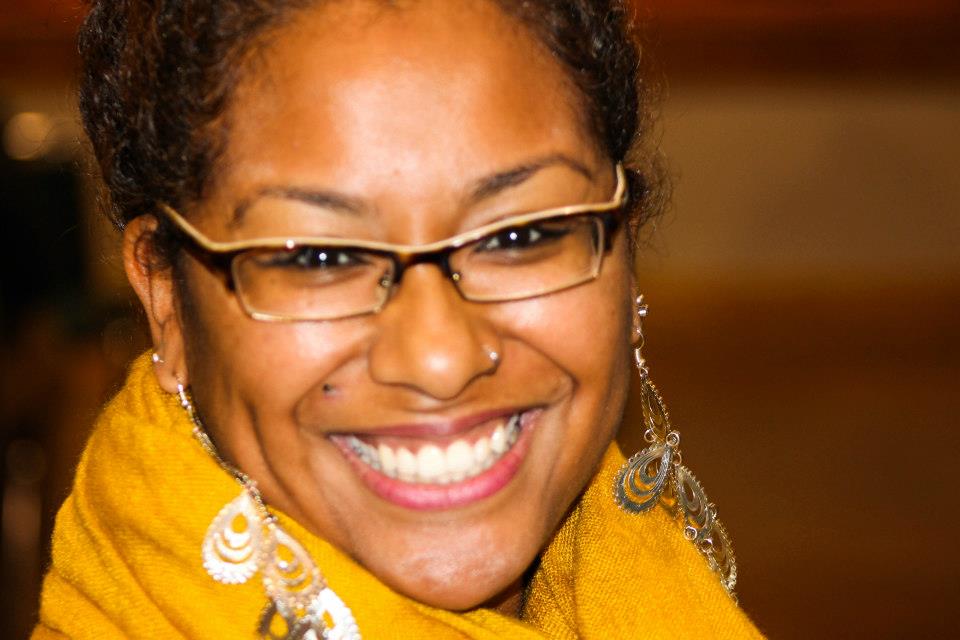
Candice Rose Valenzuela teaches English Literature at Castlemont High School in
East Oakland California, and she has been teaching and organizing inner-city youth for the past eight years. She is currently pursuing a Masters in East-West Psychology at the California Institute for Integral Studies, and desires to bring indigenous healing methodologies into teaching and learning in the inner-city.
Discover more from Feminism and Religion
Subscribe to get the latest posts sent to your email.
 Feminism and Religion
Such a sad situation. I give money to anti-gun causes like Gabby Giffords’ and the Brady campaign. I think all guns should be melted down. That’s partly because I can remember when Dr. King was shot, partly because just about all we hear about on the news these days is kids shooting each other. I hope you find peace at the ocean. Are you going to write about that?
LikeLike
Hi Barbara. I do write about my experience at the ocean. This piece was long so we had to separate it into two parts. I hope you have a chance to read the second part.
LikeLike
It’s hard to thank you for this post, Candice, since the events you describe are so tragic. But I AM glad to have read it. As those of us on this site know, gun violence in the US is out of control because of a small group of gun manufacturers and some born-again 2nd amendment gundamentalists who have control of the NRA. My life coaching client Janet Fitch has been trying to change the conversation around guns from a focus on crime and the “right to bear arms” — what the NRA wants us to think about — to a question of public health prevention. She has produced three award-winning films — “Dear Rita,” “The Promise of America,” and “Changing the Conversation.” Maybe one of these films might bring your school community together. You can learn more about them at http://www.ChangeGunViolence.com.
LikeLike
Blessed are the healers for they will help us to become whole again.
LikeLike