

This was originally posted on June 23, 2021
At first glance the ancient belief that bees were birthed from dead bulls seems odd. But if we delve deeply into pre-historical artifacts we discover the mythopoetic roots of this idea.
Our Paleolithic ancestors lived immersed in nature within the cyclical nature of time. For them the moon, which revealed monthly, yearly and even longer cycles of time, became the symbol of the cycle of birth, death and regeneration.

A 25,000 year old limestone bas-relief – The Venus of Laussel – is the first evidence of a moon goddess found. She holds a bison horn – a wild cousin to cattle – which, with its thirteen vertical strokes on the bison horn, portrays the moon’s growth cycle. Her other hand resting over her womb speaks to the fecundity of woman. This little figure ties together two concepts of importance to our ancestors – that the moon, who is the Goddess, holds the power of regeneration and the moon and the bison are one – revealing an understanding that for life to emerge both feminine and masculine forces are needed.
This merging of feminine and masculine forces is well illustrated in the cave painting named “Venus and the Sorcerer.” Located in the deepest part of the Chauvet-Pont-d’Arc Cave in southeastern France one finds a Goddess figure painted with a pubic triangle at its heart that was at a later date merged with the image of Bison.
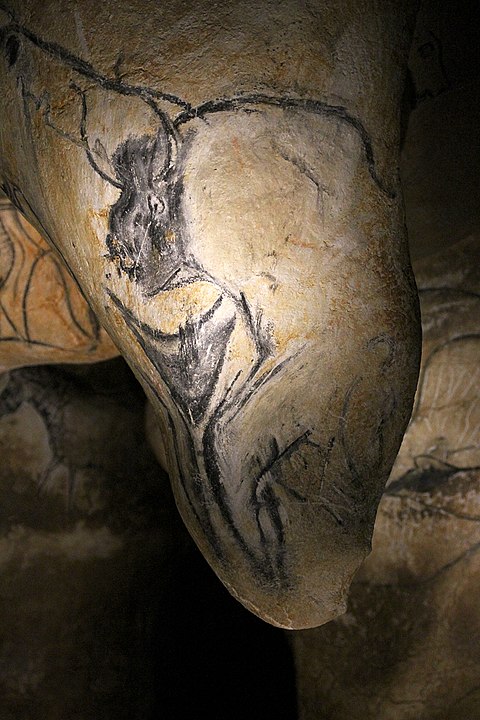
After almost 2 million years as hunters and gatherers, humans left their cave sanctuaries and settled down to till the land, around 12,000 years ago. The Goddess and her bison remained dominant motifs albeit with some changes. Hunters became herders and Bull took the place of Bison in relationship to Goddess.

Clearly the male god’s main manifestation was in the form of a bull – depicted as massive, standing stoutly on short legs and sometimes with a man’s head – the embodiment of masculine fecundity.

Bull, as moon, became part of a group of repeating images that surrounded the Great Goddess who reigned over life, death and renewal. According to Marija Gimbutas these images – crescents, caterpillars and bull’s horns – symbolize the changing moon cycles as “symbols of becoming.” The role of the Goddess is primary to this process with the bull as the essential invigorator, representing both life and death.
Joseph Campbell interprets the bull heads at Çatal Hüyük as symbols of moon’s cycles of death and rebirth through the birthing aspects of Goddess – the dust from which we come and to which we return.
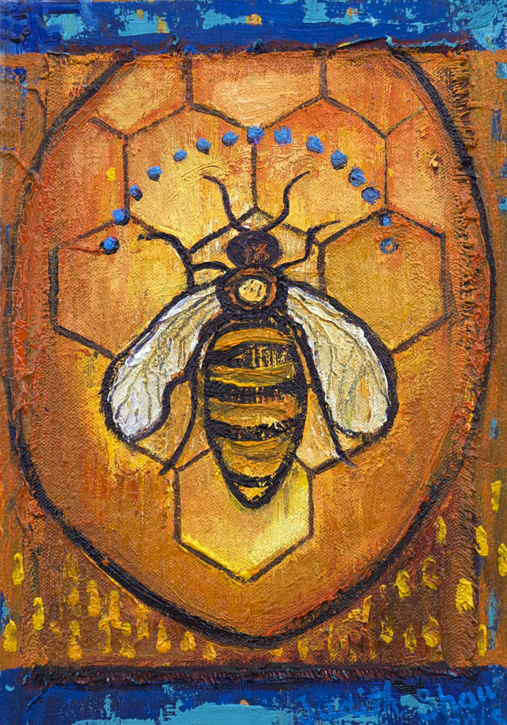
Gimbutas further postulates that the myriad of bull horn iconography represents the sacrificed bull’s body from which new life emerges. She states, “The Great Goddess… emerges from the dead bull in the shape of a bee or a butterfly” – both ancient symbols of transformation. She suggests the similarity between Bee’s antennae and Bull’s horns furthered this association.

A stylized bone bull’s head from the the 4th millennium BC, found in current day northwestern Ukraine, is incised with a bull-horned goddess in the shape of a bee. (Gimbutas, Old Europe, 188)
Bull horns as a lunar symbol expressed the sacredness of Bull. Hundreds of horned stands, pre-dating the Minoan Horns of Consecration, have been found with central holes, most likely for the insertion of a representation of the Goddess. She emerges out of the sacrificed bull.
The Minoans are famous for their Bee Goddess and their many uses of Bull symbology in their art and games. In addition to portraying bulls as complete figures and bull heads and horns, the Horns of Consecration were numerous, both in iconography and architecture. The Horns of Consecration found at Knossos perfectly frame the mountain, Jukta, at whose peak is an entrance to a deep cave. Since our beginnings the cave has been the symbol of creation – called the womb of Mother Earth. Sacrificed Bull points to Goddess in her life giving aspect.
Minoan bull heads and horns are often portrayed together with either butterfly in the form of the the double ax or with bees – both epiphanies of the Goddess.

An Onyx gem from Knossos (c. 1500 BC) portrays the Bee Goddess with Bull’s horns above her head and topped by the butterfly/double-ax.
A Bull’s head flanks the Bee Goddess found on the famous Boeotian amphora from 700 BC. Gimbutas suggests the here she is “the Goddess of Periodic Regeneration ….. The loose bull’s head is that of a sacrificed bull. The bull is dead and new life begins.”

Worship of the Apis Bull as a major source of fertility began in Neolithic Egypt, including the belief that Bees were born from Bulls. It was said that the sacrifice of an Apis Bull could produce 1000 bees and that these bees were human souls reborn.
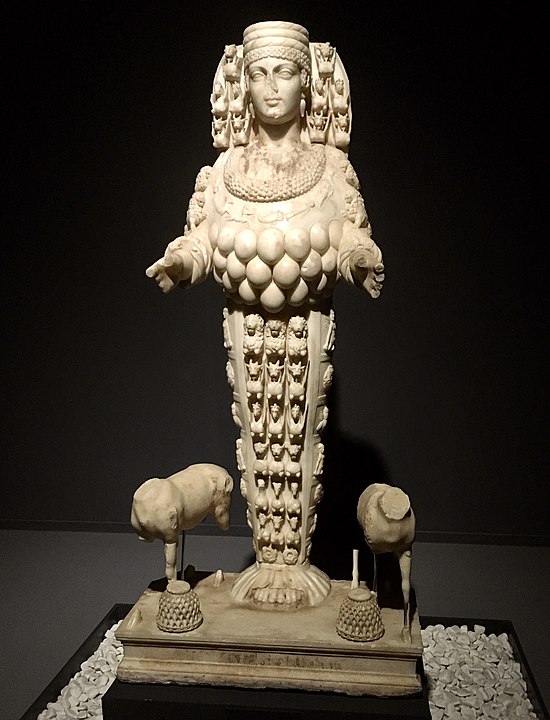
Artemis was a popular goddess, revered throughout the ancient world. The famous statue of her from Ephesus, located in present day Turkey, reveals her role as a Goddess of Fertility by the spherical objects that cover the lower part of her chest. Commonly assumed to be breasts, it is more likely they represent Bull testicles or possibly bee eggs, since Queen Bee can lay tens of thousands of eggs during her life. Perhaps in the minds of the ancients it was not a case of either/or but one of both/and, expressing again the connection between Bull, Bee and the Goddess of Regeneration.
One of the earliest written records of the belief that bees are birthed from bull comes from Antigonos of Karystos, around 250 BC – “In Egypt if you bury the ox in certain places, so that only his horns project above the ground and then saw them off, they say that bees fly out; for the ox putrefies and is resolved into bees.” (Marija Gimbutas, Old Europe, 181)
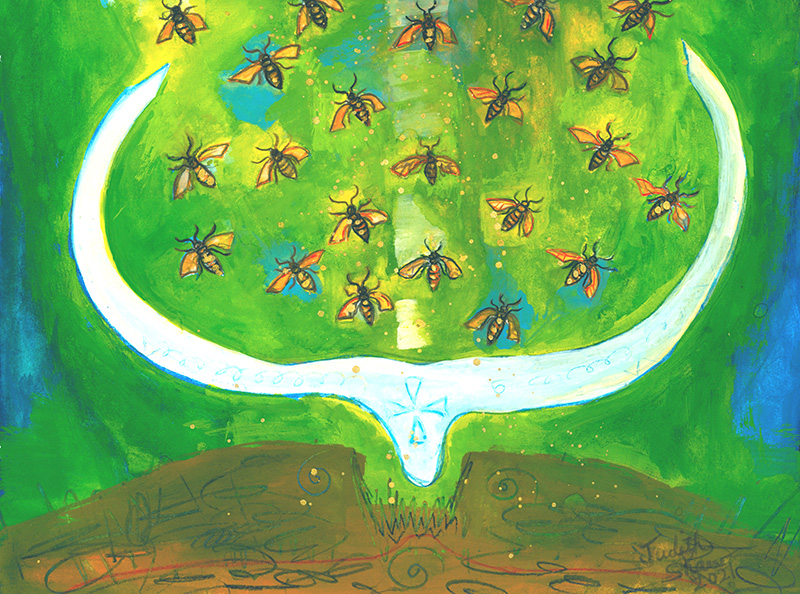
In Greek myth, Aristaeus, God of Bee-Keeping, wept because all his bees had died. The magician, Proteus, told him to slaughter a bull and bees would emerge from its decaying carcass. Ovid said ‘the death of one produced a thousand lives’ (Gimbutas, Old Europe, 181)
Dionysus, Greek God of Ritual Madness, Ecstasy and Wine was called the Bull God. One tale recounts that he was fed honey as an infant by Makris, daughter of Aristaeus. Another story says that he transformed into a bull before being torn to pieces and reborn as Bee.
Through the death of the sacrificed bull, Goddess in her bee form arises. Perhaps this is the origins of the ancient belief in the year god, who marries the Goddess and in the following spring experiences sacrificial death thus fertilizing Earth – perpetuating the ongoing cycle of life, death and rebirth.

At first glance our modern minds view Bull as a masculine symbol, complete unto itself, with an emphasis on its stubborn, aggressive qualities. Yet the wisdom of our ancient ancestors shows a different understanding – one that understood the cyclical nature of existence – that understood the connection between all beings and an acknowledgement of the complimentary aspects of the duality of manifest life. With Bull’s sacrifice, regeneration through the birthing aspect of Goddess occurs. With the epiphany of Goddess as Bee, she transforms the souls of her human children back into physical manifestation and the cycle continues.
Sources: The Goddesses and Gods of Old Europe by Marija Gimbutas, The Goddess and the Bull by Helen Benigni, Furman University – Scholar Exchange, The Bradshaw Foundation

Judith’s deck of Celtic Goddess Oracle Cards is available now. You can order your deck from Judith’s website – click here. Experience the wisdom of the Celtic Goddesses!
Discover more from Feminism and Religion
Subscribe to get the latest posts sent to your email.

 Feminism and Religion
A wonderfully rich gem from the archives, wishing you all a day full of bee and bull inspiration!
LikeLiked by 1 person