

This is part 1 of a two part posing. Part 2 will be posted tomorrow.
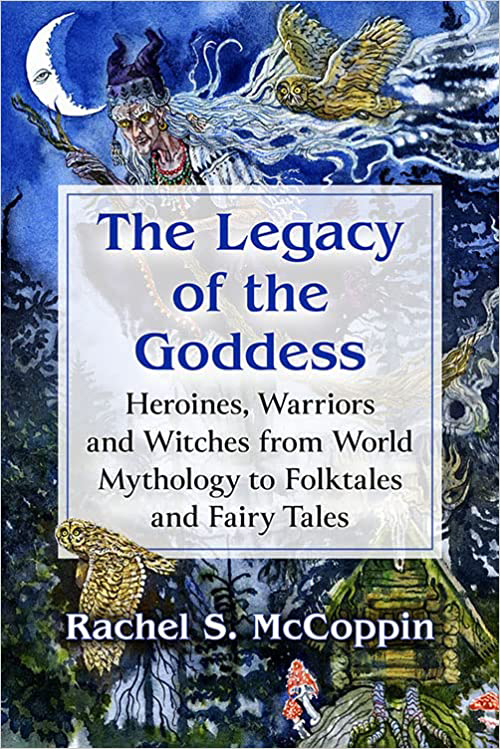
In this blog post, I would like to take the opportunity to discuss my new book, entitled: The Legacy of the Goddess: Heroines, Warriors and Witches from World Mythology to Folktales and Fairy Tales. This book argues that hundreds of folktales and fairy tales from around the world have preserved elements related to goddess worship from the sacred myths of many ancient civilizations.
Powerful goddesses were worshipped in most global cultures for centuries, until, in many regions, episodes of diffusion, conquest, colonialism, etc. caused the worship of these goddesses to be revised, lessened, or in some cases eliminated. To “preserve at least part of the reverence of goddesses, as well as the memory of the powerful religious and social roles women once held as representatives of goddesses”, hundreds of folktales and fairy tales were created, “told, and retold, most often by women storytellers” to impart goddess ideology (McCoppin, 2023, p. 5). Thus, many folktales and fairy tales portray myriad examples of powerful female characters who portray important messages connected to the goddesses and sacred women of ancient mythology.
The first half of The Legacy of the Goddess examines the female characters within folktales and fairy tales who serve as guides and teachers to the male protagonists they encounter. In mythology, the heroic journey is often a male enterprise. There are myriad world myths that show male heroes as active, brave, and strong, but mythic heroines are few and far between. However, many “global myths that do not showcase a female character as the heroine of the myth still repeatedly portray powerful female goddesses or sacred women as helping, or guiding and teaching, male heroes every step of their journeys. This trend continues in folktales and fairy tales as countless female characters are presented as animal brides, wise old women, prized maidens, ferocious monsters, etc., in order to guide and educate male protagonists through their heroic journeys” (McCoppin, p. 7).
Chapter 1 of The Legacy of the Goddess, entitled “Mother Nature, Animal Brides, and Mistresses of Animals,” “examines how female characters in many global folktales and fairy tales appear in ways quite similar to mythic representations of Earth Mothers, who are portrayed as representations of the earth itself, such as the German Frau Holle who can transform the weather at will. This first chapter of this book also looks to the myriad animal bride tales from around the world that portray women in animalistic forms who marry men in order to teach them about the ways of the environment. Finally, this chapter examines other folktale and fairy tale women who appear similar to mythic portrayals of Mistresses of Animals, whose goddess-like command of the animal kingdom also serves to teach the males they encounter about the laws of the natural world” (McCoppin, p. 8).
Chapter 2 of this book, entitled “Wise Old Women,” “focuses on the many folktales and fairy tales from around the world that portray old women as wise helpers. These old women characters often live outside of the confines of the community; therefore, they serve as exemplars of female independence to the characters who encounter them. The wisdom held by these old women, which often reflects messages carried forth by goddesses in many ancient myths, plays a central role in educating the male folktale and fairy tale heroes who encounter them” (McCoppin, p.8-9).
Chapter 3, “Maidens and Otherworldly Women,” “portrays the archetypal maiden of many folktales and fairy tales who often appears as merely a prize for a male hero, but when these maidens are examined more closely, one can see that their purpose in the narrative is to educate male heroes about tenets associated with many mythic goddesses. This chapter also shows that using otherworldly women, who reside in fantastical realms full of vitality and abundance, is a common element found in mythology, and in folktales and fairy tales, to signal goddess qualities to male heroes” (McCoppin, p. 9).
Available to purchase on Amazon or McFarland Publishing.

BIO: Rachel McCoppin, Ph.D. is a Professor of literature at the University of Minnesota Crookston. She has published the books: The Legacy of the Goddess: Heroines, Warriors and Witches from World Mythology to Folktales and Fairy Tales (MacFarland 2023), Goddess Lost: How the Downfall of Female Deities Degraded Women’s Status in World Cultures (McFarland 2023), The Ecological Heroes of Amerindian Mythology (Kendall-Hunt 2019), The Lessons of Nature in Mythology (McFarland 2015), and The Hero’s Journey and the Cycles of Nature (McFarland 2016). She has also published many scholarly articles in the areas of mythology and comparative literature. Her work has appeared in journals including: Symbiosis, Studies in American Humor, Studies in the Novel, World Literary Review, etc.and in many scholarly books published by Palgrave Macmillan, McFarland, Atlantic, Greenwood Press, etc.
Discover more from Feminism and Religion
Subscribe to get the latest posts sent to your email.
 Feminism and Religion
I have always been interested in these tales because I do see some women as embodiments of the Mistress of the Animals etc – I am one of them. Living close to nature allows for wondrous surprises. That the Wild Goddess lives is highlighted by the Greening in the northern hemisphere…. yesterday I found a ‘fairy ring’ – many mushrooms (60) species can produce these circles but my guess is that originally they were a manifestation of the Goddess in the wild…
LikeLike
Greetings,
need to consider the curses.
what about curses during creation?e.g.
Genesis 3:14-19
King James Version
14 And the Lord God said unto the serpent, Because thou hast done this, thou art cursed above all cattle, and above every beast of the field; upon thy belly shalt thou go, and dust shalt thou eat all the days of thy life:
15 And I will put enmity between thee and the woman, and between thy seed and her seed; it shall bruise thy head, and thou shalt bruise his heel.
16 Unto the woman he said, I will greatly multiply thy sorrow and thy conception; in sorrow thou shalt bring forth children; and thy desire shall be to thy husband, and he shall rule over thee.
17 And unto Adam he said, Because thou hast hearkened unto the voice of thy wife, and hast eaten of the tree, of which I commanded thee, saying, Thou shalt not eat of it: cursed is the ground for thy sake; in sorrow shalt thou eat of it all the days of thy life;
18 Thorns also and thistles shall it bring forth to thee; and thou shalt eat the herb of the field;
19 In the sweat of thy face shalt thou eat bread, till thou return unto the ground; for out of it wast thou taken: for dust thou art, and unto dust shalt thou return.
regards,mkyogi
LikeLike