

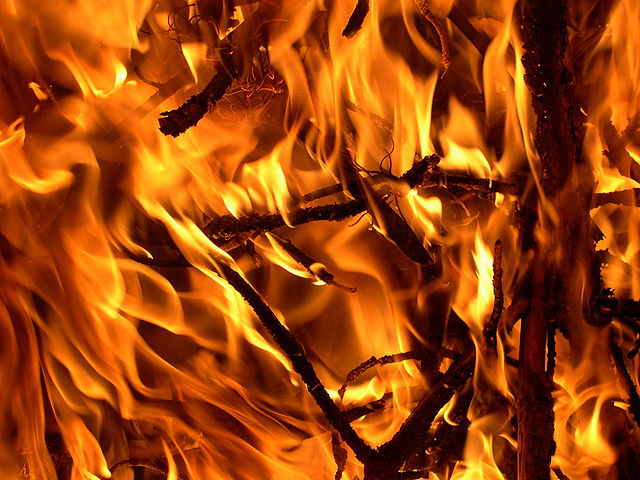
The nature and meaning of fire have been appearing in several disparate aspects of my life lately – in the fire of Celtic spring rituals; in books I’ve been reading[i]; in the fireflies of summer nights and the fireworks of the 4th of July; even as a clue in a game; and most ubiquitous of all – the smoke from Canadian wildfires. So persistent a theme begs pondering. It first appeared in a Rewilding course as the sacred element of spring in the Celtic wheel of the year. Spring is the time of new beginnings, of the sunrise – the element of fire in the sacred direction of east, of the fires of passion and creativity, and the celebration of Beltane.
As I was studying the meanings of fire, fires burning in Canada were smothering the Northeast of the US in smoke. As the smoke reached as far south as Washington, D.C., it seemed that for the first time, people in seats of power in the market, the media, and government thought more seriously about climate change. Ecotheologian Mary DeJong asks, what happens when there is too much fire? We are seeing this now. As the earth heats up, fire it seems will become a persistent aspect of summer in the north.
I’ve thought often of something Janine Benyus wrote in her book, Biomimicry: “For my money, the discovery of fire, as ballyhooed as it was, was vastly overrated. Fire was fine for a while – it kept us warm and cooked our meat. The problem is, we’ve never gone beyond fire. . . . It hasn’t brought us one inch closer to living sustainably. Instead, torching old fuels has led to rising carbon dioxide levels; calving Antarctica icebergs, swelling ocean levels, and the hottest decade on record.”[ii] Surely we need to find other ways to power our lives that do not involve fire, or we shall burn ourselves into oblivion.
DeJong recalls the story of Prometheus, who stole fire from the gods to give to humanity. She says that his act ignited the spark of human autonomy, the longing to seek the divine spark, to attempt to become divine. After World War II, Albert Camus wrote of “the men of Europe,” “ . . . they deified themselves and their misfortunes began; these gods have had their eyes put out.”[iii] It seems we have done that with fire, assuming ourselves gods, acting as if we could keep burning fossil fuels without care for the consequences when the gods of profit burn brighter than care for each other and the earth, as if fire was within our control. But as DeJong notes, fire has a life of its own, defying boundaries, consuming everything in its path. And so our misfortunes began.
But this, as De Jong notes, is just the shadow side of fire. Fire can also be inviting, welcoming, warming. It is the hearth – the centerpiece of home. In the game we were playing, “Wavelength,” “fire in a fireplace” was the clue given for something midway between ordinary and extraordinary. We debated the ordinariness and extraordinariness of fire for some time, for it is a bit of both. In the way we light fires for cooking, warmth, and ambience, fire contained within a fireplace is quite an ordinary thing; but fire is also quite extraordinary in the dance of the flames, in the way it transforms the energy contained in the wood into heat and light, in the way it can mesmerize. Sitting around campfires, we sing, tell stories, share in the glow. The fire brings us together, gives us feelings of protection, harmony, and communion. We no longer feel alone. Fire is quite extraordinary in this regard.
When the hearings about the proposed construction of Line 3 in Minnesota began, one of my tasks was regularly to bring wood, food, and supplies to the woman keeping the sacred fire going –fire as prayer, as ceremony to prevent the construction of the pipelines that would bring more fossil fuels to be burned from the tar sands of Alberta to the oil refineries in Superior, Wisconsin. Fire as profit for the destruction of the earth; fire as prayer for protection of the earth.
Among the Anishinaabe, the indigenous peoples on whose land I dwell, this is the time of the Seventh Fire. During this time, we will have choice between two paths. The one path is green and lush; the other black and charred. If we choose the right path, the Seventh Fire will light the Eighth and final fire of peace, love, and harmony. What path will we choose? Will we heed Camus’s wisdom when he wrote, “The only original rule of life today: to learn to live and to die, and, . . . to refuse to be a god. . . . the earth remains our first and our last love. . . . It is time to forsake our age and its adolescent furies.”[iv] Will we mature in time?
As the fires continue to rage across North America, commentators say we must learn to adapt to living indoors — as if the only beings affected by these fires are wealthy humans who live off plastic food, filtered water, and purified air. Rather, it seems the lesson of the fires is that we need to adapt to living without fossil fuels, to consuming less, to living simply so that all may live.
During our recent vacation in northern Michigan, we were forced inside due to the thickness of the smoke from the Canadian wildfires. The day after the smoke cleared and we were once again able to go outside, as the sun came out and shone on the clear waters, I rocked my infant grandson in the old hammock by the lake, singing, “If I had a day that I could give you, I’d give to you, a day just like today.”[v] I was teary thinking of his future if we continue this way. May we learn the lesson of fire and choose the right path — to live so that every day of the years ahead may be a day with air as clear as that day.
Sources
Benyus, Janine M. 1997. Biomimicry: Innovation Inspired by Nature. New York: William Morrow.
Camus, Albert. 1956. The Rebel: An Essay on Man in Revolt. With a foreword by Sir Herbert Read. Trans. Anthony Bower. New York: Vintage.
DeJong, Mary. “Wild Spring: Your Seasonal Journey.” Rewilding. Waymarkers.
Gyasi, Yaa. 2016. Homegoing. New York: Vintage.
Winn, Raynor. 2022. Landlines. UK: Penguin Michael Joseph.
[i] Raynor Winn’s Landlines where she finds the peatlands of Scotland scorched, and Yaa Gyasi’s Homegoing where fire is both threatening and freeing.
[ii] Benyus, Biomimicry, 61.
[iii] Camus, The Rebel, 305.
[iv] Ibid., 306.
[v] John Denver, “Sunshine on My Shoulders.”
Discover more from Feminism and Religion
Subscribe to get the latest posts sent to your email.

 Feminism and Religion
THANK YOU FOR THIS POST. WITH 60 PERCENT OF US UNDER THREAT OF FIRE AND FLOOD WE NEED TO PRIORITIZE EARTH NOW…. WE ARE BURNING UP THE TREES WE NEED TO BREATHE… BUT BY FAR THE WORST THREAT COMES FROM INCREASINGLY UNBREATHABLE AIR
LikeLiked by 1 person
A wonderful and very timely post as the Northeast is once again about to be smothered in smoke. Another aspect of fire is that, used properly as Indigenous forest management does, it is an essential part of maintaining healthy forests and preventing the kinds of wildfires we see now. But to respond by telling people to start living their lives indoors just shows not only the desperation of those who do not want to change our consumption of fossil fuels but also that they clearly do not realize that only a small fraction of the human population has that option. I was struck by the Anishinaabe vision of two paths, one of beauty and sustainability and the other of utter destruction. What is frustrating to me is that if you presented these two visions to the vast majority of people, they would choose lush and green, I think even if they realized it would mean a change in their lives (though, again, for much of the world that does not use a lot of fossil fuels, it would be a smaller change), but still the movement towards destruction goes on. But, posts like yours that point out these two paths can make a difference, so thank you so much for it!
LikeLiked by 2 people
I appreciate your comments, Carolyn. I’m sorry you’re about to smothered in smoke again. We’ve had a lot here in Minnesota this summer, mostly from Alberta and Manitoba.
An indigenous friend of mine is working to educate settlers about indigenous techniques of using fire to prevent massive wildfires. We settlers have so much to learn.
Yes, we need to follow a different path, the lush and green path, but so few are willing to change their fossil fueled lives. I once heard Joan Chittister say that Americans are addicted to comfort. I would add consumption. It’s a dangerous path — one I hope there is still time to change.
LikeLiked by 1 person
we are addicted to comfort but its worse than that – the govt has a huge investment in keeping fossil fuels
LikeLike
So true.
LikeLiked by 1 person
While Southern Europe is also experiencing boiling temperatures and fires, we in the UK have been comfortable at 20 degrees centigrade in July, with a fair bit of rain. However, what we often have is extensive flooding in the colder months. We have unbalanced the elements globally with our greed, lack of care, separation, and materialism, yet we are pursuing artificial intelligence whilst the organic disintegrates around us. Aware people must keep putting out this message and fighting for change in whatever way is right for them.
LikeLiked by 1 person