

This has been an unusual summer. I can still listen to a roaring brook as I fall asleep at night. The flooding has been intense. The humidity is hardest to bare; I am grateful my cellar is finally free of water if not drying out. Our overall weather pattern remains the same; thundershowers almost every day; many clouds and thick morning fog. And tropical hurricane season is underway.
I am grateful for the moss and tall grasses that still glow lemony- lime emerald and sage green. My frog pond is empty except for snails; all the tadpoles have matured into tiny froglets that have disappeared into the dense foliage I have provided for them; ferns and anemones tower over others. A large toad only shows himself/herself mostly at night when he hunts from the water dish I leave for him. Wild bee balm spikes are in bloom providing bees and hummingbirds with enough food for now. Some bee balm are ragged around the edges but the rain has brought in a second blooming cycle. My magic bean, the one I planted in March (in the house) has masses of deep orange flowers just outside my window. Grape leaves are climbing over the ground and visiting with the bean vine.
The crabapples are bowed with unripe fruits. Wild cherries too. The winter wren is often silent, though cardinal greets me every pre-dawn morning as I set out to walk in the dark. Yellowthroat and Indigo Bunting serenade me seconds after I reach the top of the hill to cross an empty road to escape into a nearby field. These precious two hours are my time with the birds. With persistent road pollution (human induced noise) in the background unless I am indoors or down by the brook the clear voices of these tree lovers are dimmed. Three to four miles and I am ready to return to the house; by then the sun has risen.
My flowers have reached peak and are fading as they must. I feel this loss keenly much like I do when the froglets leave, and yet, there is a part of me that readying for the yearly mowing that will clear the hilly ground around the house, and I will once again be walking down and through my field to star gaze. Just now I am only a viewer from an edge place situated above the meadow. The goldenrod and wild asters are steepled over my head, having taken advantage of an abundance of water. Of course, the field is buzzing with bees; butterflies flutter through what’s left of the milkweed landing here and there for a moment or two. Fritillaries yes, but I have yet to see a monarch. The crabapples are bent low with fruit.
This last full moon was stunning, the air crisp and clear, the temperatures two days afterwards still in the 40’s at dawn, but no doubt this is the influence of the full moon lingering on… S/ he always heralds temporary weather changes.
This has been a summer where instead of spending time at Refuge, while researching in the woods I have stayed close to home. As this month passes if the rain doesn’t return in sheets I will once again be visiting my favorite forests. And Staying at Refuge. But I have put that decision (and myself) in Nature’s hands.
Keeping a close eye on air quality, cultivating resilience, and becoming flexible around abrupt weather shifts have been my three priorities this summer. Keeping enough humidity out of the house has been the fourth. I have never been so aware of my dependence upon electricity to keep temperatures stable for my little dog Lucy who cannot deal with weather extremes because of her heart. So far, we have managed well; for that I am deeply grateful.
Fortunately, I have some forests nearby that I can visit although some of these are four-wheeler vehicle friendly, and as a result of misuse and lack of caring about the forest except to use for recreation these machine trails are deeply rutted. It’s disturbing to see that so much erosion has occurred, but then, I see man made catastrophes anywhere I go. One reason I am so attached to home. No damage here except what Nature decrees.
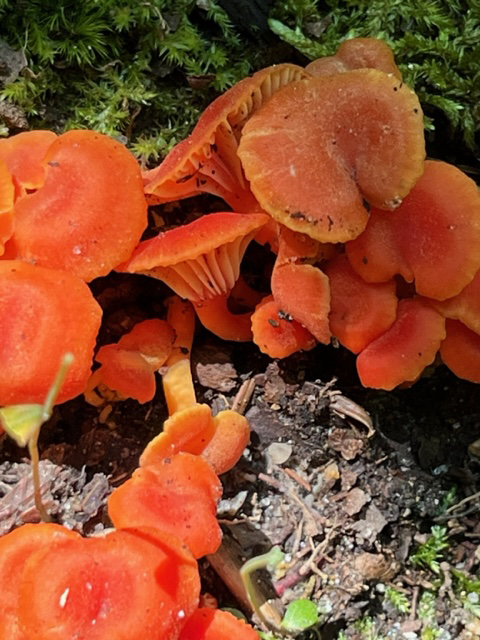
Yesterday on a walk through mountain woods I noted four families of mushrooms. The colors – bittersweet or sunset orange, buttery yellow, some almost scarlet. Others pure white. Whorled wood asters were not yet in bloom although club mosses seem to have spread. This land hasn’t been logged for a while (20 years maybe) so it is showing signs of slow recovery off trail. Moss and lichened stumps abound. The hermit thrush’s tremolo delighted me though I never saw the bird. Not a toad in sight. These last years of drought have taken a toll on all amphibians, who cannot reproduce without spring pools and weather that is not too extreme. This year I brought my (wood frog – an indicator species) tadpoles indoors until after they hatched, keeping them safe from the cold.
The light is changing, the sun sits lower on the horizon, creeping through my windows for the first time in a couple of months. One more month until Autumn’s light is gilded, emanating a golden glow. As the days grow shorter, I sleep more deeply. The darkness is my friend, just as it is for the fireflies that graced my land during the month of July.
I discovered a beech tree that is infected by a new disease. Beech leaf Disease (BLD) kills beech and was only spotted in Maine a few years ago. From what little I have learned from researching it is important not to cut these trees down until they go dormant to help the disease from spreading. Like so many of our other trees that are diseased there is little one can do.
Living with ongoing loss/unwelcome change is probably the most challenging aspect of being a naturalist. I am constantly walking a knife edge – I refuse to allow the chasm to take me. Hope as Richard Powers states ‘is a willingness to engage with the future’. Otherwise, hope remains a form of sentimental wishful thinking or an abstract ideal, one without grounding in what’s real.
It’s not as if western culture (especially the US) is about to surrender its need for power, greed, and avarice on either a personal or governmental level. In this country our military spending has reached impossible levels, and there’s a good reason for that. We need more wars to keep capitalism and racism alive. Without fossil fuels our power would diminish. If the reader has doubts, I suggest reading “The Nutmeg’s Curse.” The US is heavily invested in keeping the status quo intact; we are the richest country and the one that emerged from the blood of Indigenous People who loved and lived in harmony with the earth. There are some Native people who warn Americans that “our past will become your future”. Values of honesty, integrity, decency, compassion, community are for the most part, dead. Community in our country reflects ideological tribalism. Us and them.
Of course, there are small groups of us who are dedicated to working on behalf of the earth, but we are without the power or the necessary resources to shift the bigger picture. I really struggle with being part of this geo -political problem. I am putting in an electrical heating system and buying into community solar, which is already carbon neutral and plans to be free of fossil fuels by 2030. Yet there is an insistent voice within me that cries out – ‘what good will it do unless everyone follows suit.’ I cannot answer that question, but I can and do own that doing anything to lessen my dependence on wood or fossil fuels feels like a step towards a freedom that may or may not materialize. So many countries are without resources, with people starving… The extremes of climate change are intensifying every day, whether we choose to acknowledge these changes or not. Even denial breaks down here with catastrophic fires, floods, and disintegrating air quality.
My only defense is my ability to keep myself rooted in the present, and this is less of a challenge this time of year because as long as the weather permits, I can engage with nature on an intimate level, and as soon as I do, I lose myself. Nature is a perpetual source of wonder. And after every personal conversation (conducted beneath words) I return to myself so full of questions that it would take another lifetime to research and write about the latter.
Blessed Be.
Discover more from Feminism and Religion
Subscribe to get the latest posts sent to your email.

 Feminism and Religion
I think the only viable answer is fewer humans, although the time it would take for that to actually help is prbably too long. A few glimmers of hope: people having fewer children because they are too expensive to raise, the increase in castrated trans folks (many of whom will be infertile), and pandemics.
LikeLike