

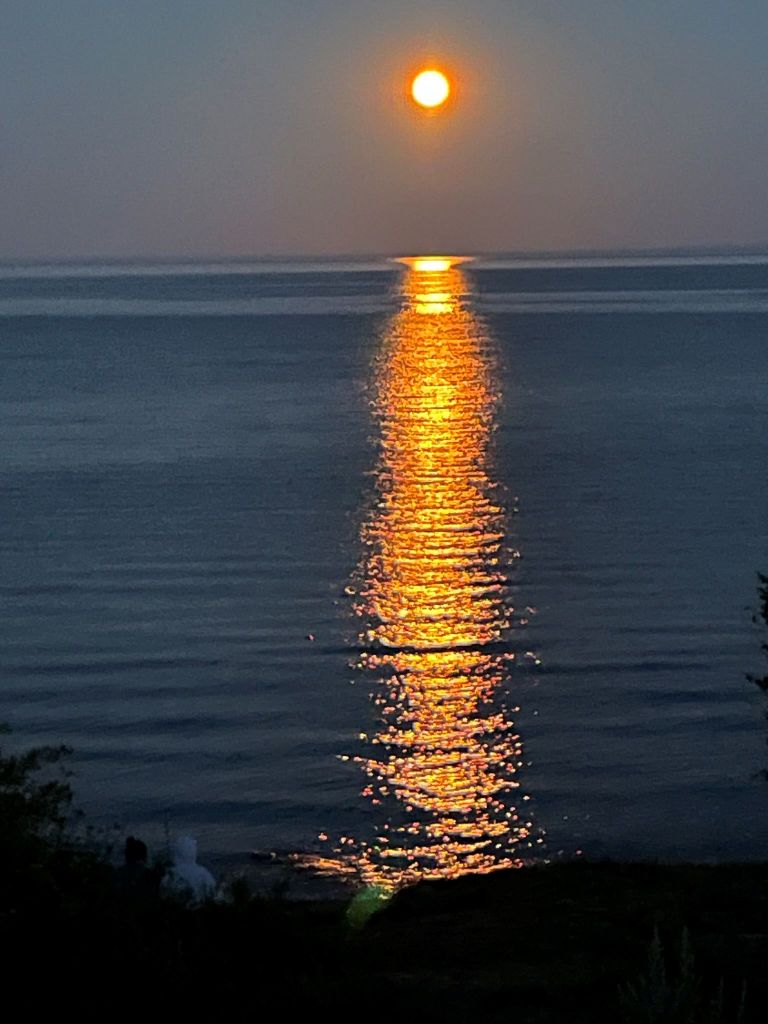
You’d have thought it was the 4th of July the way people were gathering on the shore of the great lake, Gitchee Gumee – some with coolers and lawn chairs, kids and dogs in tow, each claiming their spot — waiting for the viewing as if waiting for the fireworks. But what we awaited was far more spectacular – the “once in a very blue moon,”[i] the second full moon in a calendar month, but also a “super moon” – so named because at this time when it is closest to the earth in its orbit it appears larger than usual. Super moons happen a few times a year and blue moons happen every two to three years, but super blue moons are rare. This one was probably the last in my lifetime since the next one will occur fourteen years from now in 2037.
My husband, dog, and our son’s dog, aptly named Luna, made our way to the lake, finding our spot on the ancient rocks, joining the other moon gazers. A feeling of community celebration arose with the moon as we strangers to each other together watched the first light of rising moon with shared anticipation and appreciation. The “blue moon” in fact appeared red as it came up through the hazy atmosphere, but as it rose higher in the sky, just as in the lyrics to the song, “Blue Moon,” the moon turned to gold, casting its golden glow across the waters. As it rose, it seemed to grow even larger, rounder, brighter.
I imagined people up and down the shore of this great lake were gathering to watch the super blue moon rise, and people all over the country, and perhaps the world, doing the same. Whenever I found myself getting homesick during the time I lived in England, I’d look up at the moon and know that the same moon was shining on the people I loved back home. The moon connects us all. Indeed, now, a few days later, friends from all over are posting photos of this magnificent sight. Roxanne Ornelas, one of the Lake Superior Nibi walkers[ii] who have been circumnavigating the lake the entire month of August to honor it and pray for the its health, posted this: “Last night several of we water walkers went to the shore of Lake Superior for a full moon ceremony. We watched as the moon first appeared in the far-off distance as a glimmer on the water. We were all struck speechless and stood still in awe of the vision before us. We watched in silence as the moon slowly rose and spread Her glorious light onto the water.”[iii]
Her glorious light. “The moon is always female,” wrote poet Marge Piercy. The connection of women and the moon is strong. As Robin Wall Kimmerer says in relating “The Words That Come Before Else,” “We put our minds together and give thanks to our oldest Grandmother, the Moon, who lights the nighttime sky. She is the leader of women all over the world. . . . “[iv] In cultures around the world, the moon has been celebrated as grandmother, mother, goddess, and protector of women – the Greek Artemis, the Dinka Abuk, the Zulu iNyang, the Celtic Cerridwen, the Chinese Chang’e, the Aztec Coyolxauhqu, the Roman Luna, the Thracian Bendis, to name just a few. Women around the world celebrate the moon in full moon ceremonies and new moon ceremonies. The stages of women’s lives – maiden, mother, and crone – have also been linked to the stages of the moon – waxing, full, and waning. The moon has long been associated with the female and femininity due to the strong correlation between the lunar cycles and women’s menstrual cycles – hence the common root, mensis, for our words for “month,” “moon,” and “menstruation,” the last known among the indigenous peoples of North America as “moon time.” Is this concurrence of women’s cycles and the moon’s cycles really just coincidence? It is a striking association – the pull of the moon on the waters of the world, on the wombs of women. Is it any wonder women have long felt so connected to the moon?
I have wondered — do men feel the same connection to the moon? Do bi and trans folk? I have felt that connection so keenly, especially when my cycles and the moon’s were so in sync, but still now in my waning phase. It feels much more a spiritual connection than a purely physical one. I have made pacts with the moon, sought her wisdom, felt her blessing and her protection.
The moon protects us all. Without the moon’s gravitational pull, which keeps the earth’s axis at a steady 23.4 °, the earth would lose its balance. It would wobble, sometimes pointing straight up and down, eliminating the seasons, and sometimes lying on its side, making the poles extremely hot and the equator freezing cold. Most of what we know of life on earth — plants, animals, seasons, ocean tides, human existence — would have not been possible without this bit of earth, split off from us billions of years ago, that we know as the moon.

How different life on this planet would be without the moon — its rhythms, its welcomed light on a winter’s night, its friendly face smiling down upon us when full and its crescent enchanting us when it has just begun or is soon to leave. On the night of the super blue moon we gathered in awe and in reverent gratitude for this celestial orb that reflects the sun back to us when the daylight has dimmed, governs our oceans and tides, inspires celebration and song, prevents us from gyrating wildly through our orbit around the sun, and ironically, keeps us grounded. What Roxanne Ornelas said of the Nibi walkers was true of all of us who were drawn that night to watch the moon rise — “We were all struck speechless and stood still in awe.” While some have raced to the moon in “conquest”[v] of yet another female body, I’m content to be among the many moon worshippers who regard her with awe from afar.
References
Braun, Werner von. 1953. Conquest of the Moon. New York: Viking Press.
How does the Moon affect the Earth? | Institute of Physics (iop.org)
Kimmerer, Robin Wall. 2013. Braiding Sweetgrass: Indigenous Wisdom, Scientific Knowledge, and the Teachings of Plants. Minneapolis: Milkweed Press.
Piercy, Marge. 1981. The Moon Is Always Female. New York: Alfred A. Knopf.
The Origin of the Moon (timeanddate.com)
[i] “Once In a Very Blue Moon,” Gene Levine and Pat Alger, first introduced by Nanci Griffith on her album Once In A Very Blue Moon, 1985. Among the Anishinaabe, the indigenous peoples of the land on which I dwell, who base their calendar on the thirteen moons of a year, the blue moon would not exist. Instead, each moon is named for the phenological changes of that time — the sugarbush moon, the strawberry moon, the falling leaves moon. What those of us who use the Gregorian calendar know as ust is for the Anishinaabe Manoominii Giizhis, or ricing moon. It is the time of harvesting manoomin, wild rice, the grain that is the center of the Anishinaabe story of migration – to travel to the place where the food grows on the water – and the heart of their cultural and spiritual traditions.
[ii] The Nibi (Water) Walks, founded by Sharon Day, are Indigenous-led ceremonies to pray for the water. As they say, every step is in prayer and gratitude for water, our life-giving force. For more information visit www.nibiwalk.org. The Lake Superior Nibi Walk began in Cedar, Wisconsin on August 1st of this year. The walkers walked thirty to forty miles a day around the great lake, completing their walk on September 3rd.
[iii] (20+) Lake Superior Nibi Walk | Facebook
[iv] Braiding Sweetgrass, 113.
[v] This was the term use by rocket scientist Werner von Braun in his 1953 book, Conquest of the Moon. Many others have used the term since.
Discover more from Feminism and Religion
Subscribe to get the latest posts sent to your email.

 Feminism and Religion
Wonderful.
LikeLike
Beautiful! I was also on a lake at the time of the Super Blue Moon and people all around the lake were also watching, both in the evening and then again at sunrise as the moon slipped away. In the morning the sky was pink and if we could post photos in comments, I would post my picture here! What a gift to have this moment of grace and awe in the midst of such a tragic and challenging time to remember the magnificence of our planet and moon.
LikeLiked by 1 person
Thank you for this. I had the sense that people all over were watching. We are in need of grace and awe right now.
LikeLike
I’ll never look at mother moon the same way again. Thanks & Peace.
LikeLiked by 1 person
Thank you, Beth, I was watching from the balcony of my apartment on the coast of South Wales. I took my last photo in the very early hours of the next morning, and though there are differences in time zones, I am sure those gold, silver, and finally those exquisite pearl threads of light connected us all.
LikeLiked by 1 person
Hello, Iona. I loved your piece on the Super Moon posted two days before mine. I also love Wales and can well imagine what the moon looked like over the sea there. The connections are strong.
LikeLike
Beautiful just beautiful. I also enjoy watching and honoring the moon as well. Thank you for sharing.
LikeLiked by 2 people