

Thanksgiving is a complicated holiday. As a child, it was simple – a happy day of family and feasting. I would awake at dawn to help my mother stuff the turkey that would roast all day in the oven, and while she prepared all the rest of the meal, the younger of my brothers and I would head downtown with my nextdoor neighbor to delight in the Christmas displays in the department store windows. Our home would be filled – my older siblings returned from college and their adult lives, with a roommate, or girlfriend, and in later years, spouses and children. We would stuff ourselves with turkey, stuffing, and cranberry jelly, mashed potatoes and gravy, black cherry Jello, squash with mini marshmallows, and as my mother would always say, “corn for the Indians.” That would be the only mention of Native Americans on this day celebrating what has become a romanticized version of a harvest feast, shared by a few of the Waumpanoag people and the English settlers who owed their survival to their generosity.
It wouldn’t be until years later that I would learn the true history of the colonizers and the ensuing genocide of Native peoples as settlers plowed, lumbered, and marched their way across the continent. Genocide – the intentional act of killing and destroying a group of people, whether based on ethnicity or race or religion, carried out here through infection with deadly disease; destruction of buffalo herds; abduction and abuse of children in boarding schools; removal from homelands; land theft; rape, murder, execution, and war.
The history is clear, and yet, as a nation we have yet to acknowledge it. Indeed, we deny it. Tina Olson of Mending the Sacred Hoop[i] once told me how, under the second Bush administration, they were prohibited from using the word “genocide” in the trainings or materials they used in their work with the tribes. The Office of Violence Against Women froze their funding for a time because the language they used was not “celebratory” enough of the administration. Tina actually had to travel to DC to apologize in person. She wondered aloud, “how proud they must be, for all those people to sit around and have this tiny little Native woman say, ‘I’m sorry.’” Certainly, if anyone needs to apologize, it is the United States government.
In a conversation with Krista Tippett, Bryan Stevenson, founder of the Equal Justice Initiative,[ii] lamented the fact that the United States has yet even to acknowledge its history of racial terror and the genocide of the indigenous population of this continent, let alone begin a process of apology and atonement. We have such resistance in this country to telling the truth of our history, as evidenced in the wave of book bannings and the elimination of true and accurate history from school curricula. However, such truth telling is a necessary step toward healing.
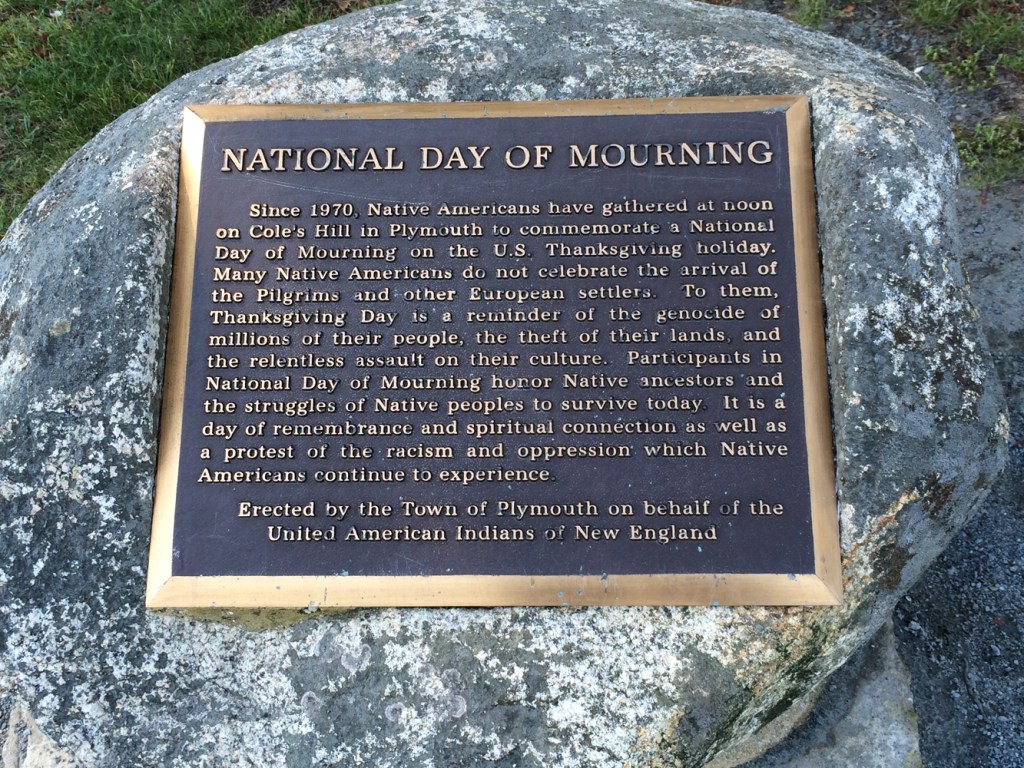
I witnessed one such acknowledgement a few years ago when I visited Plymouth, Massachusetts, the place where the first of my patrilineal ancestors came to this continent in 1624. Once a point of familial pride, now it was a place to own my past. In Plymouth, I found this plaque marking Thanksgiving as a National Day of Mourning.
Acknowledgement, apology, atonement are important beginnings, as are land acknowledgements and indigenizing place names. More than this, we can support efforts to end the epidemic of Missing and Murdered Indigenous Women, speak out against violation of treaty rights and the continued assaults on Native lands and peoples, fund efforts to return land to indigenous people, support Native food sovereignty.[iii] For me, such acts are not so much about redemption as they are about respect and right relationship. They are acts of friendship, small steps toward reciprocity.
I cannot begin to reciprocate in full measure to the indigenous peoples on whose land I live, from whose continued efforts to protect the land and water we all benefit, from whom I have learned so much — particularly about thanks giving. For the indigenous people of this land, thanks giving is not something that happens on the fourth Friday of November, but rather is a daily practice of generosity and gratitude. Rayna Green, Curator Emerita of the National Museum of American History of the Smithsonian, has spoken of how those things which we in academia accord value– the degrees, awards, grants, and publications — have little meaning in Indian Country. What matters is how much one gives. Personally, I have been so touched by the spontaneous and heartfelt generosity of indigenous peoples. With gratitude, I look around my home at the many gifts I have been given over the years – plants, a braided rag trivet, an artist- signed Mending the Sacred Hoop poster, a handmade basket, a book of poetry, a double dream catcher made for us as wedding gift. But even more meaningful are the gifts of time and wisdom and story, of feasting and friendship that have graced my life.
For all these and more I say “miigwech.” Miigwech, meaning “thank you,” was the first word of Anishinaabemowin that I learned, probably because it is said so often – miigwech to the earth, to the Creator, to all those gathered. Every prayer, every talk, every gathering, every encounter begins and ends and is woven throughout with thanks. Reflecting on how indigenous peoples around the world are “rooted in cultures of gratitude,”[iv] Robin Wall Kimmerer in Braiding Sweetgrass, shared the Onandaga Thanksgiving Address – the Words That Come Before All Else. The day begins by sending thanks to all the relatives — the earth, the waters, fish, plants, birds, berries, trees, winds, thunder, the moon and stars, and the Creator. It is a daily reminder that the highest value is gratitude, and that we have everything we need.
Practiced daily, thanks giving need not be complicated — just a simple appreciation of all the gifts of the earth, of life. Practiced daily, every day is a holy day.
References
Green, Rayna. “American Indian Women: Diverse Leadership for Social Change.” Plenary. National Women’s Studies Association Annual Meeting. Minneapolis, MN, 1988.
Kimmerer, Robin Wall. Braiding Sweetgrass. Minneapolis: Milkweed, 2013.
Olson, Tina. Personal Interview. January 2, 2008.
Tippett, Krista, host. Stevenson, Bryan, guest. “Finding the Courage for What’s Redemptive.” On Being. November 4, 2021, Original Air Date, December 3, 2020. The On Being Project.
[i] Mending the Sacred Hoop, Duluth, Minnesota, is the Office of Violence Against Women Training and Technical Assistance Provider on domestic abuse to tribes throughout Indian Country.
[ii] The Equal Justice Initiative provides legal counsel to those who have been wrongly convicted, as well as others who have been denied a fair trial. They recently opened the Legacy Museum which shares the history of the slave trade, racial terrorism, Jim Crow, and the prison system, as well as the National Memorial for Peace and Justice dedicated to truth-telling and reflection on the history of lynchings in this country.
[iii]Some ways to contribute to these causes:
The Indian Land Tenure Foundation: ILTF
Missing and Murdered Indigenous Women USA | (mmiwusa.org)
Understanding the Issue of Missing and Murdered Indigenous Women (nativehope.org)
Mending The Sacred Hoop | Domestic Violence Prevention | Duluth, MN (mshoop.org)
LANDBACK – Building lasting Indigenous sovereignty.
Honor The Earth (honorearth.org)
[iv] 106.
Discover more from Feminism and Religion
Subscribe to get the latest posts sent to your email.

 Feminism and Religion
Oh, this is such a heartrending post – I feel compelled to reblog it – On behalf of all Indigenous peoples Miigwech to the Earth and all those invisible Indigenous peoples who suffered and suffer still because of the profound lack of accountability on the part of the dominant culture…. thank you with all my heart….. many years ago – 50 plus I spent this day in the hospital on the last day of my grandmother’s life washing her unconscious face with warm cloths and telling her I loved her – thanksgiving became a day of mourning – and it was with profound relief that I gave up this holiday at mid life after cooking god knows how many meals for others out of obligation… Like Earth Day, gratitude as Judith mentioned yesterday needs to be ongoing – not stuffed into a gathering of people on one day a year. THANK YOU
LikeLiked by 1 person
Thank you, Sara. That is such a tender memory of your grandmother. Yes, daily gratitude is so important.
LikeLiked by 1 person
Look what happened to girls and women under patriarchy. In Canada women could not vote until what a hundred years ago, before the we were not people- though we are half the human race, under patriarchy. I am noticing tremendous confusion culturally, patriarchy is about men over women, does not mater what color women are. In Japan and China we had the lotus foot, in Africa so many parts of the world still today, we have infibulation, girls of women of every color suffer under patriarchy, which is perpetrated by men of every color onto girls and women of every color. Today women are afraid to say they are a women, women can not name what that means. I am waiting for our reconciliation by governments around the world who supported our oppression. I know, the only way this world will change is by women changing it, now is the time of divine feminine, we are watching patriarchy crumbling, can not be soon enough. I have watched so many reconciliations and wondered when women’s would come, not a chance. What I know for sure is that nobody owns this earth, this earth is Gaia’s earth and we are just passing through. Ever grateful to Gaia.
LikeLiked by 1 person
You are so right, Cate.
LikeLike
What a wonderful essay about a holiday that is both a mournful time and an opportunity for us to listen to and truly hear truth, with all the possibilities that may bring. I have recently been thinking about the deeper meaning of gratitude and thanksgiving and have come to see what I find also in your essay. Giving thanks requires taking responsibility for using the gifts we have been given, whether from the Earth or other people, to right wrongs and make the world a better and more truthful place. I hadn’t thought about this in the context of Thanksgiving, but now I will!
LikeLiked by 1 person
The indigenous people of the world teach us all how to live humbly, with great gratitude and simplicity. A great spiritual teaching, a lifetime learning for us all. Many thanks, Beth.
Annelinde Metzner, composer and poet Click here for Annelinde’s weekly poems: Annelinde’s Worldhttp://annelindesworld.blogspot.com Poems of the natural world: In Love with the Rooted Earthhttp://therootedearth.blogspot.com/ Poems of heroic women: Isn’t It All of Us?http://isntitallofus.blogspot.com/ ________________________________
LikeLike
Yes, they do. I feel very privileged and humbled from all the wisdom shared with me over the years.
LikeLike