

In honor of November being the month dedicated to the remembrance of veterans, our Herstory Profile will be focused on an unsung hero/veteran of WWII, Noor Inayat Khan. Born into an Indian Muslim Royal Family but removed from their ancestral home, Noor spent the majority of her life in Europe. She would answer the call as thousands of others did during the onset of World War II. She would become one of the most successful Spies in Occupied France. Noor would eventually lose her life in the Dachau Concentration Camp. It is only in the last 17 years that Noor’s incredible story and contributions have resurfaced.
Noor Inayat Khan was born in 1914 in Moscow to her parents, Sufi Master Inayat Khan and Pirani Ameena Begum(an American woman previously named Ora Ray Baker). At birth, her parents gave her the name Noor-un-nisa Inayat Khan which means ‘light of womanhood.” Noor’s direct descendant was the famous Tipu Sultan, the ruler of Mysore and who died fighting against the British in 1799.

Islam and more importantly, the Sufi tradition, were highly important in the Khan family. Sadly her father died when Noor was 13.

She would help lead the family and would eventually attend the Sorbonne for Child Psychology. She would also study music at the Paris Conservatory. While at the Conservatory, Noor would fall in love with a Jewish musician.

Despite becoming engaged, there was incredible pressure and disapproval of the match. She would become a celebrated writer of both poetry and children’s literature. In 1939, she published Twenty Jataka Tales, inspired retellings of the Buddhist Jataka scriptures. Before her love life would be settled, war erupted.
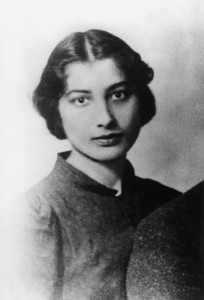
Noor and her family were very fiercely and openly Pacifists. But Noor and her brother, Vilayat, felt called to act against the rising face of Nazism. Noor joined the Women’s Auxiliary Air Force(WAAF) in 1940. She became an Aircraftwoman 2nd Class and was trained as a wireless operator.

She would eventually apply for a commission where she was recruited by the Special Operations Executive. She joined the F Section(Operations in France) of the SOE under the name of Nora Baker. She was the first woman to be sent into Occupied France as a wireless operator in 1943. She was considered one of the best wireless operators due to her previous training in the WAAF. Her code name was Madeleine.
At the time that Noor was sent to France, a wireless operator’s life expectancy was 6 weeks. Noor would operate and transmit from June to October 1943 a total of 4 months, defying all odds. She became the longest wireless operator in France during WWII. Not only did she beat the odds she also did it alone for three months as the group that she was assigned to were all arrested within days of her arrival. She would continue to evade capture and transmit. She was even able to talk her way out of multiple occasions of being stopped and questioned even after the Gestapo found some of her transmission equipment. At the London SOE office, the agents were constantly stunned and impressed with Noor’s ability to stay alive and for her efficient transmissions.
She would be betrayed by one of her fellow underground participants for 100,000 francs. Noor was only days away from being sent back to London when she was betrayed. She would be arrested and sent to the SD headquarters in Paris. She would escape twice. Her second escape failed due to the Royal Air Force bombing the headquarters at the same time of her escape. (Historians have postulated that if her escape would have been successful it would have become one of the most legendary escapes of WWII) It was later revealed from some of her captors that she never broke under interrogation nor did she reveal any of the secret codes that were assigned to wireless operators. By her second escape and her refusal to sign a declaration to not escape again, Noor was sent to Germany in November 1943. Her removal was under the utmost secrecy and security. Noor would become the first woman to be transported to this German Prison. She was held for over ten months in solitary confinement. She was classified as highly dangerous and remained unbroken. She would find ways to communicate with her fellow prisoners sending messages of hope and strength.
On September 12, 1944 Noor was transferred to Dachau Concentration Camp with 3 other Female SOE agents, Yolande Beekman, Madeleine Damerment, and Eliane Plewman. All four were executed on the morning of September 13, 1944. There are a few accounts of the execution by Camp guards as well as survivors. Noor was said to have been beaten before she was ordered to kneel next to the three others and that before she was shot from behind, she shouted “Liberté.” Her body was placed in the Crematorium. Her mother and brother stated that they both had the same dream that night, where Noor came to them surrounded by blue light and told them she was free.
Noor until the day that she was killed, was a fervent believer in Pacifism, respect of humanity, and a love of all religions. She abhorred violence but that did not deter her from finding ways to combat the evil that she was witnessing.
Between 1946 and 1949, Noor Inayat Khan was posthumously ordered the George Cross, the French Croix de Guerre, and the Silver Star. The George Cross is the Highest British medal for gallantry in the face of the enemy.

The Mayor of Paris described her as a modern day Joan of Arc. Her life and legacy would stay dormant until the release of her 2006 biography by Shrabani Basu.
In 2011, a crowd funded campaign began to get a bronze statue placed of Noor at her former home. It was officially established in 2012 by the Princess Royal.

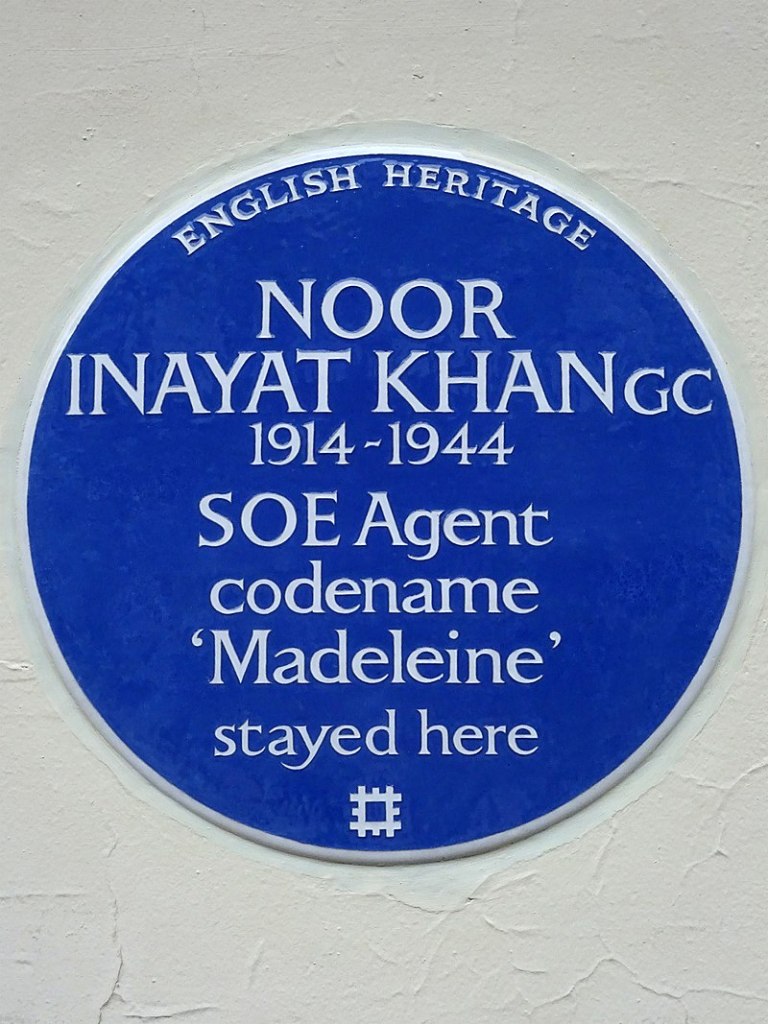
In 2019, Noor was honored with a Blue Plaque. The Plaque honors her sacrifices as a SOE in France. It was placed outside of her last wartime residence in London. When it was unveiled in 2020, Noor became the first woman of South Asian descent to be given a Blue Plaque honor.
In 2019, a motion picture A Call to Spy premiered documenting Noor’s incredible story. Noor is remembered as a heroine of the French Resistance.

A plaque has been placed outside of her family’s residence and every Bastille Day, the parade and band march outside of the residence. I will leave you with the words given at her memorial service by the niece of Charles De Gaulle:
“Nothing, neither her nationality, nor the tradition of her family, none of these obliged her to take her position in the war. However she chose it. It is our fight that she chose, that she pursued with an admirable and invincible courage.”
Madame de Gaulle Anthonioz

Additional Resources
https://www.nationalarchives.gov.uk/education/resources/who-was-noor-khan/
https://www.aljazeera.com/features/2020/10/28/noor-inayat-khan
https://war-experience.org/lives/noor-inayat-khan-soe/
Discover more from Feminism and Religion
Subscribe to get the latest posts sent to your email.

 Feminism and Religion
Wow, what a woman and what a story! Thank you so much for sharing it.
LikeLiked by 2 people
I will print out her picture to place on my Spirit Shrine so I can venerate her as a Folk Saint. She deserves offerings in her memory. It’s shameful that it took this long for history to remember her. She should never have been forgotten, and I have the feeling that were she a white British woman, she would not have been. I wonder how many other unsung heroes exist that are kept in the shadows
LikeLiked by 1 person