

You can read part 1 here.
The erasure of this web is to make women feel alone and disconnected. Maybe it would make them want to give up.
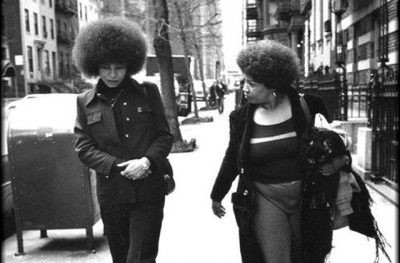
Angela Davis and Toni Morrison
This may sound extreme but imagine this scenario: You are a young woman starting out and you are told that the path you wish to follow is one of pain, loneliness and lacks any kind of support or network with other women that came before you. There are plenty of men but you are left out of that network.
Why would you want to do it? Because in your soul of souls you are a writer, or an artist or a scientist . . . So you decide to do it anyway. But instead of expecting support and connection you have already decided, based on what you have been told, that there won’t be any and so you start to not expect it.
Often we don’t see, look for or even try to cultivate what we don’t expect or don’t believe exists.
We cannot avail ourselves of something we don’t know about and we often won’t even see something that is there if we do not believe it is there.
Once I felt the web and it began to grow with ongoing research, my place in the herstory of time changed. I felt things I had never felt before: women writer friends and women writer friends who had friends and supported friends and inspired and encouraged friends. I felt I belonged to something bigger, that my writing mind could embed inside this larger web of women writers’ minds and rest in context and feed and be fed.
And I felt happy that these other women writers had friends. Their lives were suddenly not so sad. Then other things began to be revealed: like all the deliberate work of women writers mentoring other women writers, all the intentional work of women writers supporting other women writers that also went undocumented and unnoticed. Women writers like Virginia Woolf and Toni Morrison, Margaret Fuller, Adrienne Rich and Toni Cade Bambara. Women writers who have worked hard on behalf of and for women writers of all time.
Women writers, I say unto you: it turns out there isn’t lack. There is connectedness and a wholeness that you can call upon and be fed by. But first you need to believe it is there.
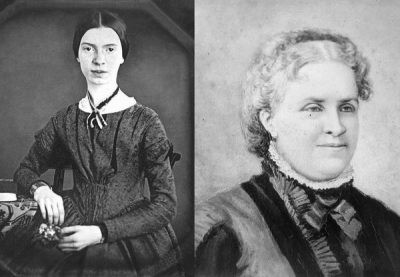
Emily Dickinson and Helen Hunt Jackson
If the web exists, it can be a source of nourishment and support. The interconnections on the web feed the whole. Then as women writers we understand that we may contribute to the web with our work. We can support the work of other women writers in the network by reading them, talking about them imbibing their wisdom, learning from their mistakes, growing from what they wrote and learned. And the web becomes like the mycelial web in the ecosystem. It has its own intelligence and sends information where it needs to go based on what it senses. The web is alive. If we know we have this alive, interactive web of support available to us and we can avail ourselves of it, how different would our lives be?
This doesn’t mean there will not be personal disappointments and interactions with other women and women writers that are less than wonderful. But it does mean that we won’t be so upset and knocked off our center by those because we we are part of the larger web. A personal infraction cannot destroy the entire web of woman writers. The web, woven out of centuries of interconnection, is stronger than a string breaking. We are held by the wholeness of the entirety. Individual relational breaks, which are normal and bound to happen, will be less devastating.
Let’s expose and reveal this web and keep it hidden no longer. Let’s believe in this web and expect to be supported and nourished by it. This will help strengthen it and make it more visible and felt.
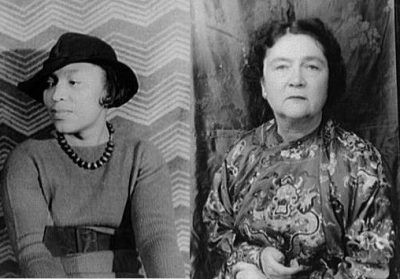
Zora Neale Hurston and Marjorie Kinnan Rawlings
Some connections I have found without looking for them:
- Writer Marjorie Kinnan Rawlings + writer Zora Neale Hurston.
- Writer Marjorie Kinnan Rawlings + writer Margaret Mitchell.
- Writer Marjorie Kinnan Rawlings + writer and activist Marjory Stoneman Douglas.
- Writer Toni Morrison + writer Virginia Woolf.
- Writers Ursula Le Guin + Virginia Woolf.
- Woman writer Virginia Woolf + writer Anne Thackeray.
- Writer Virginia Woolf and woman writer Vita Sackville-West.
- Writer Toni Morrison + writers Toni Cade Bambara + Angela Davis.
- Woman writer Adrienne Rich + Emily Dickinson.
- Emily Dickinson + the Brontës + Jane Austen.
- Writers Adrienne Rich + Audre Lorde.
- Toni Cade Bambara + Adrienne Maree Brown.
- Toni Cade Bambara + Alexis Pauline Gumbs, scholar Farah Jasmine Griffin, filmmaker+ activist Aishah Shahidah Simmons, artist and abolitionist Kai Lumumba Barrow, healer and organizer Cara Page, + editor and intellectual activist Cheryll Y. Greene: all were personally influenced, mentored, “sistered” and “mothered” by Bambara.
- Artists Paula Modersohn-Becker and Clara Westhoff.
- Writers and academics Tiya Miles + Saidiya Hartman.
- Woman writer Cathy Park Hong + writer Theresa Cha.
- Writer Claudia Rankine + Cathy Park Hong.
- Writers and activists Harriet Beecher Stowe + Angelina + Sarah Grimké.
- Sarah Grimké + suffragette Elizabeth Cady Stanton.
- Sarah Grimké + Harriot Kezia Hunt, first female medical practitioner in the United States.
- Writers Jane Austen + Frances Burney.
- Women writers Margaret Fuller + George Sand.
- Sculptor Edmonia Lewis, actress Charlotte Cushman + sculptor Harriet Hosmer.
- Mathematicians Ada Lovelace + Mary Somerville.
- Artist and writer Judy Chicago + writer Anaïs Nin.
- Feminists Elizabeth Cady Stanton, Susan B. Anthony + Sojourner Truth.
This is the smallest tip of a very large iceberg. I did not go looking for any of these connections. They are just there on the surface when I read these women’s autobiographies or personal stories, essays or biographies about them. I only began writing them down very recently when I could ignore it no longer. Imagine all the ones I have not written down.
Nasty Women Writers will begin including pieces about these invisible connections between women writers to further reveal and strengthen this vital and powerful web. Read them all in the category found on the sidebar: “Nasty Women Writers: Revealing the Web of Women Writers-Connections that Nurture and Inspire.”
We can change the world and the way we feel in the world one connection at a time.
You can see the original Nasty Women Writers post here.
BIO: Theresa C. Dintino is the author of Membranes of Hope: A Guide to Attending to the Spiritual Boundaries that Keep Lifesystems Healthy from the Personal to the Cosmic, The Tree Medicine Trilogy which includes: The Amazon Pattern: A Message from Ancient Women Diviners of Trees and Time, Notes From a Diviner in the Postmodern World: A Handbook for Spirit Workers, and Teachings from the Trees: Spiritual Mentoring from the Standing Ones. She is also the author of The Strega and the Dreamer, a work of historical fiction based in the true story of her great-grandparents, Ode to Minoa and Stories They Told Me, two novels exploring the life of a snake priestess in Bronze Age Crete, and Welcoming Lilith: Awakening and Welcoming Pure Female Power. Find out more about Theresa at ritualgoddess.com
Discover more from Feminism and Religion
Subscribe to get the latest posts sent to your email.
 Feminism and Religion
Puzzled by the phrase “Nasty Women Writers” seems to reinforce the darkness around women in patriarchal culture…. I think of Emily D. who rarely left her house and can’t imagine her as nasty. Or for that matter any of our courageous Foremothers.
LikeLike
Hi Sara,
We use the word Nasty as a form of resistance in response to Donald Trump calling every powerful woman who called him out in his first presidential election and term “Nasty.” He continues to use that term for women of power. Below is our mission statement.
About the Nasty Women Writers Project
Hillary Clinton was called a nasty woman by Donald Trump in the final presidential debate of the 2016 election, raising the ire of every woman who has ever been maligned for using her voice to speak the truth, for using her voice to assert herself.
We live in a patriarchy where women who have voices and use them are called all kinds of disparaging names, among them, more often than not, nasty. On Nasty Women Writers, powerful truth-espousing women are 100% welcome.
We say no to this shut down of powerful women’s voices and claim nasty as a stance of power! We support nasty women’s voices and the nasty voices of women writers who have been on the frontlines of this fight for years. Through this project, we give voice to the wide range and diversity of Nasty Women Writers, both past and present.
For years, these women’s voices have been silenced and erased from the fabric of our collective experience. The devastation has been tremendous. Girls and women not seeing themselves represented in roles of power and heroism further perpetuates disempowerment and exploitation.
The vital threads of these women’s visions and voices destroyed and silenced, discrediting and discounting their contributions to the pattern, the pattern of a balanced, healthy paradigm. Here we seek to restore and reveal their integral threads, a step toward weaving a pattern that will set us on the path to wholeness.
We are two literal sisters who rebelled all our lives, our big first effort at resistance when as young girls we packed up our Kool-Aid lunchboxes and spent an entire day in the woods and on the railroad trestle behind our house, imagining freedom.
We are both writers and we are both nasty.
LikeLike
Great….
LikeLike
“Often we don’t see, look for or even try to cultivate what we don’t expect or don’t believe exists. We . . . often won’t even see something that is there if we do not believe it is there.”
Thank you. Just what I needed to hear this morning.
LikeLike