

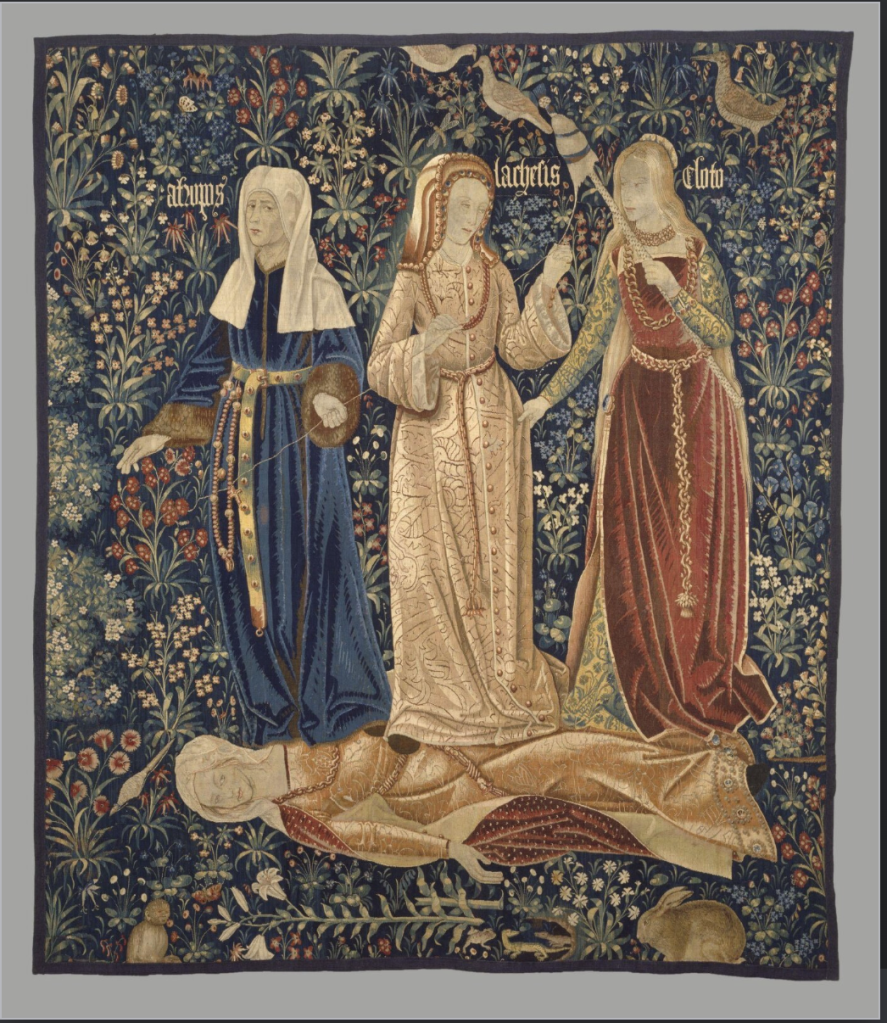
There is an old Yiddish incantation, documented from the 18th century forward, that features three mysterious women. It is a folk spell warding off the evil eye–the negative influence that may come either from demons or from the jealousy and spite of others (or both). Fear of the evil eye is the reason it was traditional not to compliment cute babies or talented people—because the evil eye might be attracted to such beauty or talent and cause harm. The evil eye, to give a personal example, is the reason my father, who was normally not a religious person, refused to allow my mother to shop for a crib until I was born, lest the evil eye notice they were going to have a baby and prepare some terrible fate for me.
I learned this particular incantation against the evil eye from scholar and Kohenet (priestess) Annabel Cohen, who is a scholar of Yiddish and particularly of Ashkenazi Jewish women’s customs. I looked the spell up myself because there was something about it that spoke to me deeply. At a particularly difficult point in my life, I found myself repeating the English of this incantation. Here is the text of it in transliteration and translation:
Zitsn dray vayber oyf a shteyn
Ein zogt yo, di tsveyte zogt neyn,
Di dritte zogt: Fun vanen s’iz gekumen,
Ahin zol es geyn.
Three women sit on a stone.
One says yes and the other says no.
The third one says, “From where it came, there shall it go.”
Poo-poo-poo.
(The translation is my variation on Annabel Cohen’s translation.) According to Cohen, the three women are saying “yes, So-and-So has the evil eye,” and “no, they don’t,” and “may the evil eye go back where it came from.” “Poo-poo-poo” is meant to indicate spitting three times, which was an essential part of the spell, to ward off the spirits. In some way, the “yes/no”quality of this spell helped the magic: if the person did have the evil eye, the incantation was meant to unravel it and send the negative energies back to their source. And if the person didn’t have it, so much the better.
The original incantation was often much longer than this and had many variations, protecting fields, people, etc. In A Frog Under the Tongue: Jewish Folk Medicine in Eastern Europe, Marek Tuszewicki reports a variant: In der midber shteyt a groyser shteyn, oyf im sitzen dray vayber… “In the wilderness stands a great stone, and on it sit three women…” (p. 280) Tuszewicki notes that a stone is “a symbol of the boundary between worlds.”
I was drawn to this incantation because of the three women, and also because of the stone. These three women are unknown to me from other Jewish sources. The biblical figures known as the matriarchs are either four (Sarah, Rebekah, Rachel, and Leah) or six (with the addition of Bilhah and Zilpah). I couldn’t help but think, when I first heard this poem-spell, that the women reminded me of the three Fates, or the Norns of Germanic tradition. They are, in some way, managing a person’s fate, just like the Fates or Norns.
Scholars agree that the origin of this incantation is likely not a Jewish one. One commentator, Natan Meir, connects the three women to the “three holy maidens” of European tradition, called in Germany the Bethen. The three holy maidens were identified with various saints, though their origin is surely much older, and were sometimes worshipped at stones.
And yet, there is one Jewish mystical source that, uncannily enough, seems to relate. In the 13th century kabbalistic work called the Zohar, we find a story of “the foundation stone.” This stone is known throughout Jewish legend as the spot at which God created the world, and from which the cosmos spread out in the four directions. It is the navel of the universe. The Zohar tells the story in this way:
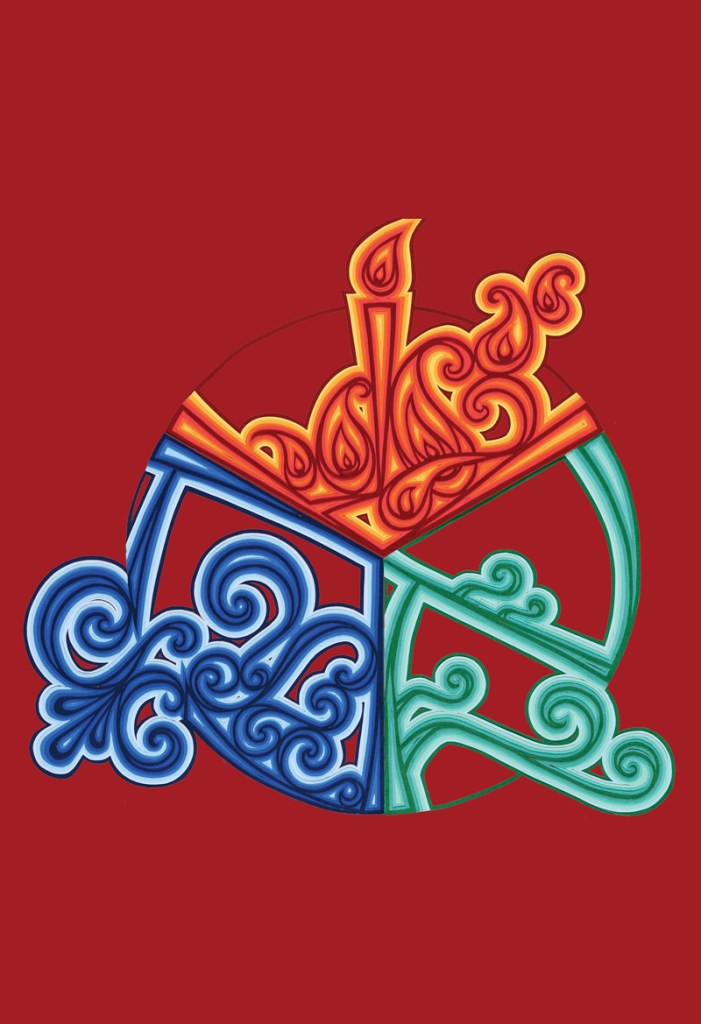
The Holy One created the world by taking a stone, the ‘foundation stone,’ and casting it into the abyss so that it stayed there, and from it the world grew. This is the center of the universe, and atop it stands the Holy of Holies….The stone is made of fire, water, and air, and rests on the abyss. At times water flows out of it and fills the deeps.
Zohar I, 231a
The stone, which rests in the midst of the void, is made of fire, water, and air. This is connected to an earlier Jewish legend (Exodus Rabbah 15:22) that three creations preceded the world: fire, water, and air. The fire conceived and gave birth to light, the water conceived and gave birth to darkness, and the air conceived and gave birth to wisdom. In a mystical text known as Sefer Yetzirah, fire, water, and air (and their corresponding Hebrew letters, Shin, Mem, and Aleph) are called the Three Mothers. These three mothers, in this Zohar passage, make up the foundation stone that is the heart of the universe.
There you have it. Three women and a single stone. In this myth, the three “women” are the elements, who shape the world. While the Yiddish incantation likely is based in wider European folklore, I like to think of it as referring to the three mothers “sitting” on the great stone at the heart of the cosmos. Who better to call on in time of need, when destiny needs to be re-shaped, than these primordial mothers of matter?
At a time in the world when our destiny surely needs to be remade, may the three mothers intervene on our behalf and guide us to a better fate for all. Poo-poo-poo.
Discover more from Feminism and Religion
Subscribe to get the latest posts sent to your email.
 Feminism and Religion
I really enjoyed your explorations in this post and the archaeological way you followed the incantation up, down and round about to find out more about it. I asked for your book ‘Sefer Yetzirah’ for Christmas ( an irony!) and am very much enjoying it. I was drawn to it because although I am a non Jew, I taught in a Jewish school for 11 years and have always been fond of the Baal Shem Tov. Keep writing, Jill – your posts are fascinating.
LikeLike
Thank you so much– I am glad you enjoyed this piece. And I’m so pleased you’ve been reading Sefer Yetzirah. I hope it brings you good insights. Much appreciation for the encouragement!
LikeLiked by 1 person
Wow – such a thought provoking in formative post – you not only included one tradition but all. Three Women Sitting on Stone at the Center of the world – Three women that understand that evil exists and how important it is to acknowledge and return the energy to the sender – especially without personal malice… Folklore addresses the evil eye because it exists and the way to deal with it is to return the distorted energy (rage jealousy hatred ill will etc) to person who sent it and if you don’t know imagine.. I would add that it’s important to be aware of the necessity of protecting oneself in a situation like this. thank you.
LikeLike
This is a wonderful incantation, and fascinating research. Spitting three times would definitely connect your body to the Earth. What is the meaning of the “Holy of Holies” which sits on top of the stone? That phrase is part of “The 23rd Psalm” as composed with female pronouns by Bobby McFerrin. My UU choir is singing it this week. https://www.youtube.com/watch?v=cn2zKKhhF3I
Many thanks, Annelinde Metzner
LikeLike
The Holy of Holies is the central, curtained shrine of the Temple (or Tabernacle), where God’s presence is said to dwell. Thanks so much for your kind words, and thanks also for letting me know about the feminized 23rd Psalm!
LikeLike